
Why Beech Creek Mining and Metals Plants Are Rethinking Solids Removal in 2026
Beech Creek, a small aggregate and secondary-metals corridor in Clinton County, PA, sits in a climate band where January wastewater influent routinely drops below 5 °C. That single fact decides more about solids-removal performance than most specification sheets admit: water viscosity climbs roughly 20–30% from 20 °C to 5 °C, and Stokes' law dictates that settling velocity drops proportionally, so a gravity clarifier sized at 20 °C will underperform in a Beech Creek January. The variable most guides ignore is the winter operating penalty, not the vendor's nameplate surface-loading rate.
Federal compliance is anchored to 40 CFR Part 437, which sets monthly-average ceilings on total suspended solids (TSS) and total recoverable metals (lead, zinc, copper, nickel) for the Metal Mining (Subpart A), Ore Dressing (Subpart B), and Metal Finishing/Metal Products (Subparts C–J) subcategories. Most subparts require discharge through a POTW or under direct NPDES, and many plants route the same stream through both, which means the solids-removal step upstream of metals precipitation must hit the tighter of the two ceilings.
For 2026, the decision is driven by three forces: tighter monthly-average metals limits in the metal-finishing subparts, the cost of fresh intake water that pushes operators toward 60–80% recycle, and the footprint constraint on plants laid out before 40 CFR 437 was revised. A side-by-side look at 2026 heavy metals removal technology guide buyers making this same call in other regions consistently lands on the same two unit processes: dissolved air flotation (DAF) and the gravity/lamella clarifier. The rest of this article sizes them for Beech Creek.
How a DAF System and a Gravity Clarifier Actually Separate Solids
A dissolved air flotation (DAF) system saturates a side-stream of clarified effluent with air at 4–6 bar, then releases that pressure through needle valves or nozzles inside the flotation cell. The pressure drop nucleates a cloud of 10–80 µm micro-bubbles that attach to destabilized floc (or native oil-coated particles) and lift it to the surface, where a skimmer removes the float. The design variables that govern removal are the air-to-solids ratio (A/S), typically 0.02–0.10 (mass of air released per mass of TSS), and the hydraulic surface loading, which is commonly set in the 15–25 m/h range for industrial wastewater (per Hahn, 2010, and EPA Process Design Manual, 1975, Chapter 7, Table 7-4).
A gravity clarifier lets floc fall under laminar flow into a sludge blanket, then compacts it. A lamella clarifier installs inclined plates at 55–60° inside the basin so the effective settling path is the plate spacing, not the water depth. The EPA manual and standard texts (Hazen & Sawyer, 1975) report conventional basin surface loadings of 1–2 m/h, while lamella geometry pushes effective loadings to 20–40 m/h. This explains why lamella wins on footprint: a 200 m³/h flow at 1 m/h needs 200 m² of plan area in a conventional basin, versus roughly 5–10 m² of plan area in a lamella with the same throughput.
Both processes are listed in the EPA's 1975 Process Design Manual for Suspended Solids Removal (Chapter 7 — Gravity Separation, Section 7.8 — Flotation, and Section 7.9 — Shallow Settling Devices) as benchmark unit operations, and most engineers in 2026 still pre-size from those tables, then validate with a jar test and a short on-site pilot.
DAF vs Clarifier for Beech Creek Mining and Metals Wastewater
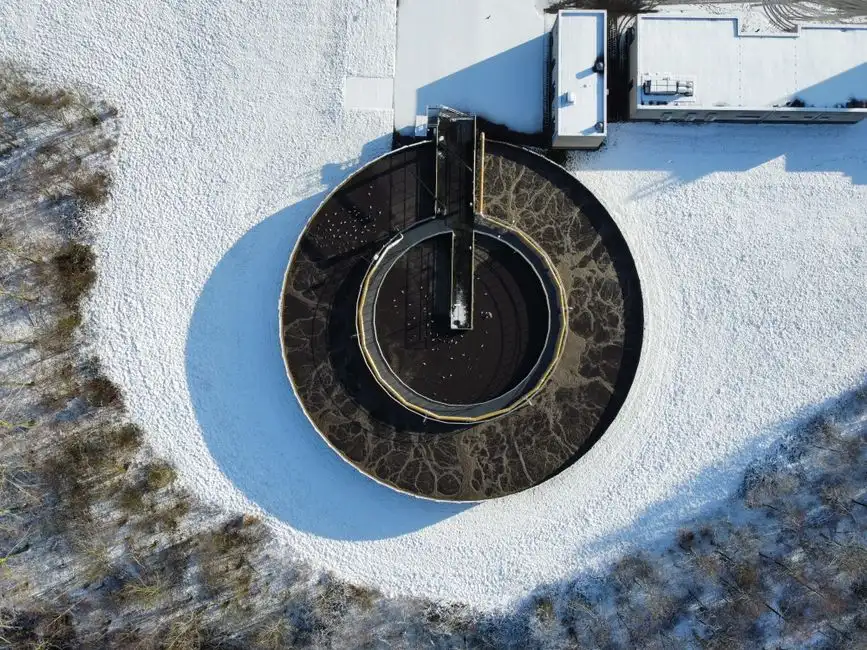
The choice depends on which physical mechanism matches the particles present: low-density, oil-coated, or freshly precipitated fines favor the buoyancy path; settleable, higher-density, mineral-rich sludges favor the gravity path. The numeric ranges below are the working windows for both units in mining and metals duty.
| Parameter | DAF | Lamella / Gravity Clarifier |
|---|---|---|
| TSS removal | 80–95% on low-density and oil-coated precipitates (Hahn 2010 cites ~90% oil removal) | 70–90% on settleable solids; drops on colloidal fines and emulsified oil |
| Surface loading | 15–25 m/h (hydraulic) | 20–40 m/h effective (lamella); 1–2 m/h (conventional basin) |
| Footprint at 100 m³/h | Compact packaged unit, ~6–8 m² | Lamella: ~3–5 m² plan area but 4–5 m tall; conventional basin: 50–100 m² |
| Chemical demand | Polymer flocculant only in most cases | Coagulant (e.g., lime, ferric) plus flocculant; sludge recirculation can save up to ~30% coagulant |
| Cold-feed tolerance (≤ 10 °C) | Stable; A/S and bubble size dominate, not viscosity | Performance degrades sharply below 10 °C; higher viscosity slows settling |
| Typical flow range | 4–300 m³/h packaged | 50–2000+ m³/h; preferred above ~200 m³/h |
Three Beech Creek-specific consequences result from that table. First, cold-feed tolerance tilts the decision toward DAF for plants with outdoor sumps or unheated equalization. Second, the 20–40 m/h surface loading on a lamella unit favors lamella once you cross the 200 m³/h threshold. Third, the chemical line is not a slam-dunk DAF advantage; sludge recirculation in a solids-contact clarifier can offset 30% of the coagulant dose, narrowing the OPEX gap at higher flows.
For the actual equipment, plants in this duty class evaluate the HydropureWater DAF system against the HydropureWater lamella clarifier. A regional comparison for the same decision in a different climate and effluent profile is laid out in this sibling mining/metals DAF-vs-clarifier guide for Fairhope; the framework is identical but the winter penalty and metals ceiling are not.
40 CFR Part 437 Limits That Drive the Choice
40 CFR Part 437 is the binding federal framework for the metal-mining and metal-finishing categories, and the subcategory your site falls into determines the monthly-average ceiling your equipment must hit. Subpart A (Metal Mining) and Subpart B (Ore Dressing) carry different TSS and metals ceilings than Subparts C–J (Metal Finishing/Metal Products), and the metals lists (lead, zinc, copper, nickel, sometimes cadmium and chromium) differ by subpart.
| Subcategory | Representative monthly-average TSS ceiling | Representative total recoverable metals (each, monthly avg.) |
|---|---|---|
| Subpart A — Metal Mining | Order-of-magnitude 30 mg/L class, subpart-specific | Low mg/L to sub-mg/L by metal |
| Subpart B — Ore Dressing | Order-of-magnitude 30–60 mg/L class | Low mg/L to sub-mg/L by metal |
| Subparts C–J — Metal Finishing / Metal Products | Many subparts in the 30–60 mg/L monthly-average range | Sub-mg/L to low mg/L by metal; some subparts with very tight lead and zinc limits |
The decision rule is mechanical: if a single technology — DAF alone or lamella alone — cannot reliably meet the binding monthly-average TSS and metals ceiling, specify the two in series. If a single unit can hit the ceiling with margin, take the cheaper single-stage option. The reason this matters for Beech Creek is that the metals-precipitation step (typically pH 8.5–9.5 with lime or caustic, then a coagulant) generates a fine, low-density precipitate that often overloads a lamella clarifier in cold weather but cleans up well in a DAF. This operational reality explains why a DAF-then-lamella series appears more often than the reverse in this subcategory.
Sizing a DAF or Lamella Clarifier for a Beech Creek Plant
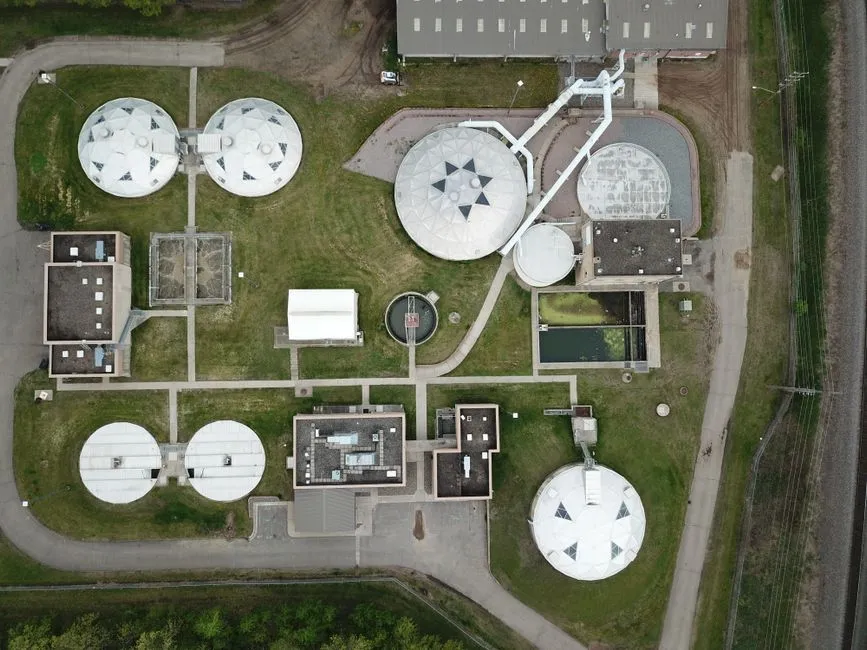
Pre-sizing requires peak hourly flow (m³/h), influent TSS (mg/L), target effluent TSS, influent temperature profile, and a jar-test result that confirms the coagulant/polymer combination works at site temperature. The following calculations provide a baseline for equipment selection.
For a DAF unit, the sizing chain is: required A/S ratio (typically 0.03–0.06 for mining and metals precipitates) → recycle flow rate (usually 20–40% of throughput at 4–6 bar saturation) → cell surface area = (forward flow + recycle) / hydraulic loading (15–25 m/h) → check retention time 20–40 minutes. HydropureWater field data and the EPA manual (1975) treat this retention window as the lower bound for full flotation; going shorter starves floc of bubble contact time.
For a lamella clarifier, the sizing chain is: required plate area = peak flow (m³/h) / surface loading rate (20–40 m/h, conservative end for cold feeds) → number of plates from plate spacing (50–80 mm standard) and inclination (55–60°) → check sludge thickening zone volume for 2–4 hours of underflow storage. The EPA manual recommends jar tests plus an on-site pilot when metals precipitation is involved, because the sludge-blanket behavior in cold months is difficult to predict from bench data alone.
Both paths assume a PLC-controlled chemical dosing system upstream to keep coagulant and polymer feed proportional to flow spikes. Without feed-by-flow control, neither unit will reach its nameplate removal capacity in a Beech Creek plant.
2026 Cost and Compliance Trade-Offs
The economic argument aligns with the engineering one. A packaged DAF at flows below ~50 m³/h carries higher unit CAPEX but installs in days because the skids are pre-assembled; above that flow the unit-cost gap narrows. A lamella clarifier is cheaper per m³ of throughput once you cross roughly 200 m³/h, but it requires civil works—a basin, a launder system, sludge pumps—that a packaged DAF avoids.
On OPEX, DAF burns energy on the saturated recycle pump and consumes polymer (typically a few mg/L of cationic or anionic polyacrylamide), while a lamella clarifier burns less energy but consumes more coagulant, partially offset by sludge-recirculation savings of approximately 30%. Because costs depend on local chemical pricing, electricity tariffs, and sludge-disposal fees, I avoid quoting dollar figures here. The compliance direction is clear: pick the technology whose effluent reliably meets the binding 40 CFR Part 437 monthly-average ceiling. The cheapest first-pass option is rarely the right answer when the monthly-average metals limit is in the sub-mg/L range.
Frequently Asked Questions
When is DAF clearly better than a clarifier for mining wastewater?
DAF is the better fit when the wastewater carries low-density fines, oil-coated precipitates, or freshly formed metal hydroxides at TSS under ~500 mg/L, especially when influent temperature drops below 10 °C. In that envelope, DAF routinely delivers 80–95% TSS removal at 15–25 m/h hydraulic loading without depending on settling velocity (per Hahn 2010 and EPA Process Design Manual, 1975).
Can a lamella clarifier meet 40 CFR Part 437 alone?
Often yes for settleable, higher-density sl
Frequently Asked Questions
Is a DAF or a clarifier better for mining and metals wastewater in Beech Creek?
The selection depends on the specific gravity and particle size of the suspended solids. Dissolved Air Flotation (DAF) is generally superior for mining wastewater containing oil, grease, or low-density metal precipitates that tend to stay in suspension, achieving removal efficiencies of 85% to 95% for light particulates. Traditional gravity clarifiers are more effective for heavy, inorganic metal solids with a specific gravity greater than 2.0, where rapid settling is achievable through simple sedimentation.
Can a lamella clarifier meet 40 CFR 437 TSS limits on its own?
A lamella clarifier can achieve effluent Total Suspended Solids (TSS) concentrations between 50 mg/L and 100 mg/L depending on the influent loading. However, 40 CFR 437 standards for the Centralized Waste Treatment (CWT) category often require stringent limits that may necessitate secondary polishing. While lamella systems provide a small footprint, they typically require upstream coagulation-flocculation and may need downstream multimedia filtration to consistently meet sub-20 mg/L discharge limits.
How does cold Pennsylvania winter weather affect clarifier vs DAF performance?
Cold temperatures significantly increase water viscosity, which slows the settling velocity of particles according to Stokes' Law, thereby reducing the hydraulic capacity of clarifiers by 10% to 20% during winter months. DAF systems are less affected by viscosity-related settling issues but face risks of icing on exposed surface skimmers and potential degradation of air-saturation efficiency if the process water drops below 4°C, requiring insulated or enclosed process tanks for Beech Creek operations.
How much polymer does a DAF system use per cubic meter of mining wastewater?
Polymer consumption in a DAF system for mining applications typically ranges from 1 to 5 grams per cubic meter (g/m³) of treated water. This dosage is highly dependent on the Zeta potential of the suspended metal particles and the presence of surfactants. Accurate dosing must be determined via jar testing to prevent overdosing, which can lead to "pin-floc" formation and increased effluent turbidity.
Is a DAF followed by a clarifier ever justified for metals plants?
A sequential DAF-clarifier configuration is justified when processing complex waste streams that contain both free-floating hydrocarbons and heavy metal hydroxides. In this setup, the DAF acts as a primary separator to remove oils and light flocs, protecting the downstream clarifier from surface blinding. This hybrid approach is often necessary to achieve ultra-low effluent concentrations that satisfy local NPDES discharge permits in sensitive watersheds like Beech Creek.