What a Peterborough Fabricated-Metals Plant Is Actually Treating
Peterborough, USA fabricated-metals plants should choose a Dissolved Air Flotation (DAF) system when influent TSS runs above ~500 mg/L or contains free/emulsified oils from stamping or machining coolants — DAF achieves 85–98% TSS removal and lifts FOG to the surface for skimming. A lamella/Inclined-Plate clarifier is the better pick for lower-TSS rinse streams dominated by settleable heavy-metal hydroxides under 40 CFR 433 limits.
A typical Peterborough shop generating waste from stamping presses, CNC machining cells, and a chromate conversion-coating line will see three distinct waste streams converging on the pretreatment system. The first is spent emulsified machining coolant — a stable oil-in-water emulsion with droplet sizes in the 1–20 µm range that resists gravity separation. The second is free and emulsified stamping and drawing lubricants, which can show up as a floating oil layer or, after mixing with cleaners, as a broken emulsion with FOG concentrations of 100–2,000 mg/L. The third is low-pH rinse water bearing hexavalent chromium and other regulated metals (Ni, Zn, Pb, Cd, Cu) from plating, chromate conversion coating, and passivation operations.
Influent TSS at these plants typically runs 200–3,000 mg/L depending on whether the equalization tank captures the full day's flow or just the rinse sidestreams. O&G ranges 100–2,000 mg/L. Both parameters are explicitly regulated under 40 CFR 433 — Metal Finishing Point Source Category, which sets daily-maximum and monthly-average limits for TSS, O&G, total metals, and hexavalent chromium. Most Peterborough shops are indirect dischargers to the local POTW (the Town of Peterborough wastewater treatment facility), so the POTW's local sewer-use limits overlay the federal categorical limits — a plant must meet whichever number is more stringent on a parameter-by-parameter basis. That dual-compliance reality is what makes the DAF-vs-clarifier decision non-trivial: the equipment you pick has to clear both the federal categorical bar and the local utility's often-tighter O&G and metals targets.
How a DAF System Works on Oily Metals Wastewater
DAF works by attaching microscopic air bubbles to contaminants whose specific gravity is close to water — exactly the population of oil droplets, coolant emulsion particles, and metal-hydroxide floc that defines a fabricated-metals waste stream. A side-stream of clarified effluent (typically 20–40% of the forward flow) is pressurized to ~100 psi in an air-saturation vessel, where compressed air dissolves into the recycle stream (per Aries Equipment). When that supersaturated recycle is released into the flotation tank through a pressure-relief valve, the dissolved air comes out of solution as ~30 µm micro-bubbles — a bubble size small enough to have a slow rise velocity and high surface-area-to-volume ratio, which maximizes collision frequency with suspended particles (Aries Equipment).
Those micro-bubbles attach to oil droplets and emulsified coolant particles that a clarifier simply cannot capture, because their density is too close to water for gravity settling to work in a reasonable residence time. Before bubble attachment, though, the chemistry has to be right: pH control brings the stream to the optimum range for precipitation, coagulant (typically a ferric or aluminum salt, or a cationic polymer) neutralizes the surface charge on individual particles, and a long-chain flocculant polymer bridges the neutralized particles into visible flocs sized 0.5–3 mm (Aries Equipment). Without that coagulation → flocculation sequence, micro-bubbles slide past the colloidal particles and removal efficiency collapses.
Surface skimming is the final mechanical step. Aries specifies a polymeric chain flight system with 304SS flights and chemical/heat-resistant wipers that drag the floated mat over a beach plate and into a sludge sump; the weight of the flight itself provides a squeezing effect that thickens the float. Typical DAF float consistency is 2–4% dry solids (DAF Corp) — about 10× thicker than what a clarifier underflow typically produces, which directly reduces downstream dewatering cost. For a Peterborough plant evaluating equipment, a HydropureWater DAF system packages the saturation vessel, recycle pump, and flight skimmer into a single skid suitable for both indoor and covered outdoor installation.
How a Clarifier (and Lamella Settler) Works on the Same Stream
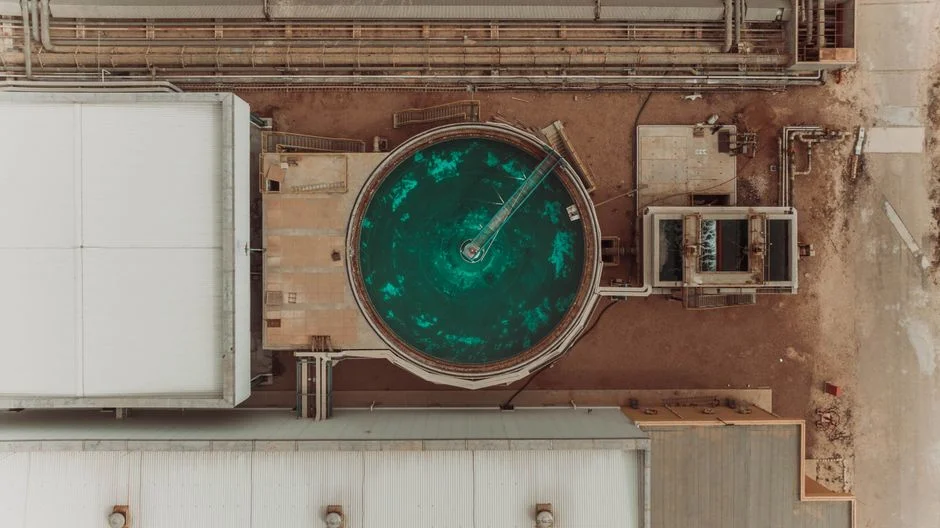
A conventional clarifier relies on gravity alone. Solids denser than water settle to the bottom of a rectangular or circular tank and are raked to a central sludge hopper; clarified water overflows a peripheral weir. The technology is simple, well-understood, and cheap per gallon — but it only removes what gravity can pull down within the tank's hydraulic residence time, which at typical industrial loading rates of 0.5–1.0 GPM/ft² means a 30–60 minute residence window.
Inclined-plate (lamella) settlers pack the same settling work into a much smaller footprint by stacking parallel plates at 55–60° from horizontal. Effective surface loading rates climb to 20–40 m/h because each plate behaves as its own shallow settling zone; solids slide down the plate face and consolidate in a hopper beneath the pack. A HydropureWater high-efficiency lamella clarifier is sized for exactly this kind of retrofit duty in metals plants. Two practical consequences: the unit footprint drops to roughly 1/5 of an equivalent conventional clarifier, and the short residence time means polymer demand falls by ~30% because the floc does not have to remain intact for an hour — it only needs to survive the few-minute transit through the plate pack.
The hard limitation is mechanism. Lamellas and conventional clarifiers only capture settleable solids. Emulsified oils with droplet sizes below ~50 µm, neutrally buoyant coolant particles, and colloidal metal-hydroxide precipitates that did not grow large enough during floc formation will largely pass through and report to the overflow. If the upstream chemistry is dialed in (pH 8.5–9.5 for Cr(OH)₃ precipitation, adequate coagulant dose), a lamella can hit 70–85% TSS removal on a metal-hydroxide-dominated stream — but on an oily coolant stream, the same unit may fall below 50%.
DAF vs Clarifier: Head-to-Head for Fabricated Metals
No single number decides this — the influent profile does. The matrix below puts the two technologies on the same parameter rows using removal-efficiency data from DAF Corp (FC Maximizer, RC UniMax), ClearStream, FRC Systems, and typical lamella performance ranges reported for metals-finishing applications.
| Parameter | DAF (FC Maximizer / RC UniMax) | Lamella / Inclined-Plate Clarifier |
|---|---|---|
| TSS removal efficiency | 92–98% (FC Maximizer, 10–11,000 GPM) / 85–90% (RC UniMax, 10–1,000 GPM) — DAF Corp | ~50–70% (unhindered settling); 70–85% with polymer aid and proper floc formation |
| FOG / emulsified oil removal | 85–95% — micro-bubbles attach to neutrally buoyant oil droplets that gravity cannot remove (Aries) | Effective only on free oil after a prior oil-water separator; poor on emulsified oil <50 µm |
| Settleable metals removal (Cr, Ni, Zn, Pb as hydroxides) | 80–95% when floc is well-formed | 75–90% — well-suited when metal precipitates are dense and well-coagulated |
| Footprint per GPM | ~0.1–0.3 ft²/GPM effective area (FRC Systems: 35–3,100+ ft² effective) | ~0.05–0.15 ft²/GPM with inclined plates; retrofit-friendly but not a high-rate option for high oil |
| Chemical demand (coagulant + flocculant) | Moderate to high; chemistry critical for TSS and oil capture | ~30% lower than conventional basin; lower than DAF on oil-free streams |
| Sludge consistency | 2–4% dry solids (DAF Corp) | 0.5–1.5% dry solids — thinner, larger volume to dewater |
| Retrofit difficulty | Moderate — ClearStream rectangular DAFs ship fully shop-assembled and can drop into existing concrete basins | Low to moderate — plate packs retrofit into existing tanks; no recycle pump or saturation vessel |
| Capex / Opex rank | Higher capex (saturation vessel, recycle pump, skimmer drive); lower opex per pound of solids removed because sludge is drier | Lower capex; higher opex on polymer and downstream dewatering due to thinner sludge |
| Sensitivity to flow surges | Low — equalization plus the recycle stream buffers hydraulic variation | Moderate to high — surges can re-entrain settled floc and carry it over the weir |
The decision rules from the matrix: an oil-dominated stream (FOG > 200 mg/L, free oil present) points to DAF; a metal-hydroxide-dominated, low-oil stream (FOG < 50 mg/L, TSS < 500 mg/L, heavy metals the binding constraint under 40 CFR 433) points to lamella; a mixed stream with surge from a batch stamping line points to a DAF primary + lamella polish configuration, which is a common arrangement at larger fabricators with both oily machining and rinse-water streams.
Sizing a DAF for a Peterborough Plant: A Worked Example
Start from a published benchmark rather than a guess. DAF Corp's FC-150 Maximizer is rated for 500 GPM of wastewater at 2,000 PPM influent TSS, clarified to ~50 PPM — a 97.5% removal figure that lines up with the FC Maximizer's 92–98% published range (DAF Corp). Daily throughput at that loading is 500 GPM × 1,440 min/day = 720,000 GPD, or about 0.72 MG per single-shift day. For hydraulic sizing, FRC Systems publishes effective-area ranges of 35–3,100+ ft² across their product line, with flow rates up to 2,000+ GPM in stainless 304/316/duplex construction; DAF Corp's FC Maximizer extends the upper end to 11,000 GPM in diameters up to 70 ft. A 500 GPM unit therefore sits in the middle of both product lines, and a 50 GPM job (a small job shop with one CNC cell and one stamping press) falls comfortably in the RC UniMax 10–1,000 GPM envelope at 85–90% TSS removal.
Backing into effective area: at a typical hydraulic loading of ~1.5–2.0 GPM/ft² for a high-rate DAF treating metal-finishing waste, a 500 GPM unit needs roughly 250–330 ft² of effective flotation area, which corresponds to an FC-150 tank in the 14–16 ft diameter range. Polymer dose, air-to-solids ratio, and recycle percentage (typically 20–40% of forward flow) all shift that number, which is why jar testing and pilot work — both offered by Aries and DAF Corp — should precede any purchase order.
Peterborough-specific retrofit constraints matter. New Hampshire winters push daily lows well below freezing from December through March, so any outdoor DAF installation needs enclosed covers for vapor control and a heated recycle pump skid to prevent the saturation vessel from freezing. ClearStream explicitly markets covers for odor control and gas-blanket applications on its rectangular DAFs, and the same enclosure that contains vapor also retains heat. Indoor installation in an existing high-bay is the cleaner answer for plants with the floor space, and the rectangular ClearStream or RC UniMax form factor ships fully shop-assembled and drops into a prepared concrete pad or existing basin (ClearStream).
Cost, Compliance, and 2026 Selection Checklist
Capex on a DAF runs higher than a comparably rated lamella because of the air-saturation vessel, recycle pump, compressor, and flight skimmer drive. Opex tells the opposite story: DAF float at 2–4% dry solids means smaller sludge volumes heading to the dewatering press, which directly cuts hauling and polymer-conditioned filter-press cycles. A lamella clarifier is cheaper to buy and faster to install, but it produces 0.5–1.5% underflow — typically 3–5× the sludge volume of a DAF on the same load — so the dewatering cost downstream has to be carried in the comparison.
On compliance, 40 CFR 433 sets daily-maximum and monthly-average limits for TSS, O&G, total metals (Cr, Cu, Ni, Pb, Zn, Cd, Ag, CN), and hexavalent chromium. The Town of Peterborough's sewer-use ordinance overlays those federal categorical limits and is typically more stringent on O&G and metals — for example, a common local limit is 100 mg/L O&G versus the federal 52 mg/L daily-max / 26 mg/L monthly-average under 40 CFR 433. Whatever equipment you select has to clear both bars. The auxiliary systems that almost always accompany a DAF or clarifier at a metals plant are a HydropureWater automatic chemical dosing skid (pH adjustment, coagulant, flocculant) and a HydropureWater plate and frame filter press for sludge dewatering to 25–35% cake solids.
| # | Checklist item | What to record for the RFQ |
|---|---|---|
| 1 | Influent TSS (24-hr composite, mg/L) | Peak and average across one production week |
| 2 | Oil content — free, emulsified, total O&G (mg/L) | Jar-test demulsifier response if free oil > 100 mg/L |
| 3 | Regulated metals profile under 40 CFR 433 | Cr(VI), Cr(total), Cu, Ni, Zn, Pb, Cd concentrations |
| 4 | Available footprint and headroom (ft², ft clear) | Confirm indoor vs outdoor; ceiling height for skimmer bridge |
| 5 | Indoor vs outdoor installation; freeze-protection need | Heated recycle skid, vapor cover, NH winter rating |
| 6 | Downstream dewatering capacity (ft³/day sludge) | Plate-and-frame press size, cake-solids target, haul-off volume |
Frequently Asked Questions
Can a DAF handle emulsified machining coolant and tramp oil from a stamping line?
Yes. Recycle pressurization at ~100 psi generates ~30 µm micro-bubbles that attach to oil droplets with specific gravity close to water, which is precisely the mechanism a clarifier lacks (Aries Equipment). DAF Corp's FC Maximizer delivers 92–98% TSS removal on streams with 2,000 PPM suspended solids, and FOG removal on emulsified oil typically runs 85–95% with proper coagulant and flocculant dosing.
When is a lamella clarifier acceptable under 40 CFR 433 for a fabricated-metals plant?
A lamella is acceptable when the stream is dominated by settleable metal-hydroxide floc — typically after pH adjustment to 8.5–9.5 for chromium precipitation and adequate coagulant dose — and free/emulsified oil is below ~50 mg/L. With well-formed floc, a lamella hits 70–85% TSS removal and clears the federal categorical metals limits; local POTW limits may still require polishing.
How difficult is it to retrofit a DAF into an existing Peterborough plant?
Less difficult than most buyers expect. ClearStream's rectangular DAFs ship fully shop-assembled with integral coagulation and flocculation chambers and are designed to drop into existing concrete basins, which is exactly the retrofit path most New England fabricators take. Site work is typically limited to piping tie-ins, the recycle pump skid, and a compressed-air supply.
What cold-climate provisions are needed for a DAF in Peterborough, NH?
Enclosed covers for vapor control (ClearStream) double as freeze protection for the saturation vessel; the recycle pump skid should be heated or located indoors; and saturation tank instrumentation needs cold-rated enclosures. Many New Hampshire plants opt for full indoor installation in an existing high-bay to keep the entire DAF above freezing from December through March.
Which parameters does 40 CFR 433 actually regulate for a fabricator with a chromate line?
40 CFR 433 sets daily-maximum and monthly-average limits for TSS, O&G, total chromium, hexavalent chromium, copper, nickel, lead, zinc, cadmium, silver, and total cyanide. Indirect dischargers in Peterborough must also satisfy the local POTW's sewer-use ordinance, which is typically more stringent on O&G and metals than the federal categorical floor.