What Oshkosh Fabricated Metals Plants Are Actually Discharging
Oshkosh's fabricated-metals corridor — stamping presses, CNC machining cells, parts washers, vibratory finishing, and powder-coating lines — generates a wastewater stream that is more chemically complex than a generic "industrial" discharge. Typical influent to on-site pretreatment runs 500–4,000 mg/L TSS, 100–2,000 mg/L oil & grease, pH 6–10, and trace metals (zinc from galvanizing, copper from machining coolants, lead and chromium from tool wear) measured in single-digit mg/L. Cutting and stamping emulsions frequently break out at the wash step, sending 500–5,000 mg/L FOG surges through the equalization tank during shift changeovers.
Discharge to the City of Oshkosh Water Utility's POTW is governed by WPDES industrial pretreatment permits that enforce 40 CFR 433 Metal Finishing categorical standards. The binding daily maximum limits include 1.0 mg/L cadmium, 2.0 mg/L chromium (total), 4.0 mg/L copper, 1.6 mg/L lead, 2.0 mg/L nickel, 5.2 mg/L zinc, and 52 mg/L total toxic organics, with oil & grease capped at 52 mg/L in many local permits (per 40 CFR 433.102). Because the Fox River/Winnebago watershed is the receiving water, the City applies these EPA categorical limits strictly before accepting waste to the municipal system.
The trichotomy that decides the unit operation is the form of the contaminant: free oil is floatable and easily skimmed with an API plate; emulsified oil (broken coolants, synthetic lubricants) requires chemistry plus fine bubbles to coalesce; metal fines are dense, often abrasive, and only partially settleable. Plants running stamping wash water plus machining coolant breakout in the same equalization basin have all three simultaneously, which is why a single-stage DAF is the default and a gravity clarifier alone rarely suffices.
How a DAF Actually Treats Fabricated Metals Wastewater
A dissolved air flotation system removes suspended fines and broken-oil emulsions in one stage by attaching 20–50 µm micro-bubbles to chemically conditioned floc and floating it to the surface. The mechanism is the same whether the unit is a circular FC Maximizer or a rectangular RC UniMax, and the chemistry is the same whether the vendor is DAF Corporation in Kaukauna or Clearwater/SigmaDAF USA in Brown Deer — both under ~100 miles from Oshkosh, which matters for service and pilot work.
The process chain runs: coagulant dosing (typically a cationic or anionic blend plus pH adjustment) to neutralize surface charge on emulsified oil droplets and metal fines; flocculant dosing to grow a 1–3 mm pin floc; recycle pressurization at 60–80 psig to dissolve air into 20–30% of clarified effluent; release through a micro-bubble generator that produces consistent 20–40 µm bubbles (per DAF Corp MBG specs) with no coarse air carryover; bubble-floc attachment in the contact zone; and skimmer + bottom auger solids removal. The DAF Corp MBG is specified at 20–40 µm because bubbles in that range provide the highest surface-area-to-volume ratio for attaching to fine metal particles and broken coolant droplets — bubbles above ~100 µm rise too fast and strip off before attachment.
Performance is well documented. The DAF Corp FC Maximizer delivers 92–98% TSS removal at flows from 10 to 11,000 GPM, with the FC-150 example taking 2,000 PPM feed down to 50 PPM at 500 GPM in a single pass (per DAF Corp). The rectangular RC UniMax is rated at 85–90% TSS removal on flows up to 1,000 GPM. Floated sludge reaches 2–4% solids concentration, which substantially reduces downstream dewatering load versus a gravity clarifier's 0.5–1.5% underflow (per DAF Corp field data). Standard wetted parts are 304 stainless; 316 stainless or polypropylene is recommended for chloride-bearing coolants and acidic pickle rinse overflows common in fabricated metals work.
How a Lamella or Gravity Clarifier Treats the Same Stream
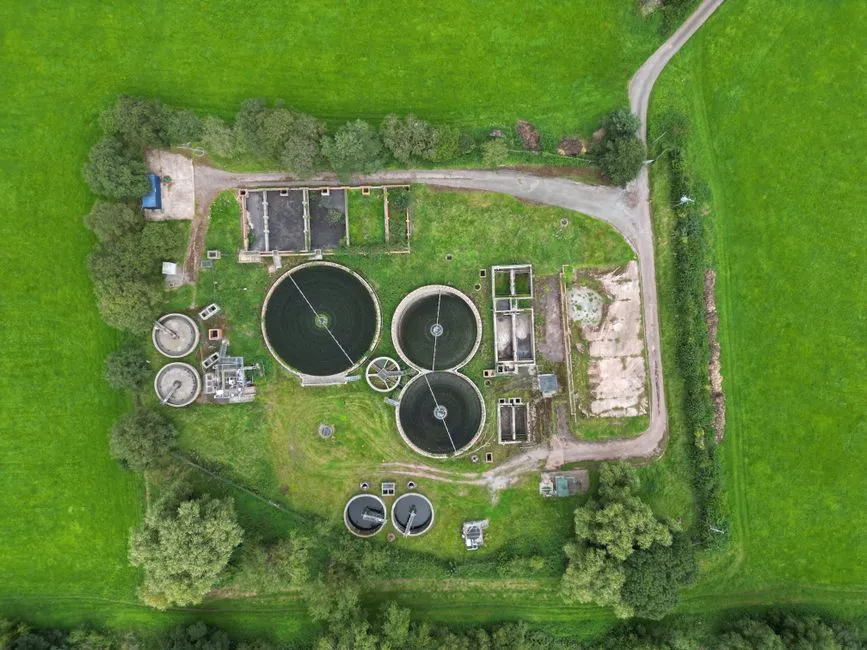
An inclined-plate (lamella) clarifier settles suspended solids by gravity through a parallel plate pack, exploiting the reduced settling distance and high effective surface area. Typical design surface loading is 20–40 m/h (per HydropureWater product data for the HydropureWater high-efficiency lamella clarifier), roughly 25–40% of the footprint of a conventional rectangular clarifier at equivalent flow, and polymer consumption is typically 30% lower than a conventional clarifier because the short settling path requires smaller, denser floc. The plate pack sits at 55–60°, so settled sludge slides to a hopper while clarified water rises counter-current through the plates.
Lamella is fundamentally a settler, not a floater. It handles settleable fines, suspended solids, and precipitates well; it does not handle free or emulsified oil, because oil-coated fines have a specific gravity close to water and travel with the overflow. Plants that try to run a lamella on coolant-laden feed typically see 30–60% oil breakthrough and a floating oil pad that re-entrains on every flow surge. The honest rule is that a clarifier handles oil-free streams of settleable solids, and a DAF handles oil-laden streams. Many Oshkosh fabricators run DAF primary followed by a lamella as a polishing/thickening step — or run a lamella after a DAF to clarify DAF subnatant before discharge. The underlying design authority for both unit operations is the EPA Process Design Manual for Sludge Treatment and Disposal (US EPA, nepis.epa.gov).
DAF vs Clarifier for Fabricated Metals: 2026 Comparison
For an Oshkosh fabricator evaluating 2026 capital expenditure, the decision reduces to a few quantified parameters. The table below summarizes the head-to-head numbers that drive procurement, EHS, and management sign-off.
| Parameter | DAF (circular or rectangular) | Lamella / Inclined-Plate Clarifier |
|---|---|---|
| Typical TSS removal | 92–98% (FC Maximizer); 85–90% (RC UniMax) — per DAF Corp | 60–85% on settleable fines only |
| Oil & grease handling | Removes free + emulsified oil in one stage | Cannot remove emulsified oil; requires upstream skimmer |
| Typical capacity range | 10–11,000 GPM (DAF Corp); Compact DAF skid to 66 GPM (SigmaDAF) | Designed per 20–40 m/h surface loading; modular plate packs |
| Footprint at 100 GPM equivalent | ~6–15 ft diameter circular; rectangular shop-assembled | ~25–40% of conventional rectangular clarifier |
| Relative CAPEX (skid + chemistry) | Higher unit cost, lower civil work | Lower unit cost, larger basin / plate pack |
| OPEX drivers | Polymer + saturator power + air | Polymer (lower) + sludge pumping |
| Sludge dryness | 2–4% floated solids (per DAF Corp) | 0.5–1.5% underflow (typical) |
| Retrofit into existing basin | Yes — rectangular units can drop into concrete tanks (per ClearStream) | Plate packs can be added to existing tanks |
| Best influent profile | FOG > 50 mg/L, emulsified coolants, metal fines | FOG < 50 mg/L, mostly settleable fines |
For context on why oil & grease and metals must be addressed together, the table below summarizes the 40 CFR 433 daily maximum limits that Wisconsin fabricators must hit before discharge to the City of Oshkosh POTW (per 40 CFR 433.102):
| Pollutant | Daily Maximum (mg/L) |
|---|---|
| Cadmium | 1.0 |
| Chromium (total) | 2.0 |
| Copper | 4.0 |
| Lead | 1.6 |
| Nickel | 2.0 |
| Silver | 1.6 |
| Zinc | 5.2 |
| Oil & grease | 52 |
| Total toxic organics | 52 |
The rule that emerges is straightforward: if influent oil & grease is above ~50 mg/L — and at any fabricated metals site with coolant breakout it is — a DAF must be the primary unit operation. A lamella can serve as primary clarifier only after an upstream oil removal step (API skimmer, DAF, or coalescer) drives FOG below that threshold. The local supply base makes the DAF path low-friction: SigmaDAF USA in Brown Deer (~95 miles from Oshkosh) and DAF Corporation in Kaukauna (~30 miles) both fabricate and pilot systems in Wisconsin. For primary solids and oil removal, a HydropureWater DAF system covers 4–300 m³/h, which brackets the typical Oshkosh mid-sized plant envelope. For a deeper regional comparison of how this decision plays out in another Midwest metals cluster, see this DAF or clarifier for fabricated metals in Springfield factory guide.
A 2026 Selection Framework for Oshkosh Factories
Translate the comparison into a defensible purchase decision in five steps.
- Characterize the influent. Pull 24-hour composite samples across two production weeks. Quantify flow (m³/h), TSS, FOG, pH, metals (Cd, Cr, Cu, Pb, Ni, Zn), and coolant type (synthetic, semi-synthetic, straight oil). A common DAF design point is 2,000 PPM feed TSS down to 50 PPM — the DAF Corp FC-150 example operates exactly at that point at 500 GPM.
- Pick the unit operation by oil/coolant fraction. High oil or broken coolant → DAF primary. Low oil and mostly settleable fines → lamella primary. Mixed profile (the most common Oshkosh case) → DAF primary with optional lamella polish on the subnatant.
- Match equipment size to flowrate. For small parts-washer skid duty, the SigmaDAF Compact DAF handles up to 66 GPM on a single pre-assembled skid; above 66 GPM it ships modular. The HydropureWater DAF line spans 4–300 m³/h. DAF Corp covers 48 GPM pilot units up to 11,000 GPM full scale (FC Maximizer 6–70 ft diameter). For the lamella side, the HydropureWater high-efficiency lamella clarifier is sized off the 20–40 m/h surface loading rule.
- Pilot, then specify. Run jar tests first to screen coagulant/flocculant chemistry, then commit to a 1–2 week on-site pilot. DAF Corp explicitly offers pilot feasibility studies on its FC-60 (48 GPM) and RC UniMax pilot (80–100 GPM) units; most Wisconsin DAF vendors will do the same. Do not skip this step — the 2,000 PPM down to 50 PPM number is achievable but is chemistry-dependent.
- Confirm the compliance path. Map the selected unit operation back to 40 CFR 433 daily maximums, lock in WPDES permit sampling, and plan downstream sludge handling under EPA Process Design Manual guidance. Plan a HydropureWater plate and frame filter press downstream of the DAF for the 2–4% floated sludge — see the plate and frame filter press selection guide for sizing detail.
Chemistry control is the make-or-break input on every step above. A HydropureWater automatic chemical dosing system tied to flow-paced control is what holds the DAF inside its 92–98% removal band when influent surges.
2026 Cost, Footprint, and Local Sourcing Notes
For 2026 capital planning, order-of-magnitude CAPEX for a skid-mounted DAF system (4–50 m³/h, with chemical dosing, PLC controls, and start-up) typically runs in the low-to-mid six figures USD; turnkey installations including civil work, building, and effluent monitoring commonly land in the mid-to-high six figures. A packaged lamella clarifier at the same flowrate is typically 20–40% lower on equipment cost but can equalize on total installed cost once the larger basin and pumping are factored in. Specific quotes depend on materials (304SS vs 316SS vs polypropylene wetted parts), instrumentation, and WPDES-specific monitoring — request bids with and without chloride-rated alloy upgrades before locking the spec.
Footprint is a real Oshkosh constraint: many plants are landlocked between rail spurs and the Fox River, and a 6–70 ft diameter circular DAF or a rectangular shop-assembled unit will fit where an equivalent conventional clarifier will not. The DAF Corp FC Maximizer range is 6–70 ft diameter; rectangular RC UniMax units ship fully shop-assembled and can drop into existing concrete basins (also a ClearStream DAF retrofit pattern). A lamella clarifier typically uses 25–40% of the equivalent conventional clarifier footprint at the 20–40 m/h surface loading mark — a meaningful saving when brownfield space is tight, but irrelevant if the influent is oil-laden.
Local supply is a genuine Wisconsin advantage. SigmaDAF USA in Brown Deer, WI (a joint venture between Clearwater Industries and Sigmadaf Clarifiers, in business since 1996) and DAF Corporation in Kaukauna, WI both fabricate, pilot, and service systems in-region. Both have run metals-finishing installations since the 1990s, both offer jar testing and on-site pilots, and both are close enough for next-day field service to Oshkosh. Downstream, floated DAF sludge at 2–4% solids typically goes to a plate and frame filter press for dewatering to 25–35% cake — see the plate and frame filter press selection guide for the sizing and cost ranges that pair with a 4–50 m³/h DAF.
Frequently Asked Questions
Which is better for fabricated metals wastewater — DAF or a clarifier?
For Oshkosh fabricators, DAF is the correct primary unit operation whenever the influent carries free or emulsified oil, cutting coolant, or tramp metal fines. DAF delivers 92–98% TSS removal in a single stage (per DAF Corp FC Maximizer data) and floats oil in the same pass, which is what 40 CFR 433 compliance requires. A lamella clarifier handles settleable fines only and cannot remove emulsified oil without upstream skimming.
What TSS and FOG removal can a DAF realistically hit on coolant-laden stamping wastewater?
A circular DAF (FC Maximizer class) is rated at 92–98% TSS removal and a rectangular DAF (RC UniMax class) at 85–90% on flows up to 1,000 GPM, per DAF Corp. The standard design point is 2,000 PPM feed TSS clarified to 50 PPM at 500 GPM on the FC-150 example. FOG removal tracks TSS removal when chemistry is properly tuned because the oil is bound to the floc.
Are there Wisconsin DAF vendors close to Oshkosh?
Yes. SigmaDAF USA operates from Brown Deer, WI (~95 miles from Oshkosh) and DAF Corporation is in Kaukauna, WI (~30 miles). Both manufacture DAF systems in Wisconsin, both run pilot units (DAF Corp offers a 48 GPM FC-60 and an 80–100 GPM RC UniMax pilot), and both serve the upper Midwest metals-finishing market with on-site feasibility studies.
When does a lamella clarifier make sense as primary treatment at a fabricated metals plant?
Only when the influent oil & grease has already been reduced below ~50 mg/L by upstream oil removal — typically an API skimmer or a DAF. At that point, a lamella clarifier sized at 20–40 m/h surface loading is a cost-effective primary settler for settleable metal fines and works well as a polishing step after a DAF on a metals-finishing line. A HydropureWater DAF system for primary removal paired with a lamella polish is a common Oshkosh configuration.