Why the DAF-vs-Clarifier Question Matters for Orem Food Plants in 2026
Orem and the surrounding Utah County corridor are anchored by dairy processing, snack-food frying, ready-meal cook lines, and a growing craft-brewery cluster in neighboring Provo and Springville. Those waste streams mix high FOG with suspended solids — the exact matrix where a clarifier-only train underperforms and a dissolved air flotation system earns its place. Any plant discharging to the Provo or Jordan River system, or to a local POTW, is regulated by a Utah Pollutant Discharge Elimination System (UPDES) industrial permit, and dairy-adjacent facilities are additionally bound by the BOD, TSS, and FOG limits in 40 CFR Part 405 (Dairy Products category).
Reliant Solutions operated DAF and wastewater tanks at the new Olam Food Ingredients (ofi) dairy factory, commissioning in December 2023, which is the most current Orem-adjacent field reference showing that DAF is the dairy-industry default for primary clarification in 2026. The decision for an Orem buyer is not "either/or" — DAF wins on FOG and floatables, a lamella clarifier wins on heavy settleable solids and lower CapEx, and a hybrid DAF + lamella polish covers mixed streams. This article provides the comparison, the 2026 decision framework, and the Utah compliance anchor to defend the choice to a regulator or a Utah-based owner.
How DAF and Clarifiers Actually Treat Food & Beverage Water
A dissolved air flotation unit saturates a side stream (typically 20–40% of clarified recycle) with air at 4–6 bar, then releases that stream through needle valves so 30–50 micron microbubbles form in the contact zone. The bubbles attach to oil droplets, FOG, and chemically flocculated fine solids, lifting them to the surface where a paddle skimmer scrapes the float into a sludge trough (per Clearwater/SigmaDAF, 2026). DAF must be paired with coagulation and flocculation chemistry — typically a polyaluminum chloride coagulant followed by a polymer flocculant — for the microbubbles to attach reliably.
A lamella clarifier relies on gravity sedimentation. Inclined plates spaced at 50–60 mm shorten the settling distance and raise effective surface loading to 20–40 m/h, which is roughly 20× a conventional rectangular clarifier at the same footprint. A lamella typically needs only flocculant and pH adjustment, not a saturator and air compressor, so OpEx is lower. Sludge character differs: DAF float is thin (1–3% dry solids), oily, and hard to dewater on its own; clarifier underflow is denser (3–6% dry solids) and dewaters well on a plate-and-frame press.
Side-by-Side: DAF vs Clarifier for Orem Food & Beverage Streams
The table below provides data an Orem engineer can drop into a permit memo, using performance numbers from the Ecologix 2026 field comparison to ensure a consistent data set across the proposal.
| Parameter | Dissolved Air Flotation (DAF) | Lamella Clarifier |
|---|---|---|
| FOG removal (same stream) | 95% | 70% |
| TSS removal | 85–95% (with coagulant) | ~90% on settleable streams |
| BOD reduction | 40–60% | 25–40% |
| Footprint (per m³/h) | Compact; high-rate | Compact at 20–40 m/h loading; deeper tank as standalone primary |
| Hydraulic residence time | 15–25 min | 45–90 min |
| CapEx index | Higher (saturator, compressor, controls) | Lower (tank + plates only) |
| OpEx index | Higher (compressed air, polymer, energy) | Lower (no saturator, less air) |
| Sludge character | Thin float, 1–3% DS, oily | Denser underflow, 3–6% DS |
| Best influent fit | High FOG, fine solids, emulsified oil | High settleable TSS, low FOG |
| Typical Orem food-stream fit | Dairy whey, snack frying, brewery cookers, ready-meal grease | Bakery dough wash, grain steep, produce wash, brewery spent grain |
| Hybrid role | Primary on mixed stream | Polish after DAF for residual TSS |
DAF and clarifier technologies are not redundant; DAF is a flotation device while a clarifier is a sedimentation device, and the 25-percentage-point FOG gap between them is the primary reason UPDES dairy permits in 2026 continue to specify DAF as the primary step.
2026 Decision Framework: Which One Should Your Orem Plant Choose?
The 2026 answer for an Orem food or beverage plant follows three branches based on the influent fingerprint.
Branch 1 — DAF first. If influent FOG exceeds 100 mg/L or there is visible free oil, specify a HydropureWater dissolved air flotation system sized for 15–25 minutes of hydraulic retention with a 20–40% recycle ratio. The DAF covers 4–300 m³/h across 13 standard models, which matches the typical 200–2,000 m³/day Orem food-plant envelope. Expect 95% FOG removal, 85–95% TSS removal, and 40–60% BOD reduction. This branch covers dairy and cheese whey, snack frying lines, brewery cookers, and ready-meal grease-bearing streams.
Branch 2 — Lamella clarifier first. If FOG is below 50 mg/L and TSS is above 500 mg/L, specify a HydropureWater high-efficiency lamella clarifier at 20–40 m/h surface loading. Expect ~90% TSS at lower CapEx, with up to 30% polymer savings relative to a conventional clarifier. This branch covers bakery dough wash, produce wash, grain steep, and brewery spent-grain streams.
Branch 3 — Hybrid DAF → lamella polish. Mixed streams with both floatables and heavy settleables benefit from this configuration. DAF removes the FOG first, then a lamella polish removes the residual TSS before biological treatment. Pair the primary train with an MBR membrane bioreactor and ClO₂ or UV disinfection to meet UPDES BOD and TSS limits. Size the clarifier on peak hourly flow plus a 1.5× surge factor, and size the DAF on 4-hour average flow.
Utah DWQ and UPDES Compliance: What Orem Plants Must Hit in 2026
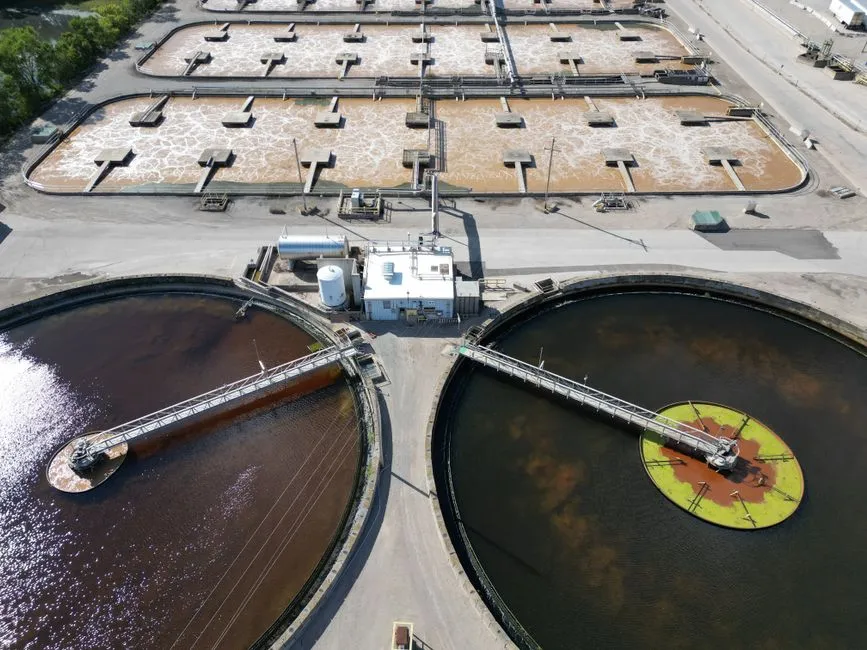
UPDES industrial permits issued by the Utah Division of Water Quality (DWQ) require effluent monitoring for TSS, BOD₅, FOG, and pH on every food or beverage discharge to surface water or to a POTW. Daily-maximum FOG limits in the 100 mg/L range are typical for food processors discharging to the Provo or Jordan River system, and 40 CFR Part 405 sets dairy-category effluent limits that any Orem plant handling milk, whey, or cheese by-product must meet. The 95% FOG removal a DAF delivers aligns directly with those limits; a 70% clarifier on the same stream does not.
Discharge to a POTW (most Orem food plants send to the Orem City Water Reclamation Facility) triggers local pretreatment standards, and a DAF + lamella train with proper automatic chemical dosing covers both. Two field references an Orem engineer can show a Utah DWQ reviewer in 2026 include the Reliant/ofi dairy installation (December 2023) and the Ecologix 2026 DAF-vs-clarifier selection update. Both are publicly documented and anchor the recommendation in current operating data rather than legacy spec sheets.
Cost, Footprint and ROI: 2026 Numbers for a 100–500 m³/d Orem Plant
For a representative 100–500 m³/day Orem food plant, the 2026 cost picture follows three paths. DAF first, then lamella polish, offers the lowest FOG-compliance risk and a typical 18–30 month payback on avoided POTW surcharges and water-reuse credits. Clarifier-only systems offer the lowest CapEx and moderate OpEx, fitting bakeries and produce washers where FOG is below 50 mg/L. Hybrid systems provide CapEx between the two, with the regulatory flexibility to handle recipe swings on a snack or ready-meal line.
Footprint is rarely a constraint in Orem, where most food plants sit on 2–10 acre parcels, but a DAF is roughly half the footprint of a conventional clarifier at the same flow. The HydropureWater DAF line covers 4–300 m³/h across 13 standard models, allowing an Orem plant to right-size the unit. Send the DAF float and clarifier underflow to a plate and frame filter press; the 3–6% DS clarifier underflow dewaters to a 25–35% cake, which is the most efficient solids-handling method for a 2026 food plant.
Frequently Asked Questions
When should an Orem food or beverage plant choose a DAF instead of a clarifier?
Choose a DAF when the influent carries FOG above 100 mg/L or visible free oil — dairy whey, snack frying, brewery cookers, and ready-meal grease streams. A DAF removes 95% of FOG versus 70% for a lamella clarifier on the same stream, aligning the plant with 40 CFR Part 405 dairy limits and typical UPDES daily-max FOG caps.
Can a DAF and a clarifier be combined for a mixed food-stream in Utah County?
Yes. A DAF primary followed by a lamella clarifier polish is a defined configuration for streams with both floatables and heavy settleables. For an Orem plant, the hybrid typically runs DAF first to drop FOG to under 30 mg/L, then a lamella to drop residual TSS before an MBR or SBR.
What size DAF does a 100–500 m³/day Orem food plant need in 2026?
For that envelope, the DAF line covers 4–300 m³/h across 13 standard models, providing sufficient resolution to right-size a primary DAF. Size the unit on 4-hour average flow with 15–25 minutes of hydraulic retention, a 20–40% recycle ratio, and a 1.5× surge factor on downstream biological treatment.