

Why Arlington Semiconductor Fabs Are Revisiting Primary Clarification in 2026
Fabs in the Arlington, TX corridor discharge under 40 CFR Part 433 categorical pretreatment standards for SIC 3674 (Semiconductors and Related Devices), enforced locally through the City of Arlington pretreatment program and the Trinity River Authority's industrial discharge permits, with the Upper Trinity Regional Water District (UTRWD) supplying the inbound process water. A 2026 capacity expansion, an EUV-tool upgrade, or a Notice of Violation on copper or nickel is the typical trigger that pulls a plant manager back into primary-clarification design.
The wastewater matrix in a 2026-node fab is not the matrix a 2015-era clarifier was sized for. Chemical-mechanical planarization (CMP) tools shed sub-10 µm slurries of colloidal silica, alumina, and ceria that stay in suspension for hours. Wet-etch and clean tools contribute fluoride at 50–500 mg/L, tetramethylammonium hydroxide (TMAH) developers at 10–100 mg/L, isopropyl alcohol (IPA) rinses, and photoresist stripper residues that arrive as buoyant, partially emulsified organics. Trace copper, lead, and nickel from copper damascene, electroless plating, and wafer-level packaging lines show up at 0.1–10 mg/L — well within the EPA Metal Finishing categorical band but tight against the Arlington POTW's daily-max and monthly-average limits. A legacy concrete clarifier that worked for settleable inorganics now returns colloidal fines to the overflow and trips the metals trend report.
What Each Unit Actually Does: DAF and Clarifier Mechanisms Side by Side
DAF and clarifier systems serve distinct separation needs based on the physical properties of the wastewater contaminants. A DAF unit saturates a recycle stream with air at 4–6 bar, then depressurizes it inside the flotation cell, releasing 30–50 µm micro-bubbles (per SigmaDAF USA product literature) that attach to chemically conditioned floc and lift it to a surface skimmer. A gravity or lamella clarifier relies on Stokes-law settling: chemically conditioned floc falls under gravity, and inclined lamella plates multiply the effective settling area to surface-loading rates of 20–40 m³/m²·h.
The mechanism dictates the match to the contaminant. DAF wins on anything that is buoyant, emulsified, oily, or colloidal — CMP slurry fines, photoresist residues, IPA-laden rinsewater, and FOG from solder flux. Clarifiers win on dense, settleable inorganics: metal hydroxides from pH adjustment at pH 9–10, calcium fluoride co-precipitates, and inert RO-reject solids. Both depend on upstream coagulation and flocculation; a DAF with the wrong polymer dose is an expensive tank, and integrating chemistry afterwards is where projects lose weeks (per Spectrum Water field practice).
| Parameter | DAF | Lamella / Gravity Clarifier |
|---|---|---|
| Mechanism | Micro-bubble flotation, 30–50 µm bubbles | Gravity settling on inclined plates |
| Best-fit contaminants | CMP slurry, photoresist, FOG, colloids, emulsified organics | Metal hydroxides, CaF₂, inert inorganics |
| Surface / hydraulic loading | Up to ~25 m³/m²·h cell loading; 5–25% recycle ratio | 20–40 m³/m²·h on lamella plates |
| Sidewall depth | 1.0–1.5 m (shallow skid) | 3–4 m (concrete basin) |
| Typical TSS removal | 80–95% (with chemistry) | 50–80% (inorganics only) |
| Operator complexity | Saturator, recycle pump, polymer skid, air system | Sludge pump, polymer feed, no pressurized air |
| CAPEX driver | Packaged skid, smaller excavation | Concrete basin, longer build |
| 40 CFR Part 433 alignment | Polishing of colloidal metals carryover | Bulk removal of settleable metals hydroxides |
Semiconductor-Specific Performance: Where DAF Beats the Clarifier in 2026
CMP slurry is the primary application for DAF systems in semiconductor manufacturing. Colloidal silica, alumina, and ceria particles sit in the 20–200 nm range, well below the 10 µm threshold at which gravity settling becomes practical, and a 2026 high-node fab can push slurry loading past 200 mg/L TSS during peak tool campaigns. A lamella clarifier returns most of that load to the overflow; a DAF system floated with a cationic coagulant and an anionic flocculant removes 85–95% in a single pass.
Photoresist and stripper residues arrive as buoyant, partially emulsified organics with a density only marginally above water. DAF lifts them in 10–15 minutes of residence time; a clarifier either passes them through or skims them as a messy, water-laden top layer that re-emulsifies on sludge handling. Fluoride-bearing streams benefit from CaCl₂ precipitation to CaF₂, which produces a settleable floe that either unit can handle, but a downstream DAF polisher captures the sub-10 µm fines that escape a clarifier's overflow and keeps the fluoride trend line under the Arlington POTW's monthly-average ceiling.
For trace metals under 40 CFR Part 433 — copper at 3.38 mg/L daily-max / 2.07 mg/L monthly-average, nickel at 3.98 / 2.38, lead at 0.69 / 0.43 (per 40 CFR §433.13) — the most robust 2026 control sequence is pH elevation to 9–10, hydroxide precipitation, and a lamella clarifier for the bulk floe, with a DAF as the colloidal-polish step. The two units in series consistently deliver lower metals in the clarified effluent than either unit alone, and that is the configuration most fab environmental engineers in Arlington are standardizing on for 2026 builds.
Where a Clarifier Still Wins for Arlington Fabs in 2026
Not every fab stream requires the complexity of a DAF system. A lamella clarifier is the cheaper, simpler primary unit when the stream is dominated by settleable inorganics and the operator wants to keep the line items small. High-flow, low-contaminant utility streams — cooling-tower blowdown, RO reject, and DI rinse backwash — are predominantly inert inorganics that clarify cleanly, and a well-designed lamella plate pack at 20–40 m³/m²·h removes 50–80% TSS without a saturator vessel, a recycle pump, or a compressed-air system.
Brownfield sites with an existing concrete clarifier and limited headroom often retrofit a DAF skid alongside the basin rather than rebuild. The clarifier handles 80% of the settleable load, the DAF polishes the colloidal fraction, and the combined footprint stays inside the existing concrete pad. A lamella clarifier also cuts coagulant consumption by up to 30% versus a DAF on equivalent load (HydropureWater field data, 2026), and it has no pressurized recycle loop, which simplifies operator training in a 2026 labor market where skilled wastewater technicians are scarce. For fabs on tight CAPEX ceilings — and most Arlington fabs in 2026 are — the clarifier-first, DAF-as-needed hybrid is the lower-risk default.
2026 Cost and Footprint Comparison for an Arlington Fab
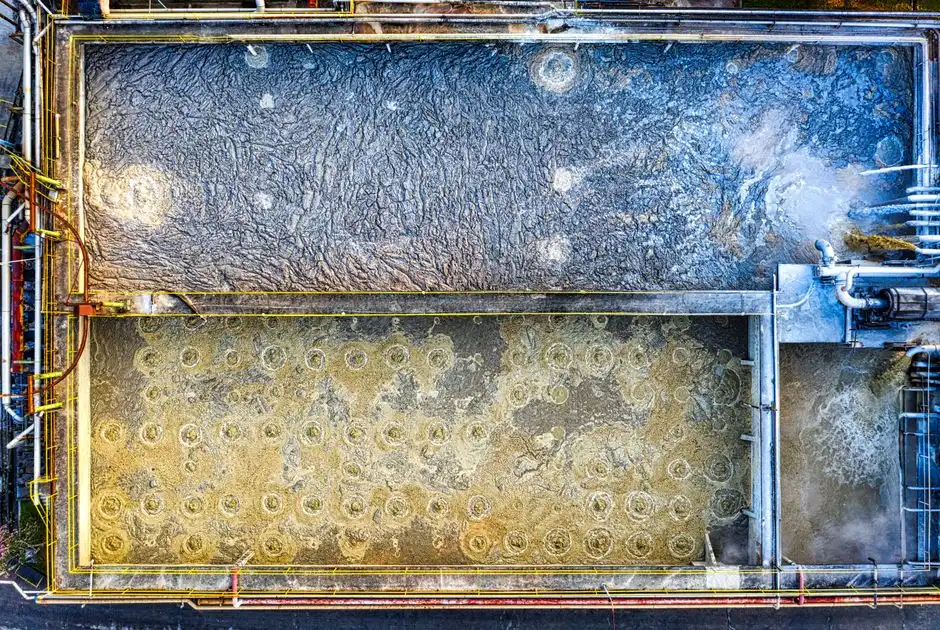
Packaged DAF skids in the DAF 4–300 m³/h range typically run lower installed CAPEX per m³/h than a custom concrete clarifier basin because the fab buys a fabricated, factory-tested unit rather than managing a civil-works project. The auxiliary costs that swing the comparison are the saturated recycle pump, the air-saturation vessel, and the compressor package — together 15–25% of the skid price. A lamella clarifier skips those auxiliaries but pays for the concrete, the plate pack, and the longer construction schedule.
Footprint is decisive inside a sub-fab or tool-utility room. A DAF cell sits at 1.0–1.5 m sidewall depth, which fits under standard 2.4 m fab ceilings and alongside a GX series rotary bar screen without raising the slab. A gravity clarifier needs 3–4 m of sidewall depth, which often forces an outdoor basin or a deep pit. On chemical OPEX, DAF demands consistent coagulant plus flocculant dosing, while a lamella clarifier can run up to 30% lower coagulant use on inorganics-dominated streams. Energy is the line item that ERCOT-driven 2026 power pricing amplifies: WERF's 2010 energy-efficiency compendium (S1) shows pumping and aeration as the dominant liquid-treatment energy draws, and DAF recycle pumps plus saturation-vessel compressors are the line items a fab engineer has to size against ERCOT's time-of-use tariff.
| Line Item (2026, Arlington) | DAF primary | Lamella clarifier primary | Hybrid: DAF + clarifier |
|---|---|---|---|
| Installed CAPEX range | $$ (packaged skid) | $$$ (concrete + plate pack) | $$$$ (two units) |
| Footprint | Small / shallow | Large / deep basin | Medium / outdoor |
| Coagulant use | Baseline | −20 to −30% | Optimized per stage |
| Energy (kWh/m³) | Higher (recycle + saturator) | Lower (hydraulic only) | Moderate |
| Operator skill | Higher (air system) | Lower | Moderate |
| 40 CFR Part 433 compliance | Strong on colloids | Strong on settleable metals | Strongest combined |
| 2026 risk | ERCOT power cost | CAPEX overrun | Coordination complexity |
Decision Framework: DAF, Clarifier, or Hybrid for Your Fab
The choice follows the dominant stream, not the equipment vendor. If your daily composite is dominated by CMP slurry, photoresist stripper residues, or sub-10 µm colloidal fines, a DAF primary is the right call — and pairing it with an automatic chemical dosing skid upstream is non-negotiable. If the stream is mostly settleable inorganics — RO reject, cooling-tower blowdown, calcium fluoride co-precipitate — start with a lamella clarifier and reserve the DAF budget for a polish step later.
For mixed-signal and power-device fabs in Arlington that run both CMP-heavy front-end and metals-bearing back-end lines through the same pretreatment, the 2026 default is the hybrid train: DAF primary on the slurry side, lamella clarifier polish on the metals side, both feeding a common sludge-handling line. Downstream dewatering on a plate-and-frame filter press keeps the sludge cake at 30–35% DS, which is the range Arlington haulers accept for off-site disposal. A full 2026 cost breakdown and ROI calculator for ZLD systems provides the necessary data for the next planning phase.
Frequently Asked Questions
Which is better for semiconductor fab wastewater — DAF or clarifier?
A DAF system is the better primary clarifier for semiconductor and related devices wastewater in Arlington, TX when the stream carries CMP slurry, photoresist, or fluorinated etch chemistries, because 30–50 µm micro-bubbles capture low-density and colloidal solids that gravity clarifiers routinely miss; a lamella clarifier is preferred only when the stream is dominated by settleable inorganics under 40 CFR Part 433 categorical pretreatment standards.
What bubble size does a DAF generate, and why does it matter for CMP slurry?
The DAF unit generates 30–50 µm micro-bubbles (per SigmaDAF USA product data), small enough to attach to sub-10 µm colloidal silica,
Frequently Asked Questions
Should a semiconductor fab in Arlington, TX use a DAF or a clarifier in 2026?
The choice depends on the specific waste stream composition and the facility's footprint. In Arlington, where municipal wastewater infrastructure faces strict pretreatment standards, a Dissolved Air Flotation (DAF) system is generally preferred for low-density, colloidal particles and oil-laden streams, as it achieves high removal rates for suspended solids with a footprint 70-80% smaller than conventional gravity clarifiers. However, for high-density inorganic solids and heavy metal precipitation, traditional circular or rectangular clarifiers remain the standard for operational stability.
Can a DAF system remove CMP slurry from semiconductor wastewater?
Yes, a DAF system is highly effective for Chemical Mechanical Planarization (CMP) slurry removal, provided it is paired with appropriate chemical coagulation and flocculation. Because CMP slurries often contain sub-micron silica or cerium oxide particles that settle slowly, the micro-bubbles generated by a DAF system provide the necessary buoyancy to float these particles to the surface. This process typically achieves a 90-95% reduction in total suspended solids (TSS) when influent concentrations are properly managed via automated pH adjustment and polymer dosing.
What is the best primary clarifier for photoresist wastewater?
For photoresist-heavy waste streams, a lamella clarifier is the most efficient primary treatment option. Photoresist waste often contains organic solvents and polymer residues that require precise chemical precipitation; the inclined plate design of a lamella clarifier increases the effective settling area within a compact vertical space, allowing for the capture of light, flocculated organic solids that might otherwise remain suspended in a standard horizontal clarifier.
Does a lamella clarifier meet 40 CFR Part 433 discharge limits for semiconductors?
A lamella clarifier alone is typically insufficient to meet 40 CFR Part 433 standards, which regulate toxic metal pollutants like copper, nickel, and lead. While the clarifier effectively removes the precipitated metal hydroxides, it must be integrated into a system that includes multi-stage pH neutralization and precise chemical precipitation tanks. When operated within a properly designed treatment train, a lamella clarifier can consistently help facilities achieve the required daily maximum concentration limits for metal concentrations.
How much does a packaged DAF system cost for a semiconductor fab in 2026?
In 2026, a fully packaged, skid-mounted DAF system for a semiconductor application typically ranges from $120,000 to $350,000, depending on the required flow capacity, material of construction (typically 316L stainless steel for chemical compatibility), and the complexity of the integrated control system. This pricing generally excludes site-specific installation, piping, and the necessary upstream chemical dosing skids required for full compliance with local Arlington pretreatment ordinances.