
What Plymouth Fabricated Metals Plants Are Actually Discharging
Most stamping, machine-shop, and job-shop floors in the Plymouth industrial park produce three signature wastewater streams that the floor drain alone cannot handle: tramp oils at 10-500+ mg/L oil and grease, cutting and cooling fluids carrying emulsified oils and 200-2,000 mg/L total suspended solids (TSS), and metal fines from grinding and stamping with specific gravity between 1.5 and 7.8 g/cc — heavy enough to settle fast but small enough to ride a grease film and never reach the bottom of a quiescent basin. The combined load routinely pushes TSS and O&G above 60 mg/L and 52 mg/L respectively, the daily-maximum categorical pretreatment limits set by EPA at 40 CFR Part 433.10 for the Metal Finishing point source category.
Part 433 also caps 14 metals (Cd, total Cr, Cu, Pb, Ni, Ag, Zn, Mn, Fe, Al, cyanide, total phenols, fluoride, and ammonia) at limits typically ranging from 0.07 to 10.4 mg/L daily max depending on the analyte — so any clarifier or flotation unit selected must protect against re-suspension of metal-laden fines as well as oil breakout. On top of the federal ceiling, Massachusetts 314 CMR 3.00 governs surface-water discharge and 314 CMR 7.00 covers industrial waste, while the local POTW (the Plymouth County sewer use ordinance adopted by the receiving facility) layers local limits and surcharges on top of the federal categorical standards. For baseline equipment design, EPA Process Design Manual 625/1-75-003a Chapter 7 remains the authoritative reference for primary clarifier parameters (per the 1975 manual, Chapter 7 Table 7-2 gives the design surface loadings and detention times still used today).
How a DAF Clarifier Works on Oily Metalworking Wastewater
Dissolved air flotation separates oil and suspended fines by attaching micron-scale bubbles to the contaminant and floating it to the surface. In the standard configuration, 20-40% of clarified effluent is recycled through a saturation tank pressurized to 60-80 psi (4-5.5 bar) with dissolved air, then released back into the flotation cell through needle valves or a dedicated micro-bubble generator. The pressure drop nucleates a cloud of 20-40 micron bubbles that attach to oil droplets and destabilized TSS, lifting them into a thick float layer that a surface skimmer sweeps to a sludge hopper.
DAF Corp's published specifications for the FC Maximizer cite 92-98% TSS removal at 50 mg/L effluent from a 2,000 mg/L feed using the zero-velocity shallow-tank design, with float sludge thickened to 2-4% dry solids — already in the range a downstream plate-and-frame filter press can handle without further conditioning. The micro-bubble generator in the same product line is rated for consistent 20-40 micron bubbles with no coarse-air contamination, which matters because larger bubbles strip oil droplets back into the water column before the float can be skimmed. For plants that want to avoid alum and the resulting hazardous sludge classification, the WesTech mobile DAF can be run with polymer alone; jar tests typically show improved float clarity at 5-25 mg/L anionic polyacrylamide depending on the cutting-fluid emulsion.
From a tankage standpoint, the float-skim cycle produces 2-4% DS versus 0.5-2% DS for clarifier underflow, so a DAF-fed plate and frame filter press sees roughly half the hydraulic load per pound of dry solids — a real downstream savings in polymer and haul-off. A packaged DAF skid sized for a 50-200 gpm fabricated metals plant typically costs less to install in a tight bay than a comparably rated rectangular clarifier because the flotation cell footprint is shallow (4-6 ft water depth) and circular. Equipment like the HydropureWater dissolved air flotation system ships pre-skidded with air-saturation pump, reactor, and skimmer wired and piped for one-day install.
How a Conventional Gravity Clarifier Performs on the Same Stream
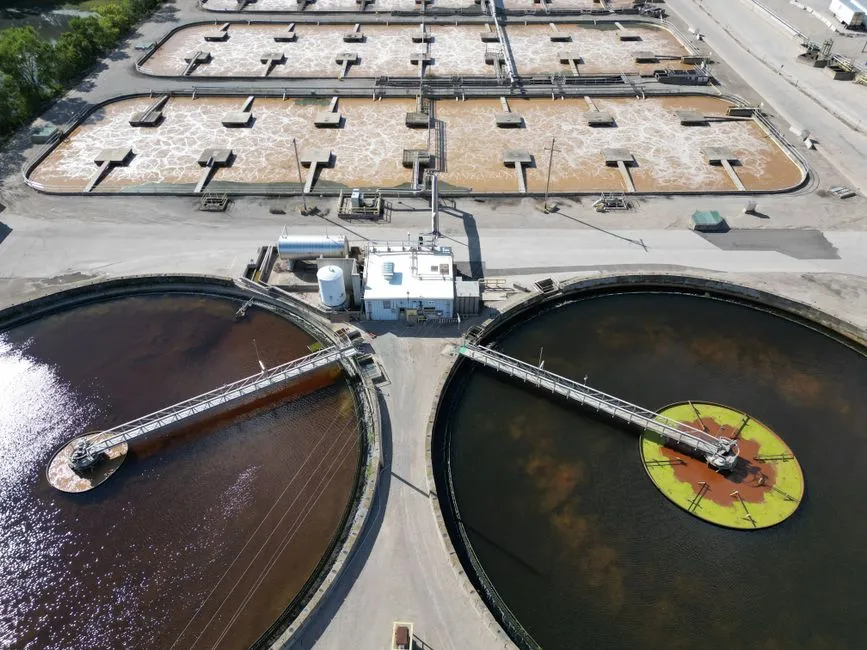
A conventional gravity clarifier — rectangular basin, circular sludge-blanket unit, or lamella/inclined-plate pack — settles solids by density difference in quiescent flow. EPA Process Design Manual 625/1-75-003a Chapter 7 lays out the baseline design parameters still used for primary and solids-contact clarifiers, including surface loading rates, detention times, and weir-loading criteria. A modern lamella clarifier runs 20-40 m/h surface loading on the projected plate area, cuts chemical demand by roughly 30% relative to a conventional basin, and occupies about half the floor area of a comparably rated rectangular clarifier — making it a credible option for retrofits inside an existing building where height is the constraint rather than floor space.
On a fabricated metals stream, the lamella or conventional clarifier has one disqualifying weakness: free and emulsified oil rises, it does not sink. Without an upstream corrugated-plate interceptor (CPI) or skim weir, oil coalesces at the surface and weeps over the effluent launder. The result is consistently poor O&G removal — typically 20-40% on a raw metalworking stream — and chronic excursions above the 52 mg/L daily-max ceiling at 40 CFR 433.10. Coagulant addition (alum, ferric, or cationic polymer) helps, but it does not convert an oil droplet into a settleable particle; the oil still wants to float. The other operational gotcha is calcium scaling: lamella plates running on alkaline soak-cleaner waste (pH 10-12, high calcium) need an acid-wash cycle every 2-4 weeks to prevent calcite buildup that blinds the plates and crashes performance. For plants that already separate oil upstream or run a relatively dry stream (O&G below ~30 mg/L), a lamella clarifier can still meet Part 433 limits and do it at lower capex than a DAF skid.
DAF vs Clarifier: Head-to-Head Comparison
The table below puts the two technologies side-by-side on the metrics a Plymouth procurement manager actually cares about — regulatory compliance, footprint, cold-weather performance, sludge handling, and 2026 dollar impact. All values are typical ranges for fabricated metals influent (O&G 50-500 mg/L, TSS 200-2,000 mg/L) and should be confirmed by jar test or pilot before any purchase order.
| Parameter | DAF (with chemical) | Gravity / Lamella Clarifier (with chemical) |
|---|---|---|
| O&G removal (single stage) | 80-95% | 20-40% alone; 50-60% with prior CPI |
| TSS removal | 92-98% (DAF Corp FC Maximizer data) | 50-70% primary; 70-85% lamella with coagulant |
| Effluent TSS (from 1,000 mg/L feed) | 20-80 mg/L | 150-500 mg/L |
| Meets 40 CFR 433.10 (52 mg/L O&G, 60 mg/L TSS) directly | Yes, with polymer dose | Rarely; upstream oil removal usually required |
| Footprint (200 gpm) | ~10-14 ft circular, 4-6 ft deep | ~16-24 ft circular or 10×18 ft rectangular lamella |
| Sludge consistency | 2-4% DS float | 0.5-2% DS underflow |
| Cold-weather operation (5-10 °C) | Stable; micro-bubble process unaffected | Settling velocity drops ~30% at 5 °C; viscosity penalty |
| Indicative 2026 capex (50-200 gpm) | USD 80,000-180,000 installed | USD 40,000-100,000 installed |
| Indicative 2026 capex (200-500 gpm) | USD 180,000-350,000 | USD 100,000-220,000 |
| Annual opex drivers | Polymer (0.02-0.08 USD/gal), air-saturation pump kWh | Polymer, sludge pumping kWh, plate-acid wash labor |
Two patterns jump out of the table. First, on the compliance column only DAF clears 40 CFR Part 433 daily-max limits in a single stage on a raw metalworking stream — the clarifier needs an upstream oil-removal unit to compete. Second, on sludge the DAF float is two-to-four times thicker than clarifier underflow, which compounds into fewer haul-off trips and a smaller downstream dewatering press.
Matching the Technology to Your Plymouth Plant
Translate the table into a decision rule and the call becomes straightforward for most Plymouth NAICS 332 sites. Choose DAF when the influent carries more than 50 mg/L O&G, when bay-side floor space is limited to a 12×12 ft pad, when the float sludge must be hauled as non-hazardous (Massachusetts fuel-soil criteria), or when the plant runs a single production shift and a cold-start needs to reach steady effluent in under 30 minutes. A cavitation air flotation deep-dive is worth reading if the plant has emulsified oils at sub-50 micron droplet size, where standard DAF performance softens.
Choose a lamella clarifier when the wastewater is already oil-stripped (O&G below 30 mg/L, rare in fabricated metals without prior CPI), when flow exceeds 500 gpm and the stream is dilute, when an existing rectangular or circular tank can be retrofit with an inclined-plate pack to gain effective area without civil work, or when capital budget is constrained and the POTW's local sewer use limit is generous. A third option — a hybrid DAF + lamella polish — is the right call for plants that need closed-loop rinse-water reuse below 30 mg/L TSS or that face a tight in-house TSS ceiling; DAF takes out 90%+ of the load, the lamella polishes the residual, and the combined effluent can feed a plating rinse tank or a stamping wash.
Plymouth-specific operating constraints — coastal cold snaps that pull bay-side influent below 5 °C, small industrial-park lots where a 24 ft circular clarifier footprint is non-starter, and Massachusetts 314 CMR 3.00 surface-water rules that run stricter than federal minimums — all tilt the default toward DAF, with the lamella reserved for retrofit inside heated buildings or for low-O&G sidestreams like machine-tool coolant overflow.
2026 Capex, Opex, and ROI Snapshot
Put numbers a CFO will sign off on. A 50-200 gpm packaged DAF skid sized for a typical Plymouth job shop or small stamping plant runs USD 80,000-180,000 installed, including saturation pump, polymer make-down, controls, and tie-ins; a 200-500 gpm unit, more appropriate for a two-shift operation with significant coolant flow, runs USD 180,000-350,000. A lamella clarifier retrofit of the same flow band lands at USD 40,000-100,000 (50-200 gpm) or USD 100,000-220,000 (200-500 gpm), with the lower number typical when an existing basin is being repackaged. For chemical-program consistency across both technologies, an automatic chemical dosing skid sized to the polymer demand keeps jar-test results reproducible at full scale.
Operating cost is dominated by polymer and sludge haul-off. Polymer typically lands at USD 0.02-0.08 per gallon treated depending on the emulsion, and sludge haul-off runs USD 50-120 per wet ton. Because DAF float exits at 2-4% DS versus 0.5-1% for clarifier underflow, a DAF plant hauls 50-75% fewer wet tons per pound of dry solids — the single largest opex delta. DAF payback sits in the 18-36 month range from reduced haul volume and avoided 40 CFR Part 433 surcharge events from the POTW; clarifier payback is shorter on capex (8-18 months) but only if the upstream oil problem is already solved.
Before any PO, run a 60-80 gpm pilot — either on a mobile DAF trailer or with a column test on a lamella pilot — for at least two production shifts. The pilot confirms achievable effluent on your actual stream, validates polymer dose, and turns vendor selection from a brochure comparison into a head-to-head data set. Engineers weighing the same decision in other Mid-Atlantic industrial corridors can compare notes in the Birmingham fabricated metals DAF vs clarifier 2026 guide, which uses the same four-metric frame against a different regulatory backdrop.
Frequently Asked Questions
Can a clarifier remove oil and grease to 40 CFR Part 433 limits on its own?
Rarely. A conventional or lamella clarifier typically delivers 20-40% O&G removal on a raw metalworking stream because free and emulsified oil rises rather than settles. Hitting the 52 mg/L daily-max limit at 40 CFR 433.10 almost always requires an upstream CPI, DAF, or skim weir, after which the clarifier can polish TSS. Field data from EPA Process Design Manual Chapter 7 confirm that primary clarifier design is optimized for settleable solids, not floated oil.
What polymer dose does a DAF need for cutting fluid wastewater?
Most emulsified cutting-fluid and coolant streams respond to 5-25 mg/L of anionic or cationic polyacrylamide, with the exact dose and charge set by jar test on the live stream. Higher oil loadings (above 200 mg/L O&G) generally need the upper end plus a coagulant (alum or ferric at 50-150 mg/L) to break the emulsion before the polymer can bridge the destabilized droplets. WesTech's mobile DAF pilots typically run 8-15 mg/L anionic polymer with no coagulant on lightly emulsified streams.
How cold is too cold for a clarifier in a Plymouth bay-side plant?
Lamella and conventional clarifiers lose settling velocity as water viscosity rises below 10 °C — at 5 °C the settling rate of typical metalworking floc drops roughly 30% relative to 20 °C operation. DAF is largely unaffected by temperature because the micro-bubble attachment is a physical adhesion, not a settling process; FC Maximizer and similar units are rated for 5-40 °C without performance derating. For unheated bay-side tanks in coastal Massachusetts, that is the single biggest argument for flotation.
Do I need flocculant if my influent TSS is under 200 mg/L?
For DAF, often no — the micro-bubble attachment can pull light TSS without polymer, though a small dose (2-5 mg/L) typically improves float clarity. For a lamella clarifier below 200 mg/L TSS, polymer is still recommended to build floc size large enough to settle on the plate pack; without it, fine TSS passes over the weir and shows up in the effluent as 50-100 mg/L non-compliance. Confirm with a 30-minute jar test on both technologies before sizing.
Can DAF and lamella be combined for water reuse?
Yes. A common closed-loop configuration is DAF primary followed by lamella polish and a multimedia or bag filter, producing rinse-quality water under 30 mg/L TSS and 10 mg/L O&G. This is the standard arrangement for plating and stamping lines that need to reuse rinse water to cut incoming water surcharges and sewer discharge volume. The DAF takes the bulk solids load, the lamella catches carryover fines, and the polish filter protects nozzles and spray bars from plugging.