Why EID's Receiving Plants Change the Compliance Math
The El Dorado Irrigation District runs two wastewater plants that are an order of magnitude smaller than the reference POTW most pretreatment guides assume: a combined 6.1 mgd dry-weather design capacity, averaging 4.9 mgd of actual flow (EPA 2003, p.5). Deer Creek WWTP takes 2.94 mgd average / 4.45 mgd peak against a 5.0 mgd design, while El Dorado Hills WWTP takes 1.94 mgd average / 2.92 mgd peak (EPA 2003, p.5). El Dorado Hills sends 0.5 mgd minimum to Carson Creek after media filtration, and routes 1.0 mgd of tertiary effluent to Deer Creek after chlorination/dechlorination (EPA 2003, p.3-4). The hydraulic envelope a chemical plant works against is therefore much tighter than a generic 25,000 gpd threshold suggests, and the 40 CFR 403.3(v) Significant Industrial User (SIU) test at 5% of dry-weather hydraulic or organic capacity fires first for almost any chemical plant on the line.
Deer Creek operates under WDRs R5-2002-0210 and R5-2002-0211, which carry narrative prohibitions, effluent limits, receiving-water limits, monitoring, pretreatment provisions, and sludge disposal requirements (EPA 2003, p.5). El Dorado Hills operates under Order 5-01-135 (issued June 14, 2001), which also functions as the NPDES permit CA0078671 (EPA 2003, p.6). A 30,000 gpd batch stream is roughly 1% of EID's combined 4.9 mgd average flow, but it is 1.02% of Deer Creek's 2.94 mgd alone and 1.55% of El Dorado Hills' 1.94 mgd alone. The 5% SIU trigger is reachable for any plant over approximately 73,000 gpd discharging to Deer Creek or 49,000 gpd to El Dorado Hills, on the hydraulic test alone, before the organic test even runs.
| Parameter | Deer Creek WWTP | El Dorado Hills WWTP | Combined EID |
|---|---|---|---|
| Average flow (mgd) | 2.94 | 1.94 | 4.9 |
| Peak flow (mgd) | 4.45 | 2.92 | — |
| Design capacity (mgd) | 5.0 | 5.0 | 6.1 dry-weather |
| Receiving water | Deer Creek | Carson Creek (0.5 mgd min) + Deer Creek (1.0 mgd tertiary) | — |
| WDR order | R5-2002-0210 / 0211 | 5-01-135 (June 14, 2001) | — |
| NPDES permit | CA0078062 | CA0078671 | — |
| 5% SIU flow threshold (gpd, hydraulic) | ~147,000 | ~97,000 | ~245,000 |
The Three-Layer Federal Pretreatment Stack Applied to EID
Layer 1 is the general and specific prohibitions at 40 CFR 403.5. The general prohibitions under 40 CFR 403.5(a) bar any discharge that causes pass-through (defined at 40 CFR 403.3(p)) or interference (defined at 40 CFR 403.3(k)). The specific prohibitions under 40 CFR 403.5(b) carry hard numeric cutoffs: pH less than 5.0 or greater than 12.0 at the SIU discharge point guidance, closed-cup flashpoint below 140°F (60°C), source temperature above 140°F, headworks temperature above 104°F (40°C), solids or viscous substances in amounts that obstruct flow, and explosion-meter readings above 5% LEL sustained or 10% LEL on any single reading (per EPA 2026, summarized in S5).
Layer 2 is the federal categorical pretreatment standards under 40 CFR Parts 405-471. Most chemical plants hit one of: 40 CFR Part 414 (organic chemicals, plastics, and synthetic fibers), Part 415 (inorganic chemicals manufacturing), Part 417 (soap and detergent), Part 419 (petroleum refining), or Part 433 (metal finishing). The 2003 EPA inspection specifically calls out 40 CFR 414D for thermoplastic resins as the applicable subpart for Rippey Corp, illustrating that EID inspectors verify which subpart actually applies to each SIU (EPA 2003, p.20). Engineers should always pull the active numeric categorical limits from the current 40 CFR database and any Federal Register notice within the last 12 months, because EPA revises subparts on a multi-year cycle (per EPA 2026).
Layer 3 is the local limit, derived from the pollutants of concern EID has identified as having more than a 1% statistical chance of causing a WDR or Federal sludge limit violation. Metals, ammonia, and oil & grease are the typical focus (EPA 2003, p.11-12). The most stringent applicable number from the three layers always controls. For Deer Creek and El Dorado Hills, local limits often tighten the federal floor because the receiving plants are small and the dilution envelope is constrained.
| Layer | Regulatory basis | Key driver | Typical values (illustrative) |
|---|---|---|---|
| 1 — General/specific prohibitions | 40 CFR 403.5(a) and (b) | Pass-through, interference, pH 5.0-12.0 envelope, flashpoint, LEL, headworks T < 104°F | Qualitative + numeric cutoffs |
| 2 — Categorical standards | 40 CFR Parts 414, 415, 417, 419, 433 (most common for chemical plants) | Industry-specific numeric limits, mg/L or kg/kkg | Subpart-specific; confirm in 40 CFR database |
| 3 — EID local limits | WDRs R5-2002-0210/0211 (Deer Creek) and 5-01-135 (El Dorado Hills) | Pollutants of concern with >1% chance of WDR/sludge violation: metals, ammonia, oil & grease | Site-specific; tighter than federal for small POTW |
What EID's Receiving-Water Data Tells a Chemical Plant

The 2003 EPA inspection pulled 15 months of effluent data, and the picture it paints is asymmetric: ammonia headroom is large, but nitrate headroom is essentially zero, and metals/priority pollutants are the only toxicity vector with measurable risk. Against the summer minimum sliding-scale ammonia limits of 2.37 mg/L monthly-average / 13.3 mg/L sample-maximum at Deer Creek and 2.21 mg/L / 9.64 mg/L at El Dorado Hills, both plants hold ammonia below 1 mg/L year-round, with 99th-percentile peaks also under 1 mg/L (EPA 2003, p.8). That headroom is what a chemical plant risks losing if it sends nitrification-killing compounds to the headworks.
The nitrate envelope is the binding constraint. Every El Dorado Hills sample and all but one Deer Creek sample in the inspection period exceeded the 10 mg/L standard, with averages of 17.1 mg/L at Deer Creek and 24.2 mg/L at El Dorado Hills, and 99th-percentile peaks of 27.5 mg/L and 34.7 mg/L respectively (EPA 2003, p.8). EID inspectors therefore look hard at nitrogen loading, which is why MBR polishing is a defensible choice rather than an over-spec. Biocide sensitivity is low: less than 2% chance of exceeding lindane limits, and consistent compliance with both acute and three-species chronic toxicity (fathead minnows, algae, ceriodaphnia) confirms no non-ammonia acute toxicity at either plant (EPA 2003, p.8-9). The implication: priority pollutants, metals, and slug-event ammonia are the real risk vectors, and the equipment train should target those.
| Parameter | Deer Creek (avg) | Deer Creek (99th%) | El Dorado Hills (avg) | El Dorado Hills (99th%) | Standard | Headroom |
|---|---|---|---|---|---|---|
| Ammonia (summer minimum, mg/L) | <1.0 | <1.0 | <1.0 | <1.0 | 2.37/13.3 (DC); 2.21/9.64 (EDH) | Large |
| Nitrate (mg/L) | 17.1 | 27.5 | 24.2 | 34.7 | 10 | None; all samples >10 except one DC |
| Lindane exceedance probability | — | — | — | — | — | <2% |
| Three-species chronic toxicity | In compliance | — | In compliance | — | Pass | No non-ammonia acute toxicity |
The Equipment Train That Reliably Meets EID Pretreatment
The train has five stages, each tied to a specific 40 CFR or EID driver so procurement can defend the spec line by line. Stage 1 is equalization: an aerated EQ basin with a mechanical mixer, level control, and a rotary mechanical bar screen ahead of it to catch ragging and oversized debris during upset events. Sizing is 4-8 hr HRT for continuous streams and 24-48 hr for batch, targeted at 100% of daily batch discharge to dampen pH, flow, and temperature swings and prevent slug events under 40 CFR 403.8(f) (HydropureWater Rockland guide, 2026).
Stage 2 is pH and temperature conditioning: a PLC-controlled chemical dosing skid paired with a plate heat exchanger to hold pH inside the 6.0-10.0 envelope, source temperature below 140°F, and headworks temperature below 104°F (40°C), satisfying 40 CFR 403.5(b) specific prohibitions. Stage 3 is primary clarification, with the choice between a dissolved air flotation system (4-300 m³/h, 95-99% TSS removal with chemical conditioning) for emulsified oil, FOG, and surfactants, and a high-efficiency lamella clarifier (20-40 m/h surface loading, up to 30% lower polymer use via sludge recirculation) for metals precipitation and high-density inorganics.
Stage 4 is biological polishing with an integrated MBR membrane bioreactor using submerged 0.1-1 µm PVDF membranes, MLSS 8,000-12,000 mg/L, HRT 6-12 hr. MBR hits the BOD/COD local limits and helps on the nitrate envelope that EID is sensitive to, in roughly 60% of the footprint of conventional activated sludge. Stage 5 is disinfection via an on-site chlorine dioxide generator (50 g/h to 20,000 g/h) sized to discharge CT; pair with RO at up to 95% recovery if reuse is on the roadmap.
| Stage | Unit operation | Key spec | Regulatory driver |
|---|---|---|---|
| 1 — Equalization | Aerated EQ basin + mechanical mixer + rotary bar screen | 4-8 hr HRT (continuous), 24-48 hr (batch); 100% of daily batch | 40 CFR 403.8(f) slug control |
| 2 — pH/T conditioning | PLC dosing skid + plate heat exchanger | pH 6.0-10.0; source <140°F; headworks <104°F | 40 CFR 403.5(b) specific prohibitions |
| 3 — Primary clarification | DAF or lamella clarifier | DAF 95-99% TSS; lamella 20-40 m/h, 30% lower polymer use | Categorical + local limit on FOG/TSS/metals |
| 4 — Biological polishing | Integrated MBR (submerged PVDF 0.1-1 µm) | MLSS 8,000-12,000 mg/L; HRT 6-12 hr; ~60% smaller than CAS | Categorical + local BOD/COD + nitrate envelope |
| 5 — Disinfection | ClO₂ generator; optional RO at 95% recovery | 50 g/h to 20,000 g/h ClO₂ | Local coliform limit; reuse targets |
DAF vs Lamella for an EID-Bound Chemical Plant
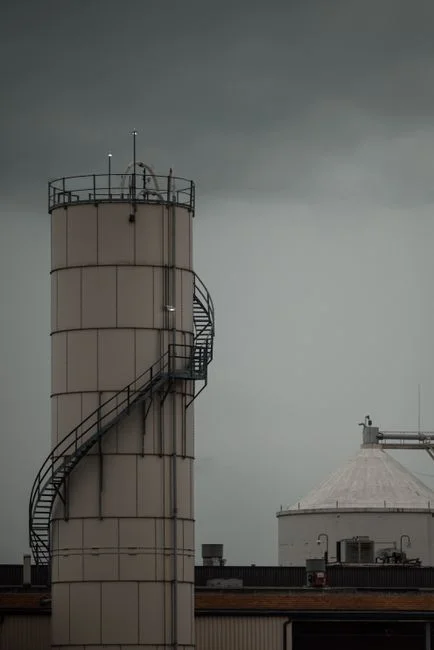
The highest-leverage decision in the primary-clarification slot is DAF versus lamella, and it should be driven by influent character rather than habit. DAF wins for organic-rich or surfactant-laden streams covered by 40 CFR Parts 414, 417, or 419, because the 95-99% TSS removal with chemical conditioning handles emulsified FOG with low operator attention; the trade-off is compressed-air OPEX and a saturator footprint. Lamella wins for high-density inorganic particulates and metals precipitation under 40 CFR Part 433: 80-95% removal, 20-40 m/h surface loading, up to 30% lower polymer use via sludge recirculation, no saturator; the trade-off is more sensitivity to FOG spikes. Plants with less than 8 hr of EQ should default to DAF because lamella needs stable influent to hit its polymer savings. For a 30,000 gpd batch specialty-chemical plant with mixed organics, a dissolved air flotation system followed by a high-efficiency lamella clarifier is a defensible belt-and-suspenders option when local TSS limits are tight.
| Decision axis | DAF | Lamella clarifier |
|---|---|---|
| Best influent character | Emulsified oil, FOG, surfactants, fine TSS (Parts 414, 417, 419) | High-density inorganics, metals precipitation (Part 433) |
| TSS removal | 95-99% with chemical conditioning | 80-95% with sludge recirculation |
| Surface loading / capacity | 4-300 m³/h | 20-40 m/h |
| Polymer use | Standard | Up to 30% lower via sludge recirculation |
| Footprint / auxiliaries | Larger; needs saturator, air system, skimmer | Compact; no pressurized saturator |
| OPEX drivers | Compressed air, polymer, skimmer maintenance | Lower air OPEX, modest polymer use |
| Selection tie-break (EQ HRT) | Default if EQ HRT < 8 hr | Preferred if EQ HRT 24+ hr and FOG low |
Worked Example: A 30,000 gpd Batch Plant Discharging to Deer Creek
A 30,000 gpd batch specialty-chemical plant routed to Deer Creek's 2.94 mgd average flow is a 1.02% hydraulic share. The 25,000 gpd flow trigger at 40 CFR 403.3(v) fires on its own, and the 5% organic test will trip at any multi-thousand-pound organic load, so SIU status is essentially automatic. The plant inherits the full SIU obligation stack: a Baseline Monitoring Report at startup, 90-day compliance reports on a defined schedule, periodic self-monitoring, routine POTW inspections with sampling, and a written slug control plan under 40 CFR 403.8(f).
Significant Noncompliance (SNC) is the operational risk to design against. SNC triggers on chronic violations in 66% or more of measurements over a six-month period, or TRC violations in 33% or more of measurements (TRC = 1.4 for BOD, TSS, FOG; TRC = 1.2 for all other pollutants), or failure to meet a 90-day compliance-schedule milestone. Any pass-through or interference event is SNC regardless of the chronic percentages, and once SNC fires, the 40 CFR 403.12(b)(7) public-notice and state-EPA reporting cascade trips regardless of whether a numeric categorical limit was technically exceeded.
The slug plan content is fixed by 40 CFR 403.8(f): discharge practices, chemical storage and secondary containment, immediate-notification procedures, and a written BMP program that documents routine sampling against the same numeric limits the EID inspector will use during inspection. Plants that pass a single pass-through event almost always skip BMP documentation first, which is why 40 CFR 403.8(f) ties the slug plan to the BMP program rather than to capital equipment. Map the slug plan onto existing operating procedures before design, not after permit issuance.
Frequently Asked Questions
At what flow does a chemical plant become an SIU when discharging to EID?
SIU status under 40 CFR 403.3(v) trips at 25,000 gpd of process wastewater (excluding sanitary, non-contact cooling, and boiler blowdown), at 5% of the receiving POTW's average dry-weather hydraulic or organic capacity, at any applicable categorical standard, or by Control Authority designation. Against EID's 2.94 mgd Deer Creek and 1.94 mgd El Dorado Hills average flows, the 5% hydraulic trigger fires at roughly 147,000 gpd and 97,000 gpd respectively, so the 25,000 gpd line is usually the binding one for chemical plants on this system.
Which categorical subparts apply to a typical chemical plant near El Dorado?
Most chemical plants hit one of 40 CFR Part 414 (organic chemicals, plastics, synthetic fibers), Part 415 (inorganic chemicals), Part 417 (soap and detergent), Part 419 (petroleum refining), or Part 433 (metal finishing). EID's 2003 EPA inspection specifically applied 40 CFR 414D to Rippey Corp for thermoplastic resins (EPA 2003, p.20), which is a useful precedent for resin and polymer operations. Always pull the active numeric limits from the current 40 CFR database and any Federal Register notice within the last 12 months, because EPA revises subparts on a multi-year cycle.
Why is MBR polishing a defensible choice for EID specifically?
Both EID plants routinely exceed the 10 mg/L nitrate standard: every El Dorado Hills sample and all but one Deer Creek sample in the 2003 inspection period, with averages of 17.1 mg/L (Deer Creek) and 24.2 mg/L (El Dorado Hills) and 99th-percentile peaks of 27.5 and 34.7 mg/L (EPA 2003, p.8). A submerged-membrane MBR at MLSS 8,000-12,000 mg/L and 6-12 hr HRT reduces nitrate-loading risk from the chemical plant side, which buys goodwill with EID's Control Authority and protects the receiving plant's already-tight nitrogen envelope. This is a different design driver than the standard CAS sizing for a 25,000-40,000 gpd batch plant; the EID envelope is what justifies the membrane capital.