Why Valparaiso Chemicals Plants Are Rethinking Their Primary Separator in 2026
Valparaiso's Elden Kuehl Pollution Control Facility is running at 92% of its 26 MGD hydraulic capacity, and that single number now drives every pretreatment decision in Porter County (per 2024 city council minutes, cited in the Valparaiso 2026 compliance and cost guide). Chemicals plants discharging into Elden Kuehl must hold TSS below 300 mg/L, FOG below 100 mg/L, and total chromium below 2.77 mg/L under Chapter 52. The local FOG cap is stricter than EPA's 150 mg/L general pretreatment standard in 40 CFR Part 403, and chromium aligns with 40 CFR 433 categorical limits for metal finishing — both leave little room for an underperforming primary separator.
In 2024 the city issued 12 industrial fines averaging $42,000 each, with chemicals and metal-finishing plants the most frequent violators. Add Chapter 52's volume-based surcharges — about $0.50/lb for TSS over the 300 mg/L ceiling and $1.20/lb for FOG over 100 mg/L — and an undersized or misapplied clarifier can pay for a properly sized DAF system inside 12–18 months once surcharges and downtime are included. The Porter County 2025 Water Quality Management Plan also targets a 20% reduction in industrial TSS and FOG loads against Indiana's impaired waters list, so enforcement pressure is not going to ease. For a procurement engineer building a 2026 capital case, the first-stage separator is now a financial risk decision before it is a process engineering choice.
How DAF and Lamella Clarifiers Actually Work in a Chemicals Stream
Understanding the mechanism is what lets a plant engineer defend the choice in front of operations and finance — both technologies look like "tanks" on a P&ID, but they move contaminants in opposite directions.
A dissolved air flotation (DAF) system saturates a pressurized recycle stream (typically 10–30% of the clarified effluent) with air at 4–6 bar, then releases that stream into the flotation tank at atmospheric pressure. The pressure drop generates 20–100 μm micro-bubbles that attach to flocculated particles and lift them to the surface, where a skimmer removes the float (HydropureWater engineering data, 2025). Surface loading rates of 5–15 m/h mean a DAF tank treats the same flow in 20–25% of the footprint a clarifier needs, which is decisive on tight Valparaiso industrial lots. Cationic or anionic polymer at 0.5–5 mg/L is essential to build the floc that bubbles can lift; pH control within 6.5–8.5 keeps polymer performance stable. Aeration draws 0.2–0.5 kWh/m³, and the float reaches 3–5% dry solids — the key reason DAF cuts hauled sludge volume 50–70% versus a gravity unit.
A lamella clarifier is a gravity sedimentation tank fitted with inclined plates spaced at 50–80 mm. Solids settle against the plates and slide to a hopper; clarified water rises through the plate pack. Surface loading runs 20–40 m/h on the plate area, but the equivalent basin loading is 2–4 m/h, which is why the unit still needs significant footprint (HydropureWater, 2025). Lamellas excel on heavy inorganic solids and metal-hydroxide floc with specific gravity well above 1.0, and they often run with less polymer than a DAF. The trade-off is a 1–2% underflow solids stream — roughly 2–3× the volume of DAF float at comparable loadings — so disposal OPEX on organic chemicals streams usually erases the clarifier's lower power cost.
DAF vs. Lamella Clarifier: Side-by-Side for Chemicals Wastewater
The table below is the head-to-head most procurement engineers will lift directly into a CAPEX review. Removal figures reflect typical operating envelopes for a flocculated chemicals feed, not lab-best results.
| Parameter | Dissolved Air Flotation (DAF) | Lamella Clarifier |
|---|---|---|
| Primary mechanism | Micro-bubble flotation of floc to surface | Gravity sedimentation along inclined plates |
| Best-fit contaminant | Emulsified oils, FOG, surfactants, light organic floc | Sand, grit, metal-hydroxide sludge, heavy inorganic TSS |
| TSS removal | 90–95% | 80–90% |
| FOG removal | 90–95% | 60–75% |
| Surface loading rate | 5–15 m/h | 2–4 m/h (basin equivalent) |
| Footprint vs. baseline | 0.20–0.25× | 1.0× (reference) |
| Sludge dry solids | 3–5% float | 1–2% underflow |
| Sludge volume index | Lower (50–70% less volume) | Higher |
| OPEX (per m³, Valparaiso 2025) | $0.50–$1.20 incl. polymer and disposal | $0.20–$0.40 plus higher disposal |
| Polymer demand | 0.5–5 mg/L (essential) | 0–2 mg/L (often optional) |
| Energy draw | 0.2–0.5 kWh/m³ | Minimal |
| pH operating window | 6.5–8.5 (polymer dependent) | 5.0–9.0 (broader) |
| Response to slug loads | Strong — adjustable recycle and pressure | Weak — hydraulic surges resuspend solids |
| Typical CapEx, 100 m³/day | $250K–$1.2M | $100K–$400K |
Sources: Ecologix 2026 selection guide; HydropureWater field data 2025; Valparaiso 2026 compliance and cost guide.
Which One Wins for Common Valparaiso Chemicals Sub-Streams
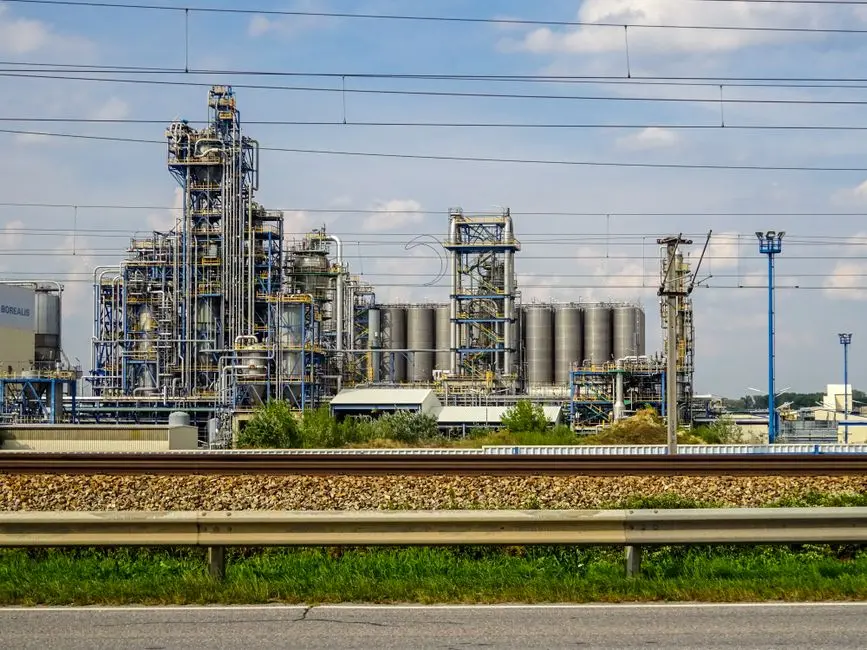
Generic comparisons fail because chemicals plants are not generic. The decision below maps the four sub-streams the Porter County industrial base actually runs, and pairs each with the technology — or train — that hits Chapter 52 on the first try.
Specialty chemicals and agrochemicals (high surfactants, solvents, batch cleaners): Emulsified organics defeat gravity settling because the dispersed phase has a specific gravity near 1.0. DAF is the default. With 90–95% FOG removal and 90–95% TSS removal, a properly sized DAF holds the plant well below the 100 mg/L Chapter 52 FOG cap that EPA's 40 CFR Part 403 would otherwise allow at 150 mg/L. Pair with a PLC-controlled chemical dosing system if the stream also carries trace metals.
Basic inorganic chemicals (acids, alkalis, metal salts, fertilizer by-products): After pH neutralization and chemical precipitation, the resulting metal-hydroxide floc is heavy, dense, and settles cleanly. A HydropureWater lamella clarifier is the more economical choice — about $100K–$400K CapEx for 100 m³/day versus $250K–$1.2M for DAF — and 80–90% TSS removal handles the 300 mg/L Chapter 52 ceiling on most inorganic feeds. Clarifier performance is more sensitive to hydraulic surge, so equalization upstream is mandatory for batch discharges.
Pharmaceuticals and fine chemicals (intermittent batches, BOD spikes, CIP releases): Production shift swings look like slug loads to a primary separator. DAF's adjustable recycle ratio and 4–6 bar aeration keep removal steady when influent concentration jumps 3–5×; clarifier performance drops measurably during the same surges (HydropureWater, 2025). For a Valparaiso API or intermediates plant above 50 m³/day, DAF is the lower-risk primary.
Petrochemical and resin manufacturing (oily emulsions plus heavy solids, >200 m³/day): Hybrid trains are now the norm at larger Valparaiso facilities — DAF first to strip oils and light floc, lamella clarifier polish to capture residual TSS, then a plate and frame filter press for sludge dewatering. If chromium is present, both technologies must be paired with PLC-controlled chemical precipitation and a downstream filter press to consistently hit <2.77 mg/L (Chapter 52 and 40 CFR 433). For DAF OPEX detail on this layout, see the DAF maintenance cost 2026 OPEX breakdown.
Valparaiso 2026 Cost Benchmark for a 100 m³/day Chemicals Plant
The worked numbers below are sized for a representative 100 m³/day (≈ 26,400 GPD) chemicals line — large enough that Chapter 52's 25,000 GPD composite-sampling threshold under 52.04 applies, small enough that a single DAF or clarifier train is the whole CAPEX conversation. The 13 standard DAF models cover 4–300 m³/h, so a 100 m³/day system is a standard build, not a special.
| Cost line | DAF (100 m³/day) | Lamella Clarifier (100 m³/day) |
|---|---|---|
| Mechanical CapEx | $250K–$1.2M (≈ $5K–$25K per m³/day) | $100K–$400K |
| Auxiliary CapEx (dosing, controls) | $80K–$150K | $50K–$120K |
| Total installed CapEx (typical) | ~$500K (mid-point for SS304 unit) | ~$220K (mid-point) |
| OPEX per m³ (2025) | $0.50–$1.20 | $0.20–$0.40 |
| Annual OPEX (100 m³/day, 330 days) | $16,500–$39,600 | $6,600–$13,200 |
| Sludge dry solids | 3–5% | 1–2% |
| Annual hauled sludge cost | ~$15K (≈ 50% less volume) | ~$45K |
| Annual disposal savings vs. clarifier | $30K–$50K | Reference baseline |
| Porter County 2025 Reuse Program (≤30% CapEx) | Up to $150K credit at <10 mg/L TSS | Generally not eligible |
| Typical ROI (high-FOG chemicals plant) | 1.5–3 years incl. fine avoidance | 2.5–4 years when sludge OPEX is included |
The headline CapEx gap is real, but it is also front-loaded: a properly sized DAF in a high-FOG chemicals plant typically returns the difference within 1.5–3 years once hauled-sludge savings, avoided $42K average fines, and avoided surcharges ($0.50/lb TSS, $1.20/lb FOG) are credited. The Porter County 2025 Industrial Water Reuse Program reimburses up to 30% of CapEx for systems that hit <10 mg/L TSS — the application deadline was June 30, 2025, and a similar 2026 cycle is the kind of line item a CFO will ask about. For a deeper CAPEX/OPEX walkthrough, see the Valparaiso 2026 compliance and cost guide and the companion chemical plant pretreatment compliance 2026 guide.
A 5-Step Selection Protocol for Valparaiso Chemicals Buyers
Running the same five-step process before issuing an RFQ keeps the conversation with vendors anchored to your influent, not their catalog. Each step produces a number that survives a CFO review.
- Audit the stream. Pull 24-hour composite samples across at least one full production week — Chapter 52.04 already requires composite sampling above 25,000 GPD, so the data doubles as compliance evidence. Benchmark against <300 mg/L TSS, <100 mg/L FOG, and <2.77 mg/L chromium.
- Set the target efficiency. Use (Influent − Limit) / Influent × 100. Example: 1,200 mg/L TSS vs. 300 mg/L limit = 75% required removal. Anything below 80% TSS removal rules out a clarifier on most organics feeds; anything above 90% FOG removal rules out a clarifier entirely.
- Match feed to technology. Route to DAF if FOG >200 mg/L or solids are light/emulsified. Route to lamella clarifier if TSS is mostly inorganic and FOG <100 mg/L. Route to a DAF/clarifier train above 200 m³/day or when both oil and grit show up in the audit.
- Build a 5-year OPEX view. Include sludge hauling, polymer, power, maintenance, and a 20% contingency for Chapter 52 fine risk — the 2024 average fine was $42K, and repeat-offender permit revocation under 52.12 is the tail risk that never makes the slide deck but always ends the project.
- Validate the vendor. Require pilot data on a comparable chemicals stream, SAT/loop testing on the skimmer mechanism and recycle pump, and a written performance guarantee tied to Chapter 52 limits, not generic lab claims. Equipment without chemicals-stream reference data is the most expensive equipment you can buy.
Frequently Asked Questions
Which is better for a Valparaiso chemicals plant with high FOG — DAF or clarifier?
DAF. With 90–95% FOG removal and surface loading of 5–15 m/h, a properly sized DAF holds the stream well below Chapter 52's 100 mg/L FOG cap, while a lamella clarifier typically only achieves 60–75% FOG removal on the same feed and is more likely to trigger the $1.20/lb FOG surcharge. For a 100 m³/day chemicals line, a DAF system is the standard recommendation.
What is the 2026 CAPEX range for a 100 m³/day DAF versus a lamella clarifier in Valparaiso?
DAF CapEx runs $250K–$1.2M installed, or roughly $5K–$25K per m³/day of capacity; a mid-point SS304 unit is about $500K including dosing and controls. A lamella clarifier of the same capacity is $100K–$400K installed. The DAF CapEx premium is typically recovered inside 1.5–3 years through lower sludge hauling and avoided Chapter 52 surcharges on high-FOG streams.
How does Chapter 52's FOG limit compare to EPA's general pretreatment standard?
Chapter 52 caps FOG at 100 mg/L, which is one-third stricter than EPA's 150 mg/L general pretreatment standard under 40 CFR Part 403. The TSS limit of 300 mg/L is slightly more lenient than Gary's 250 mg/L cap, but the FOG difference is the one that pushes Valparaiso chemicals plants toward DAF rather than gravity settling. Surcharges of about $1.20/lb over the FOG cap and $0.50/lb over the TSS cap apply on top of any formal fine.
Can a DAF system and a lamella clarifier be combined for a chemicals plant?
Yes. For Valparaiso petrochemical and resin manufacturers above 200 m³/day, a DAF-first train to strip oils, followed by a lamella clarifier polish to capture residual TSS, is now the norm — and a downstream plate and frame filter press dewatering stage is the standard finish. The hybrid handles both emulsified organics and heavy inorganic solids without forcing one unit to do the other's job.
What removal efficiency does chromium pretreatment require under Valparaiso Chapter 52?
Discharge must be below 2.77 mg/L total chromium, consistent with 40 CFR 433 categorical pretreatment standards. PLC-controlled chemical precipitation typically achieves 90–98% chromium removal, with the metal-hydroxide floc then sent to a clarifier or DAF and a filter press for dewatering. Neither DAF nor lamella clarifier alone can hit <2.77 mg/L without the precipitation stage in front of it.