Why Campus Wastewater Design Pushed Centrifuges to the Front
A university campus behaves like a small city that cycles through three populations a day: residential overnight, daytime academic, and weekend sporting events. That mixing produces a wastewater stream that is dilute, diurnally spiked, and loaded with lab organics, dining grease, and cooling-tower blowdown. Conventional dewatering equipment sized for a steady municipal plant is a poor fit. A horizontal decanter centrifuge that runs fully automatic, fits inside a retrofit mechanical room, and produces a 20–25% dry-solids cake is what is moving centrifuges to the front of capital requests for 2026 campus projects. The headline figure that closes the deal with a university capex committee is straightforward: dry cake from a decanter reduces sludge volume and disposal cost by up to 50% (Dolphin Centrifuge, reviewed 2026-05), which directly lowers the annual landfill or incinerator hauls that show up on the sustainability office's Scope 3 report.
Compared with belt and filter presses, decanters need no filter media to replace, run unattended under PLC control, and occupy a footprint that fits inside an existing campus basement. The Dolphin-supplied Alfa Laval NX-314 measures 3 ft × 8 ft × 4 ft and processes up to 40 GPM of wastewater at 5% sludge (Dolphin Centrifuge, 2026-05) — small enough to slide into a service building next to a dining hall. A real precedent exists on the West Coast: a California university combined a Sharples P-3000 decanter with an Alfa Laval WHPX-510 to manage high-solids leachate carrying residual organic oils, an operating point that a belt press could not have handled without frequent media changes (Dolphin Centrifuge case file, 2026-05).
How a Decanter Centrifuge Actually Separates Campus Sludge
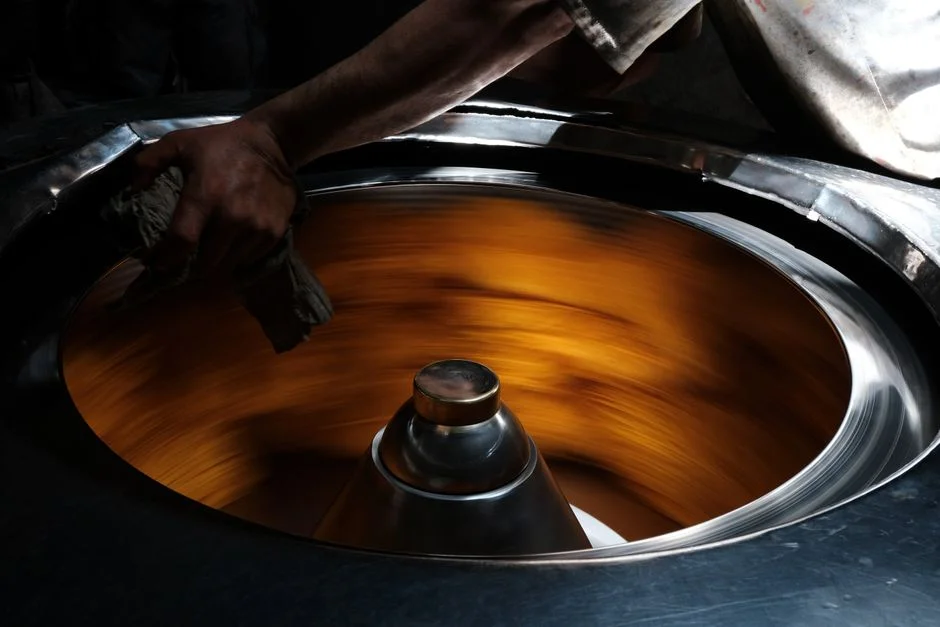
A horizontal decanter centrifuge is a solid-bowl machine with an internal screw conveyor — the scroll — that turns at a slightly higher rotational speed than the bowl itself. The differential speed (Δn) is what walks the dewatered solids up the conical beach and out the cake ports, while the clarified liquid, or centrate, leaves through ports at the opposite end of the bowl. Centrifugal force in the 3,100+ G class (Dolphin, 2026-05) is the working variable that drives separation, not filter area as in a press. Higher G means drier cake at the same residence time.
Two operating modes matter for a campus designer. In thickening mode, the goal is to raise feed solids (often 0.5–1%) to 5–7% so a downstream digester or holding tank has less water to heat. In dewatering mode, the goal is a stackable cake at 20–25% dry solids (DS) or higher that can go directly to landfill or incineration. Most campus plants run dewatering because they have no on-site digester and want to skip the intermediate storage step. The Sciencedirect energy model (Bevilacqua et al., 2024) shows that cake dryness falls as Δn or feed rate rises, so differential speed is a real control knob — turn it down to dry the cake, accept the higher motor load, and watch the specific-energy number move with it.
Sizing the Decanter for a 2026 Campus: A Step-by-Step Method
A defensible sizing starts with population, not flow, because campus flow data is unreliable at the conceptual stage. The method below is what an external consultant would put on a one-pager for the university's project committee.
- Establish the design population. Sum enrolled FTE, residential head-count, and a daytime non-student count (faculty, staff, hospital visitors). For a 20,000-FTE campus with 8,000 residents and 6,000 daily staff, the design population sits near 34,000 people during a fall semester.
- Pick a per-capita base flow. Campus sewage typically runs 150–250 L/person·day before any institutional allowance. Use the local sewer authority's published unit flow for the receiving municipality rather than a national average — campus water meters and the POTW's billing records are the real ground truth.
- Apply a peak factor. Dormitory morning and evening surges (showers plus laundry) drive a 2.5–3.5× peaking at the headworks. Worked one-liner: 20,000 FTE × 200 L/person·day × 2.5 peak ≈ 10,000 m³/day average, with a peak hour roughly 415 m³/h. The decanter does not see the full headworks peak — it sees the thickened sludge line off the biology stage — but the same peaking logic propagates to the solids load.
- Match flow to a decanter model. After thickening, the sludge flow to the decanter is on the order of 9–10 m³/h for a mid-size campus, which lines up with an Alfa Laval NX-314 (40 GPM water-sludge thickening capacity per Dolphin, 2026-05). A larger campus with a co-located hospital and dining services pushing 25 m³/h of thickened sludge moves to an NX-414, NX-416, or NX-418.
- Specify the feed-solids window and target cake. Post-primary sludge typically enters at 0.5–3% DS; post-thickener feed at 3–5% DS. Target cake ≥20% DS for direct landfill and ≥25% DS if the campus operates an incinerator (EPA 40 CFR Part 503 mass-based limits for surface disposal apply once a hauling contract is in place).
| Parameter | Value / Range | Source |
|---|---|---|
| Design population (FTE + residential + staff) | 5,000–40,000 | Project-specific |
| Per-capita base flow | 150–250 L/person·day | Local sewer authority |
| Dormitory peak factor (vs. daily average) | 2.5–3.5× | Engineering estimate |
| Thickened sludge flow to decanter | 9–25 m³/h | Dolphin, 2026-05 |
| Feed solids window | 0.5–3% (post-primary), 3–5% (post-thickener) | Typical engineering range |
| Target cake dryness | ≥20% DS (landfill), ≥25% DS (incineration) | 40 CFR Part 503 framework |
Decanter Specifications an Engineer Should Put on the Data Sheet
The procurement spec should list capacity in both GPM and m³/h, G-force class, wetted materials, auger protection, motor power, and standard instrumentation. The table below is built from the Alfa Laval NX-series build sheet published by Dolphin Centrifuge (2026-05) and is the minimum an engineer should hand to a vendor for budgetary pricing.
| Model | Capacity (water-sludge thickening) | G-force class | Bowl material | Auger protection | Footprint |
|---|---|---|---|---|---|
| Alfa Laval NX-314 | 40 GPM (~9 m³/h) | 3,100+ G | 316L SS | Tungsten carbide hard-faced | 3 ft × 8 ft × 4 ft |
| Alfa Laval NX-414 | Mid-range | 3,100+ G class | 316L SS | Tungsten carbide hard-faced | Larger than NX-314 |
| Alfa Laval NX-416 | 40 GPM (organic sludge example) | 3,100+ G class | 316L SS | Tungsten carbide hard-faced | Per Alfa Laval datasheet |
| Alfa Laval NX-418 | 110 GPM water-sludge thickening (~25 m³/h) | 3,100+ G class | 316L SS | Tungsten carbide hard-faced | Per Alfa Laval datasheet |
Standard instrumentation, sourced from the Dolphin standard build sheet (2026-05), should be specified as: VFD-driven main and back-drive, bearing temperature monitoring, automatic back-drive control, and a torque limiter. The control package is a fully automatic PLC with touchscreen, with remote telemetry so the campus utilities team does not need a 24/7 operator on the sludge line. The process flow inside the skid runs feed pump → grinder → decanter → polymer dosing → cake conveyor → centrate to downstream treatment.
Energy, OPEX, and Reuse Economics for a Campus Decanter
The 2024 Sciencedirect energy model (Bevilacqua et al., 2024) is the cleanest reference for specific energy and recovery on a modern VFD-driven decanter. At 15, 20, and 25 m³/h, the lowest specific-energy consumptions are 1.88, 1.76, and 1.57 kWh/m³ respectively. The same model reports back-drive energy recovery of 5.88, 0.31, and 12.10 kW at those three flow points. The non-intuitive result is that high recovery does not always mean high net saving — the validated model is the source of truth, not the headline recovery number.
To convert kWh/m³ into $/m³ for a CFO conversation, layer the campus electricity tariff onto the specific-energy number, add polymer dose (typical 5–15 kg active polymer per metric ton of dry solids, depending on the sludge), and compare on a per-metric-ton-of-DS basis rather than per cubic metre of feed. Sludge dry tonnage, not flow, is what drives hauling contracts. The reuse upside is what flips the OPEX story for a sustainability office: polishing centrate through an MBR centrate-polishing train with downstream UV lets a campus reclaim water for cooling-tower make-up or landscape irrigation, reducing potable demand on the campus utility. Polymer and coagulant injection is handled by an automatic polymer and coagulant dosing skid tied into the same PLC.
Decanter vs. Screw Press vs. Belt Press for a Campus
Three dewatering technologies compete for a campus solids-handling slot. The table below uses only what the source pages actually support: a centrifuge delivers a dry cake, has a small footprint, runs automatic, and consumes no filter media.
| Criterion | Decanter centrifuge | Screw press | Belt press |
|---|---|---|---|
| Cake dryness | 20–25% DS typical, up to 30% | 18–22% DS | 18–22% DS |
| Footprint | Small (NX-314 = 3 ft × 8 ft × 4 ft) | Moderate | Large |
| Operator labor | Unattended, PLC | Periodic attention | Day-shift operator typical |
| Filter media | None | None (screen wear) | Belt cloth replaced regularly |
| Best-fit campus size | Mid-to-large (peak flow >10 m³/h) | Small (<2,000 residents) | Legacy plants only |
Belt and filter presses need filter media and steady day-shift attention, which is a poor match for a campus utilities team that often runs with one or two operators across a 200-building footprint. A screw press is a defensible lower-CAPEX alternative for very small campuses (under 2,000 residents) where peak flow never approaches 10 m³/h, but the centrifuge scales better and recovers more energy through VFD back-drive at higher throughput. Decision rule: pick a decanter centrifuge when campus peak thickened-sludge flow exceeds ~10 m³/h or the available footprint is constrained to a basement mechanical room.
Integrating the Decanter Into a Campus Treatment Train
The decanter sits between upstream biology and downstream reuse or discharge, and the centrate stream is the highest-strength recycle on campus. A working train for a 2026 campus plant: rotary bar screen at the campus headworks → grit removal → biological stage (MBR or SBR; see the SBR process flow diagram for campus biology for sequencing detail) → lamella clarifier ahead of the decanter for sludge thickening → decanter → centrate polishing on an MBR → UV or chlorine dioxide → discharge to sewer or reuse loop for cooling-tower make-up.
Two integration points deserve attention in design review. First, the polymer dosing skid must be on the feed line to the decanter, with PLC-coordinated dose tied to the feed-flow signal; manual dose adjustment is a common root cause of wet cake. Second, the centrate stream must be returned to the head of the biological stage, not blended forward — it carries the same BOD load as the raw influent and will overload any downstream polishing step if shunted past the biology. For an existing inclined-plate settling stage, see the inclined-plate settler troubleshooting guide; for centrate-quality verification, install suspended-solids online monitoring on the centrate line so a centrate breakthrough is caught in minutes, not at the next day's composite sample.
Frequently Asked Questions
What flow rate can a single decanter centrifuge handle on a campus?
A remanufactured Alfa Laval NX-314 handles up to 40 GPM (~9 m³/h) of water-sludge thickening, and the larger NX-418 reaches 110 GPM (~25 m³/h) on the same duty (Dolphin Centrifuge, 2026-05). For most mid-size campuses in the 20,000-FTE range, one NX-314 sized to the thickened-sludge line is sufficient, with an NX-414 or NX-416 specified for larger flows.
How much energy does a decanter centrifuge use per cubic metre of feed?
The Sciencedirect energy model (Bevilacqua et al., 2024) gives 1.88 kWh/m³ at 15 m³/h, 1.76 kWh/m³ at 20 m³/h, and 1.57 kWh/m³ at 25 m³/h, with VFD back-drive energy recovery of 5.88, 0.31, and 12.10 kW respectively.
How much sludge volume can a decanter centrifuge reduce?
Dewatering to 20–25% dry solids cuts sludge volume and disposal cost by up to 50% compared with thickened or liquid sludge hauling (Dolphin Centrifuge, 2026-05). The exact reduction depends on feed solids — a 1% feed going to 22% cake is a roughly 22× volume reduction before any downstream blend.
What discharge limits apply to a campus decanter centrate stream?
Centrate routed back to the head of the biological stage is regulated as part of the internal recycle; centrate discharged to a sanitary sewer falls under the local POTW's pretreatment limits (US: EPA 40 CFR Part 403 framework, with specific pollutant limits set by the receiving authority). For surface or reuse discharge, EPA 40 CFR Part 503 and any tighter state-level reuse rules apply. Confirm the actual numerical limits with the local sewer authority before sizing downstream polishing equipment.