Why Coal Chemical Wastewater Pushes Plants Toward MVR
High-salt coal chemical wastewater carries 10,000–30,000 mg/L of total dissolved solids, with freshwater makeup streams alone contributing roughly 50% of the total salt load in a typical gasification or coking plant (WTEYA, 2024). The feed is a mix of Na⁺, K⁺, Ca²⁺, Mg²⁺, Cl⁻, SO₄²⁻, and NO₃⁻, layered with residual cyanides, phenols, and aromatic hydrocarbons stripped from gas-wash and desalter streams. Once TDS climbs past 10,000 mg/L, biological treatment collapses: microbial cells undergo plasmolysis, COD removal efficiency drops below 40–50%, and the conventional activated-sludge train becomes a liability rather than a barrier (WTEYA, 2024).
What remains is a brine the plant cannot discharge under tightening China and EU zero-liquid-discharge rules, and cannot economically truck off-site at 30,000 mg/L — a 20-ton/h stream produces roughly 170 m³/day of liquid concentrate that no hauler wants at $20–40/m³. Thermal concentration becomes the only path to ZLD, and among thermal options, mechanical vapor recompression is the configuration that pairs the lowest recurring energy cost with the smallest steam-header footprint. For engineers sizing equipment under these constraints, this aligns with the broader compliance planning described in chemical plant pretreatment compliance 2026 and the ZLD train design 2026 framework for adjacent process industries.
How an MVR Evaporator Works on Coal Chemical Brine
An MVR evaporator concentrates feed by boiling it under vacuum, then compressing the resulting vapor with a mechanical compressor so the same vapor becomes the heater-side heating medium. Thermodynamically it is single-effect, but economically it competes with multi-effect systems because the compressor — not fresh steam — supplies the latent-heat ΔT across the heater. The only utility the plant buys is electricity to drive the compressor and the recirculation pumps.
The process sequence is fixed: feed is preheated to 88–100 °C to strip non-condensable gases (O₂, CO₂) and limit carbonate scaling, then boiled under vacuum at roughly 90 °C. The vapor leaves the separator, enters a centrifugal or positive-displacement compressor, and is discharged 8–15 °C hotter and at higher pressure. That superheated vapor condenses inside the heater, giving up its latent heat to the recirculating brine, and the condensate leaves as distilled water ready for polishing (Condorchem, 2024; WTEYA, 2024). Boiling-point rise (BPR) — the elevation of boiling temperature above pure-water boiling at the same pressure — shifts as TDS climbs; at 25–30 wt% TDS in a coal chemical brine, BPR can reach 6–10 °C, which the engineer must add to the compressor ΔT when sizing heater area and vacuum-pump capacity.
Three commercial configurations dominate. Falling-film (FF) MVR suits low-viscosity feeds with moderate scaling tendency and runs at 35–60 kWh/m³ of distillate. Forced-circulation (FC) MVR handles higher solids and viscous brines at the same 35–60 kWh/m³ band but at 90–94 °C. FC paired with a crystallizer pushes the concentrate past saturation into controlled salt precipitation and draws 64 kWh/m³ — the premium buys the ZLD endpoint (Condorchem, 2024). For coal chemical brine, the FC or FC+crystallizer line is the typical selection because suspended and dissolved solids loadings are too high for a clean falling-film surface.
| Parameter | MVR Falling Film (FF) | MVR Forced Circulation (FC) | MVR FC + Crystallizer |
|---|---|---|---|
| Specific electricity | 35–60 kWh/m³ distillate | 35 kWh/m³ distillate | 64 kWh/m³ distillate |
| Evaporation temperature | ≈ 90 °C | 90–94 °C | ≈ 90 °C |
| Configuration | Single-effect with vapor recompression | Single-effect, external recirculation | FC evaporator + flash crystallizer |
| Best-fit coal chemical stream | Low-solids overhead condensate | Gas-wash brine, desalter blowdown | ZLD polishing, saturated brine |
| Steam equivalent (ref. only) | ~0.13–0.22 kg/kWh boiler basis | ~0.13 kg/kWh | ~0.23 kg/kWh |
Antiscalant chemistry is part of the operating envelope, not an afterthought — PLC-controlled antiscalant dosing ahead of the heater is standard practice for keeping calcium carbonate and silica fouling within a clean-in-place cycle the operations team can actually schedule.
MVR Operating Envelope and Design Parameters for Coal Chemical Streams
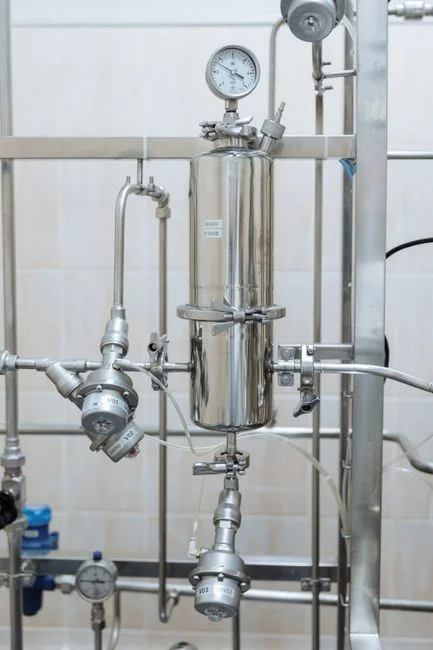
The numbers below are the screen the engineer runs before issuing an MVR inquiry. They are drawn from manufacturer curves and practitioner ranges for chloride-rich, high-TDS coal chemical feeds; the engineer should validate against the specific feed assay.
| Design parameter | Typical range / value | Engineering note |
|---|---|---|
| Feed TDS | 10,000–30,000 mg/L raw; 5,000–8,000 mg/L after RO trim | RO trim before MVR is the 2024 optimized configuration for coal-fired brine (Membranes, 2024-03) |
| Evaporation temperature | ≈ 90 °C (FC 90–94 °C) | Sets vacuum at roughly 0.3 bar abs |
| Compressor ΔT (vapor) | 8–15 °C | Drives heater ΔT and overall energy use |
| Heater ΔT (log mean) | 5–10 °C | Lower ΔT = larger heater area, higher CAPEX |
| Boiling-point rise at 25–30 wt% TDS | 6–10 °C | Add to compressor ΔT to set vacuum target |
| Residence time in separator | 30–90 s | Longer for FC + crystallizer to grow seed crystals |
| Recirculation ratio (FC) | 10:1 to 25:1 | Higher for viscous or scaling brines |
| Specific electricity | 35–60 kWh/m³ (FF/FC); 64 kWh/m³ (FC + crystallizer) | Condorchem, 2024 |
| Steam-equivalent reference | ~0.13–0.23 kg steam/kWh at 90% boiler efficiency | Use only for fair comparison with MEE/TVR |
| Heater tube material | Titanium Gr.2 or duplex 2205 for Cl⁻ > 5,000 mg/L at > 80 °C | Avoid 316L under those conditions |
Upstream pre-treatment sets the floor on MVR fouling rate. A dissolved-air flotation or lamella clarifier knocks out oil and suspended solids, a weak-acid cation softener drops hardness to < 20 mg/L as CaCO₃, and a two-pass RO system ahead of the MVR brings the MVR feed into the 5,000–8,000 mg/L TDS band where BPR and scaling stay manageable (Membranes, 2024-03). A multi-media filter downstream of the softener and ahead of the RO protects the RO membranes from precipitated hardness carryover, and a high-efficiency sedimentation tank upstream of the DAF handles the bulk TSS load on retrofits where the equalization basin is undersized. Threshold antiscalants for CaCO₃ and CaSO₄, a silica dispersant, and pH control with sulfuric acid in the crystallizer loop are the standard chemistry program. Where the coal chemical stream carries ammonia or HCN, expect a vapor scrubber on the MVR overhead to protect the compressor from non-condensable carryover and corrosion-grade (titanium or duplex) heater tubes as a baseline material of construction, not an upgrade.
Integrating MVR into a Coal Chemical ZLD Train
The MVR does not stand alone — it is the middle of a brine train that begins with equalization and ends with a dry salt stack or landfill cell. The full coal chemical ZLD train runs: equalization → DAF or lamella clarifier → biological (only for the low-salt, biodegradable split) → weak-acid cation softener → two-pass RO → MVR evaporator → MVR FC crystallizer → centrifuge or filter press → dry salt or landfill (WTEYA, 2024). Each step exists to protect the next: the DAF protects the softener, the softener protects the RO, the RO protects the MVR, and the MVR protects the crystallizer from operating past its fouling window.
The 2024 RO-MVR joint optimization study for coal-fired power plant wastewater — a chemically adjacent feed — set the optimized water-production cost at 3.16 CNY/m³ with daily operating cost reduced 22% versus the unoptimized baseline (Membranes, 2024-03). For a coal chemical plant running a similar train at 20 ton/h of brine, that figure is the right order-of-magnitude reference for the 2026 budget envelope, not a guarantee. Water-recovery economics are favorable: MVR distillate is typically returned to the plant as boiler feedwater after polishing, recovering 90–95% of the water in the brine stream. The fouling bottleneck of the train sits at the MVR heater, not the RO — so the RO recovery rate is intentionally capped (typically 65–75%) to keep the MVR feed within BPR and scaling limits. Solids leaving the crystallizer report to a centrifuge or filter press for crystal separation, with filtrate returned to the MVR feed tank. A dissolved-air flotation unit at the head of the train handles the oil and grease that periodically breaks through from gas-wash condensates.
Field-Proven Performance and Common Failure Modes
The cleanest field anchor for MVR performance comes from Gotsu Mill in Japan, where Nippon Paper replaced a multi-effect vacuum evaporator with an MVR unit in 2019. The documented results: 13% energy-cost reduction versus the multi-effect baseline, and pulp output increased to 111% of the prior baseline once the evaporator was no longer the production bottleneck (Japan Tappi Journal, 2024). Gotsu also documented the two failure modes that show up in every MVR audit: heater fouling from scale, and compressor vibration from salt carryover into the vapor stream. Heater fouling was mitigated by strengthening vapor-drain cleaning cycles, and compressor vibration by periodic open-tank cleaning of the impeller (Japan Tappi Journal, 2024).
Translated to coal chemical plants, the Gotsu lessons mean budgeting quarterly vapor-drain CIP cycles and a 6–12 month open cleaning for the compressor into the operating cost model — do not assume the steady-state 35–60 kWh/m³ holds year-round. When the feed carries ammonia, HCN, or chloride above 5,000 mg/L at > 80 °C, expect titanium or duplex heater tubes and a vapor scrubber on the MVR overhead to protect the compressor from non-condensable carryover. These mitigations are not optional for chloride-rich coal chemical brine — they are the difference between a plant that runs and a plant that spends its first year in commissioning. Reference design criteria for the RO side of the train are documented separately in RO design criteria 2026 and water reclaim benchmarks in ESG reports.
MVR vs MEE vs TVR: Choosing the Right Evaporator for Coal Chemical Brine
The three thermal evaporation options for high-salt brine are MVR, multi-effect evaporator (MEE), and thermal vapor recompression (TVR). They compete on energy source, CAPEX, turndown, and scaling tolerance — and the right answer depends on the plant's existing utilities more than on the evaporator technology itself.
| Criterion | MVR | MEE | TVR |
|---|---|---|---|
| Energy source | Electricity (35–60 kWh/m³) | Steam (0.25–0.45 kg/m³ per effect) | Live steam motive fluid |
| CAPEX class | High (compressor, motors) | Medium (multiple vessels) | Lower (no compressor) |
| OPEX driver | Electricity price | Steam price and boiler efficiency | Steam header pressure |
| Turndown ratio | Limited (compressor surge) | Good (drop effects) | Limited (motive steam range) |
| Scaling tolerance | Good (FC, large heater area) | Good (long residence time) | Moderate |
| Best-fit brine flow | ≤ 20 ton/h | > 20 ton/h | Where steam header exists |
| Field anchor | Gotsu Mill 13% energy-cost reduction vs MEE (Japan Tappi, 2024) | Mature baseline | Mature baseline |
Decision rule: choose MVR for ≤ 20 ton/h brine flow, ≥ 3,000 mg/L TDS, and sites with low-cost electricity or captive waste-heat power; choose MEE for higher flows where cheap steam is available; choose TVR only when a steam header already exists at the plant and the capital cost of a compressor cannot be justified. The Gotsu 13% energy-cost figure (Japan Tappi Journal, 2024) is the cleanest 2026 reference for MVR-over-MEE economics, but it is a single-site measurement against a multi-effect vacuum evaporator — not a guarantee for any specific coal chemical feed.
Frequently Asked Questions
What TDS range makes MVR cost-effective for coal chemical wastewater?
MVR becomes the default selection once feed TDS climbs into the 10,000–30,000 mg/L band typical of coal gasification washing, desalter blowdown, and boiler drain streams. Below 3,000 mg/L, RO alone is usually cheaper; above 30,000 mg/L, the MVR heater area and BPR penalties push engineers toward an RO-MVR joint configuration where RO trims the brine to 5,000–8,000 mg/L before MVR (WTEYA, 2024; Membranes, 2024-03).
How much electricity does an MVR use per cubic meter of distillate?
Forced-circulation and falling-film MVR units draw 35–60 kWh/m³ of distillate at roughly 90 °C evaporation temperature. An FC MVR paired with a crystallizer draws about 64 kWh/m³ because the crystallizer loop adds recirculation and flash-evaporation load (Condorchem, 2024).
What causes MVR heater scaling on coal chemical brine and how is it controlled?
The three dominant scalants are calcium carbonate, calcium sulfate, and silica, with ammonium salts contributing to fouling when the feed carries ammonia from gas-wash streams. Control rests on three layers: upstream weak-acid cation softening to drop hardness below 20 mg/L as CaCO₃, threshold antiscalant and silica-dispersant dosing, and a vapor-drain CIP cycle on the heater. The Gotsu Mill audit confirmed that strengthening the vapor-drain cleaning was the decisive intervention to keep heater performance stable (Japan Tappi Journal, 2024).
Can MVR replace a multi-effect evaporator?
Yes, and the Gotsu Mill retrofit is the documented field anchor: replacing a multi-effect vacuum evaporator with MVR delivered a 13% energy-cost reduction and raised throughput to 111% of the prior baseline once the evaporator was no longer the production bottleneck (Japan Tappi Journal, 2024). The trade is higher CAPEX for the compressor against lower recurring steam cost.
How does an MVR + crystallizer fit into a zero-liquid-discharge train?
The MVR + crystallizer is the final concentration step before solids separation. The four-step pattern is preheat (88–100 °C to strip non-condensables), MVR evaporation, crystallization by flash evaporation in the FC crystallizer, and solid-liquid separation by centrifuge or filter press (WTEYA, 2024). Recovered water returns to the plant as boiler feedwater after polishing, and the solids report to dry salt handling or landfill.