
Ethanol Wastewater Characteristics That Dictate SBR Design
Cellulosic ethanol wastewater typically presents a chemical oxygen demand (COD) range of 20,000–50,000 mg/L and sulfate levels between 2,000–5,000 mg/L, with a COD/sulfate ratio of 8–15:1, closely matching conditions used in recent pilot studies (Shan et al., 2026, S3). In contrast, corn ethanol stillage is generally characterized by higher COD concentrations, often between 80,000–120,000 mg/L, and sulfate levels from 1,500–3,000 mg/L, resulting in a COD/sulfate ratio of 30–60:1. This higher ratio for corn ethanol stillage often necessitates significant dilution or dedicated sulfate reduction pretreatment to optimize anaerobic treatment efficiency and prevent sulfide toxicity.
Key inhibitory factors in raw ethanol stillage include low pH, typically ranging from 3.5–5.0, and elevated temperatures, often between 35–55°C. sulfide concentrations exceeding 200 mg/L can be toxic to methanogenic and even some aerobic biomass. The inherent batch nature of an SBR system is advantageous here, allowing for effective pH and temperature equalization during the fill phase, mitigating shock loads that continuous systems might struggle with. This batch operation also inherently handles variable flow rates, a common characteristic of ethanol plants due to batch distillation processes, accommodating 2–4x flow swings without requiring large upstream equalization tanks that would be necessary for continuous flow systems.
Two-Stage Anaerobic-Aerobic SBR Process Flow
A two-stage anaerobic-aerobic SBR system, as demonstrated by Shan et al. (2026, S3), achieves a total COD removal efficiency of 94.5% and 89.3% sulfate reduction for sulfate-rich cellulosic ethanol wastewater. The initial stage typically employs an anaerobic EGSB (Expanded Granular Sludge Bed) or CSTR (Continuously Stirred Tank Reactor) operating with a hydraulic retention time (HRT) of 12–24 hours and an organic loading rate (OLR) of 15–35 kg COD/(m³·day). This stage maintains a mesophilic temperature of 35°C and a pH range of 6.8–7.2, often requiring alkalinity dosing. A recycle ratio of 3:1 is common to ensure proper granule retention and mixing. This anaerobic pretreatment typically achieves 60–70% COD removal and contributes significantly to sulfate reduction, reaching 60.9% in pilot studies (Shan et al., 2026, S3).
Following anaerobic treatment, the effluent proceeds to the aerobic SBR stage for polishing. This stage typically operates with 4–6 cycles per day, with each cycle comprising distinct phases: a 1.5-hour fill, a 3-hour react phase, a 1-hour settle phase, a 0.5-hour decant phase, and a 0.5-hour idle phase. The aerobic SBR maintains an HRT of 12–24 hours, a mixed liquor suspended solids (MLSS) concentration of 3,000–5,000 mg/L, and a dissolved oxygen (DO) level of 2–3 mg/L. While inter-stage sulfide stripping (e.g., pH 5.5 air stripping) or chemical precipitation (e.g., FeCl₃) can be employed to protect aerobic biomass from sulfide toxicity, certain dominant aerobic bacteria, such as Truepera, have shown tolerance to direct feed from anaerobic effluent (Shan et al., 2026, S3).
Sludge handling involves wasting anaerobic granules (0.5–1.5 mm diameter) at a rate of 0.5–1% VSS/day to maintain optimal biomass concentration. The aerobic waste activated sludge (WAS) is typically thickened to 3–4% solids before further dewatering using equipment such as a plate and frame filter press for sludge dewatering.
| Process Stage | Parameter | Typical Range | Notes |
|---|---|---|---|
| Anaerobic EGSB/CSTR | HRT | 12–24 hr | |
| OLR | 15–35 kg COD/(m³·day) | ||
| pH | 6.8–7.2 | Alkalinity dosing often required | |
| Temperature | 35°C (mesophilic) | ||
| Recycle Ratio | 3:1 | For granule retention | |
| COD Removal | 60–70% | 60.9% sulfate removal (Shan et al., 2026, S3) | |
| Aerobic SBR | Cycles/Day | 4–6 | |
| Cycle Time | 4–6 hr | Fill: 1.5 hr, React: 3 hr, Settle: 1 hr, Decant: 0.5 hr, Idle: 0.5 hr | |
| HRT | 12–24 hr | ||
| MLSS | 3,000–5,000 mg/L | ||
| DO | 2–3 mg/L | ||
| COD Removal | 83.2% of remaining COD | (Shan et al., 2026, S3) | |
| Dominant Bacteria | Truepera | (Shan et al., 2026, S3) |
SBR Design Parameter Table for Ethanol Wastewater
A two-phase anaerobic-aerobic system treating sulfate-rich cellulosic ethanol wastewater achieved a stable total COD removal efficiency of 94.5% at an organic loading rate of 32.4 kg COD/(m³·day) (Shan et al., 2026, S3). The following table provides key design parameters for specifying SBR systems in ethanol plant wastewater treatment, integrating recent pilot-scale performance data and established engineering practices.
| Parameter | Anaerobic EGSB | Aerobic SBR | Source / Notes |
|---|---|---|---|
| OLR (kg COD/m³·day) | 15–35 | 0.5–1.2 (aerobic stage) | Shan et al., 2026 (S3) |
| HRT (hr) | 12–24 | 12–24 | Pilot data (Shan et al., 2026, S3) |
| Influent COD/sulfate ratio | 8:1–15:1 | N/A | Yao et al., 2026 (S2) |
| Target COD removal | 60–70% | 83.2% of remaining COD | Shan et al., 2026 (S3) |
| Target sulfate removal | 60.9% | Minimal | Shan et al., 2026 (S3) |
| Dominant Biomass | Granular (Desulfobulbus) | Flocculent (Truepera) | Yao et al., 2026 (S2), Shan et al., 2026 (S3) |
| Operating Temperature | 35°C (mesophilic) | 20–30°C (ambient) | Standard engineering practice |
| pH Control Range | 6.8–7.2 (alkalinity dosing) | 7.0–7.5 (auto-controlled) | Standard engineering practice |
SBR vs MBR vs UASB: Technology Comparison for Ethanol Stillage
A hybrid anaerobic EGSB/UASB followed by an aerobic SBR system provides a balanced approach, achieving 94.5% total COD removal (Shan et al., 2026, S3) without the high capital expenditure and operational challenges associated with membranes. SBR systems offer several advantages for ethanol plant wastewater, including inherent equalization capabilities that effectively handle the variable flow rates typical of batch distillation processes. Unlike membrane bioreactors (MBRs), SBRs eliminate the risk of membrane fouling, a significant concern with lipid and protein-rich stillage, and require lower energy input due to the absence of cross-flow filtration. The flexible cycle timing of SBRs also allows for optimal adaptation to variable organic loads.
MBR systems, while offering a smaller footprint (up to 60% less than conventional activated sludge) and producing high-quality effluent with less than 5 mg/L COD suitable for reuse, come with substantial operational costs. Membrane replacement costs can range from $15–25/m³/yr, alongside energy demands for permeate pumping and membrane scouring. Upflow Anaerobic Sludge Blanket (UASB) reactors are proven at full-scale for distillery wastewater, demonstrating high organic loading rates of 20–40 kg COD/m³·day. However, UASB systems do not provide aerobic polishing, carry a risk of sulfide toxicity if not properly managed, and offer poor nutrient removal. The optimal solution often involves a hybrid approach, where an anaerobic EGSB or UASB reactor handles the bulk of the organic load and sulfate reduction, followed by an aerobic SBR for final COD polishing and nutrient removal. Tertiary treatment, such as reverse osmosis, is added only if stringent water reuse standards are required, as explored in ZLD case studies with anaerobic-aerobic-MBRO integration.
| Feature | SBR (Aerobic Stage) | MBR | UASB (Anaerobic Stage) |
|---|---|---|---|
| Equalization Capability | Excellent (inherent batch operation) | Requires upstream equalization | Requires upstream equalization |
| Fouling Risk | None (no membranes) | High (lipids/proteins in stillage) | None |
| Footprint | Moderate | Small (up to 60% less than CAS) | Moderate |
| Effluent Quality (COD) | Typically <50 mg/L | Typically <5 mg/L (high for reuse) | Typically 200–500 mg/L (requires polishing) |
| Energy Consumption | Moderate (aeration) | High (aeration + membrane filtration) | Low (no aeration) |
| O&M Complexity | Moderate | High (membrane cleaning/replacement) | Moderate (granule management) |
| Sulfide Toxicity | Low (post-anaerobic treatment) | Low | High (if COD/sulfate ratio is low) |
| Nutrient Removal | Good (Nitrification/Denitrification) | Excellent (Nitrification/Denitrification) | Poor |
| Typical OLR | 0.5–1.2 kg COD/m³·day | 1.0–2.0 kg COD/m³·day | 20–40 kg COD/m³·day |
| Key Advantage for Ethanol | Handles variable flow, no membrane issues, effective polishing | High effluent quality for direct reuse | High OLR, biogas production |
Equipment Specifications: Aeration, Decanters, Controls
Fine-bubble disc diffusers typically achieve a standard oxygen transfer efficiency (SOTE) of 25–30% at 5 meters submergence, consuming 1.2–1.5 kW per 1000 m³ of tank volume. These diffusers should feature ethylene propylene diene monomer (EPDM) membranes for chemical resistance and offer a service life of 5–7 years. For SBR decanters, a floating arm or fixed weir design with variable speed control (0.5–2 m/min) is recommended, capable of decanting 5–15% of the tank volume per cycle. Construction material should be SS316 stainless steel for corrosion resistance.
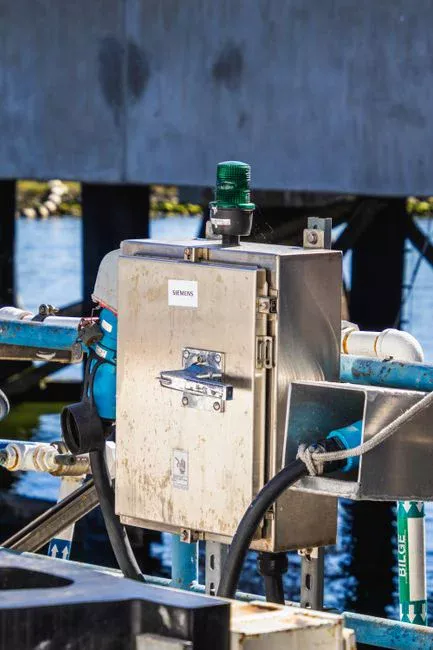
The SBR control system should be built around a Programmable Logic Controller (PLC), managing cycle timers, dissolved oxygen (DO) cascade control via variable frequency drives (VFDs) for blowers, and level probes for precise fill and decant operations. An ultrasonic sludge blanket sensor is critical for optimizing decant timing and preventing solids washout. Remote SCADA (Supervisory Control and Data Acquisition) integration allows for centralized monitoring and control, potentially enhanced by AI control for SBR cycle optimization. Blowers, either rotary lobe or turbo types, should be sized to deliver 1.5–2.5 bar pressure, meeting a peak oxygen uptake rate (OUR) of 80–120 mg O₂/L·hr during the react phase.
For the anaerobic stage, an EGSB reactor requires a robust three-phase separator for efficient gas, liquid, and solid separation, an influent distribution header to ensure even flow, and a granular sludge recycle pump operating at 0.5–1% of the influent flow (Q) to maintain biomass concentration. An automatic chemical dosing system is essential for pH adjustment and nutrient supplementation in both stages.
Regulatory Compliance Checklist: China GB, EPA, EU IED
China's GB 14554-93 standard for the ethanol industry sets specific discharge limits, including COD ≤400 mg/L, BOD₅ ≤100 mg/L, NH₃-N ≤25 mg/L, SS ≤150 mg/L, and sulfide ≤1 mg/L. To meet the ammonia nitrogen limit, the aerobic SBR stage must be designed for effective nitrification. For facilities in the United States, EPA 40 CFR 412 regulations for corn wet milling specify discharge limits of BOD₅ ≤100 mg/L, TSS ≤150 mg/L, and a pH range of 6–9. An aerobic SBR operating with a 12-hour or greater HRT can typically achieve these parameters.
In the European Union, the Industrial Emissions Directive (IED) 2010/75/EU Best Available Techniques (BAT) Associated Emission Levels (AEL) for the food and drink sector are more stringent, requiring COD ≤150 mg/L, total nitrogen (TN) ≤20 mg/L, and total phosphorus (TP) ≤2 mg/L. Meeting these limits often necessitates tertiary treatment for nitrogen and phosphorus removal post-SBR. A critical parameter across jurisdictions is sulfide, with China's limit at 1 mg/L and EPA's at 2 mg/L. This dictates that the anaerobic pretreatment stage must effectively reduce sulfate concentrations to below 500 mg/L before the effluent enters the aerobic SBR, preventing both toxicity to aerobic biomass and exceedance of discharge limits.
CapEx/OpEx Drivers and ROI Benchmarks
Capital expenditure (CapEx) for a two-stage anaerobic-aerobic SBR system for ethanol wastewater typically ranges from $120–180/m³ of reactor volume for the anaerobic EGSB stage and $80–120/m³ for the aerobic SBR tank. Control systems and instrumentation usually account for an additional 15–20% of the core equipment cost. For integrated wastewater treatment plant manufacturer specs, costs, and ROI, these benchmarks are critical.
Operational expenditure (OpEx) is primarily driven by aeration, which constitutes 60–70% of the total OpEx, with energy consumption typically between 0.8–1.2 kWh per kilogram of COD removed. Sludge disposal costs range from $50–80 per ton of dewatered sludge, while chemical dosing for alkalinity and nutrient supplementation accounts for 10–15% of OpEx. A significant offset to OpEx is energy recovery from biogas. Anaerobic digestion can yield 0.35–0.45 Nm³ of biogas per kilogram of COD removed, with methane content typically around 60%. At an OLR of 32.4 kg COD/(m³·day), as seen in pilot studies (Shan et al., 2026, S3), this translates to a methane production rate of 11.5 L/day (pilot scale), which can be scaled up to generate 2.5–3.5 kWh per cubic meter of feed. Compared to aerobic-only systems that lack biogas recovery, a two-stage anaerobic-aerobic SBR system typically offers a payback period of 3–5 years, assuming an electricity cost of $0.10/kWh and a potential water reuse credit of $5/m³.
Frequently Asked Questions
What COD/sulfate ratio is optimal for SBR treating ethanol wastewater?
An optimal influent COD/sulfate ratio of 8:1 to 10:1 is recommended for anaerobic-aerobic SBR systems treating ethanol wastewater, as identified by Yao et al. (2026, S2). Ratios below 6:1 can lead to sulfide toxicity, inhibiting methanogens, while ratios above 15:1 may result in incomplete sulfate reduction, requiring more robust post-treatment.
Can SBR handle the low pH of raw stillage (pH 3.5–5.0)?
Yes, SBR systems can handle the low pH of raw stillage. During the fill phase, the incoming acidic wastewater is mixed with the existing reactor volume, allowing for neutralization. It is common practice to dose 1.5–2.0 kg of CaCO₃ per kilogram of COD removed in the anaerobic stage to maintain optimal pH, while the aerobic SBR stage typically auto-maintains a pH of 7.0–7.5.
How many SBR cycles per day for ethanol wastewater?
For ethanol wastewater, 4–6 SBR cycles per day (each lasting 4–6 hours) are typically employed. This frequency balances adequate treatment time with efficient decant volume. Pilot studies for cellulosic ethanol wastewater, for example, successfully used 4 cycles per day with a 24-hour HRT (Shan et al., 2026, S3).
What sludge yield for anaerobic-aerobic SBR on ethanol waste?
The typical sludge yield for anaerobic-aerobic SBR treating ethanol wastewater is approximately 0.05–0.08 g VSS (volatile suspended solids) per gram of COD removed in the anaerobic stage, and 0.3–0.4 g VSS/g COD removed in the aerobic stage. This results in a total sludge yield of around 0.4 g VSS/g COD removed across the entire system.
Is granular sludge required for the anaerobic stage?
Yes, granular sludge is highly recommended and often required for the anaerobic stage (EGSB/UASB) when treating ethanol wastewater. Granules, typically 0.5–1.5 mm in diameter, achieve organic loading rates up to three times higher than flocculent sludge due to their excellent settling properties and high biomass concentration. Seeding the reactor with granular sludge from an existing brewery or distillery digester can significantly accelerate startup.
Related Equipment
- MBR system for polishing SBR effluent to reuse quality — specifications, capacity range, and technical data
- DAF pretreatment for lipid and protein removal — specifications, capacity range, and technical data