
Why French Textile Mills Are Under New Pressure in 2026
France collected 268,161 metric tons of textiles in 2023 out of roughly 833,000 t sold — a 32% collection rate that Refashion must lift to 60% by 2028 under the 2007/2020 French EPR law (Trellis, 2024-09). The same law bans destruction of unsold stock and forces recycled-content and microplastics labelling on every garment sold into France. On top of that, the October 2026 eco-score enforcement under the 2021 Climate and Resilience Law assigns each product a weighted score across 16 environmental factors via the Ecobalyse calculator; non-compliance carries fines of 5% of annual revenue, and a third party may publish a score on a brand's behalf if the brand refuses (Trellis, 2024).
Layered over French law is the EU's September 2025 textile directive, the largest EPR law for fashion outside California. Member states have 30 months to transpose, mandatory reporting starts in March 2028, and smaller sellers under €800,000/yr (≈$890,220) get an extra 12-month grace period (Trellis, 2024). The directive references the EU Industrial Emissions Directive 2010/75/EU, which sets BAT-AELs for textile finishing — meaning a French dyehouse's effluent line is now auditable under four overlapping frameworks at once. For an engineer sizing a 2026 refurbishment, the practical consequence is that freshwater pollution and microplastics — two of the 16 eco-score factors most directly influenced by on-site effluent treatment — have moved from "nice to reduce" to line items on the capex submission. The DAF stage that removes colloidal dyes, FOG, and suspended solids before biological polishing is now also a data source for compliance reporting, as described in the DAF System Process Flow Diagram: 2026 Engineering Walkthrough.
What Comes Out of a French Dyehouse: Effluent Characterisation
Desizing alone generates about 50% of the total wastewater volume from a textile finishing plant, with scouring, bleaching, mercerising, dyeing, and printing contributing the rest (Babu et al., 2007; Volmajer Valh et al., 2011, cited in ScienceDirect Topics). A typical 2026 dyehouse influent carries 2,000–3,000 mg/L of total dissolved salts from sodium chloride and sodium sulphate used as dye bath electrolytes (Mattioli et al., 2002, via ScienceDirect), plus 1–10 mg/L of heavy metals — chiefly Cu and Cr — released during the dyeing step. Dye loss is the most visible pollutant: 10–15% of all pigment mass is discharged to drain, and for individual dye classes the loss rate runs 10–60%, with azo, reactive, and disperse dyes dominating French cotton and wool mills (Yuranova et al., 2004, via ScienceDirect).
Real dyeing-mill influent COD to an FBR-Fenton polishing stage sits at 185–200 mg/L (ScienceDirect Topics, 2026), and cotton-denim MBR feed runs an order of magnitude higher before biological treatment. The BOD:COD ratio of raw textile effluent is typically below 0.2, which makes it biologically recalcitrant — conventional activated sludge struggles, and a high-pH, high-salinity feed often has to be diluted 5× and pH-adjusted to ~8 just to keep an MBR alive (Friha et al., via ScienceDirect). pH swings of 2–12 across batches and temperatures of 30–80 °C during dyeing mean the equalisation basin is not optional; without it, every downstream biological stage sees shock loads that the membrane cannot absorb.
| Parameter | Typical French dyehouse influent (2026) | Source |
|---|---|---|
| Total volume share from desizing | ~50% | Babu et al., 2007; Volmajer Valh et al., 2011 |
| Salinity (TDS) | 2,000–3,000 mg/L | Mattioli et al., 2002 |
| Heavy metals (Cu, Cr) | 1–10 mg/L | ScienceDirect Topics |
| Dye loss to effluent | 10–15% of pigments (10–60% per dye class) | Yuranova et al., 2004 |
| COD — real dyeing-mill feed to Fenton | 185–200 mg/L | ScienceDirect Topics |
| BOD:COD ratio | <0.2 (typically) | ScienceDirect Topics |
| pH swing | 2–12 across batches | ScienceDirect Topics |
For mills recovering salts or polishing with ion exchange before reuse, the Ion Exchange System Retrofit and Upgrade in 2026 guide covers the resin-selection and regeneration logic that complements the biological and membrane stages described below.
The 2026 Process Train: Screening, DAF, MBR, and Polish
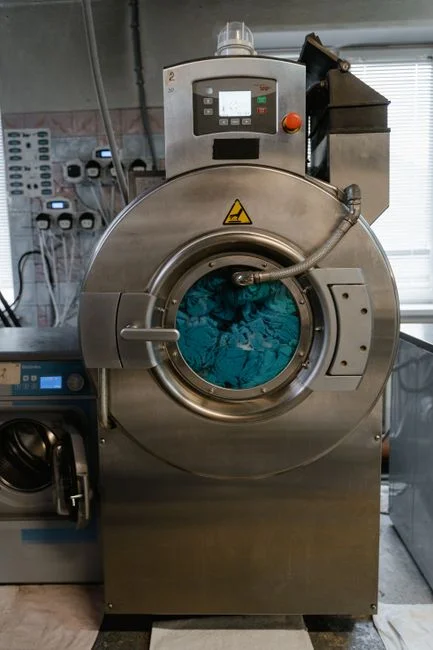
A defensible 2026 train for a French cotton/wool dyehouse is five stages in series: rotary bar screen → equalisation → DAF → anaerobic + aerobic MBR → ozonation or Fenton polish, with RO on the reuse branch. The screen matters more than it looks: a GX rotary mechanical bar screen for fibre and lint removal ahead of the MBR protects the membranes from the lint, packaging debris, and loose fibres that would otherwise blind them within days. The dissolved air flotation system for dye and FOG removal then strips 80–95% of TSS, FOG, and colloidal dye before biological loading — at 4–300 m³/h it covers the flow range of a mid-sized French finishing mill.
Biological treatment is an anaerobic pre-stage feeding an integrated MBR membrane bioreactor for COD and colour reduction. On raw cotton denim, an aerobic MBR at MLSS 13.9–17.0 g/L and constant flux 20 L/m²/h delivered >95% COD removal and >97% colour removal (Yigit et al., 2009, via ScienceDirect). On broader textile wastewater, Friha et al. recorded 98% COD and 100% colour after dilution and pH adjustment to 8. Anaerobic contact time matters because azo dye cleavage produces aromatic amines that only a properly sized anoxic/anaerobic zone will degrade before the aerobic MBR. The polishing stage is either ozone or FBR-Fenton: FBR-Fenton takes a real dyeing-mill feed of 185–200 mg/L COD down to ~80 mg/L with 93% decolorization (ScienceDirect Topics).
For mills targeting reuse, an industrial RO system for textile process water reuse on MBR permeate brings salts below 500 mg/L at up to 95% recovery, and an on-site chlorine dioxide generator for reused process water disinfection keeps the recycled rinse water within EU Drinking Water Directive 98/83/EC contact limits for finished goods. Automatic chemical dosing (coagulant, pH correction) sits ahead of the DAF; missing it is the single most common reason DAF performance drops below 70% TSS in field audits.
| Stage | Target removal / output | Benchmark |
|---|---|---|
| Rotary bar screen | Fibre, lint, debris removal; membrane protection | Field data, 2026 |
| DAF | 80–95% TSS, FOG, colloidal dye | HydropureWater field data, 2026 |
| Anaerobic + aerobic MBR | >95% COD, >97% colour (raw cotton denim) | Yigit et al., 2009 |
| MBR (broad textile, diluted, pH 8) | 98% COD, 100% colour | Friha et al. (via ScienceDirect) |
| FBR-Fenton polish | COD 185–200 → ~80 mg/L; 93% decolorization | ScienceDirect Topics |
| RO polish (reuse branch) | Salts <500 mg/L, up to 95% recovery | HydropureWater field data, 2026 |
Discharge, Reuse, or ZLD: Choosing the Right 2026 Endpoint
The endpoint decision turns on three numbers: local freshwater price (€/m³), the municipal sewer tariff plus any Refashion-exposed surcharges, and the plant's exposure to eco-score freshwater-pollution weighting. Discharge to municipal sewer is the default for mills with a tight sewer tariff and no freshwater scarcity pressure, but it does nothing for the eco-score freshwater factor. On-site reuse via MBR + RO typically supports 50–80% of dyeing rinse water as recycled permeate, which is the largest single reduction available in the 16-factor Ecobalyse water-use score.
Zero-liquid-discharge — RO followed by a multi-effect evaporator or crystalliser — is reserved for water-restricted basins (PACA, Occitanie) or for mills where the discharge permit is the binding constraint. Recovery sits at 90–95% as a baseline; the residual brine is the disposal problem, not the water. The Multiple Effect Evaporator Retrofit and Upgrade: 2026 Engineering Guide covers the heat-economy sizing for that stage. Roughly 60% of textile effluent can be productively reused with a properly designed MBR + RO train, which simultaneously cuts freshwater draw and shrinks the virgin-material footprint that Refashion fees scale against.
| Endpoint | When to pick it | Water recovery | Eco-score impact |
|---|---|---|---|
| Discharge to sewer | Low sewer tariff, no freshwater scarcity | 0% | Neutral |
| MBR + RO reuse | Rinse-water demand; freshwater price >~€2/m³ | 50–80% | Largest single reduction in water-use factor |
| ZLD (RO + MEE/crystalliser) | Restricted basin, binding discharge permit | 90–95% | Maximal; brine disposal is the new constraint |
French Compliance Stack: Refashion, Eco-Score, and the EU IED
Four layers apply simultaneously: the 2007/2020 French EPR law, Refashion PRO reporting on collected volumes, the October 2026 eco-score (16-factor Ecobalyse), and the EU Industrial Emissions Directive 2010/75/EU BAT-AELs for textile finishing. Each layer demands specific data: influent/effluent volumes, mass-balance of COD, colour, salts, and heavy metals for IED; recycled-content share and microplastics labelling for EPR; collection-rate reporting for Refashion; and product-level freshwater-pollution and microfibre shedding metrics for the eco-score. The MBR + DAF + RO train described above auto-generates the daily and weekly data the eco-score and Refashion audits will require, provided the SCADA logs the meter flows and the lab runs the standard parameter set on a fixed cadence.
The March 2028 reporting milestone is the binding deadline; engineering teams should pre-build the document set through 2026 rather than scramble in 2027. Any reused process water that contacts finished goods must meet EU Drinking Water Directive 98/83/EC parameters, which is the reason an RO polish and a ClO₂ disinfection step sit on the reuse branch and not just on the discharge branch. The 12-month grace for sub-€800,000/yr sellers does not protect a mill from the eco-score or the IED — it only delays the EPR reporting cadence.
Frequently Asked Questions
What is the Refashion collection target for 2026 and 2028?
Refashion collected 268,161 t out of ~833,000 t sold in 2023 — a 32% rate — and French EPR law requires that rate to reach 60% by 2028 (Trellis, 2024). Fees scale with recyclability, so non-circular producers pay more per garment into the PRO.
What COD and colour removal can an MBR deliver on textile effluent?
An aerobic MBR on raw cotton denim achieved >95% COD and >97% colour removal at MLSS 13.9–17.0 g/L and constant flux 20 L/m²/h (Yigit et al., 2009, via ScienceDirect). On broader textile wastewater with 5× dilution and pH adjusted to 8, Friha et al. reported 98% COD and 100% colour removal.
When does the France eco-score become mandatory, and what is the fine?
Full eco-score enforcement begins in October 2026 under the 2021 Climate and Resilience Law. Non-compliant brands face fines of 5% of annual revenue, and a third party may publish an eco-score on a brand's behalf if the brand refuses (Trellis, 2024).
How much textile effluent can be reused with MBR + RO?
A properly designed MBR + RO train supports 50–80% reuse of dyeing rinse water at up to 95% RO recovery (HydropureWater field data, 2026). The reused water must meet EU Drinking Water Directive 98/83/EC if it contacts finished goods, which is why RO polish and ClO₂ disinfection sit on the reuse branch.
Related Equipment
- industrial RO system for textile process water reuse — specifications, capacity range, and technical data