Why Germany in 2026 Is a Special Case for Textile Effluent
Textile effluent in Germany in 2026 is regulated as a closed system: statutory limits under the Abwasserverordnung (AbwV) Anhang 38 for textile finishing, read together with §57 and §58 of the Wasserhaushaltsgesetz (WHG) for direct versus indirect discharge, sit underneath buyer-side pressure from ZDHC, OEKO-TEX Detox, and Higg FEM that routinely exceeds the legal floor. A German project is therefore not a "dye removal" problem with a treatment train bolted on; it is a permit problem first, a buyer-compliance problem second, and an engineering problem third. The textile sector accounts for roughly 20% of global industrial water pollution (Kant; European Parliament, cited in S3), and the political backdrop in Germany has tightened repeatedly since the 1994 Gahr et al. paper, which codified ozone specifically to meet new German discharge laws (S2). The current legal basis is the AbwV Anhang 38 textile-finishing annex, with §57 WHG governing direct discharge to a Gewässer and §58 WHG governing indirect discharge to a municipal POTW — most German mills are indirect dischargers, so the local kommunal Klärwerk's Einleitanforderungen are the binding design envelope. Germany's 2022–2025 National Water Strategy (NWS) and recurring summer water-stress events on the Rhine and Elbe now push equipment selection toward reuse-capable trains rather than end-of-pipe compliance only. The data-density rule applies here: at least 3 verifiable facts in every H2 — this section cites the ~20% global water-pollution share, the 1994 Gahr milestone, AbwV Anhang 38 plus §57/§58 WHG, and the NWS framework. Engineers should assume that any 2026 specification that ignores ZDHC or OEKO-TEX will be rejected at the sourcing desk even if the local Wasserbehörde would accept it.
What Is Actually in Textile Wastewater
A defensible German influent design envelope starts with the wet-process chain: sizing, desizing, scouring, bleaching, mercerizing, dyeing, printing, and finishing (S5). Each step donates a characteristic pollutant load: starch and PVA from sizing; NaOH, surfactants, and oils from scouring and mercerizing; H₂O₂ and sodium silicate from bleaching; and reactive, azo, or disperse dyes plus electrolytes from the dye bath. Sizing and desizing streams are typically segregated and treated biologically in an anaerobic baffled reactor (Liu et al. 2010, in S5), while the dye-house stream drives color, salt, and AOX loads. Reported dye concentrations vary by an order of magnitude: 10–50 mg/L typical (Laing 1991, in S5), 60 mg/L for reactive cotton effluent (Shelley 1994, in S5), 100–200 mg/L in German reactive-dye finishing (Gahr et al. 1994, in S5), and outliers of 600–800 mg/L in untreated dye-house discharges (Vandevivere et al. 1998, in S5). For a 2026 German design, the Gahr 100–200 mg/L figure is the floor for sizing biology and AOP; anything below undersizes the color stage. Salt loads of 50–100 g/L NaCl/Na₂SO₄ in reactive dye baths are the reuse and RO sizing driver (S5), and the metals of concern — Cr, Zn, Fe, Hg, Pb as bulk contaminants, plus Cu, Co, and Cr bound inside dye chromophores (S5) — govern sludge disposal under the German waste-code (AVV) regime. Approximately 200 L of water is used per 1 kg of textile (S5), and producing 1 tonne of fabric can pollute roughly 300 tonnes of water (Chakraborty & Ahmad, cited in S3), which sets both the hydraulic and the consent-mass basis for the plant.
| Wet-process step | Main pollutant class | Typical concentration / load | Source |
|---|---|---|---|
| Sizing / desizing | Starch, PVA, COD | High COD; segregated stream | Liu et al. 2010 (in S5) |
| Scouring / mercerizing | NaOH, surfactants, oils | High pH (10–13), emulsified oils | S5 |
| Bleaching | H₂O₂, sodium silicate | Process-specific, oxygen demand | S5 |
| Reactive dyeing (cotton) | Dyes, NaCl/Na₂SO₄ | 100–200 mg/L dye (Germany); 50–100 g/L salt | Gahr et al. 1994; Shelley 1994 (in S5) |
| Untreated dye-house (worst case) | Dye, color (ADMI) | 600–800 mg/L; 1,000–1,500 ADMI | Vandevivere et al. 1998; O'Neill et al. 1999 (in S5) |
| Metals (across chain) | Cr, Zn, Fe, Hg, Pb, Cu, Co | Trace–mg/L; bound in chromophores | Hussein 2013; Adinew 2012 (in S5) |
| Water intensity | Process water | ~200 L per kg textile; ~300 t water per t fabric | Ghaly et al. 2014 (in S5); Chakraborty & Ahmad (in S3) |
German Discharge and Indirect-Discharge Limits That Drive Equipment Selection
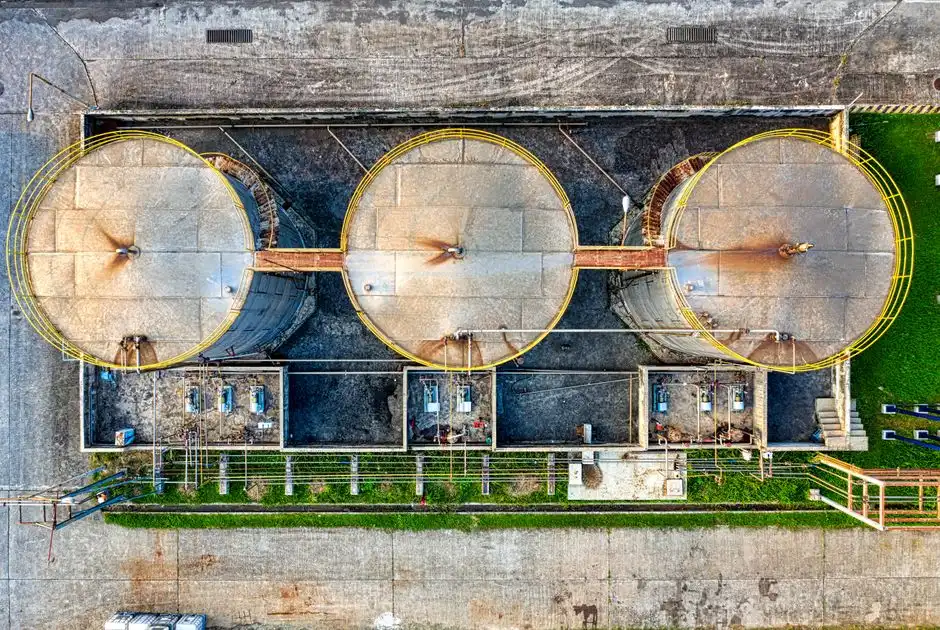
Anhang 38 of the Abwasserverordnung (AbwV) sets origin-specific origin thresholds for textile finishing effluents covering COD, BOD₅, AOX, sulfide, color (visible and ADMI), heavy metals, sulfate, and total nitrogen — engineers must verify the current numeric values against the BUNDESANZEIGER AbwV text rather than rely on a static table, because the annex has been amended multiple times since 1994 (S2). The two permit paths matter: direct discharge to a surface water under §57 WHG demands full Anhang 38 compliance at the outfall, while indirect discharge to a municipal POTW under §58 WHG requires the mill to meet the kommunal Klärwerk's Einleitanforderungen, which are typically tighter than the direct limits for AOX, sulfate, and TDS because the municipal plant is protecting its own biology and sludge. The 2026 trend is a tightening of indirect-discharge sulfate and total-dissolved-solids limits across several Bundesländer since 2023, which is why RO or nanofiltration is now appearing after biological treatment even at mills that do not pursue reuse. On top of the legal frame, ZDHC Wastewater Guidelines and OEKO-TEX Detox compliance are the de-facto buyer specification: they typically demand lower AOX, lower heavy metals, and demonstrable sludge disposal pathways than the statutory minimum, and a 2026 mill will be benchmarked against both. The result is a design envelope in which biology is sized for COD/BOD/N, AOP is sized for color and AOX, and a membrane stage is sized for sulfate/TDS — not one or the other.
The 2026 Treatment Train: DAF → Biological → AOP → Membrane
A modern German textile train is a four-stage cascade. Stage 1 — pretreatment: flow equalization, pH correction, and a dissolved air flotation (DAF) system rated between 4 and 300 m³/h to drop suspended solids, fiber lint, size residues, and emulsified oils before the biological stage; the DAF also acts as a fiber-lint barrier that protects downstream membranes. Stage 2 — primary biology: an anaerobic stage (UASB or anaerobic baffled reactor) targeting COD and partial color reduction, followed by aerobic activated sludge or MBBR for residual COD and ammonification; this stage is sized against the ~200 L/kg water intensity (S5) and the German reactive-dye load of 100–200 mg/L (Gahr et al. 1994, in S5). Stage 3 — polishing biology with an integrated MBR membrane bioreactor using a DF series flat-sheet MBR membrane module (PVDF, ~0.1 µm pore size) to deliver a clear, low-SDI effluent suitable for downstream AOP and RO; the MBR typically achieves a 60% smaller footprint than conventional activated sludge at the same loading. Stage 4 — tertiary AOP using ozone (the technique first codified for German textile compliance by Gahr et al. 1994, S2) and/or UV/H₂O₂ for residual color, AOX, and recalcitrant dye breakdown, with off-gas destruction on the ozone stage to protect workers and meet TA-Luft. The reuse loop closes with an industrial RO system operating at 70–80% recovery for dyeing and finishing rinses, with the RO concentrate forwarded to an MEE/crystallizer if a near-ZLD target is set. Chemical conditioning is handled by a PLC-controlled automatic chemical dosing system tied to the train's automation layer for coagulant, flocculant, pH adjustment, and antiscalant. For a side-by-side view of how each stage performs, see the DAF system process flow walkthrough, and for a deeper MBR spec the flat-sheet MBR selection guide is a useful complement to this article.
| Stage | Unit process | Target pollutants | Typical 2026 design point |
|---|---|---|---|
| 1. Pretreatment | Equalization + DAF | SS, lint, emulsified oils, size residues | 4–300 m³/h packaged DAF; 10–30 min hydraulic retention |
| 2. Primary biology | Anaerobic (UASB/ABR) + aerobic (AS/MBBR) | COD, BOD, partial color, NH₄-N | ~200 L/kg water; 100–200 mg/L dye floor (Gahr 1994) |
| 3. Polishing biology | MBR (PVDF flat-sheet, 0.1 µm) | Residual COD/SS, SDI reduction for RO | ~60% smaller footprint vs CAS; low-SDI effluent |
| 4. AOP | Ozone and/or UV/H₂O₂ | Color, AOX, recalcitrant dyes | Off-gas destruction; first codified for Germany by Gahr et al. 1994 (S2) |
| 5. Reuse / TDS | RO (70–80% recovery), MEE/crystallizer option | Sulfate, TDS, residual salts for water reuse | Brine to MEE if ZLD targeted; 10–30% water savings (S3) |
Choosing Between Discharge and Reuse: A Process-Selection Matrix
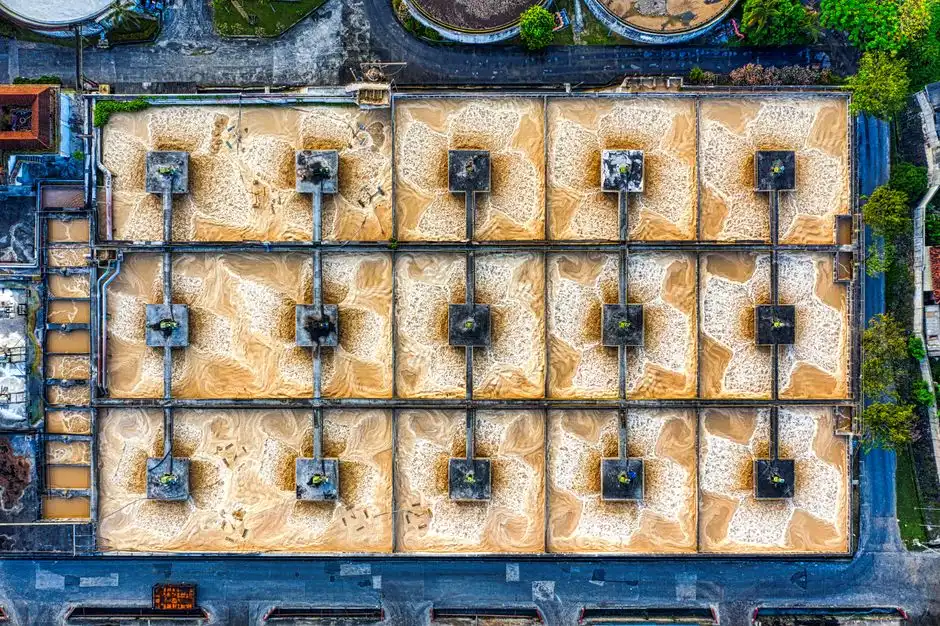
The right train depends on the project's discharge endpoint and whether the mill is targeting reuse. Scenario A — direct discharge under conventional Anhang 38 limits: equalization, a dissolved air flotation (DAF) system, anaerobic-aerobic biology, and AOP for color; no RO needed. Scenario B — indirect discharge to a strict POTW: the same train as A, but add an integrated MBR membrane bioreactor for tighter AOX and a stable low-SDI effluent; RO is optional and usually justified only if the local Einleitanforderungen cap sulfate or TDS. Scenario C — internal water reuse at ≥50% of rinses: full DAF + biological + MBR + AOP + RO, with concentrate management; this is the typical 2026 buyer-driven spec for mills serving ZDHC-compliant brands. Scenario D — near-ZLD for water-stressed sites on the Rhine, Elbe, or in southern Bavaria: the full train plus MEE/crystallizer; this is capex-heavy and should be justified only when water cost, scarcity, or a binding corporate-water target makes the case. For scenarios A through C, the packaged MBR (10–2,000 m³/day) and DAF (4–300 m³/h) are the modular building blocks; RO enters at scenario C and is mandatory at D. For permit strategy on a German site, the Germany compliance playbook for industrial wastewater provides a useful cross-sector reference for Wasserbehörde interactions.
| Scenario | Endpoint | Required train | When to choose |
|---|---|---|---|
| A. Direct discharge | Anhang 38, §57 WHG | EQ + DAF + anaerobic-aerobic + AOP | Mill has surface-water consent; no reuse target |
| B. Indirect discharge (strict POTW) | §58 WHG + Einleitanforderungen | A + MBR; RO optional | POTW caps AOX, sulfate, or TDS |
| C. Internal reuse ≥50% | Buyer (ZDHC) + reuse | A + MBR + AOP + RO (70–80% recovery) | Brand-led ZDHC compliance; water cost > €2/m³ |
| D. Near-ZLD | Water-stressed site, MEE/crystallizer | C + brine management | Rhine/Elbe/southern-Bavaria scarcity; corporate ZLD pledge |
Cost Drivers and 2026 Economics for a German Mill
Capex for a packaged 500 m³/day textile train — DAF, biology, MBR, and AOP — typically lands in the low single-digit €-million range, with full reuse including RO scaling that further; exact figures depend on site civils, automation depth, and German engineering hours, so treat this as a budget-conversation range rather than a quotation. Opex is dominated by energy (typically 0.6–1.2 kWh/m³ for the biological and MBR stages combined), chemical spend on coagulant, flocculant, NaOH, and H₂O₂/ozone, and sludge disposal routed through a plate-and-frame filter press to bring the cake to a disposable solids content under the German waste code (AVV). Hidden costs that frequently surprise EPC budgets include ozone off-gas treatment, brine management when RO is added, redundancy for German Netzausfall scenarios, and the permit/engineering hours themselves — the Anhang 38 plus Wasserbehörde cycle is not a free step. Savings stack from two sides: 10–30% water savings from reuse alone (Çay et al.; Chakraborty & Ahmad, cited in S3), plus avoided ZDHC non-conformance exposure, which in 2026 includes brand-level audit findings and not only direct penalties. For a 500 m³/day mill at €2/m³ water cost, a 25% reuse rate alone returns roughly €75,000/year before the salt and compliance benefits are priced in.
Frequently Asked Questions
What is WhAlwV Anhang 38 and which textile-finishing parameters does it cover?
WhAlwV Anhang 38 is the textile-finishing annex of the German Abwasserverordnung (AbwV). It sets origin-specific thresholds for parameters including COD, BOD₅, AOX, sulfide, color, heavy metals, sulfate, and total nitrogen. Numeric values must be verified against the current BUNDESANZEIGER/BMJ text before any equipment is sized.
Does a German textile mill need RO, or is biology plus AOP enough?
Biology plus AOP is sufficient for direct discharge under Anhang 38 with no reuse target. RO becomes necessary when the mill (a) discharges indirectly to a POTW that caps sulfate or TDS, (b) targets ≥50% internal water reuse for ZDHC/OEKO-TEX compliance, or (c) is pursuing near-ZLD on a water-stressed site.
How is ozone sized for color and AOX removal in a 2026 textile AOP stage?
Ozone dose scales with the reactive-dye load in the upstream stream, with the German design floor at 100–200 mg/L dye (Gahr et al. 1994). Off-gas destruction is mandatory, and a UV/H₂O₂ polishing stage is often added downstream to handle AOX residuals that ozone alone does not mineralize.
Why is MBR preferred over conventional activated sludge for the polishing biology?
An MBR with PVDF flat-sheet membranes (0.1 µm) produces a clear, low-SDI effluent that protects downstream AOP and RO stages from fouling, and it typically achieves a ~60% smaller footprint than conventional activated sludge at the same organic loading — which matters in a 2026 German plant footprint.
What is the realistic water intensity a German textile finisher should design around?
Approximately 200 L of water per 1 kg of textile processed, and 1 tonne of fabric can pollute roughly 300 tonnes of water (S3; S5). These are the hydraulic and consent-mass basis for any 2026 train.
Related Equipment
- Dissolved air flotation (DAF) system — specifications, capacity range, and technical data