
Why Goshen Transportation Equipment Wastewater Is Not a Generic DAF Case
Goshen, Indiana sits in the heart of Elkhart County's RV and trailer manufacturing cluster, and the influent profile at a chassis stamping line or a parts-washer bay has almost nothing in common with the food-processing FOG case studies that dominate DAF vendor literature. The local industrial base is dominated by recreational vehicle assembly, trailer fabrication, metal stamping, and metal finishing — plants whose wastewater streams run through drawing compounds, alkaline cleaners, phosphate rinses, and emulsified coolants, with discharge typically routed to the City of Goshen WWTP for pretreatment acceptance (per IDEM pretreatment program guidelines). The governing federal standards for these operations are 40 CFR 433 (Metal Finishing) and 40 CFR 464 (Metal Molding and Casting), with metal finishing daily-maximum limits of 2.13 mg/L total lead, 1.48 mg/L total zinc, and 0.43 mg/L total cadmium — and these limits are enforced at the POTW headworks regardless of whether the upstream clarifier is a DAF or a lamella.
Vendor pages lean on poultry, dairy, and rendering plants where FOG runs 500–5,000 mg/L and the answer is always "buy a DAF." That pitch does not transfer to a Goshen RV plant discharging <200 mg/L oil & grease and 200–400 mg/L TSS from coolant and rinse streams. The decision variable is the oil-and-FOG concentration paired with TSS character — not just flow in GPM. A DAF sized for a food plant will be over-specified and over-budgeted for an Elkhart County parts washer, while a lamella clarifier will underperform badly if emulsified oil is present without a polish stage. This article is built on the actual Goshen influent envelope, not the borrowed food-industry narrative.
How a DAF Clarifier Works on Transportation Equipment Wastewater
A dissolved air flotation system saturates a side-stream of clarified effluent with air at 4–6 bar in a pressurized saturator, then injects that stream back into the flotation cell where the pressure drop releases 30–50 micron micro-bubbles (per SigmaDAF technical documentation, 2026-04). Those bubbles attach to chemically conditioned floc and lift it to the surface in 3–5 minutes of residence time, where a paddle skimmer flight scrapes the float layer into a scum trough; heavier settleables drop to a bottom auger and discharge separately. The chemical train ahead of the cell is non-negotiable: pH adjust to the optimum for the coagulant (typically 6.5–8.5), then a coagulant dose — ferric chloride at 50–150 mg/L or polyaluminum chloride (PACl) at 20–80 mg/L — followed by an anionic polyacrylamide flocculant at 0.5–3 mg/L through a serpentine floc tube or stirred mix tank. The floc size, not the bubble size, is what controls capture efficiency on the fine metal-hydroxide particles that dominate Elkhart County streams.
Material of construction matters in Goshen chemistry. Standard 304SS works for near-neutral rinses, but drawing compounds and chloride-bearing coolants push the spec to 316SS; acidic phosphate rinse lines above pH 4 often justify a polypropylene cell. Removal bands on conditioned influent are 80–95% TSS, 90%+ oil & grease, and 60–80% BOD (per SigmaDAF/Clearwater performance data, 2026-04). Sizing rules: a single skid handles flows ≤66 GPM (≈15 m³/h); above that threshold a modular two-skid arrangement is the standard pattern (per SigmaDAF Compact DAF sizing rule). For a plant engineer reviewing a proposal, the HydropureWater DAF system follows the same micro-bubble, floc-conditioned architecture and accepts the same chemistry envelope.
How an Inclined-Plate (Lamella) Clarifier Works on the Same Stream
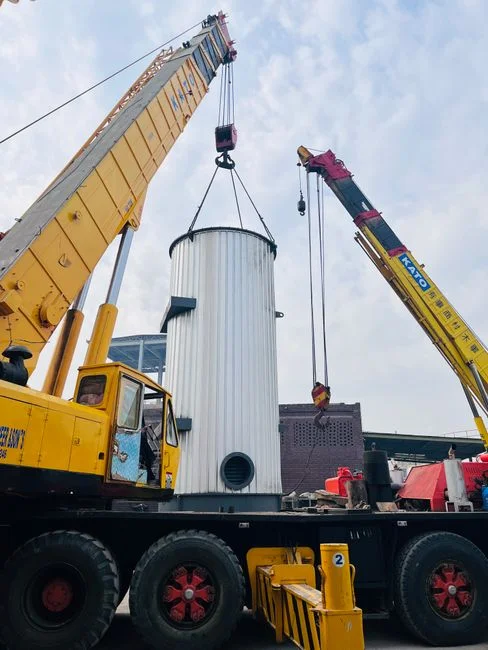
An inclined-plate (lamella) clarifier is a parallel-plate sedimentation device: a stack of plates at 55–60° from horizontal multiplies the effective settling area by 1/cos(angle), so a footprint of 1–1.5 m² can handle 10 m³/h that would need 8–12 m² in a conventional basin. Surface loading on the HydropureWater high-efficiency sedimentation tank (lamella clarifier) runs 20–40 m/h, versus the 1–2 m/h of a conventional clarifier (HydropureWater product specifications, 2026) — roughly an order-of-magnitude jump in clarifier throughput per unit area. The chemical conditioning train upstream is the same coagulant + flocculant sequence used ahead of a DAF, and a properly sized HydropureWater automatic chemical dosing skid serves either configuration.
The lamella clarifier has no saturator, no recycle pump, no air compressor, and no skimmer flight. Flocculated solids settle onto the plate surfaces, slide down the inclined face, and collect in a bottom hopper; clarified effluent exits over a peripheral weir. This architecture is a strong fit for the inorganic-heavy, low-oil streams typical of Goshen metal-finishing lines: zinc and nickel hydroxide floc from pH-adjusted precipitation, calcium phosphate from rinse-water softening, and drawing-compound solids after the emulsified oil has been broken. Sludge from the hopper is normally pumped to a plate-and-frame filter press for dewatering to 25–35% dry solids. The unit is fit-and-forget once conditioned — quarterly plate inspection and annual hose replacement is the typical maintenance envelope — and it is the right call whenever free oil is below ~50 mg/L and FOG is not a compliance driver.
DAF vs Lamella Clarifier: 2026 Side-by-Side Comparison
The table below is the screenshot most procurement reviewers will keep. All cost and performance numbers are 2026 USD ranges drawn from SigmaDAF/Clearwater product literature (2026-04) and HydropureWater field data, not vendor quotes specific to your plant.
| Parameter | Dissolved Air Flotation (DAF) | Inclined-Plate (Lamella) Clarifier |
|---|---|---|
| Best-fit influent | Free or emulsified oil >50 mg/L; FOG-laden; TSS 200–3,000 mg/L | Low oil (<50 mg/L); inorganic solids 100–500 mg/L; stable flow |
| TSS removal | 80–95% | 50–80% |
| FOG / oil & grease removal | 90%+ | <30% (near-zero for free oil) |
| BOD removal | 60–80% | 20–40% |
| Footprint per 10 m³/h | 3–4 m² (saturator + cell) | 1–1.5 m² |
| Installed capex (5–50 m³/h skid) | $80,000–$250,000 | $30,000–$110,000 (40–60% lower) |
| Energy use | 5–15 kWh per 10 m³/h (saturator + compressor) | Negligible (passive once fed) |
| Operator skill | PLC literate, daily chemistry tuning | Fit-and-forget; quarterly plate inspection |
| 40 CFR 433 oil & grease compliance | Consistently meets discharge limits | Requires upstream oil removal or DAF polish |
| Rebuild interval | ~2 years on saturator pump and seals | Plate pack life 10+ years |
The headline takeaway: a DAF buys compliance headroom on oil & grease at a 40–60% installed-cost premium, plus ongoing energy and maintenance. A lamella clarifier buys low capex and operational simplicity but cannot, on its own, meet 40 CFR 433 oil & grease limits when free or emulsified oil is present.
Goshen-Specific Decision Matrix: Which Technology When
For an Elkhart County plant engineer writing a memo, the four-row matrix below maps the dominant Goshen line types to a recommended primary clarifier. All selections assume 40 CFR 433 / 464 categorical compliance and a downstream municipal POTW agreement with the City of Goshen WWTP.
| Line type / stream | Typical influent character | Primary unit | Rationale |
|---|---|---|---|
| Phosphate rinse / metal precipitation | High TSS (300–800 mg/L), very low oil | Lamella clarifier | Inorganic floc settles cleanly; no oil to float; lowest capex |
| Parts washer with alkaline cleaner | Moderate TSS (200–500 mg/L), emulsified oil 100–400 mg/L | DAF | Emulsified oil requires micro-bubble capture; lamella cannot hit O&G limits |
| Aluminum RV chassis stamping coolant | Free oil + graphite, TSS 500–1,500 mg/L | DAF with coalescer pre-stage | Coalescer knocks down free oil; DAF polishes emulsified fraction and graphite |
| Mixed RV assembly plant flow (combined rinses) | Variable TSS 200–600 mg/L, intermittent oil spikes | Lamella primary + DAF polish on oil-rich side-stream | Bulk inorganic removal cheap; DAF only on the stream that needs it |
The "mixed RV assembly" row is the configuration most often missed by vendor-led articles, and it is the configuration many Goshen plants actually run. Splitting the flow at the oil-rich side-stream keeps total capex well below a plant-wide DAF while preserving compliance margin on the line that drives POTW surcharges.
2026 Capex and Opex Bands for Goshen Factories
Order-of-magnitude installed cost (equipment + install + commissioning) in 2026 USD runs from roughly $60,000 for a 5 m³/h lamella system to about $140,000 for the same flow on a DAF skid; at 30 m³/h the spread widens to roughly $110,000 (lamella) versus $320,000 (DAF). The 40–60% DAF premium is consistent across flow rates and is the single number a procurement reviewer will anchor on. Annual opex is dominated by coagulant and flocculant consumption at $0.02–$0.06 per m³ treated (HydropureWater field data, 2026); a DAF adds energy for the saturator pump and compressor at 5–15 kWh per 10 m³/h, plus a planned 2-year rebuild on the saturator pump and seals.
Indiana-specific cost layers matter. Discharges above local limits trigger Elkhart County POTW surcharges on TSS, BOD, oil & grease, and metals — and the surcharge schedule typically prices oil & grease at several times the TSS rate per pound. A DAF pays back its capex premium in 12–24 months whenever influent oil & grease runs above ~150 mg/L, because the avoided surcharges on the oil & grease line item alone cover the financing. For dewatering the sludge off either clarifier, a HydropureWater plate-and-frame filter press typically reaches 25–35% dry solids and cuts hauling cost by 50–70% versus liquid sludge removal. Any chemical program in front of either clarifier should run through a HydropureWater automatic chemical dosing skid to keep coagulant and flocculant draw steady across shift changes. For a parallel read on a different industry with similar low-FOG, high-inorganic-solids chemistry, see this DAF vs clarifier comparison for mining wastewater; for a state-by-state compliance framing on transportation equipment pretreatment, the pretreatment compliance guide for transportation equipment plants covers the IDEM-side paperwork.
Frequently Asked Questions
When should a Goshen transportation equipment plant choose a DAF over a clarifier?
Choose a DAF when free or emulsified oil exceeds ~50 mg/L in the influent, when FOG-laden streams from alkaline parts washers dominate the flow, or when the plant cannot risk an oil & grease excursion at the POTW headworks. Below those thresholds a lamella clarifier typically meets compliance at lower capex.
What influent TSS is the cutoff between DAF and lamella?
Above ~500 mg/L TSS, or whenever heavy metal-hydroxide floc from chemical precipitation overwhelms a lamella's plate-loading envelope, a DAF is the safer primary unit. Below ~300 mg/L TSS, a lamella clarifier is usually sufficient on its own, especially when paired with a pH-adjustment stage ahead of it.
Do DAF and lamella clarifiers meet EPA 40 CFR 433 metal finishing limits on their own?
Neither unit removes dissolved metals. Both remove solids-bound metals effectively when paired with upstream chemical precipitation (pH adjustment to 8.5–9.5 for zinc, 9.5–10.5 for nickel). The 2.13 mg/L lead, 1.48 mg/L zinc, and 0.43 mg/L cadmium daily-maximum limits are met by the precipitation + clarification combination, not by the clarifier alone.
Can a DAF and a lamella clarifier be used together?
Yes, and it is a common 2026 retrofit pattern: a lamella clarifier handles bulk inorganic removal cheaply, then a DAF polishes residual oil and FOG on the side-stream that drives surcharges. The hybrid usually lands 20–30% below full-plant DAF capex while preserving compliance margin.
What flow rate triggers a modular two-skid DAF instead of a single skid?
Above 66 GPM (≈15 m³/h) the standard pattern is a modular two-skid arrangement (per SigmaDAF Compact DAF sizing rule, 2026-04). Below 66 GPM a single skid with integrated chemical conditioning, DAF cell, and PLC control panel is the default packaging.