
Why Georgetown EV and Auto Plants Are Revisiting Primary Clarification in 2026
Georgetown County, SC has absorbed more than $2 billion in announced EV and tier-1 supplier capex since 2023, and most of those plants discharge to either the Lower Savannah Water Authority or the Georgetown Water & Sewer District — both of which enforce SCDHEC industrial pretreatment limits (typically 300 mg/L TSS, 100 mg/L FOG, 5 mg/L zinc, 1 mg/L total phosphorus at the POTW tap per SCDHEC R.61-9.403). Three operational pressures are forcing a 2026 revisit of primary clarification. First, gigafactory-adjacent tier-1 lines are routing more coolant and stamping lube through a single equalization basin, pushing intermittent oil loadings past 800 mg/L — above what the existing API separator was sized for. Second, SCDHEC renewed permits in 2025 are tightening local TSS/FOG ceilings to 200/75 mg/L at several Georgetown outfalls. Third, water-reuse targets for robot wash and paint rinse loops (typically 60-80% recirculation) demand clarified effluent with <30 mg/L TSS and <10 mg/L FOG entering RO or UF polishers. The EPA Process Design Manual for Suspended Solids Removal (NSCEP) remains the sizing basis for both DAF and gravity clarifiers; the manual publishes overflow rate curves that govern both. The core claim of this article: the DAF vs lamella clarifier decision is driven by influent characteristics, not by which vendor walks in first.
The Three Wastewater Profiles That Define a Georgetown EV/Auto Plant
Every Georgetown EV or auto plant effectively has three streams that engineering teams either treat separately or — more often — homogenize in a common equalization basin. The decision changes the answer to "DAF or clarifier?" by a factor of ten.
Profile 1 — Cathode/anode coating & binder recovery. High TDS (5,000-15,000 mg/L from salt-laden slurries), NMP or PVDF binder residuals, fine suspended solids in the 10-50 μm range, low FOG (<30 mg/L). Flow is small, typically 1-3% of total plant volume, but it is the hardest stream to polish downstream.
Profile 2 — Paint shop (ED coat, primer, topcoat) + zinc phosphate pretreatment. Emulsified paints, surfactants, PFAS-bearing detack solids, and oil from phosphate bath carryover. FOG spikes to 300-600 mg/L during a booth dump or when a transfer line slips. Zinc is regulated and phosphate drives eutrophication in the receiving water.
Profile 3 — Machining, stamping and coolant lines. Free and emulsified cutting oils, tramp oils from hydraulic press leaks, and metal fines (Fe, Al, Cu). This is often the largest single flow and the largest FOG contributor in the plant — routinely 50-70% of total plant hydraulic load and 60-80% of the oil mass.
Mixing all three in one equalization basin is common in Georgetown plants because it saves civil capex, but the homogenization actually hurts both DAF and clarifier performance: oil coats the floc and starves a clarifier, while high TDS depresses bubble attachment in a DAF. Pre-segregation into at least two trains is the lowest-cost 2026 upgrade most plants can make.
How a DAF Clarifier Works in an Auto Plant Context
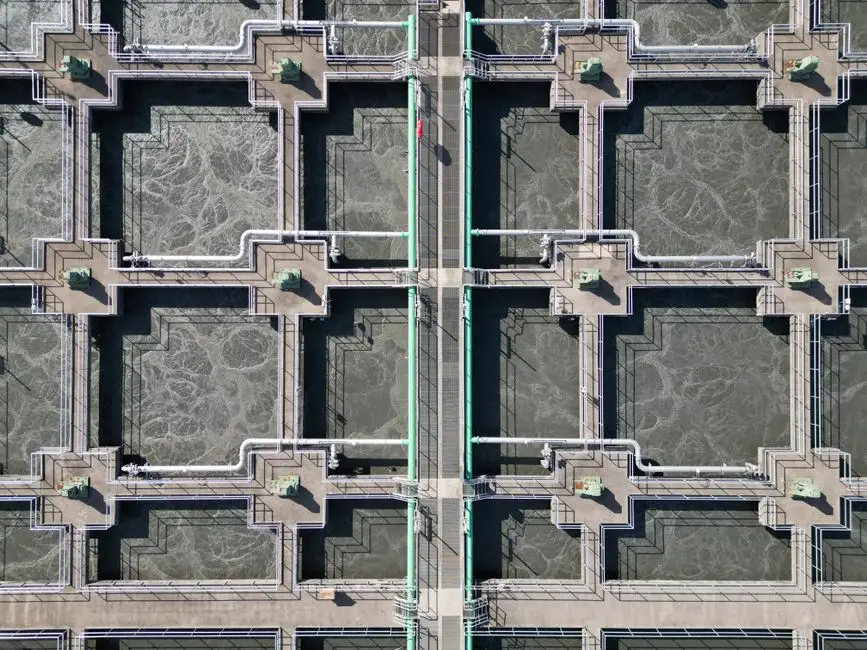
A DAF saturates 10-30% of clarified effluent with air at 4-6 bar in a recycle pressurization loop; on release to atmospheric pressure, the dissolved air comes out of solution as 30-50 μm microbubbles (per Clearwater/SigmaDAF USA, 2026). Those bubbles attach to oil droplets, FOG globules, and pre-flocculated TSS, lifting them to the surface where a paddle skimmer sweeps the float into a hopper. Heavier settleable solids drop to a bottom auger. Surface loading is typically 5-25 m/h and hydraulic retention time runs 15-30 minutes (RTW 2026 design language). For EV/auto streams, DAF is almost never run without chemistry — coagulation with PAC or alum (50-200 mg/L) followed by flocculation with anionic polyacrylamide (2-10 mg/L) grows oil droplets and detack particles large enough for bubble attachment. A correctly run auto-plant DAF produces float at 3-5% dry solids, which dewateres well on a plate-and-frame press downstream. A DAF system sized for 50 m³/h is the typical building block for Georgetown pretreatment trains.
How a Lamella (High-Rate) Clarifier Works in an Auto Plant Context
A lamella clarifier stacks inclined plates at 55-60° inside a rectangular tank, shortening the effective settling distance so surface loading climbs to 20-40 m/h versus roughly 5-12 m/h for a conventional clarifier (per HydropureWater lamella spec, 2026). HRT runs 20-45 minutes. A portion of the settled sludge is recirculated to form a dense floc blanket that captures fine particles as they pass through; this blanket can cut coagulant consumption by up to 30% on well-settled streams. The technology performs best on settleable, non-buoyant TSS — metal fines, phosphate floc, electrode-coating binder residues — and is weak on free oil and emulsified FOG, which simply rides up the plate pack and re-enters the overflow. The footprint advantage is 4-8× over a conventional clarifier, which is the dominant reason Georgetown brownfield retrofits choose a HydropureWater lamella clarifier when the stream is already low-oil.
DAF vs Lamella Clarifier: Side-by-Side for EV/Auto Wastewater
The table below compares the two technologies on the parameters that actually drive a 2026 Georgetown procurement decision. Numbers reflect vendor-published design data (Clearwater/SigmaDAF 2026, RTW 2026, HydropureWater 2026) and standard municipal/auto-plant field results.
| Parameter | DAF | Lamella Clarifier | EV/Auto Implication |
|---|---|---|---|
| TSS removal | 70-95% | 60-85% (settleable TSS only) | DAF wins on paint detack and fines with bound oil; lamella wins on phosphate floc |
| FOG/oil removal | 80-95% | 20-40% (free oil only) | DAF dominates for machining and paint-shop streams |
| Surface loading | 5-25 m/h | 20-40 m/h | Lamella handles 2-4× the flow per unit area |
| HRT | 15-30 min | 20-45 min | DAF recovers faster after a hydraulic spike |
| Footprint per 50 m³/h (incl. plate pack & skimmer) | ~25-40 m² | ~6-10 m² | Lamella wins on constrained brownfield sites |
| CAPEX band per m³/h (turnkey, 2026) | $15,000-$35,000 | $8,000-$18,000 | Lamella is roughly half the capital cost |
| OPEX band per m³/h (annual) | $1,200-$2,500 (chemicals + air) | $500-$1,200 (mostly chemical) | DAF is energy- and polymer-intensive |
| Sludge dryness | 3-5% DS float | 0.5-1.5% DS underflow | DAF float dewateres directly; lamella sludge needs thickening first |
For paint shop and machining rows, the numbers favor DAF; for cathode/anode coating and phosphate rinse rows, they favor lamella — unless oil is present, in which case DAF returns as the primary and lamella moves downstream as a polishing step.
Which Georgetown EV/Auto Stream Should Pick Which Technology
The right primary clarifier is the one matched to the worst 20% of daily flow, not the average. The mapping below is what 2026 Georgetown engineering specs are converging on.
| Stream Profile | Primary Technology | Polishing / Downstream | Reason |
|---|---|---|---|
| Paint shop + zinc phosphate pretreatment | DAF (with coagulation + flocculation) | Lamella clarifier for phosphate floc, then biological or MBR | Emulsified paint, PFAS-bearing detack, and oil from phosphate baths all demand bubble flotation |
| Machining, stamping and coolant lines | DAF with oil-skimming top layer | Equalization basin, then biological or membrane | Free and emulsified oils plus metal fines — DAF removes 80-95% of FOG in a single pass |
| Cathode/anode coating binder recovery | Lamella clarifier (settles binder floc, low FOG) | Ultrafiltration or RO for water reuse | Stream is low-FOG and high-TDS; lamella captures settleable binder at the lowest capex |
| Mixed equalization (all three streams after segregation) | DAF primary, lamella secondary, then biological/MBR | MBR or UF/RO polish | Hybrid train is the 2026 default for new gigafactory-adjacent lines; see the MBR integrated treatment train for the downstream biological step |
2026 Cost Reality: CAPEX, OPEX and Footprint for a 50 m³/h Line
Indicative 2026 turnkey CAPEX for a 50 m³/h DAF system (skid, coagulation, flocculation, control panel, installation) lands in the $0.8-1.8M USD band; an equivalent lamella clarifier — including the plate pack, floc blanket recirculation, and chemical dosing skid — sits at $0.4-0.9M USD. The roughly 2× delta is the dominant reason lamella wins on greenfield cathode-coating lines. OPEX splits differently: DAF is energy- and chemical-heavy (air saturation pump at 5-15 kW, polymer dose 2-10 mg/L, coagulant 50-200 mg/L), while lamella is lower chemical but pushes more wet sludge downstream. On a constrained Georgetown site, the footprint delta is often the deciding factor — a DAF needs roughly 30 m² of floor area including the chemical skid, while a lamella clarifier handles the same 50 m³/h in about 8 m². Downstream of the clarifier, DAF float at 3-5% DS feeds directly to a plate-and-frame sludge dewatering press; lamella underflow at 0.5-1.5% DS needs a thickener first or a larger press. A HydropureWater automatic chemical dosing skid is the typical pairing for either primary, with coagulant and polymer setpoints tuned to the actual stream jar test.
A Simple 2026 Decision Tree for Georgetown Plants
Use this three-question path after pulling representative daily composite and grab samples from the equalization basin. Question 1: Is free or emulsified oil/FOG greater than 50 mg/L at any point in the day? If yes, specify DAF. If no, go to Question 2. Question 2: Is peak flow more than 4× the daily average (typical of robot washdown spikes in a stamping shop)? If yes, specify DAF for hydraulic resilience. If no, go to Question 3. Question 3: Is less than 30 m² available for the primary unit on the existing pad? If no, specify lamella. If yes, either is viable — pick by the oil/FOG answer in Q1. If Q1 is borderline (30-60 mg/L), the single most cost-effective 2026 pilot step for any Georgetown auto plant is a jar test with DAF recycle on the actual stream — it is cheaper than a feasibility study and gives a defensible removal number for the permit renewal. A 50 m³/h DAF pilot typically rents for $8,000-$15,000 per month (Clearwater/SigmaDAF 2026), and the data feeds directly into the final equipment selection.
Frequently Asked Questions
Is a DAF or a lamella clarifier cheaper for a 50 m³/h EV/auto wastewater line in Georgetown?
For a 50 m³/h turnkey installation in 2026, a lamella clarifier runs $0.4-0.9M USD versus $0.8-1.8M USD for a DAF system, so lamella is roughly half the capital cost (HydropureWater 2026 spec, Clearwater/SigmaDAF 2026). OPEX reverses the relationship on oil-bearing streams because DAF removes 80-95% of FOG while lamella removes 20-40% — meaning a cheap lamella on a machining line will pass oil straight through and trigger SCDHEC permit excursions at the Georgetown Water & Sewer District tap.
Can a lamella clarifier handle emulsified coolant or paint detack solids?
No. Inclined-plate settling depends on gravity and density differential, and emulsified oil, PFAS-bearing paint detack, and fine coolant droplets are buoyant or near-neutral. They ride up the plate pack and re-enter the overflow. DAF is the correct technology for these streams because the 30-50 μm microbubbles attach to the droplet surface and force floatation (Clearwater/SigmaDAF 2026).
What is the smallest footprint package for a DAF treating machining coolant at a Georgetown plant?
A pre-assembled turnkey DAF skid handling up to 66 GPM (≈15 m³/h) fits in roughly 12-15 m² including the chemical conditioning tank and control panel (SigmaDAF COMPACT design, 2026). For a 50 m³/h machining line, expect a modular two-skid layout around 25-40 m² — still larger than a lamella clarifier, but the only option that meets SCDHEC FOG limits on emulsified streams.
Do Georgetown SCDHEC pretreatment limits drive the DAF vs clarifier choice?
Yes. SCDHEC R.61-9.403 industrial pretreatment limits (300 mg/L TSS, 100 mg/L FOG, 5 mg/L zinc at the POTW tap, with tighter site-specific caps on renewed 2025-2026 permits) effectively mandate DAF for any stream with >50 mg/L emulsified FOG, because a lamella clarifier cannot reliably hit the FOG ceiling on oil-bearing auto waste. For low-FOG streams like cathode-coating binder recovery, lamella is fully compliant and saves capex.
How does the EPA Process Design Manual for Suspended Solids Removal apply to DAF sizing in 2026?
The EPA manual (NSCEP) provides the overflow rate and surface loading curves still used to size both DAF and gravity clarifiers, even though it predates modern DAF designs. Engineers use the manual's settling columns as a check on vendor-supplied surface loading rates, then verify with a jar test on the actual stream. The manual remains the regulatory baseline SCDHEC reviewers expect to see cited in a permit submission.