Why Van Buren Mining and Metals Discharges Run Through VBMU Pretreatment
Mining and metals plants near Van Buren, AR meet sewer pretreatment limits by discharging to the City of Van Buren Municipal Utilities (VBMU) Industrial Wastewater Pretreatment Program, which is the local POTW authority operating under NPDES Permit AR0021482 and the EPA categorical pretreatment standards in 40 CFR Part 403. Compliance typically requires source control, pH adjustment, suspended-solids and oil removal, chemical precipitation or reactive filtration for dissolved metals, and biological polishing (MBBR/IFAS or cold-tolerant SAGR) for ammonia — a staged train that lets the discharger hit VBMU's local limits before any flow reaches the collection system.
VBMU is the legally designated POTW for any industrial user who taps the City of Van Buren sanitary sewer. The pretreatment program is documented on vbmu.org under Standards, Backflow, Pretreatment, and is approved by the Arkansas Department of Health. Federal categorical pretreatment standards in 40 CFR Part 403 — covering metal finishing (Subpart N), ore mining (Subpart J), and similar categories — apply on top of VBMU's local sewer-use ordinance, with the stricter of the two controlling where they overlap. That dual structure is the most common source of confusion for new permittees: a fabricator who thinks "I'm below the EPA number, so I'm fine" can still receive a Notice of Violation from VBMU if local limits are tighter.
ADEQ audits VBMU's program under NPDES Permit AR0021482. The most recent publicly available audit on ADEQ's WebDatabases is dated 2016-11-15, and ADEQ publishes Significant Non-Compliance findings annually. A direct mine discharge to a stream — for example, treated stormwater from a tailings pile — is a separate permit track; this article covers the sewer-discharge path only. Direct discharges to a receiving water in Arkansas require an individual or general NPDES industrial stormwater or mining permit, not a VBMU permit.
What Pollutants a Mining or Metals Plant Must Actually Hit Before the Sewer
Acid mine drainage commonly arrives at pH 2–4, with TSS in the hundreds to several thousand mg/L and dissolved metals — Cu, Zn, Pb, Ni, Cd, As — plus iron, manganese, and sulfate, and ammonia or cyanide depending on the ore body. A metal-finishing rinse line is a different beast: near-neutral pH but high in chelated copper, nickel, and zinc, plus oil/grease from coolant drag-out. Coal-related streams add salinity and sometimes selenium, which a conventional hydroxide train will not touch. As Fluence's mining page puts it, "mining wastewater may be highly acidic and high in suspended solids" with contamination from "metals, heavy metals, and metalloids like arsenic, iron, and manganese" (source: fluencecorp.com).
VBMU's local limits cover the standard POTW band: pH 5.0–10.5, TSS, oil & grease, copper, zinc, lead, nickel, cadmium, total metals, ammonia, and in some cases cyanide or total residual chlorine. These are typical municipal/industrial POTW bands; verify against current VBMU limits before design. The failure mode that drives most enforcement actions is not the average concentration on a 24-hour composite — it is the slug. A slug of low-pH water or a spike of chelated copper can kill the receiving POTW's biomass in minutes, which is why the pretreatment bar is set to protect the biological plant, not just to hit a single-sample number. EPA's 40 CFR 403.5 prohibits discharges that "cause pass through or interference" at the POTW, and slug control plans are how VBMU documents compliance with that prohibition.
| Parameter | Typical Influent Range (mining/metals) | VBMU-Style Local Limit (verify before design) | Treatment Stage That Targets It |
|---|---|---|---|
| pH | 2–4 (AMD) to 7–9 (rinse water) | 5.0–10.5 | Equalization + pH adjustment |
| TSS | 200–5,000+ mg/L | ~250 mg/L (typical POTW band) | Coagulation + DAF or lamella |
| Oil & Grease | 50–500+ mg/L | ~100 mg/L (typical POTW band) | DAF (primary) |
| Copper, dissolved | 0.5–50 mg/L | Low mg/L band; categorical limits stricter | Chemical precipitation + reactive filtration (8 µg/L demonstrated) |
| Zinc, dissolved | 1–100 mg/L | Low mg/L band; categorical limits stricter | Hydroxide precipitation at pH 8.5–9.0 |
| Lead, Nickel, Cadmium | 0.1–20 mg/L | µg/L to low mg/L band | Hydroxide or sulfide precipitation |
| Arsenic | 0.05–5 mg/L | µg/L band | Ferric co-precipitation + reactive media |
| Ammonia (as N) | 5–200 mg/L | Site-specific; often seasonal | MBBR/IFAS or SAGR post-lagoon |
| Iron, Manganese | 5–200 mg/L | Site-specific | Aeration + precipitation/sand filter |
| Selenium (coal) | 0.01–1 mg/L | µg/L band | Specialized reactive media (not hydroxide) |
The 2026 Treatment Train That Actually Works for Mining and Metals
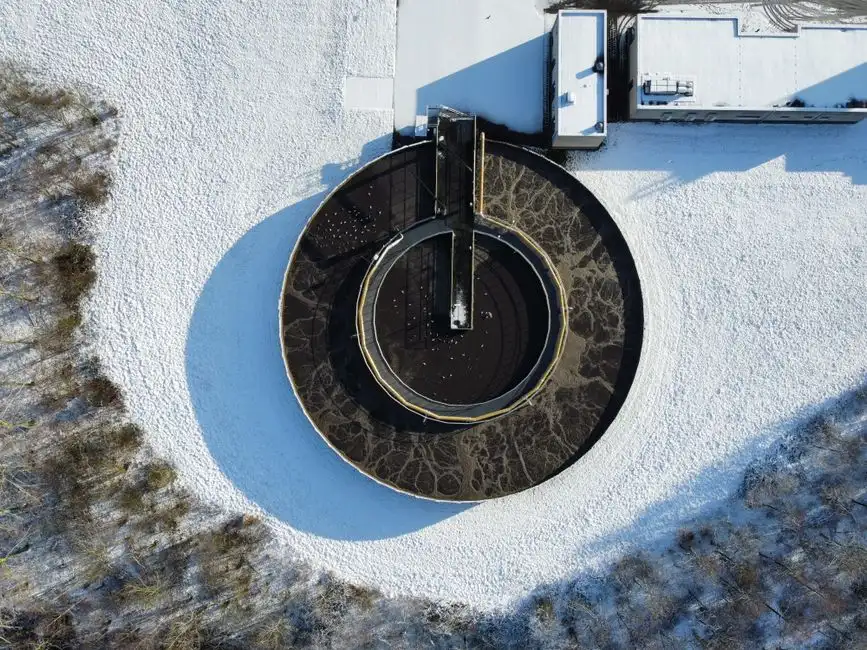
The unit operations below are the sequence I would specify for a 2026 retrofit in this region. The order is not optional — putting chemical precipitation upstream of oil removal, for example, ties up reagent as metal-soap sludge and starves the DAF of the air-attached floc it needs.
Step 1 — Source control and segregation. Keep process rinse water, machine coolant, and stormwater in separate collection systems. Never co-mix acid mine drainage with oily waste; oil coats the floc and destroys DAF performance. Segregation is the cheapest removal step you'll ever install, and it usually pays for the rest of the train inside a year.
Step 2 — Flow equalization and pH adjustment. An equalization basin sized for 8–24 hours of retention smooths slug flows and gives pH probes a stable target. NaOH or lime brings the stream into the 6.5–8.5 band that metal-precipitation chemistry needs. Lime is cheaper per pound but generates 3–5× more sludge than caustic; the trade-off is reagent cost versus solids-handling cost, and it depends on the plant's dewatering capacity.
Step 3 — Coagulation, flocculation, DAF or lamella. This stage removes TSS, oil & grease, and coagulated metals. The dissolved air flotation system covers 4–300 m³/h, which spans most small-to-mid mining and metals facilities, and has documented use in metalworking and mining-related applications. Where footprint is the binding constraint, a high-rate lamella clarifier runs at 20–40 m/h surface loading and is typically paired with the DAF for a two-stage physical-chemical front end. If you are still choosing between the two, the DAF vs. clarifier buyer's guide for mining wastewater walks through the decision logic.
Step 4 — Chemical precipitation and reactive filtration for dissolved metals. Hydroxide precipitation at controlled pH removes Cu, Zn, Ni, and Cd; sulfide precipitation works on tighter targets but is harder to control. Polishing with reactive media — sand coated with the reactant inside an upflow filter — is what gets you to microgram-per-liter. The benchmark here is the Burrillville, RI installation, where Blue PRO reactive filtration took copper to 8 µg/L (0.008 mg/L) to meet an ultra-low objective (source: nexom.com). For arsenic, ferric chloride co-precipitation is the standard approach.
Step 5 — Biological polishing for ammonia. MBBR with HDPE-carrier biofilm handles warm or moderate-strength streams; BioPorts-style MBBRs are designed specifically for "high-strength and highly-variable flows" (source: nexom.com). For cold-climate or seasonal mining flows, SAGR post-lagoon nitrification is the field-proven answer: the Northern Ontario gold mine discharge case is documented at <1°C (34°F), and there are over 100 full-scale SAGR installations across North America, some more than a decade old (source: nexom.com). The SAGR is a strategic choice when pond temperatures drop below the threshold where conventional nitrification stalls.
Step 6 — Final polishing and monitoring. A multi-media polishing filter catches any TSS excursion before the sewer and reduces SDI if the plant later adds reuse RO. Online pH and temperature on the discharge line are non-negotiable; a continuous metals analyzer on Cu and Zn is the difference between catching a slug at 4 a.m. and explaining it to VBMU on Monday morning. If rinse-water reuse is on the roadmap, the steel mill RO CAPEX and OPEX breakdown covers the economics.
| Stage | Unit Operation | Target Pollutants | Vendor-Validated Performance Anchor |
|---|---|---|---|
| 1 | Segregation / source control | Flow variability, oil, AMD | — |
| 2 | Equalization + pH adjustment | pH excursion, slug flow | 8–24 h HRT typical |
| 3 | Coag/floc + DAF or lamella | TSS, O&G, coagulated metals | DAF 4–300 m³/h; lamella 20–40 m/h |
| 4 | Chemical ppt + reactive filtration | Dissolved Cu, Zn, Ni, Cd, As | 8 µg/L Cu demonstrated (Blue PRO, Burrillville RI) |
| 5 | MBBR/IFAS or SAGR | Ammonia, nitrate | <1°C nitrification; 100+ SAGR installations |
| 6 | Multi-media polish + online monitoring | TSS excursion, compliance proof | Continuous Cu/Zn analyzer |
Matching the Right HydropureWater Equipment to Each Pretreatment Stage
Map the train to a bill of equipment a procurement team can request quotes on. The dissolved air flotation system is the workhorse for primary TSS, oil, and FOG removal ahead of any metals step; its 4–300 m³/h range covers most small-to-mid mining and metals facilities in the Van Buren area. The high-rate lamella clarifier handles sites where footprint is the binding constraint and pairs naturally with the DAF for a two-stage physical-chemical front end. For the chemistry that actually drives metals removal, a PLC-controlled coagulant and pH dosing skid is required — stable pH within ±0.2 units is the difference between hitting a metals limit and missing it by an order of magnitude. The multi-media polishing filter is the final guard before the sewer and reduces SDI for any future reuse RO. If the plant wants a high-purity rinse-water recycle loop rather than just sewer discharge, the DF series flat-sheet MBR frames the conversation beyond compliance and into water-reuse economics. The lamella clarifier installation and commissioning protocol covers startup sequencing if you are new to the technology.
Design, Permitting, and Audit Realities for a 2026 Van Buren Project
Plan for a 4–8 month pre-treatment submittal cycle. VBMU typically requires a baseline monitoring report (BMR), a slug control plan, and a chemical/material inventory before the discharge permit is issued. ADEQ's audit cycle under AR0021482 includes inspection of Significant Industrial User (SIU) files, sampling records, and enforcement response; paperwork failures trigger the same enforcement as sample failures, so chain-of-custody and self-monitoring logs need to be auditable from day one.
The cold-climate caveat is real for any plant using ponds or lagoons before biological polishing. Northern Arkansas winters drop pond temperatures into the range where conventional nitrification stalls, and the SAGR sub-1°C case is a real-world operating point, not a theoretical one (source: nexom.com). Plants that cannot tolerate seasonal ammonia excursions should size SAGR beds for worst-case loading rather than summer average.
Operator skill: MBBR and SAGR are simpler to run than activated sludge, but reactive filtration and chemical precipitation both need reliable pH and dosing control. Specify automatic dosing, a basic SCADA, and online analyzers on the discharge — the cost of instrumentation is a fraction of the cost of one SNC finding.
Frequently Asked Questions
Who regulates sewer discharges from mining and metals plants near Van Buren, AR?
VBMU (City of Van Buren Municipal Utilities) is the local POTW authority and runs the Industrial Wastewater Pretreatment Program. ADEQ audits the program under NPDES Permit AR0021482 (most recent published audit dated 2016-11-15), and federal categorical pretreatment standards under 40 CFR Part 403 apply on top of local limits wherever they are stricter.
What dissolved-copper level can a properly designed metals pretreatment train actually hit?
A staged train of chemical precipitation followed by reactive sand filtration has demonstrated copper to 8 µg/L (0.008 mg/L) at the Burrillville, RI installation, well below typical POTW local limits and most categorical standards (source: nexom.com).
Can biological ammonia removal work in winter at a Van Buren mining site with outdoor ponds?
Yes. SAGR post-lagoon nitrification has been documented operating at <1°C (34°F) at a Northern Ontario gold mine, and there are over 100 full-scale SAGR installations across North America, some more than a decade old (source: nexom.com). Specify SAGR beds sized for worst-case winter loading, not summer average.