

Why Norfolk Food & Beverage Plants Are Revisiting Pretreatment in 2026
For most Norfolk food and beverage plants in 2026, dissolved air flotation (DAF) outperforms a conventional clarifier as a primary FOG and suspended-solids removal step — DAF typically removes roughly 80% of organic load and the majority of free and emulsified oils, while a lamella clarifier needs much higher surface loading to match that. Choose a DAF first, then a lamella clarifier as a polishing step, unless your stream is low-FOG and the plant is footprint-constrained.
The reason this matters locally is that Hampton Roads Sanitation District (HRSD) treats industrial discharges from most Norfolk food and beverage plants under its Industrial Wastewater Discharge (IWD) program, with surcharge triggers tied to biochemical oxygen demand (BOD), total suspended solids (TSS), and oil and grease (O&G) — meaning a single FOG excursion can move a plant from "compliant" to "surcharged" in one shift (per HRSD IWD program, 2026). On top of that, Virginia implements the Chesapeake Bay nutrient total maximum daily load (TMDL), so nitrogen and phosphorus caps tighten every permit cycle. A food plant that only removes FOG but does not control the dissolved nitrogen it sends downstream will still be out of compliance by 2027 — this is why primary FOG removal is no longer a standalone question.
Raw food streams are strong enough that gravity alone is rarely adequate. ASABE documented mean chemical oxygen demand (COD) of 5,263 mg/L and total solids of 3,335 mg/L for raw poultry processing wastewater (ASABE, 2012). The Italian Amadori poultry retrofit — DAF pretreatment feeding an anaerobic digester, then nitrification-denitrification, then a final clarifier at 3,180 m³/d — produces 3,600 Nm³/d of methane while meeting EU effluent limits (Fluence, meat processing reference). Norfolk plants evaluating a 2026 capex should treat that train as the reference architecture, not a DAF-or-clarifier binary.
How a DAF System Actually Treats Food & Beverage Wastewater
A HydropureWater dissolved air flotation system separates contaminants by buoyancy, not by settling. Saturated water is depressurized inside the flotation tank, releasing a dense cloud of micro-bubbles ≤50 µm that attach to oil droplets, colloids, and fine suspended solids, lifting them to the surface as a float layer that a mechanical skimmer removes (Sigmadaf, oil and grease removal reference). The mechanism only works when the bubbles are small and uniformly distributed, which is the structural difference versus older air-flotation designs.
Chemistry makes the bubble stick. Coagulation followed by flocculation neutralizes the surface charge of emulsified oil and colloidal organics, so the particles agglomerate into floatable flocs that the micro-bubbles can lift (Sigmadaf). Without that polymer dose, DAF performance collapses even if the hydraulic design is perfect — this is why any DAF spec for a Norfolk food plant must be paired with an engineered coagulant/flocculant program.
By contrast, cavitated-air flotation (CAF) uses a vortex-generated bubble field and reaches only 60–80% oil removal because the bubbles are larger and irregular (Sigmadaf). CAF is useful as a low-cost pre-stage for very high-FOG streams, but it is not a substitute for a properly designed DAF on the main flotation duty.
For food and beverage streams, DAF is the right first step because it protects everything downstream. FOG that reaches a biological tank causes anoxia, and FOG that reaches membranes fouls them within hours; both failure modes are documented as common causes of unplanned downtime (Sigmadaf, 2026). Removing FOG and TSS upstream lets the biological step — whether an anaerobic digester, a moving-bed biofilm reactor, or a membrane bioreactor — run at design loading.
Capacity is not a constraint. The DAF line spans 4–300 m³/h as packaged units, so a Norfolk craft brewery at 20 m³/h and a 24/7 poultry plant at 250 m³/h can both be served from the same product family.
How a Clarifier Performs on the Same Influent
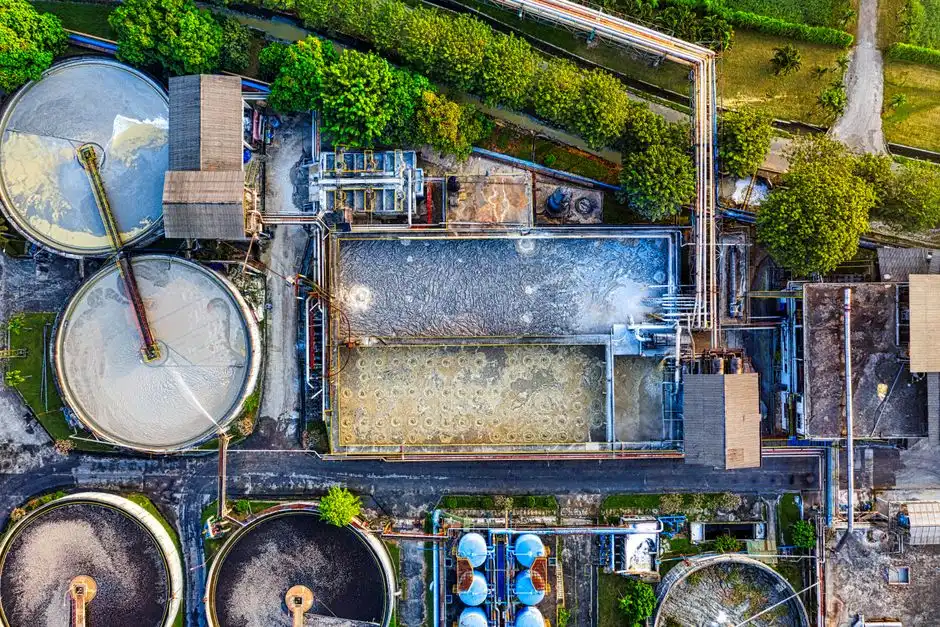
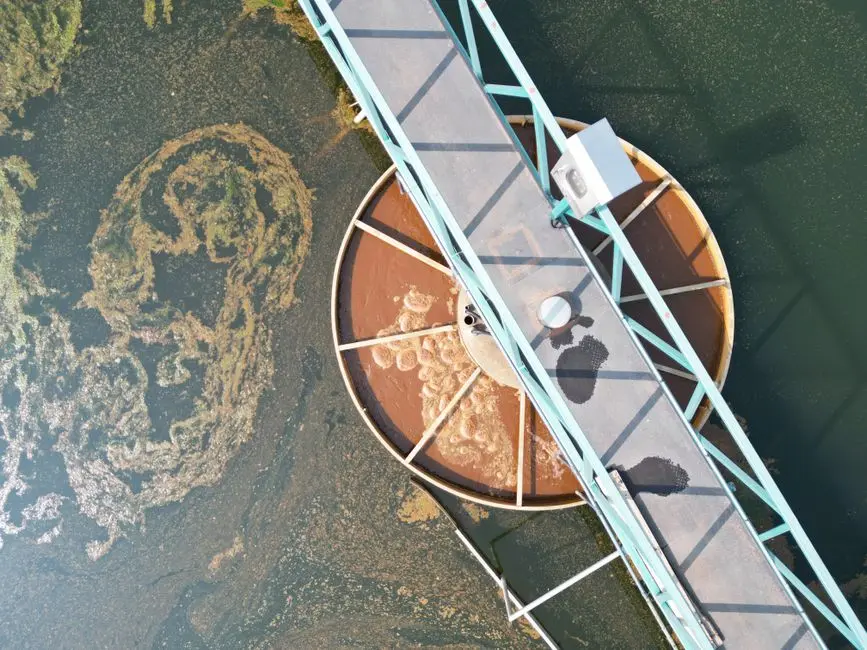
A HydropureWater high-efficiency lamella clarifier separates by density under quiescent conditions. Inclined plates at 55–60° multiply the effective settling area inside a small footprint, so suspended solids settle onto the plate surfaces and slide down to a sludge hopper while clarified water rises to the effluent launder. It is a passive device — no air system, no saturation tank, no recycle pump — which is its main operational advantage.
High-efficiency sedimentation tanks (lamella clarifiers) operate at surface loadings of 20–40 m/h and can cut coagulant and flocculant consumption by up to 30% versus conventional rectangular clarifiers treating the same stream (HydropureWater engineering data, 2026). That chemistry saving is real and worth modeling into a 10-year OPEX projection.
On a raw food wastewater stream, however, a clarifier has well-known limits. FOG is buoyant, not settleable, so a clarifier captures only the fraction of oil that has already broken out of emulsion — usually a small share. Free oil can be skimmed from the surface, but emulsified oil passes straight through to the downstream biological stage. Footprint is the second constraint: matching DAF-class hydraulic throughput with a clarifier alone usually requires a tank two to three times larger than the equivalent DAF, which is a non-starter for brownfield Norfolk sites.
Where the clarifier wins is downstream of a DAF, or on streams that are genuinely low in FOG and high in settleable solids — think of a beverage bottling line after bottle-wash breakout, or a seafood plant where most solids are shells and fines rather than emulsified fat.
DAF vs Clarifier: Head-to-Head Comparison for Food & Beverage Streams
Putting both units on the same influent is the only honest way to compare them. The matrix below uses Fluence's meat-processing figures for DAF, HydropureWater catalog figures for the lamella clarifier, and Sigmadaf's flotation-mechanism data for the physical limits:
| Parameter | DAF (primary) | Lamella Clarifier (primary) | DAF → Lamella (combined train) |
|---|---|---|---|
| FOG / O&G removal | ~80–95% (with chemistry) | Low on emulsified oil; skim of free oil only | ~90–99% |
| TSS removal | ~70–90% | ~50–75% | ~85–95% |
| Organic load (BOD/COD) removal | ~80% organic load; 65% nitrogen (meat processing, Fluence) | Modest, limited to settleable fraction | ~85–90% before biology |
| Hydraulic / surface loading | 5–25 m/h typical | 20–40 m/h (HydropureWater) | 5–25 m/h on DAF; lamella polishes overflow |
| Footprint for 50 m³/h | ~3–6 m² tank footprint | ~8–15 m² including plate pack | Compact: lamella is half the size it would be standalone |
| Chemical demand | Coagulant + flocculant required | Up to 30% less chemistry (HydropureWater) | Chemistry on DAF only; lamella runs light |
| Energy use | Saturation pump, recycle pump, skimmer drive | Sludge scraper only — very low kWh | DAF energy dominates; lamella adds little |
| CAPEX band | Moderate (packaged unit, controls) | Low to moderate | Highest absolute, lowest per m³ treated |
| OPEX band | Driven by chemistry and compressed air | Lowest of the three | Net lower than DAF-only at high FOG |
| Best-fit stream | High FOG, emulsified oils, variable loads | Low FOG, high settleable solids, stable flow | Most Norfolk food & beverage plants |
Two data points anchor the table. First, Fluence's meat-processing reference reports DAF removing ~80% of organic load and ~65% of nitrogen load before anaerobic digestion — a clarifier alone does not approach those numbers on the same stream (Fluence). Second, ASABE's pre-DAF poultry study measured raw COD of 5,263 mg/L, with the 100 kDa ultrafiltration membrane reaching 89% COD reduction on the DAF-pre-treated stream — confirming that DAF is what makes the downstream biology or membrane work (ASABE, 2012).
Sigmadaf's analysis is direct: of the available flotation and settling options, DAF is the most effective single step for FOG, and very high FOG streams may need a CPI or CAF pre-stage feeding the DAF. The combined DAF → lamella train is the proven food-industry pattern — Amadori's 3,180 m³/d retrofit uses exactly that sequence (Fluence).
Matching the Choice to Specific Food & Beverage Subsectors in Norfolk
Poultry and meat processors in the Norfolk port region should treat DAF as effectively mandatory. Raw COD of 5,263 mg/L and the FOG fraction are too high for a clarifier to do the primary job (ASABE, 2012), and the floated sludge is a real asset: Fluence Italy reports 1 ton of floated sludge at 10% solids can yield up to 60 m³ of methane through anaerobic digestion (Fluence). In a 2026 capex, that biogas line can offset a meaningful share of pretreatment OPEX and turns a waste-stream problem into a revenue line.
Dairy processors, breweries, and beverage bottlers usually land on DAF primary plus lamella polishing. These streams have lower but variable FOG — milk fat, yeast residuals, syrup carryover — and a lamella clarifier after the DAF catches the fine TSS and any chemical floc that escapes the float, which protects the downstream biological or membrane stage. Flow equalization upstream of the DAF is a must for dairies because clean-in-place cycles produce slug loads.
Seafood processors and condiment manufacturers need a decision rule rather than a default. If the FOG fraction is high (tuna broth, mayonnaise washwater), lead with DAF. If the stream is mostly settleable solids — shells, bone fragments, starch — a lamella clarifier may suffice as the primary, with DAF held in reserve for the higher-FOG days. In all cases, an engineered HydropureWater automatic chemical dosing system is required to make the DAF perform consistently — charge neutralization is what carries the design removal rates.
2026 Cost, Footprint and Compliance Considerations in Norfolk
CAPEX drivers on a packaged DAF in the 4–300 m³/h range are tank material (carbon steel vs. 304/316 stainless for salty or acidic food streams), skimmer type, controls and instrumentation, and whether a chemical skid is bundled. Adding a lamella polishing unit doubles the tank count but the lamella cost is modest relative to the DAF, so the combined train's CAPEX is closer to 1.3–1.5× a DAF-only system rather than 2×.
OPEX tilts in favor of the combined train at high FOG. A DAF alone carries full coagulant and flocculant load plus air-saturation pump energy; a lamella clarifier alone saves up to 30% in chemistry (HydropureWater) but lets too much FOG through. The DAF → lamella combination concentrates chemistry where it pays off (the DAF) and runs the lamella lean, so net OPEX is often lower than either unit alone on a food stream — worth a 10-year NPV before the equipment-selection meeting.
Compliance is the third lens. Two physical barriers in series — DAF then lamella — give HRSD two chances to catch a FOG or TSS excursion before it hits the sewer, and the low-FOG, low-TSS overflow feeds a biological step well enough to keep total nitrogen under the Chesapeake Bay TMDL trajectory. A 2026 design should also include headworks screening for PFAS, because U.S. food-industry pretreatment programs are tightening around emerging contaminants and a headworks tap is the cheapest place to sample. If your plant is a candidate for the related DAF or clarifier for petroleum wastewater in Baltimore guide, the selection logic is similar but the chemistry is heavier on the emulsion-breaking side.
A Practical 2026 Selection Flowchart for Your Plant
Walk these four steps in order, and you can walk into a vendor meeting with a defensible specification.
- Characterize the influent. Pull at least one week of composite samples for FOG, TSS, BOD/COD, and flow. If FOG is above ~200 mg/L or COD is above ~3,000 mg/L, lead with DAF. Below those thresholds, a lamella clarifier may be enough as primary.
- Check the footprint and existing tanks. If you are retrofitting an old rectangular clarifier, keep it as a polishing step downstream of a new DAF rather than scrapping it. Brownfield Norfolk sites rarely have room for two primary units; this is a cheaper path than rip-and-replace. For tank-retrofit detail, the lamella clarifier retrofit and upgrade 2026 guide walks through plate-pack conversions.
- Look at the downstream biology. If an anaerobic digester or membrane bioreactor is in scope, DAF upstream is non-negotiable — Fluence's Amadori case shows the digester is what produces the 3,600 Nm³/d methane revenue, and that digester only performs because the DAF has already pulled the FOG.
- Lock the discharge targets. Confirm HRSD IWD limits and Virginia DEQ permit conditions before final sizing. Pick the train that meets them with margin — designing to the line is how plants end up surcharged. A reference case for international food plants is the food processing wastewater treatment in Cameroon case, which shows the same DAF-led train under different discharge rules.
Frequently Asked Questions
Is a DAF alone enough, or do I still need a clarifier after it?
A DAF alone will hit HRSD FOG and TSS limits on most Norfolk food and beverage streams — Fluence reports ~80% organic-load removal in meat processing with a DAF as the first stage. A lamella clarifier downstream is a polishing step that catches fine TSS and chemical floc the DAF misses, and it materially reduces the risk of an HRSD surcharge on a high-FOG day.
What is the typical FOG removal rate a food plant should expect from a DAF?
With proper coagulant and flocculant dosing and micro-bubbles ≤50 µm, a well-operated DAF removes 80–95% of oils and greases from food processing wastewater (Sigmadaf). Streams above ~1,000 mg/L FOG should consider a CPI or CAF pre-stage feeding the DAF to keep the float layer manageable.
Why is DAF usually paired with a clarifier instead of replacing it?
Because they do different jobs. DAF lifts FOG and fine suspended solids by buoyancy, while a lamella clarifier settles heavier settleable solids and any chemical floc that escapes the float under quiescent conditions. The DAF → lamella train gives two physical barriers in series, which is why Amadori's 3,180 m³/d poultry retrofit ends with a final clarifier after DAF and biological treatment (Fluence).
What pretreatment rule applies to a Norfolk food plant discharging to HRSD?
Discharges to HRSD fall under the Industrial Wastewater Discharge (IWD) program, which sets local limits and surcharges on BOD, TSS, and oil and grease, and operates inside Virginia's Chesapeake Bay TMDL framework for nitrogen and phosphorus. A DAF-led train sized with margin against those limits is the standard 2026 approach for poultry, dairy, and brewing plants in the service area.
What role does chemistry play in DAF performance?
Chemistry is what makes DAF work. Coagulation followed by flocculation neutralizes the surface charge of emulsified oil and colloidal organics so they agglomerate into floatable flocs that micro-bubbles can lift (Sigmadaf). Without an engineered coagulant/flocculant program — typically delivered via a packaged automatic dosing skid — DAF removal rates collapse to a fraction of design.