
Why Burlington Pharma Plants Are Rethinking Primary Clarification in 2026
Burlington's municipal pretreatment program enforces BOD, TSS, FOG, and pH ceilings on industrial discharges; surcharge triggers start around 250 mg/L TSS and 100 mg/L FOG in the city's sewer use ordinance, with enforcement escalation through Vermont ANR when limits are exceeded. That local pressure is colliding with two new drivers in 2026: the Lake Champlain phosphorus TMDL, which is pushing Burlington-area plants toward lower-total-phosphorus effluent and tighter upstream solids capture, and a wave of contract-manufacturing and API synthesis expansion in the Champlain Valley that is adding fermenter broth, mother-liquor, and tablet-coating washwater to the same POTW headworks.
Flow profiles at a typical Burlington API or formulation site rarely look like a textbook municipal average. A single shift can swing from 200 mg/L TSS washwater out of a coating pan to a 3,000 mg/L mother-liquor spill from a centrifuge, with intermittent solvent traces that depress dissolved oxygen downstream. The primary clarifier has to absorb that variability without dragging the biological stage or the membrane polish down with it. At the same time, several Burlington sites are pursuing water reuse for CIP and cooling make-up, which raises the bar on clarified-water quality ahead of RO or MBR. A primary step chosen on capital cost alone will fail both the local compliance test and the reuse test; the choice must match the chemistry and hydraulics of the specific pharma stream.
How DAF Works vs How a Clarifier Works
DAF and gravity clarification solve the same problem using different physical principles. A HydropureWater dissolved air flotation system saturates a pressurized recycle stream with air — typically 4-6 bar through a regenerative turbine like the PEWE Rogue RGT or a compressor-based micro-bubble generator producing 20-40 micron bubbles (per PEWE USA and DAF Corp MBG published data). When the saturated recycle is released into the main flotation tank at atmospheric pressure, the dissolved air comes out of solution as a dense cloud of micro-bubbles that attach to floc particles and float them to the surface in roughly 15-25 minutes of hydraulic retention. A surface skimmer sweeps the float into a hopper; clarified water exits under a baffle wall.
A HydropureWater high-efficiency lamella clarifier relies on gravity settling of chemically flocculated solids over a 2-4 hour retention window. Lamella plates multiply the effective settling area, pushing surface loading rates into the 20-40 m/h range that would be impossible in an open tank of the same footprint. The trade-off is that anything buoyant — emulsified oil, mycelia, fats, light polymer floc — never settles; it either rides the overflow weirs or forms a scum blanket that must be managed separately.
This physical contrast dictates the selection. DAF micro-bubbles also strip free and emulsified oil, which is why DAF dominates food, FOG, and petrochemical applications and is now specified for API mother-liquor streams with solvent carryover. Clarifiers need stable, dilute, low-FOG feeds; they underperform when fats, oils, or mycelia are present because buoyant material never reaches the sludge bed. Hydraulically, DAF tolerates 1.5-2x peak flow swings with limited efficiency loss, while conventional clarifiers shed suspended solids at peak flow because the plate pack cannot load fast enough.
DAF vs Clarifier for Pharma Wastewater: Head-to-Head Comparison
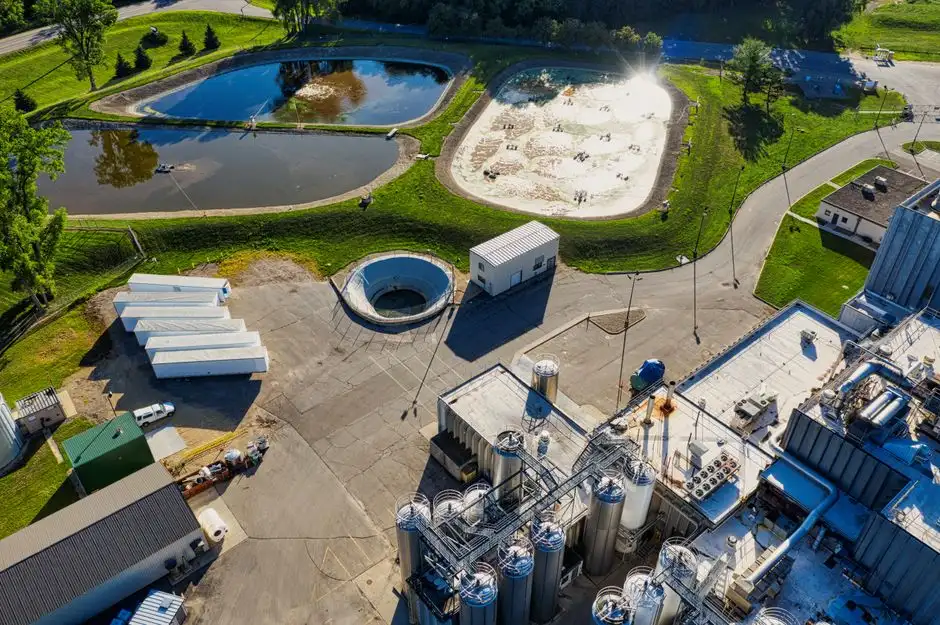
The decision for Burlington pharma buyers hinges on a handful of operational parameters. The table below compares a 10-20 m3/h DAF and a similarly rated lamella clarifier on the metrics that drive specification.
| Parameter | DAF (skid-mounted) | Lamella Clarifier | Conventional Gravity Clarifier |
|---|---|---|---|
| TSS removal | 85-98% (DAF Corp FC Maximizer; Dagyee 2026 spec) | 60-85% | 40-70% |
| FOG removal | >90% (PEWE USA; DAF Corp MBG) | Near 0% for emulsified oil | Near 0% for emulsified oil |
| Footprint at 20 m3/h | ~3 m x 1.4 m (Dagyee DAF-020) | ~4 m x 2 m plus sludge zone | ~6 m x 3 m minimum |
| Hydraulic retention | 15-25 min | 2-4 h | 4-8 h |
| Peak flow tolerance | 1.5-2x average with limited efficiency loss | Drops sharply above 1.2x average | Cannot handle surges |
| Chemical demand | Coagulant + polymer for fine-bubble attachment | Flocculant only | Flocculant only |
| Sludge consistency | 2-4% (DAF Corp) | 0.5-1.5% | 0.5-1.5% |
| CAPEX band (10-20 m3/h, 2026) | $90K-180K turnkey (PEWE-style packaged) | $40K-90K | $30K-70K plus civil |
| Best-fit pharma stream | API synthesis, fermentation, FOG-laden formulation, variable flow | Low-TSS formulation, polishing, reuse pre-filtration | Legacy sites with low loading and no FOG |
A HydropureWater dissolved air flotation system outperforms on FOG, footprint, hydraulic tolerance, and sludge thickening, while a HydropureWater high-efficiency lamella clarifier is superior for chemical simplicity and CAPEX. These technologies are not mutually exclusive; at higher-loaded sites, DAF as primary and lamella as polish satisfies both Burlington POTW surcharge thresholds and Lake Champlain phosphorus targets.
Three Burlington-Style Scenarios and the Right Pick
Applying this matrix to a specific plant environment clarifies the ideal technology choice for common Burlington-area scenarios.
Scenario 1 — API synthesis site, mother-liquor and solvent residues. Influent runs 800-2,000 mg/L TSS with intermittent solvent spikes from centrifuge discharges. The plant needs to reduce loading to the biological stage and protect a downstream MBR. A HydropureWater dissolved air flotation system delivers 90-95% TSS removal and strips emulsified solvent residues through micro-bubble attachment, which a clarifier cannot match. Sized at 15 m3/h with a 1.5x peak factor, it brings the effluent below the Burlington POTW surcharge trigger and inside Vermont ANR's anticipated industrial phosphorus guidance.
Scenario 2 — Solid-dose formulation and tablet-coating plant. Washwater is dilute, below 300 mg/L TSS, with no FOG and stable pH. A HydropureWater high-efficiency lamella clarifier saves roughly $50K-100K versus a DAF install, skips polymer dosing, and fits inside an existing building without tank extension. The trade-off is that any future addition of fermentation or solvent streams will force a re-spec — but in 2026, with no FOG source, the lamella is the right CAPEX call.
Scenario 3 — Contract manufacturer with mixed streams and intermittent CIP surges. Peak TSS hits 1,500-3,000 mg/L during CIP releases, with shift-to-shift variation that no single clarifier can smooth. The right configuration is a HydropureWater dissolved air flotation system as primary sized for 1.5x average peak flow, followed by a HydropureWater high-efficiency lamella clarifier as polish, with a HydropureWater automatic chemical dosing system managing coagulant and polymer feed. The DAF absorbs the surge and thickens sludge to 2-4%, the lamella catches the residual TSS for reuse-grade water, and the dosing skid keeps polymer consumption predictable. This combination satisfies Burlington POTW discharge objectives and positions the site for a downstream RO or MBR polish.
2026 CAPEX, OPEX, and Footprint Bands for Burlington Pharma Buyers
The following table reflects 2026 packaged pricing for the 10-20 m3/h size class typical for Burlington pharma sites.
| Cost Line | Skid-Mounted DAF (10-20 m3/h) | Lamella Clarifier (10-20 m3/h) |
|---|---|---|
| Equipment CAPEX (turnkey) | $90K-180K | $40K-90K |
| Civil / installation | 15-20% of equipment (small footprint) | 20-30% of equipment (larger footprint, longer install) |
| Polymer / flocculant OPEX | $0.02-0.05 per m3 treated | $0.01-0.03 per m3 treated |
| Energy (air-saturation pump) | 0.4-0.8 kWh per m3 | Negligible |
| Downstream biosolids handling | Lower — sludge at 2-4% consistency (DAF Corp) | Higher — sludge at 0.5-1.5% |
| Typical payback (DAF replacing overloaded clarifier) | 12-24 months via lower hauling, fewer polymer corrections, avoided POTW surcharges | — |
Budget 15-20% on top of equipment cost for installation, instrumentation, and Burlington-Vermont electrical and plumbing code compliance. Use the HydropureWater dissolved air flotation system and HydropureWater high-efficiency lamella clarifier spec sheets for the budget RFQ; vendors will price around the same envelopes once site-specific EQ tanks, controls, and chemical skids are added.
A 2026 Procurement Checklist for Burlington Pharma Decision-Makers
- Map your influent before talking to vendors — TSS, FOG, COD, pH, flow variability, solvent traces — and pull a 24-hour composite if the Burlington POTW pretreatment team hasn't already asked for one.
- Request a jar test or on-site pilot; DAF Corp's FC-60 pilot runs 48 gpm at 2,000 ppm loading, which is the right size for a Burlington pharma sidestream test.
- Verify NSF/ANSI 61 or FDA food-grade materials of construction if any stream contacts drug product, even indirectly through shared utility water.
- Specify a HydropureWater dissolved air flotation system or HydropureWater high-efficiency lamella clarifier with skidded controls, PLC data logging, and remote monitoring for 24/7 unattended operation.
- Pair the primary step with a HydropureWater automatic chemical dosing system and a HydropureWater multi-media filter downstream if clarified water is destined for CIP or cooling reuse.
Frequently Asked Questions
When is DAF the right primary clarifier for a Burlington pharmaceutical plant?
Choose DAF when
Frequently Asked Questions
Should a pharmaceutical plant in Burlington choose DAF or a clarifier in 2026?
The selection depends primarily on the density and flocculation characteristics of the pharmaceutical solids. In 2026, Dissolved Air Flotation (DAF) is preferred for wastewater containing high concentrations of lighter-than-water oils, fats, or biological solids that settle slowly, whereas lamella clarifiers are superior for dense inorganic precipitates or heavy metal hydroxides common in chemical synthesis processes.
What TSS removal rate can a DAF achieve on API wastewater?
When optimized with appropriate polymer dosing and hydraulic loading rates, a DAF system can achieve Total Suspended Solids (TSS) removal efficiencies of 85% to 95% for typical Active Pharmaceutical Ingredient (API) wastewater streams. Actual performance depends on the particle size distribution and the specific gravity of the API compounds present.
How much does a 20 m3/h DAF cost for a pharma plant in 2026?
In 2026, a high-spec stainless steel 20 m3/h DAF system designed for pharmaceutical-grade sanitation requirements typically ranges from $120,000 to $180,000 USD. This price includes the saturation tank, air compressor, scraper mechanism, and PLC controls, but excludes installation, civil works, and onsite chemical storage systems.
When is a lamella clarifier a better choice than a DAF for pharma?
A lamella clarifier is the better choice when the wastewater contains high levels of heavy, non-buoyant solids or when the footprint must be minimized in a plant where the wastewater stream has a specific gravity significantly greater than 1.05. Additionally, if the process requires the recovery of valuable metal catalysts, the gravity-based separation in a clarifier is often more efficient for sludge thickening and solids reclamation.
Do Burlington POTW discharge limits require a DAF for pharmaceutical manufacturers?
Burlington POTW (Publicly Owned Treatment Works) discharge limits focus on mass loading and concentration caps for BOD, COD, and TSS. While a DAF is not explicitly mandated by regulation, the stringent local limits on TSS and oil/grease often make DAF technology the most reliable path to compliance without incurring heavy surcharges or risking permit violations during peak production cycles.