Why Bakery Wastewater Pushes Conventional Treatment to Its Limits
Commercial bakeries produce a distinctive wastewater profile that defeats generic biological treatment trains. Butter, margarine, shortenings, fillings, sugar, and flour drive influent BOD to 1,000–3,000 mg/L, TSS to 400–1,200 mg/L, and FOG to 200–800 mg/L — well above what a municipal POTW is designed to accept in a single factory discharge (per Ecologix, 2025). More than half of the water used inside a bakery becomes oxygen-deficient sewage, with organics and FOG loading that outstrips the receiving treatment plant's aeration capacity within a single shift (per FoodSafeDrains, 2025).
The waste stream is nontoxic but highly acidic, and pH swings violently after every clean-in-place (CIP) cycle as lye and acid detergents alternate through the drain. Conventional activated sludge biomass responds to these excursions by losing floc structure, foaming, and losing nitrification capacity. A standard aeration basin sized for steady municipal sewage cannot absorb the slug loads a bread line or donut fryer generates at shift change.
The economic driver is no longer compliance alone. POTWs are applying increasing surcharges for high-strength BOD, FOG, and ammonia, and pretreatment enforcement under 40 CFR 403 is intensifying in 2026 as utilities tighten local limits to protect their own biological capacity. A bakery facing $0.20–$0.80 per pound of excess BOD surcharged by its POTW recovers the capex of a polishing step inside three to seven years, even before reuse credits are counted.
How MABR Works and Why It Fits Food Industry Effluent
A membrane aerated biofilm reactor (MABR) is an aerobic biological reactor in which a gas-permeable membrane delivers oxygen passively to a biofilm growing on the membrane's outer surface (per Fluence, 2025). The membrane envelope is spirally wound and self-respiring: air at a small positive pressure on the lumen side diffuses outward through the wall, while substrate (BOD, ammonia) diffuses inward from the surrounding mixed liquor. The two gradients meet inside the biofilm, producing an aerobic layer at the membrane and an anoxic/anaerobic layer facing the bulk liquid.
This counter-diffusion geometry is the engineering reason MABR enables simultaneous nitrification-denitrification (SND) in a single tank. Nitrifiers colonize the oxygen-rich inner biofilm; denitrifiers colonize the outer anoxic zone, with the bulk mixed liquor supplying the carbon. Conventional food industry plants that need nutrient removal must run a multi-chamber A/O or A2O train with internal recycles; an MABR collapses that into one basin at ambient pressure.
Aeration is passive. No blowers, no fine-bubble diffusers, no mechanical surface aerators. The air supply is metered to the membrane at near-atmospheric pressure and pulsed periodically for mixing. Field data from operating MABR installations show aeration energy up to 90% lower and overall plant energy up to 50% lower than a conventional activated sludge system performing equivalent treatment (per Fluence, 2025). For a bakery with a 25–40 °C warm effluent, that band is comfortably inside the MABR biofilm's working envelope and avoids the elevated-temperature fouling penalties seen in some MBR plants.
Where MABR Sits in a Bakery Wastewater Train
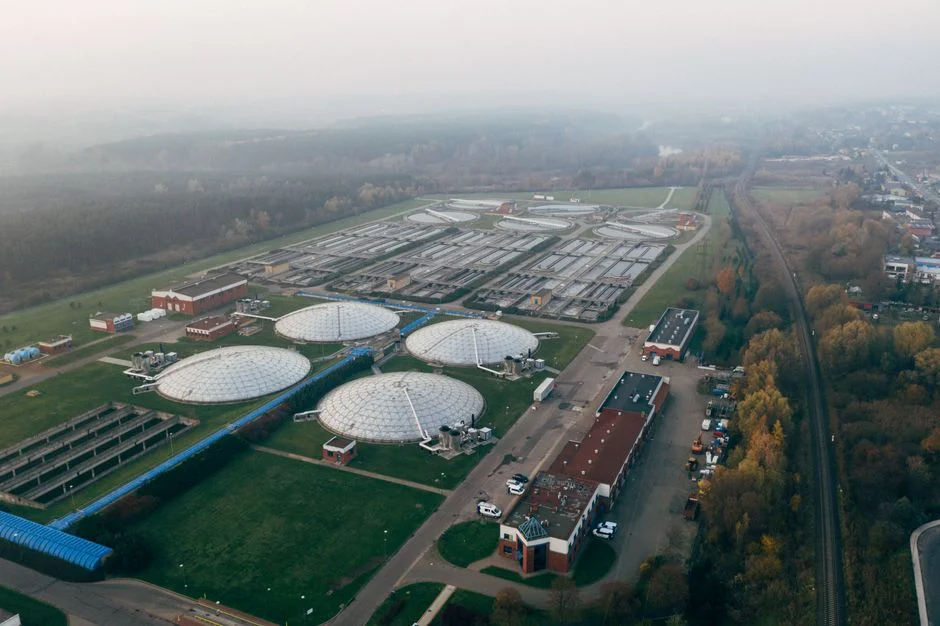
A 2026 bakery treatment train runs in five stages: rotary bar screening for hairnets, packaging, and large debris; equalization with pH control to dampen CIP swings; Enhanced DAF for FOG and TSS; MABR for soluble BOD, ammonia, and total nitrogen; and optional chlorine dioxide polishing or RO for reuse-eligible water (per Ecologix, FoodSafeDrains, and Fluence).
The DAF step is non-negotiable. An Enhanced DAF removes up to 99% of FOG and up to 97% of TSS (per Ecologix, 2025), dropping the load on the downstream MABR membrane to a level that prevents grease fouling. Without that upstream cut, residual FOG coats the membrane envelope, blocks oxygen transfer, and starves the biofilm. A properly sized DAF with a skimmer rated for peak-shift loading is the standard protection.
After DAF, MABR pilots in the food sector have consistently produced BOD below 10 mg/L, total nitrogen below 5 mg/L, and total phosphorus below 1 mg/L — with the Stanford and CENTA pilots pushing TN below 3 mg/L and TP below 0.3 mg/L (per Fluence, 2025). That effluent quality clears the bar for California Title 22 reuse, supporting toilet flushing, landscape irrigation, and cooling-tower make-up after a downstream disinfection pass. For a deeper view of how this train fits alongside other food industry streams, the broader food processing wastewater treatment technical guide provides context on sizing and integration across multiple plant types.
MABR vs MBR vs Conventional Activated Sludge for Bakeries
A 2026 bakery engineer choosing a biological polishing step needs a single page that compares the three options on the criteria the CFO and EH&S director will ask about. The table below uses Fluence pilot data for the MABR column and standard food-industry design values for MBR and CAS.
| Parameter | MABR | MBR | Conventional Activated Sludge | SBR |
|---|---|---|---|---|
| Typical footprint (per m³/d) | 0.05–0.15 m² | 0.10–0.20 m² | 0.30–0.60 m² | 0.20–0.40 m² |
| Effluent total nitrogen | <3 mg/L (Stanford pilot); 4.1 mg/L (CENTA pilot) | <5 mg/L with post-anoxic | 10–20 mg/L without tertiary | 8–15 mg/L without tertiary |
| Effluent total phosphorus | <0.3 mg/L (Stanford); 0.4 mg/L (CENTA) | <0.5 mg/L with coagulant | 1–3 mg/L without chemical P | 1–3 mg/L without chemical P |
| Aeration energy vs CAS | Up to 90% lower | 20–40% lower (with scour) | Baseline | 10–20% lower |
| FOG tolerance upstream | Requires DAF to <50 mg/L FOG | Requires DAF to <30 mg/L FOG | Tolerates up to 100 mg/L with acclimation | Tolerates up to 100 mg/L with acclimation |
| Reuse suitability | Title 22 eligible with downstream ClO₂/RO | Near-potable after RO | Irrigation only, typically | Irrigation only, typically |
| Relative capex band (200 m³/d) | $$ | $$$ | $ | $$ |
For bakeries in the 10–2,000 m³/d band that need nutrient polishing and a reuse-eligible effluent, MABR is the most cost-effective single-tank option. MBR is justified only when the site needs near-potable reuse and has the footprint and budget for membrane scour aeration and chemical cleaning. Conventional activated sludge and SBRs remain defensible where capex dominates and reuse is not a 2026–2030 priority. For sites that already operate a CAS basin short on capacity, retrofitting with submerged MABR modules in the existing basin upgrades nutrient removal without adding methanol or external carbon. For more on the comparable nitrogen-removal train in a related industry, the beverage wastewater nitrogen removal engineering guide covers a similar retrofit decision.
Operating Sensitivities Specific to Bakery Effluent
Three failure modes drive 2 a.m. service calls on bakery biological systems, and each can be engineered out at the design stage. First, quaternary ammonium sanitizers used in CIP inhibit biological growth even at trace levels and will collapse a nitrifying biofilm within days (per FoodSafeDrains, 2025). Rotate peracetic acid or hydrogen peroxide into the sanitation program, and route any quat sanitizer rinses to a holding tank for decay before they reach the MABR.
Second, pH excursions after lye or acid cleaning will push the train outside the 6.5–8.0 window that MABR biomass tolerates. Install equalization with automated pH adjustment upstream of both the DAF and the MABR so that a single 30-minute slug from a CIP does not propagate. A dosing system sized for peak CIP flow keeps the band locked without operator intervention.
Third, FOG slugs after a shift change overwhelm the DAF skimmer and pass grease into the MABR. Route all CIP rinses through the DAF first, never directly to biological treatment, and size the DAF skimmer for the 90th-percentile peak-shift loading rather than the daily average. Bakery effluent runs warm at 25–40 °C, which is inside the MABR biofilm's working range and well above the threshold where MBR membranes begin to foul faster, so temperature is an ally here rather than a constraint. For an end-to-end view of pretreatment safeguards, the 2026 POTW pretreatment compliance guide for food and beverage plants walks through the enforcement landscape that drives these safeguards.
Sizing, Energy, and ROI Snapshot for a 200 m³/d Bakery
A representative mid-size commercial bakery discharges roughly 200 m³/d with influent BOD around 1,500 mg/L, TSS around 600 mg/L, and FOG around 300 mg/L — consistent with commercial bakery profiles cited by Ecologix. After Enhanced DAF, the load on the MABR drops to BOD around 300–500 mg/L, TSS below 30 mg/L, and FOG below 30 mg/L.
For a 200 m³/d flow, a containerized MABR skid in the Aspiral-style form factor is the fastest deploy: factory-tested, weatherized, and movable if the bakery relocates (per Fluence, 2025). For larger bakeries or co-located food parks, basin-based SUBRE retrofits cover 2,000–100,000 m³/d. The energy math is direct: with up to 50% overall energy reduction versus CAS, a 200 m³/d bakery saves an estimated 200–400 kWh/d, equivalent to several thousand dollars per year at 2026 industrial tariffs. These are directional numbers; site-specific results depend on tariff structure, influent temperature, and reuse pumping energy.
The reuse upside is the more interesting ROI lever. With TN below 3 mg/L and TP below 0.3 mg/L (Stanford pilot), the MABR effluent is Title 22-eligible for toilet flushing, irrigation, and cooling-tower make-up after a downstream ClO₂ or RO polish. For a 200 m³/d bakery, redirecting 30–60% of the effluent to reuse can offset a comparable fraction of incoming freshwater cost, which carries a 5–10 year payback on the polishing train at most U.S. industrial water tariffs.
Choosing the Right MABR Configuration for Your Bakery
For a bakery under 50 m³/d, a containerized MABR skid delivers the fastest deploy and the lowest on-site civil work. Factory-tested, weatherized, and movable if the bakery relocates, this form factor matches single-site artisan bakeries and satellite commissary kitchens (per Fluence, 2025).
For 50–500 m³/d with reuse goals, a basin-based MABR tower with an upstream Enhanced DAF is the most cost-effective retrofit, sized using the SUBRE 2,000–100,000 m³/d band as a reference point. Existing CAS basins short on capacity can be retrofitted with submerged MABR modules rather than built new; gains in nutrient removal come without adding methanol or external carbon. For a packaged turnkey reference, the prefabricated packaged food-processing wastewater plant selection guide walks through the procurement and commissioning workflow.
For strict Title 22 or near-potable reuse, pair the MABR with a downstream RO or ClO₂ polishing step. The MABR handles organics and nutrients; the polishing step handles pathogens and dissolved solids. A headworks rotary bar screen ahead of the DAF keeps fibrous debris from blinding the screens, and a chlorine dioxide generator sized for the polishing flow provides the pathogen kill without bromate formation that chlorine would introduce.
Frequently Asked Questions
Can MABR handle bakery FOG directly, or is DAF required first?
DAF upstream is required. MABR's oxygen-transfer membrane fouls rapidly when exposed to emulsified FOG, so the upstream DAF must drop FOG into the 10–50 mg/L range before water reaches the MABR. The MABR then polishes soluble BOD and ammonia without fouling.
What reuse applications can a bakery pursue with MABR effluent?
With TN below 3 mg/L and TP below 0.3 mg/L (Stanford pilot, per Fluence, 2025), Title 22 reuse for toilet flushing, irrigation, and cooling-tower make-up is feasible, often paired with a downstream RO or ClO₂ polish for pathogen and dissolved-solids control.
How much energy does a bakery MABR system save?
Aeration energy runs up to 90% lower than conventional activated sludge, and total plant energy runs up to 50% lower, because the MABR delivers oxygen passively through the membrane rather than via blowers or fine-bubble diffusers (per Fluence, 2025).
Will quaternary ammonium sanitizers from CIP kill the biofilm?
Yes, even trace levels inhibit growth and can collapse a nitrifying biofilm within days (per FoodSafeDrains, 2025). Rotate peracetic acid or hydrogen peroxide into the sanitation program, and route any quat sanitizer rinses to a holding tank for decay before discharge to the MABR.
What flow band is MABR economically justified for?
Containerized MABR units suit single-site bakeries in the 10–500 m³/d range, while SUBRE-style basin retrofits suit centralized food-park plants of 2,000–100,000 m³/d. Below 10 m³/d, packaged aerobic systems remain more cost-effective; above 100,000 m³/d, conventional activated sludge with MABR polishing becomes the standard reference design (per Fluence, 2025).