Why Kinshasa Hotels Need a Purpose-Built Sewage Treatment System in 2026
A Kinshasa hotel or resort in 2026 needs a buried package sewage treatment plant (WSZ A/O series) for sites under roughly 80 m³/day, or an MBR membrane bioreactor system for properties targeting water reuse or discharging near Congo River tributaries. Both must be sized at 180–250 L per guest-night, deliver effluent BOD ≤30 mg/L and TSS ≤30 mg/L, and tolerate routine grid outages of 4–8 hours through an integrated buffer tank and PLC auto-restart.
No published engineering guide currently addresses hotel wastewater in the DRC capital. The search results for this query return travel listings, Marriott brand pages, and unrelated research — not a sizing methodology, a technology comparison, or a compliance map. The closest formal documentation of Kinshasa's hospitality built environment is a 2015 University of Michigan archival file on "Hotel ABC, Kinshasa" (source: University of Michigan Library, 2015), which confirms that resort-class construction has been documented for over a decade. The current market is active: Tripadvisor lists Aqua Splash Water Park Resort and approximately ten resort-class properties around the city, and Marriott's Protea Hotel Kinshasa confirms that international-brand compliance expectations now apply to the market (source: marriott.com; tripadvisor.com Kinshasa resort list).
Three Kinshasa-specific drivers make off-the-shelf municipal advice inadequate. First, intermittent grid power requires buffer capacity and PLC auto-restart, not a continuously aerated conventional activated-sludge basin. Second, year-round ambient temperature of 25–32°C accelerates biological kinetics by an estimated 30–50% versus temperate design assumptions, but also accelerates septic odor and grease hydrolysis upstream of the biological stage. Third, peri-urban plots have limited set-back distance, pushing designers toward buried or semi-buried skids with sealed, vented covers. The public-health case for on-site disinfection is reinforced by an Austin Publishing Group 2014–2017 study that documented DRC general-population HIV prevalence of approximately 1.2% and a 9.3% prevalence among MSM recruited in Kinshasa hotels, bars, and nightclubs (source: Austin Publishing Group, ajid-v9-id1062) — open discharge of untreated sewage near guest areas is not a defensible specification.
Influent Characteristics: What Hotel Sewage in Kinshasa Actually Looks Like
Hotel sewage in tropical Central Africa is stronger and more variable than temperate municipal sewage. The numbers below are defensible for any Kinshasa project brief and should anchor the engineer's basis-of-design report.
| Parameter | Per-capita basis (hotel guest) | Typical Kinshasa hotel sewage range | Design note |
|---|---|---|---|
| Water use | 200–300 L/guest-day | — | Driven by AC condensate, pool backwash, and laundry |
| Wastewater generation factor | 0.80–0.90 of water use | — | Apply 0.85 for design flow |
| BOD load | 40–60 g/person-day | 200–450 mg/L | Concentrated vs 150–250 mg/L typical municipal |
| TSS load | 40–70 g/person-day | 200–500 mg/L | Spikes during morning peak |
| COD | — | 400–800 mg/L | COD:BOD ratio ~1.8–2.0 |
| FOG (kitchen) | — | 50–150 mg/L | Requires grease trap upstream |
| pH | — | 6.5–8.0 | Check if laundry chemical mixing on-site |
The peak-to-average flow ratio for resort properties typically runs 2.5–3.0×, driven by morning shower and breakfast service surges. Sizing biological tanks on the average flow and the clarifier on the peak flow is the standard approach. Temperature adjustment is real: at 28–30°C the activated-sludge reaction rate constant rises by roughly 30–50% versus the 20°C reference used in temperate design curves, which means a smaller aeration basin — but it also means upstream grease and sludge go septic faster, so holding time between the kitchen grease trap and the biological stage should be capped at 4–6 hours in a Kinshasa design.
MBR vs Buried Package A/O (WSZ): Which System Fits Which Kinshasa Property
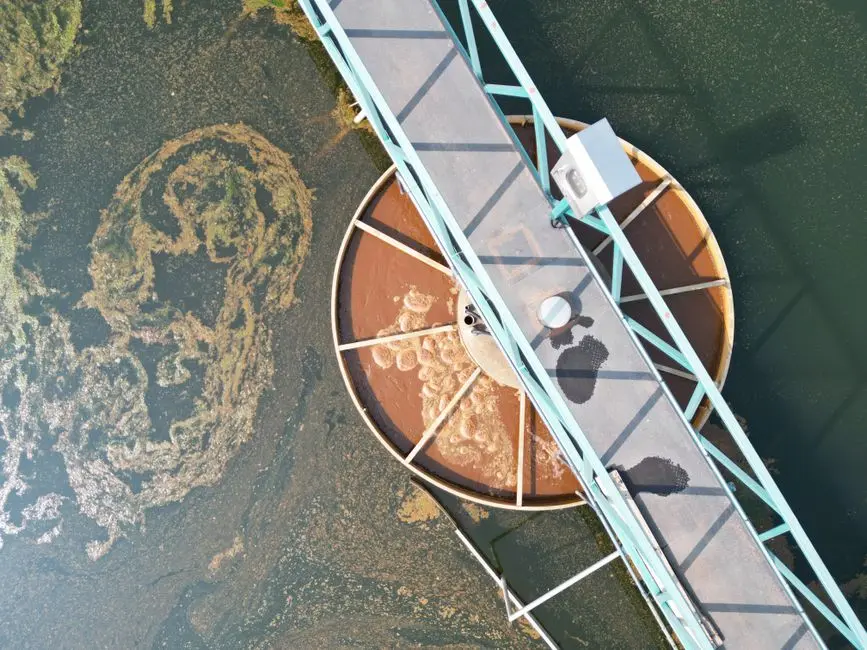
Two packaged technologies dominate the Kinshasa hospitality shortlist: a submerged MBR membrane bioreactor — activated sludge combined with PVDF ultrafiltration membranes at a nominal <1 μm cutoff — and a WSZ buried A/O package plant, which combines anoxic and aerobic contact oxidation, sedimentation, and disinfection in a single underground skid that can be landscaped over. Both are valid; they fit different site conditions and budgets.
| Parameter | MBR membrane bioreactor | WSZ buried A/O package |
|---|---|---|
| Effluent BOD / TSS | ≤5 / ≤5 mg/L (near-reuse) | ≤30 / ≤30 mg/L (standard 30/30) |
| Footprint vs conventional | ~60% smaller; flow range 10–2,000 m³/day | 1–80 m³/h in a buried tank, landscaped over |
| Reuse suitability | Landscape, toilet flushing, laundry (with UV/ClO₂) | Irrigation with caution; not for direct contact reuse |
| CAPEX (2026 factory-direct) | Higher — membrane modules add 25–40% | Lower — standard packaged A/O |
| OPEX drivers | Aeration + cross-flow energy; membrane replacement every 5–8 years | Lower energy; no membrane replacement |
| Grid-outage tolerance | 4–8 hr buffer; PLC auto-restart; membranes tolerate intermittent flux | 4–8 hr buffer; PLC auto-restart; no membrane risk |
| Sludge yield | Lower (~0.3–0.5 kg TSS/kg BOD removed) | Higher (~0.5–0.7 kg TSS/kg BOD removed) |
The decision rule is straightforward. If the property targets water reuse for gardens, toilet flushing, or laundry — or discharges within 1 km of a Congo River tributary — specify an MBR membrane bioreactor system. If the site is under roughly 80 m³/day, has limited set-back, requires a buried installation for landscaping or parking, and discharges to a soakaway or municipal sewer, specify a buried WSZ A/O package plant. The comparison in the table above is consistent with engineering practice across tropical Central Africa and mirrors the climate-driven sizing adjustments discussed in the containerized MBR sizing guide for West Africa.
Sizing a Package STP for a 50-, 100-, and 200-Room Kinshasa Hotel
Use the formula: average daily flow = rooms × guests per room × occupancy × liters per guest. For DRC resort properties, the standard assumption is 1.8 guests per room, 70% occupancy, and 220 L per guest. Apply a peak factor of 2.5× to size equalization and downstream hydraulics.
| Property | Assumption | Average flow | Peak flow (2.5×) | WSZ model | MBR model |
|---|---|---|---|---|---|
| 50-room hotel | 1.8 g/room × 70% × 220 L | ~14 m³/day | ~35 m³/day | WSZ-15 | MBR-15 |
| 100-room hotel | Same | ~28 m³/day | ~70 m³/day | WSZ-30 | MBR-50 |
| 200-room resort (F&B, laundry) | Add ~40% for kitchen/laundry | ~70–80 m³/day | ~180–220 m³/day | WSZ-80 (at limit) | MBR-100 with equalization |
Flow equalization — typically a 6–8 hour buffer tank sized at roughly 25–30% of average daily flow — adds only about 15% to total footprint but prevents hydraulic shock that would otherwise push BOD above 500 mg/L into the biological stage during the morning peak. For the 200-room case, the equalization tank is not optional: it is the difference between a stable effluent and a system that fails on Sunday morning check-out. A similar sensitivity to peak factor appears in the Calgary hotel wastewater treatment guide, although Calgary's winter sizing is driven by temperature rather than peak hydraulic shock.
DRC Compliance, Effluent Targets, and Sludge Handling in 2026
DRC national hotel-specific discharge norms are inconsistent across provinces, so engineers typically align with a defensible international envelope. For surface-water or land discharge, specify BOD ≤30 mg/L, TSS ≤30 mg/L, NH₃-N ≤10 mg/L, and fecal coliform ≤200 CFU/100 mL. For any reuse scenario — landscape irrigation, toilet flushing, laundry — align with the WHO 2006 Guidelines for the Safe Use of Wastewater in Agriculture, which require <1 fecal coliform per 100 mL for unrestricted irrigation and BOD ≤10 mg/L for landscape reuse near guest areas. Disinfection is typically handled by an on-site chlorine dioxide generator, which is more stable than chlorine at the high pH and temperature of Kinshasa effluent.
Sludge handling is the constraint most often missed in a hotel specification. Packaged plants generate roughly 0.5–1.2 m³ of dewatered cake per 100 m³ treated. Specify a plate and frame filter press for any site above 50 m³/day, or schedule third-party hauling for smaller installations. Kinshasa municipal sewer coverage is partial, so most resort sites default to on-site disposal, soakaway, or reuse — and the sludge storage volume must reflect the road-condition risk between scheduled haulings.
Resilience Engineering: Handling Kinshasa's Grid and Climate Realities
Generic package-plant brochures assume grid power is available 24/7. Kinshasa is not that grid. Specify a 4–8 hour power-outage buffer via an integrated buffer tank sized at roughly 25–30% of average daily flow, plus PLC auto-restart logic that brings aeration, recirculation, and disinfection back online in sequence rather than simultaneously to avoid inrush trips. Both WSZ and MBR families support this architecture, but the MBR's membrane skid needs soft-start VFDs to protect the cross-flow pumps from stall on auto-restart.
Three additional resilience items should be on every Kinshasa spec sheet. First, on-site sludge storage of at least 30 days in case offsite hauling is delayed by road conditions on the N1 or by river-crossing disruptions. Second, vented, sealed covers and a carbon-stage odor control module for any buried unit located within 50 m of guest buildings or food-service areas — odor complaints are the most common cause of a hotel STP being shut down by management. Third, stainless-steel (304 or 316) or FRP enclosures on all electrical cabinets, because Kinshasa's humidity routinely exceeds 80% RH and will corrode standard powder-coated steel within 18–24 months.
Capex, Opex, and ROI for a Kinshasa Hotel STP in 2026
Factory-direct CAPEX for a packaged hotel STP in 2026, FOB or CIF Kinshasa, falls into three bands. Below 50 m³/day: USD 25,000–50,000 for either a WSZ or small MBR. Between 50 and 150 m³/day: USD 50,000–80,000, with MBR configurations sitting at the upper end. Above 150 m³/day: USD 100,000-plus for an MBR-100 or larger, inclusive of flow equalization, disinfection skid, and a plate-and-frame dewatering unit.
| Cost line | WSZ A/O (100-room, ~28 m³/day) | MBR (200-room, ~75 m³/day) |
|---|---|---|
| CAPEX (2026 factory-direct) | USD 50,000–70,000 | USD 100,000–150,000 |
| Annual OPEX (energy + chemical) | USD 4,000–6,000 | USD 9,000–14,000 |
| Membrane replacement (every 5–8 yr) | — | USD 12,000–20,000 event |
| Sludge hauling (annual) | USD 5,000–8,000 | USD 6,000–10,000 |
| Water reuse offset (annual) | — | USD 8,000–15,000 |
ROI math for a 100-room property is straightforward. Replacing 30–50% of municipal water supply at USD 1.50–3.00/m³ saves roughly USD 8,000–15,000 per year for a 100-room hotel at 28 m³/day, against a trucked-offsite sludge cost of roughly USD 5,000–10,000 per year. The combined annual benefit, net of OPEX, yields a 3–5 year payback versus a sewered municipal alternative — and that excludes the avoided brand-compliance risk for an international-flag property that would otherwise be exposed to a discharge incident near a Congo River tributary. The same logic has been documented in the Bogotá hotel wastewater engineering guide, although Bogotá's grid and water-reuse economics differ from Kinshasa's.
Frequently Asked Questions
What size package STP does a 100-room Kinshasa hotel need?
A 100-room Kinshasa hotel at 70% occupancy and 1.8 guests per room generates roughly 28 m³/day average and 70 m³/day peak. Specify a WSZ-30 buried package plant for discharge to soakaway or sewer, or an MBR-50 if water reuse is targeted.
Can a packaged STP handle 6-hour power outages in Kinshasa?
Yes — both WSZ and MBR systems are specified with a 4–8 hour buffer tank (roughly 25–30% of average daily flow) and PLC auto-restart that brings aeration and disinfection back in sequence. MBR configurations should also include VFD soft-start on the cross-flow pumps.
What effluent BOD and TSS can a Kinshasa hotel STP reliably meet?
A WSZ buried A/O plant consistently meets BOD ≤30 mg/L and TSS ≤30 mg/L. An MBR membrane bioreactor delivers BOD ≤5 mg/L and TSS ≤5 mg/L, which is suitable for landscape irrigation, toilet flushing, and laundry reuse when paired with a chlorine dioxide disinfection skid.
How much does a hotel STP cost in Kinshasa in 2026?
Factory-direct CAPEX in 2026 is USD 25,000–50,000 for systems under 50 m³/day, USD 50,000–80,000 for 50–150 m³/day, and USD 100,000-plus for MBR configurations above 150 m³/day, before installation and civil works.