Why Kuwait's Residential Sewage Story Is Different
Residential wastewater treatment in Kuwait processes roughly 1 Mm³/day of domestic sewage at 154.6 m³ per capita per year, with the Sulaibiya plant alone handling about 64% of the national load using a tertiary plus Reverse Osmosis (RO) train that reuses approximately 58% of all generated wastewater (Aleisa & Al-Shayji, 2021). Decentralized residential projects—compounds, labor camps, and remote housing—typically deploy packaged A/O (WSZ series) or MBR systems sized to KEPA discharge limits, with RO polishing added when irrigation reuse is required under WHO MPN <100/100 mL thresholds.
Kuwait's climate forces a unique design mindset. Annual rainfall is approximately 100 mm, and the country historically consumed about 10% of national oil production for desalination in 2003; consequently, treated sewage is a strategic water asset rather than a disposal problem (Al-Shammari & Shahalam, 2006 via S2). Approximately 75% of all generated wastewater is treated, mostly to RO quality, and 58% is reused, while the remaining 25% is discharged to the sea. The country ranks 1st in the Arab world and 5th globally for sanitation coverage, with current targets focused on 100% coverage through expanded reuse (Aleisa & Al-Shayji, 2021). For a developer or EPC, discharge-only designs are no longer compliant with national policy; reuse-ready trains are the 2026 default.
How Sulaibiya Sets the National Benchmark for Residential Reuse
The Sulaibiya WWTP serves as the national design anchor for any Kuwaiti residential reuse project. It treats approximately 64% of Kuwait's sewage and is one of the largest RO-based reclamation plants globally (Aleisa & Al-Shayji, 2021; S2). In May 2001, the government awarded a build-operate-transfer (BOT) contract to finance, design, build, and operate the plant—a contract template relevant for any private residential reclamation scheme seeking 20- to 30-year payback against a water tariff (S2).
The plant demonstrates the efficacy of large-scale operations. Over 100,000 m³/day of RO permeate is pumped to Abdaly and Wafra for fodder and crop irrigation, including alfalfa for the United Co. for Agricultural Produce, which supplies 70% of national cattle feed (S2; Aleisa & Al-Shayji, 2021). Compliance with Kuwaiti performance standards reaches about 80% for TSS, 77.8% for BOD, and 76.9% for COD—a realistic 2026 benchmark for tertiary plus RO residential trains (Al-Shammari & Shahalam, 2006 via S2). Residential designers should target the 75-80% compliance band for unit operations and oversize the disinfection stage to compensate for variance.
KEPA, WHO and 2026 Compliance Targets for Residential Reuse

Kuwait Environment Public Authority (KEPA) effluent limits serve as the absolute floor for any discharge design, as both the tertiary treated effluent (TTE) and the RO permeate (ROP) at Sulaibiya meet KEPA and WHO standards (S3; Aleisa & Al-Shayji, 2021). For unrestricted irrigation, WHO sets a microbiological ceiling of total MPN <100 colonies per 100 mL in at least 80% of samples, which dictates the choice of chlorine dioxide or ozone downstream of biological treatment (Aleisa & Al-Shayji, 2021).
Kuwaiti domestic wastewater is classified as "very strong," with national loads reaching about 123 t/d TOC, 22.5 t/d TN, and 10.69 t/d TP; designers should not assume diluted municipal strength when sizing aeration or nutrient-removal stages (S2). Brine from RO is regulated separately—Sulaibiya characterization shows that BOD, TDS, and total phosphate in the reject stream can exceed KEPA limits and require evaporation ponds, deep-well injection, or land application rather than direct discharge (Khajah et al., 2023).
| Parameter | Typical Kuwaiti Influent | KEPA Discharge Limit (typical) | WHO Unrestricted Irrigation |
|---|---|---|---|
| BOD₅ | 300-500 mg/L | ≤ 25 mg/L (tertiary) | — |
| COD | 600-900 mg/L | ≤ 150 mg/L | — |
| TSS | 350-500 mg/L | ≤ 30 mg/L | — |
| Total Nitrogen | 40-60 mg/L | ≤ 20 mg/L | — |
| Total Phosphorus | 10-15 mg/L | ≤ 5 mg/L | — |
| Faecal coliform / MPN | 10⁶-10⁷ per 100 mL | ≤ 1,000 per 100 mL | < 100 per 100 mL (80% of samples) |
Influent ranges reflect S2 national characterization; KEPA limits are typical reuse-discharge values drawn from Sulaibiya compliance ranges; WHO MPN threshold per Aleisa & Al-Shayji (2021).
Process Trains for Residential Projects: A/O, MBR, and RO
The WSZ underground packaged A/O sewage treatment plant is the workhorse for villa clusters, labor camps, or compounds under 80 m³/h, as it can be buried below landscaping and operated unattended. Biological A/O contact oxidation handles BOD and partial denitrification, and the package footprint integrates equalization, anoxic, aerobic, and clarification stages into a single buried tank designed to withstand Kuwaiti summer soil temperatures.
The MBR membrane bioreactor package is the preferred solution for mid-size compounds where footprint, reuse-quality effluent, or a remote KOC-style 300 m³/day requirement is specified. MBR integrates activated sludge with submerged PVDF membranes at <1 μm nominal filtration, eliminating the need for clarifiers and most tertiary stages while reducing the plant footprint by about 60% compared to conventional activated sludge. Where irrigation reuse is the goal, an industrial RO polishing train downstream of the MBR is required; residential RO recovery can reach 95%, but the resulting brine must be handled via evaporation pond or deep-well injection. Disinfection with an on-site chlorine dioxide or ozone generator is the final stage, sized to consistently meet WHO MPN <100/100 mL through the summer bacterial regrowth peak (Aleisa & Al-Shayji, 2021).
| Criterion | Packaged A/O (WSZ) | MBR | Tertiary + RO |
|---|---|---|---|
| Flow range | 1-80 m³/h | 10-2,000 m³/day | Any, scaling to district |
| Footprint | Smallest (buried) | ~60% smaller than CAS | Largest (RO trains + brine handling) |
| Effluent quality | KEPA discharge | Near-reuse, <5 mg/L TSS | RO permeate, <50 mg/L TDS |
| Operator skill | Low (unattended) | Medium (membrane CIP) | High (RO + brine logistics) |
| Best fit | Villa cluster, labor camp | Compound, KOC-style 300 m³/d | District reuse, fodder irrigation |
| Brine / reject | None | Backwash only | 15-25% of feed as brine (S3) |
Sizing for Hot-Climate Residential Loads in 2026
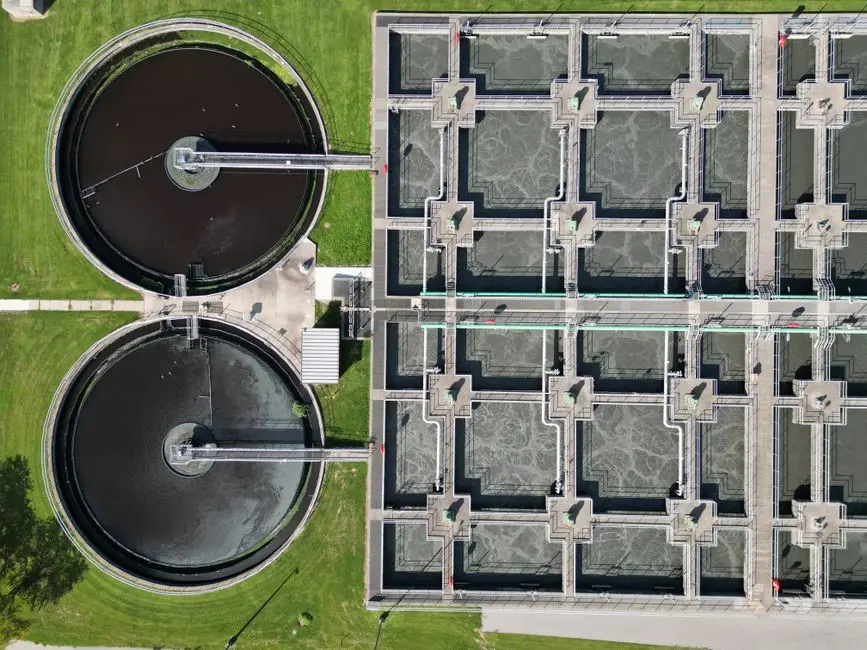
The 2026 residential design basis should use 150-200 L/person/day, derived from the 154.6 m³/capita/year national figure and 3.6% annual wastewater growth (Aleisa & Al-Shayji, 2021). Apply a peak factor of 2.5-3.0× average daily flow for compound and labor-camp hydraulics, plus a summer tourism multiplier for coastal projects where GCC visitors can increase occupancy 20-30% above winter baselines.
BOD loading of 40-60 g/person/day and TSS of 45-70 g/person/day align with the "very strong" Kuwaiti characterization and should dictate aeration tank volume and clarifier surface area. Tanker-discharged or septic-truck inflows to a residential package plant warrant a 10-15% organic and FOG buffer and typically justify a DAF pre-treatment unit upstream of the biological stage to prevent grease from fouling MBR or RO membranes.
Selecting Equipment: 2026 Spec Checklist for Kuwaiti Residential Plants
Influent screening requires a rotary mechanical bar screen (GX series) at 3-6 mm bar spacing to protect downstream MBR or RO membranes from rags, grit, and sanitary wipes common in GCC residential flows.
The biological stage should utilize A/O contact oxidation for flows ≤80 m³/h, or MBR (10-2,000 m³/day) where footprint or reuse-quality effluent is prioritized. Tertiary polishing requires a multi-media filter upstream of RO to drop SDI below 3 and protect the membranes, with the RO unit set at 95% recovery for irrigation reuse projects. Disinfection requires an on-site chlorine dioxide generator sized to peak flow plus a 20% safety factor; ClO₂ avoids trihalomethane byproducts and remains stable in high-temperature inflows. For sludge, use a lamella clarifier for thickening and a plate-and-frame filter press for dewatering, as saline and oily residential sludge in Kuwait often degrades belt presses and centrifuges. For additional technical benchmarks, refer to our residential wastewater treatment in Australia 2026 guide, the 10,000 m³/day sewage treatment plant price 2026 breakdown, and the RO recovery and zero-discharge ROI guide.
Frequently Asked Questions
What is the national reuse rate for residential wastewater in Kuwait?
Approximately 58% of all generated wastewater is reused nationally, with 75% treated (mostly to RO quality) and 25% discharged to the sea (Aleisa & Al-Shayji, 2021). The Sulaibiya plant reclaims about 64% of the country's sewage, with 100,000 m³/day of its RO permeate pumped to Abdaly and Wafra for fodder irrigation (S2).
What per-capita flow and load should a designer use for a Kuwaiti residential project in 2026?
Use 150-200 L/person/day derived from the 154.6 m³/capita/year national figure and 3.6
Frequently Asked Questions
How is residential wastewater treated in Kuwait in 2026?
In 2026, residential wastewater treatment in Kuwait relies on a combination of centralized municipal systems and decentralized onsite plants for remote compounds. Modern facilities prioritize Membrane Bioreactor (MBR) technology to achieve high-quality effluent suitable for non-potable irrigation. For decentralized systems, the process typically involves primary sedimentation followed by biological nutrient removal (BNR) and tertiary disinfection via ultraviolet (UV) or chlorination to meet local environmental safety standards.
What percentage of Kuwait's sewage is reused and how does Sulaibiya fit in?
Kuwait currently reuses approximately 80% to 90% of its treated municipal wastewater, primarily for agricultural irrigation and landscaping. The Sulaibiya Wastewater Treatment and Reclamation Plant serves as the cornerstone of this infrastructure, utilizing a sophisticated multi-barrier process involving ultrafiltration and reverse osmosis (RO). It processes over 600,000 cubic meters per day, ensuring that reclaimed water meets stringent tertiary standards before it is distributed via the national treated sewage effluent (TSE) network.
What are the KEPA and WHO limits for residential wastewater reuse in Kuwait?
The Kuwait Environment Public Authority (KEPA) mandates that treated effluent for restricted irrigation must maintain a Biological Oxygen Demand (BOD) of less than 10 mg/L and Total Suspended Solids (TSS) below 10 mg/L. These limits align with WHO guidelines for safe reuse, which specify a fecal coliform count of less than 1,000 per 100 mL for restricted irrigation, though Kuwait’s internal standards for urban landscaping often require near-zero pathogen levels to protect public health in residential zones.
Should a residential compound in Kuwait use MBR or packaged A/O treatment?
For residential compounds in Kuwait, Membrane Bioreactor (MBR) systems are significantly preferred over traditional packaged Anoxic/Oxic (A/O) systems due to their superior effluent quality and smaller physical footprint. MBR technology eliminates the need for secondary clarifiers and produces high-quality permeate that complies with KEPA's strict reuse standards. While MBR systems require higher operational energy and membrane maintenance, they are essential for meeting the stringent water quality requirements for onsite irrigation in arid, densely populated environments.
How do you size a residential STP for Kuwait's hot climate and high per-capita flow?
Sizing a residential Sewage Treatment Plant (STP) in Kuwait requires accounting for a high per-capita flow, typically estimated at 250 to 300 liters per person per day, compounded by significant diurnal load variations. Engineers must incorporate a hydraulic retention time (HRT) buffer of at least 24 hours to compensate for the accelerated biological activity caused by high ambient temperatures. Furthermore, aeration systems must be upsized by 15-20% to account for the reduced oxygen transfer efficiency in warm wastewater, ensuring the aerobic bacteria remain active throughout the summer months.