
Why Slaughterhouse Blood Water Breaks Conventional Pretreatment
A DAF for slaughterhouse blood water is sized on three coupled parameters: hydraulic surface loading of 5–20 m³/m²·h, hydraulic retention time of 20–40 minutes, and an air-to-solid ratio of 0.01–0.05 kg air per kg of suspended and emulsified solids, with 60–85% of incoming FOG removed when coagulant and flocculant dosing are optimised (Mbulawa et al., 2018). For an 80 m³/h poultry blood stream, this typically maps to a 12–18 m² effective flotation area unit operating at 30% partial recycle.
Slaughterhouse blood water is not generic industrial FOG. The dissolved protein fraction — haemoglobin, plasma albumin, and globulins — acts as a surfactant that stabilises emulsified fat droplets against coalescence, with the bulk lipid fraction comprising triglycerides, phospholipids, and amphiphilic constituents (Mbulawa et al., 2018). Total influent loads on a poultry kill line typically run at SS 800–1,500 mg/L, FOG 500–1,200 mg/L, and blood COD 4,000–8,000 mg/L — orders of magnitude beyond what a standard API separator is designed for.
Conventional oil-water separators and circular clarifiers fail on these streams for three reasons: the emulsified droplet density sits within 1–3% of water so gravity separation is too slow, the protein-stabilised film re-emulsifies within seconds of skimming, and the fine solids carryover blinds the lamella packs. DAF sidesteps all three by attaching a captive micro-bubble to the floc particle and forcing the buoyant aggregate to the surface in under 10 minutes — which is why 60–85% lipid removal in a single stage is the anchor every CAPEX paper for a DAF should be defended against.
The Three Sizing Parameters That Drive DAF Performance
A defensible DAF sizing for blood water rests on three numbers, all of which must be calculated and stamped on the P&ID before the equipment order is released.
First, the hydraulic surface loading rate (HSLR) — flow divided by effective flotation area — sets the footprint and the rise-velocity budget. For FOG/blood streams the working range is 5–20 m³/m²·h: the lower end is reserved for blood-heavy or temperature-volatile streams where viscosity at 25–30 °C slows bubble rise, the upper end for dilute rinse and paunch water where the floc loads easily. Out-of-range operation either shears floc (above 20) or wastes tank volume (below 5).
Second, the hydraulic retention time (HRT) inside the flotation cell must be 20–40 minutes. The lower bound applies at 30–35 °C, where water viscosity drops to ~0.8 cP and 40-µm bubbles clear the 0.6–0.8 m side-water depth in roughly 8–10 minutes; the upper bound is for cold streams or for plants dosing high-MW anionic polymer that needs longer floc-growth contact.
Third, the air-to-solid (A/S) ratio — kg of air injected per kg of (SS + emulsified FOG) — drives the bubble supply. For blood water the operating window is 0.01–0.05, with 0.025–0.035 the typical centrepoint. A saturator pressure of 5–7 bar is the standard supply; below 5 bar the air-mass transfer falls off, above 7 bar the pump energy bill erodes the OPEX case.
Micro-bubble diameter is the fourth lever most engineers forget. Blood protein adsorption onto the bubble surface is more efficient at 30–50 µm than at the 50–80 µm typical of municipal DAF — finer bubbles deliver more surface area per kg of air and ride out of the cell before they coalesce.
| Parameter | Symbol | Range for blood water | Typical centrepoint | Driver |
|---|---|---|---|---|
| Hydraulic surface loading rate | Q / Ae | 5–20 m³/m²·h | 10 m³/m²·h | Footprint, rise-velocity budget |
| Hydraulic retention time | V / Q | 20–40 min | 25–30 min | Floc-bubble contact time |
| Air-to-solid ratio | A/S | 0.01–0.05 kg/kg | 0.03 kg/kg | Bubble supply vs solids load |
| Saturator pressure | Psat | 5–7 bar | 6 bar | Air solubility, pump energy |
| Micro-bubble diameter | db | 30–50 µm | 40 µm | Protein attachment surface area |
Full-Flow vs Partial-Recycle Pressurisation for Blood Streams
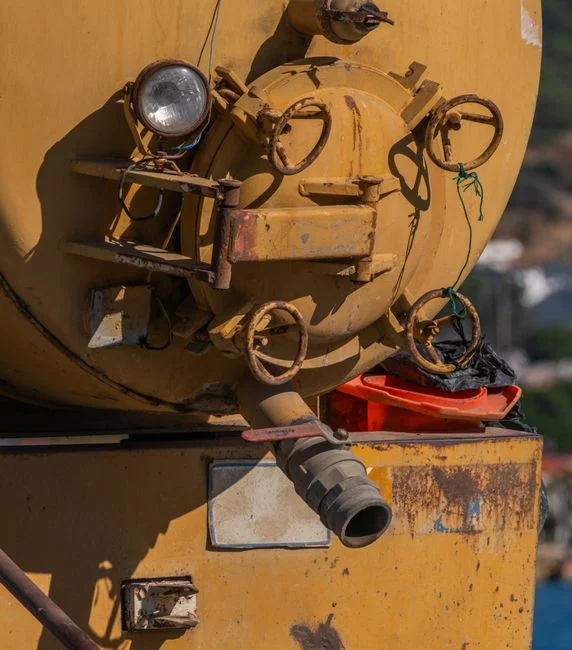
Blood protein chemistry makes the pressurisation configuration more than a cost call — it changes the FOG-removal ceiling.
Full-flow pressurisation sends 100% of the feed through the saturator. Piping is simpler, the recycle pump is the same size as the feed pump, and there is no clarified-water return line to balance. The penalty is shear: the floc that the coagulant and polymer built up in the flocculation tank gets ripped apart by the saturation pump and pressure let-down, and the protein-stabilised emulsion partially re-forms. Full-flow is acceptable on dilute paunch and trim-room wash water (FOG < 150 mg/L, blood COD < 2,000 mg/L) where the floc is robust and the load is light.
Partial-recycle pressurisation takes 25–35% of clarified effluent from the DAF outlet, pressurises it through the saturator, and reinjects it into the contact zone of the flotation cell. The floc never sees the pump. Bubble size is consistent because the recycle water is clean, and 60–85% lipid removal is routinely held over weeks rather than hours (Mbulawa et al., 2018). The trade-off is one extra pump, a saturation loop, and a return-flow control valve.
Rule of thumb the EPC community uses: choose partial-recycle when influent FOG > 150 mg/L or blood COD > 2,000 mg/L. Below those thresholds, full-flow's lower CAPEX wins.
| Criterion | Full-flow pressurisation | Partial-recycle pressurisation |
|---|---|---|
| Recycle ratio | 0% (100% feed pressurised) | 25–35% of clarified flow |
| Floc shear exposure | High — through pump and let-down | Low — floc bypasses the pump |
| Typical FOG removal | 50–70% on blood streams | 60–85% on blood streams |
| Influent FOG ceiling | < 150 mg/L | Up to ~1,500 mg/L with optimised chemistry |
| Footprint (relative) | 0.9× | 1.0× baseline |
| CAPEX (relative) | 0.85× | 1.0× baseline |
| OPEX (pump kWh) | Lower per m³ feed, but higher per kg FOG removed | Higher per m³ feed, lower per kg FOG removed |
| Operator skill | Standard | Recycle-flow tuning required |
Worked Example: Sizing a DAF for an 80 m³/h Poultry Blood Stream
Given: Q = 80 m³/h, influent FOG ≈ 800 mg/L, SS ≈ 1,200 mg/L, blood COD ≈ 6,000 mg/L, stream temperature 30–35 °C, discharge target to municipal sewer at FOG < 100 mg/L.
- Effective flotation area. Pick HSLR = 10 m³/m²·h on the conservative side of the 5–20 range (the stream is blood-heavy and warm, so viscosity is favourable but the load is high). A = Q / HSLR = 80 / 10 = 8.0 m². Round up to 10 m² for a 25% safety margin on flow turn-up and solids shock load.
- Cell volume. Pick HRT = 25 min. V = (Q × HRT) = (80/60) × 25 = 33.3 m³. With A = 10 m² the side-water depth = 33.3 / 10 = 3.3 m, which exceeds the 0.5–0.8 m shallow-flotation convention — so the cell must be partitioned into two 5 m² cells in series, each 0.8 m deep, giving V = 8 m³ per cell and a combined HRT of 12 min per cell (24 min total). This is the standard two-stage DAF layout for high-FOG streams.
- Air-to-solid calculation. Solids load = (FOG + SS) × Q = (800 + 1,200) mg/L × 80 m³/h = 160 kg/h. At A/S = 0.03, air demand = 0.03 × 160 = 4.8 kg air/h. At 6 bar saturator pressure, air solubility is ~0.6 kg/m³ in water at 30 °C, so saturated recycle flow = 4.8 / 0.06 (per kg/m³ at 90% saturation efficiency) ≈ 6 m³/h of recycle — about 7.5% of feed, well inside the 25–35% partial-recycle band; the spare recycle capacity is held in reserve for peak-shift operation.
- Equipment mapping. The 80 m³/h requirement with 10 m² effective area maps onto the 80–100 m³/h model class in the DAF range, which covers 4–300 m³/h across 13 standard models. Saturator sizing: a 6 m³/h recycle pump at 6 bar, with a contact-zone retention of 60–90 s. Skimmer: surface drive, 0.5–1.0 m/min flight speed, sized to handle a 3–5% dry-solids floated layer. Sludge pump: progressive cavity, 2–4 m³/h capacity, discharging to a sludge holding tank.
- Effluent check. Expected FOG after DAF at 75% removal (mid-range of the 60–85% envelope) = 800 × 0.25 = 200 mg/L — still above the 100 mg/L sewer target, so biological polishing (MBR or SBR) is required downstream. The DAF is correctly sized for its role as a pre-treatment, not a final polisher.
| Step | Given / assumption | Calculation | Result |
|---|---|---|---|
| Effective area | HSLR = 10 m³/m²·h | 80 / 10, round up 25% | 10 m² (2 × 5 m² cells) |
| Cell volume | HRT = 25 min | (80/60) × 25 | 33 m³ total, 0.8 m SWD |
| Solids load | FOG + SS = 2,000 mg/L | 2,000 × 80 / 1,000 | 160 kg/h |
| Air demand | A/S = 0.03 | 0.03 × 160 | 4.8 kg air/h |
| Recycle flow | 6 bar, 90% saturation | 4.8 / 0.8 | ~6 m³/h (7.5% of feed) |
| Expected FOG in effluent | 75% removal | 800 × 0.25 | 200 mg/L → needs bio polishing |
Chemistry, Screening, and Sludge Handling Around the DAF
A DAF sized perfectly will still miss its removal target if the upstream and downstream unit operations are wrong.
Upstream screening. A rotary bar screen with 1–3 mm openings must precede the DAF. Feathers, paunch content, bone fragments, and gut material from the kill line will otherwise blind the saturator pump and shred the floc. The screen protects the saturator and the polymer make-up unit; expect a 10–20% TSS reduction before the DAF even sees the stream.
Coagulant and flocculant chemistry. pH adjustment to 6.5–7.5 with caustic soda or lime is the first chemical step — outside this band the protein surface charge shifts and the floc refuses to grow. Coagulant dose is 50–150 mg/L of ferric chloride or polyaluminium chloride (PAC) to neutralise the emulsified FOG charge. Flocculant is an anionic polyacrylamide at 2–8 mg/L, prepared in a maturity tank and dosed via an automatic chemical dosing skid with flow-pacing on the DAF feed.
Sludge handling. The floated layer off the DAF skimmer runs 3–5% dry solids — too thin to landfill, too thick to pump long distances without a chopper pump. Route it to a sludge holding tank, then dewater on a plate-and-frame filter press to a >25% DS cake for off-site rendering or composting. Under-sizing the press is the most common cause of "the DAF works but the plant still smells" — the floated sludge goes septic in 6–8 hours if it is not stabilised or dewatered the same shift.
Downstream protection. DAF effluent still carries dissolved protein, blood colour, and 200–400 mg/L of residual FOG. Route to a biological polisher — MBR or SBR — before sewer discharge or on-site reuse. For plants with reuse targets, ultrafiltration downstream of the MBR closes the loop on turbidity and residual oil.
For plants handling non-blood process streams, the same three-parameter method applies with shifted ranges — see our DAF sizing for paint booth curtain water guide and the DAF configuration for diesel washdown reference. For the seafood side of the protein-processing industry, fish stickwater pretreatment before DAF follows the same A/S logic with a higher temperature correction.
Frequently Asked Questions
What is the expected FOG removal efficiency of a DAF on slaughterhouse blood water?
A correctly sized DAF with optimised coagulant and flocculant dosing removes 60–85% of influent FOG as a pre-treatment step (Mbulawa et al., 2018). The remaining 15–40% requires biological polishing — typically MBR or SBR — to meet sewer discharge targets below 100 mg/L FOG.
When should a plant choose partial-recycle DAF over full-flow pressurisation?
Choose partial-recycle when influent FOG exceeds 150 mg/L or blood COD exceeds 2,000 mg/L. Partial-recycle at 25–35% recycle ratio protects the floc from pump shear and holds the 60–85% FOG-removal band consistently; full-flow pressurisation is acceptable only on dilute paunch or trim-room wash water below those thresholds.
What coagulant and flocculant doses are typical for poultry blood streams?
pH adjustment to 6.5–7.5 with caustic or lime, followed by 50–150 mg/L ferric chloride or PAC as coagulant, and 2–8 mg/L anionic polyacrylamide as flocculant. Dose must be flow-paced from the DAF feed rather than set constant, because blood load varies with kill rhythm.
Can a DAF alone meet municipal sewer discharge limits for slaughterhouse wastewater?
No. A DAF is a pre-treatment, not a final polisher. For an 80 m³/h stream at 800 mg/L influent FOG, a well-sized DAF delivers ~200 mg/L in the effluent — still above a typical 100 mg/L sewer limit. A biological stage (MBR, SBR, or equivalent) is required downstream to close the gap on dissolved protein and residual FOG.