Why fish stickwater is not generic fish-processing wastewater
Fish stickwater is the aqueous condensate pressed or cooked out of fish mince, surimi base, or fish-stick batter—a stream that carries 1–5% suspended solids, 0.5–3% dissolved proteins, 0.1–1% emulsified fat, and exits the evaporator or cooker at 50–80 °C. These numbers place it an order of magnitude above the wash-water and blood streams that dominate a typical fish plant's total discharge, making stickwater the single highest-strength stream most plants will see on their P&ID. A 2023 ScienceDirect pilot study frames the parent problem in plain terms: fish processing wastewater causes a high organic load and can interfere with treatment operations due to high oil and grease content (source: ScienceDirect, 2023, S2213343723015920).
Temperature is the most underappreciated variable. Above 60 °C, dissolved air comes out of solution prematurely, the microbubble cloud collapses before contacting the floc, and anionic polyacrylamide chains begin to hydrolyze and lose charge density. Below 30 °C, the emulsified fat in stickwater starts to solidify on the DAF cell walls, blinding the release valves and the skimmer blade. The conditioning window—40–55 °C—is where microbubble attachment, polymer conformation, and free-fat fluidity overlap, which is why a heat exchanger ahead of the DAF is not optional in stickwater service.
The high protein fraction produces ammonia on biodegradation, with TKN routinely above 500 mg/L. Any biological step downstream—MBR, SBR, or moving-bed biofilm reactor—must be sized for that loading; engineers should plan the hydraulic residence time and sludge yield around it before the DAF hydraulic loading is finalized. The MBR configuration for fish stickwater in the reuse and discharge guide covers the downstream sizing math.
The four-stage pretreatment train upstream of DAF
A four-stage headworks train consisting of screening, grit/free-fat removal, pH and temperature conditioning, and coagulation-flocculation is required to prevent DAF cells from blinding and floating poorly. Each stage has a specific operating window that the engineer must set on the P&ID before the DAF datasheet can be written.
Stage 1 — Coarse screening. A rotary or static bar screen at 6–10 mm aperture removes scales, bones, and packaging fragments before they reach the heated conditioning tank. For continuous duty on a stickwater headworks, the GX Series rotary mechanical bar screen with stainless steel rake teeth and a self-cleaning brush discharge is the default spec; apertures finer than 6 mm blind within hours on a fish line.
Stage 2 — Grit and free-fat removal. A heated vortex grit chamber drops sand and bone fragments, followed by a gravity grease trap or inclined-plate fat trap held at 55–65 °C with 20–30 minutes of hydraulic residence time. At that temperature window, 60–80% of the free oil separates as a recoverable phase before the remaining emulsified fat reaches the DAF—and that recovered fat is sellable to rendering rather than a disposal cost.
Stage 3 — pH and temperature conditioning. An inline pH probe with caustic or lime dosing holds the stream at pH 6.5–7.5, and a plate or shell-and-tube heat exchanger drops the temperature from the cooker outlet (typically 70 °C) into the 40–55 °C window. This window is where both ferric-based coagulation chemistry and air-saturation efficiency in the recycle pump are at their peak; outside it, residual coagulant metal slips through the DAF into the biological step.
Stage 4 — Coagulation and flocculation. Rapid mix at 100–300 rpm for 30–60 s doses either polyaluminum chloride (PAC) at 10–30 mg/L as Al, or ferric chloride at 20–50 mg/L as Fe, to neutralize the surface charge on emulsified oil droplets. A slow mix at 20–50 rpm for 10–20 min then adds an anionic polyacrylamide (1–5 mg/L, 8–12 million Da molecular weight) to build a floc heavy enough to float. The 2023 ScienceDirect pilot confirmed that this chemical DAF step is the load-bearing part of the integrated train: DAF removed nearly all the oil and grease from the wastewater (source: ScienceDirect, 2023, S2213343723015920). Dosing is best handled by an automatic chemical dosing system with PAC and polymer on separate skid pumps.
DAF operating parameters that depend on upstream conditioning
DAF cell sizing must be based on the conditioned stream rather than the raw stickwater. Three ratios set the envelope: hydraulic loading, recycle ratio, and air-to-solid ratio. The numbers below apply to a chemical DAF cell in emulsified-fat service; if the upstream conditioning train is skipped, the operator will have to derate the cell or run it at 30–40% of nameplate capacity to keep the float blanket stable.
| Parameter | Operating window | Notes for stickwater service |
|---|---|---|
| Hydraulic loading rate | 5–15 m³/m²·h | Emulsified-fat streams sit at 5–10 m³/m²·h to allow full floc rise |
| Pressurized recycle ratio | 20–50% of influent flow | Use 10–20% only if post-coagulation FOG is <100 mg/L |
| Air-to-solid ratio | 0.02–0.05 kg air / kg TSS | Saturation pressure 4–6 bar |
| Microbubble size | 10–80 µm, peak 30–50 µm | Coarse bubbles collapse the float blanket on hot streams |
| Skimmer cycle | 2–4 min | Skimmings at 5–10% dry solids |
| Surface overflow rate | 0.5–2 m/h | Tied to skimmer speed and launder geometry |
The recycle ratio is the primary control for fat streams: too little recycle and bubbles are not dense enough to lift an oil-loaded floc; too much and the cell churns the float blanket back into the bulk. The 20–50% window is bracketed by FOG loading—start at 30% on a hot 60 °C stream and step up in 5% increments until the skimmings reach 5–10% dry solids. The dissolved air flotation system is rated from 4 to 300 m³/h across 13 standard models, with micro-bubble technology sized for the recycle ratios above.
Air-to-solid ratio is bounded by the saturation pressure of the recycle pump. At 4–6 bar, 0.02–0.05 kg of air dissolves per kg of suspended solids, which is enough to float a properly flocculated oil droplet in a 30–50 µm bubble cloud. Below 4 bar the cloud under-saturates; above 6 bar the pump NPSH drops and the cell starts to see jet cavitation. The skimmer speed and surface overflow rate are coupled—set the skimmer on a 2–4 min cycle, and check that the launder overflow rate stays below 2 m/h so the float blanket is not pulled back into the clarified stream.
Coagulant and flocculant selection for stickwater
Two metal coagulants and one polymer class cover most stickwater programs. The decision is driven by downstream chemistry—such as chlorination sensitivity, chloride load to the biological step, and sludge color—more than by raw removal efficiency. At proper doses, both PAC and FeCl₃ achieve similar residual turbidity in jar tests.
| Chemical | Dose window | Best-fit condition | Avoid when |
|---|---|---|---|
| Polyaluminum chloride (PAC), as Al | 10–30 mg/L | pH 6.5–7.5; downstream chlorination is in use | Effluent aluminum limits apply (typically <0.2 mg/L Al) |
| Ferric chloride (FeCl₃), as Fe | 20–50 mg/L | pH 5.5–8.5; cheaper bulk chemical | Chloride load to the biological step is constrained |
| Anionic polyacrylamide | 1–5 mg/L, MW 8–12 MDa, 10–30% charge density | Default for emulsified fat at any pH in the conditioning window | Stream is acidic (pH <5)—switch to nonionic or raise pH first |
| Cationic polyacrylamide | 0.5–2 mg/L | Acidic stickwater with high protein | Neutral pH—over-flocculates protein and carries fines into the float |
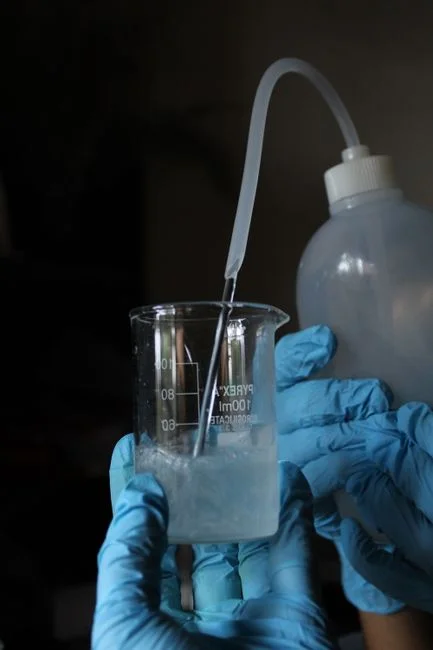
Confirm the dose and the order of addition with a six-beaker jar test: 1 L samples, 100 rpm rapid mix for 1 min after coagulant addition, 30 rpm slow mix for 15 min after polymer addition, settle 5 min, then read supernatant turbidity and residual FOG. The dose that gives the lowest supernatant turbidity at the lowest polymer dose is the operating point. Repeat the jar test whenever the fish species changes, as fat composition and protein load shift with the raw-material mix.
Reject streams, sludge handling, and handoff to DAF
Every stage of the headworks produces a reject stream, and the DAF cell adds two more. These must be integrated into the P&ID to prevent the upstream work from becoming a bottleneck.
Screenings account for 5–15% of total solids and go to a dumpster or directly to offal rendering. The 60–80% of free oil recovered in the heated grease trap is the cleanest revenue stream in the train—typical yield is 5–20 kg of recovered fat per tonne of fish stick processed, and most rendering vendors will collect it for free or pay a nominal credit. DAF skimmings come off at 5–10% dry solids and 60–80% moisture; route them to a plate and frame filter press sized at 1–50 m² of filtration area, which brings the cake to 25–35% dryness for landfill or rendering. Chemical sludge from PAC or FeCl₃ plus polyacrylamide floc solids runs 0.5–2% of the influent flow and is dewatered on the same filter press. The OPEX framing for that filter press is covered in the filter press for seafood processing wastewater cost 2026 article, and the DAF cell selection logic is in the DAF system engineering specs and selection guide.
Frequently Asked Questions
What is the right screen aperture for fish stickwater before DAF?
Use 6–10 mm aperture bar screening for fish stickwater headworks. Apertures finer than 6 mm blind within hours on a fish line because scales, bone fragments, and packaging debris carry into the screen. A rotary mechanical bar screen with self-cleaning brush discharge is the default spec for continuous duty in this service.
What temperature should stickwater be at when it enters the DAF cell?
Condition stickwater to 40–55 °C before DAF. Above 60 °C, dissolved air comes out of solution prematurely and anionic polyacrylamide loses charge density; below 30 °C, emulsified fat solidifies on the cell walls and the skimmer blade. The window is set by where microbubble attachment, polymer conformation, and free-fat fluidity overlap.
Which coagulant and polymer work best for emulsified stickwater fat?
Polyaluminum chloride at 10–30 mg/L as Al paired with an anionic polyacrylamide at 1–5 mg/L (8–12 MDa, 10–3