
Why Indigo Denim Wash Water Is a Special DAF Application
Indigo denim wash water is one of the most chemically aggressive streams a dissolved air flotation (DAF) unit will ever face. The dye is applied as a vat pigment — sodium hydrosulfite (Na2S2O4) and caustic soda reduce insoluble indigo to a soluble leuco form that fixes inside the cotton fiber, then re-oxidizes on exposure to air. In the wash line, the cycle between reduced and oxidized indigo produces a colloidal, intensely blue effluent that resists standard floc chemistry. The reducing agents, residual sulfide from desizing, and caustic carryover push the influent envelope to pH 10–12, temperature 50–70 °C, COD 800–3,000 mg/L, TSS 500–2,000 mg/L, and color 1,000–5,000 Pt-Co units (HydropureWater field data, 2026).
That envelope breaks most alum-based DAF programs. At pH above 10, aluminum hydrolyzes to soluble aluminate (Al(OH)4−) and stops forming the hydroxide floc that carries colloids to the surface. Sulfide residue makes this worse: it complexes with aluminum and ferric iron, and it scavenges the cationic charge that a conventional coagulant needs to neutralize dye particle surfaces. Generic textile DAF sizing — built for reactive-dye or print effluent at pH 6–8, 25–40 °C, no sulfide — underperforms by 30–50% on the denim envelope.
Adding to the load is the desizing step. Polyvinyl alcohol (PVA), carboxymethyl cellulose, and starch sizing agents carry over into the wash water and contribute 200–600 mg/L of slowly biodegradable BOD/COD on top of the dye load. Because these colloids are similar in size (1–50 μm) to oxidized indigo, they compete for coagulant and ride the same DAF float. A DAF cell tuned for the indigo envelope — sulfide-tolerant coagulant, pH held at 10–11, high-rate contact zone, micro-bubble size matched to the colloid — is the first real unit operation in a denim reuse or discharge train.
DAF Engineering Parameters for Denim Wash Water
Bubble size is the lever most operators get wrong. Micro-bubbles in the 20–50 μm range attach to oxidized indigo colloids (median particle size 5–30 μm) and lift them to the surface; bubbles above 80 μm rise too fast, drag efficiency drops, and the float blanket fragments. A properly tuned saturator running at 4–6 bar with a 20–30% recycle produces this micro-bubble population; below 4 bar the median diameter climbs past 70 μm and visible color removal falls by 20–30% (HydropureWater field data, 2026). For a unit purpose-built around this envelope, see the DAF for textile effluent.
Recycle ratio sets both the air-to-solids ratio and the hydraulic loading on the contact zone. For moderate-strength denim (COD <1,500 mg/L, color <2,500 Pt-Co), 20–30% recycle is the working window. For heavy-stone or laser-wash effluent with color above 3,000 Pt-Co, push recycle to 35–40% — the extra dissolved air carries the additional particle load, but the saturator and recycle pump must be sized for it. Below 15% recycle, the air-to-solids ratio (A/S) drops under 0.02 kg air/kg TSS and float yield collapses.
Hydraulic residence time splits between the contact zone (where bubble-particle attachment happens) and the separation zone (where the float thickens and slides to the skimmer). Target 15–25 min in the contact zone and 5–10 min in separation, giving total tank HRT of 20–35 min. Surface loading rate should sit at 15–25 m/h for textile dye streams; above 30 m/h, the float blanket destabilizes and TSS in the effluent rises. Match skimmer speed to float thickness — 0.5–1.5 m/min is typical for the 30–80 mm float blankets denim generates.
| Parameter | Recommended Range | Notes for Denim |
|---|---|---|
| Micro-bubble diameter | 20–50 μm | >80 μm fails to lift dye colloids |
| Recycle ratio | 20–30% (up to 40% heavy-stone) | Drives A/S ratio; saturator at 4–6 bar |
| Contact zone HRT | 15–25 min | Where bubble–particle attachment occurs |
| Separation zone HRT | 5–10 min | Float thickens, slides to skimmer |
| Total tank HRT | 20–35 min | Combined contact + separation |
| Surface loading rate | 15–25 m/h | Do not exceed 30 m/h |
| Air-to-solids (A/S) | 0.02–0.05 kg air/kg TSS | Floc-laden indigo effluent |
| Skimmer speed | 0.5–1.5 m/min | Match float thickness (30–80 mm) |
| Saturator pressure | 4–6 bar | Lower pressure → larger bubbles |
Coagulant and Flocculant Chemistry That Actually Works on Indigo
Polyaluminum chloride (PAC) at 100–300 mg/L or ferric chloride at 150–400 mg/L is the working pair for indigo wash water. Both form floc at pH 10–11 and tolerate sulfide better than alum, which loses effectiveness above pH 9.5 because Al3+ converts to soluble aluminate. PAC has the added advantage of working across a broader pH band (6–11) and producing a denser, faster-settling floc — useful when the float blanket has to thicken without breaking. Jar-test PAC and FeCl3 side-by-side on your actual wash water before sizing the dosing system; alkalinity, sulfide, and indigo loading all shift the optimum.
Hold pH at 10–10.5 with sulfuric or hydrochloric acid if the influent runs above 11.5, but do not over-correct toward neutral. pH shock fractures the floc mid-float and re-disperses the colloids you just lifted. An inline pH probe tied to the dosing pump is essential — manual pH control on a wash line that swings between desizing and stone-wash batches is a recipe for inconsistent removal. For the dosing hardware, specify a PLC-controlled coagulant dosing skid with at least two coagulant pumps and one polymer pump, paced to DAF inlet flow.
Floc strength comes from anionic polyacrylamide (A-PAM) at 0.5–3 mg/L, dosed downstream of the coagulant with a static mixer or 30–60 s of pipe contact. A-PAM works at the pH range indigo requires; cationic PAM (C-PAM) only works if you also drop pH below 9, which adds acid cost and risks H2S release from the sulfide load. Expect color reduction of 60–75% from DAF plus this chemistry alone — if the endpoint is reuse or a tight discharge color limit, plan for an oxidant polish (ozone, Fenton, or NaOCl) downstream.
Reuse vs Discharge: Same DAF, Different Trains
The DAF cell does the heavy lifting on suspended solids and a meaningful share of color and COD regardless of where the water goes next. What it cannot do is hit the final endpoint on its own, and the choice between reuse and discharge changes everything downstream of the DAF. For a Chinese mill discharging to a municipal sewer or surface water, the practical limits are COD <200 mg/L, color <80 dilution units, and SS <100 mg/L (per GB 4287-2012 textile wastewater discharge standard). DAF effluent typically lands at COD 400–1,000 mg/L and color 200–600 Pt-Co, so a biological stage (SBR or MBBR) and, if color remains stubborn, a Fenton polish are required. MBBR for the biological stage after DAF is a common pairing in denim mills with discharge permits above 1,000 m³/d.
For a mill targeting closed-loop reuse — pushing wash water back into rinsing or desizing — the endpoint tightens to TDS <500 mg/L, color negligible, and SS <10 mg/L. That requires DAF plus multi-media filtration (sand + anthracite, 10–20 μm cutoff) and either ultrafiltration (UF) or reverse osmosis (RO). RO recovery should sit at 60–75% on indigo brines; above 75% the concentrate fouls the membrane within hours. Antiscalant dosing (typically 2–5 mg/L of a phosphate-based inhibitor) is non-negotiable — without it, calcium carbonate and indigo oligomers scale the spacer and flux drops 40–60% in the first week.
| Target Parameter | Discharge Endpoint | Reuse Endpoint | Treatment Step After DAF |
|---|---|---|---|
| COD | <200 mg/L | <50 mg/L | SBR / MBBR (+ Fenton if color-locked) |
| Color | <80 dilution units | Negligible | Fenton, ozone, or RO polish |
| SS | <100 mg/L | <10 mg/L | Multi-media filter (10–20 μm) |
| TDS | No limit (typical) | <500 mg/L | RO at 60–75% recovery + antiscalant |
| pH | 6–9 | Match feed water | Neutralization (discharge only) |
| Final unit op | Clarifier / sand filter | RO or UF | — |
Process Flow and Equipment Layout for a Denim Laundry DAF Cell
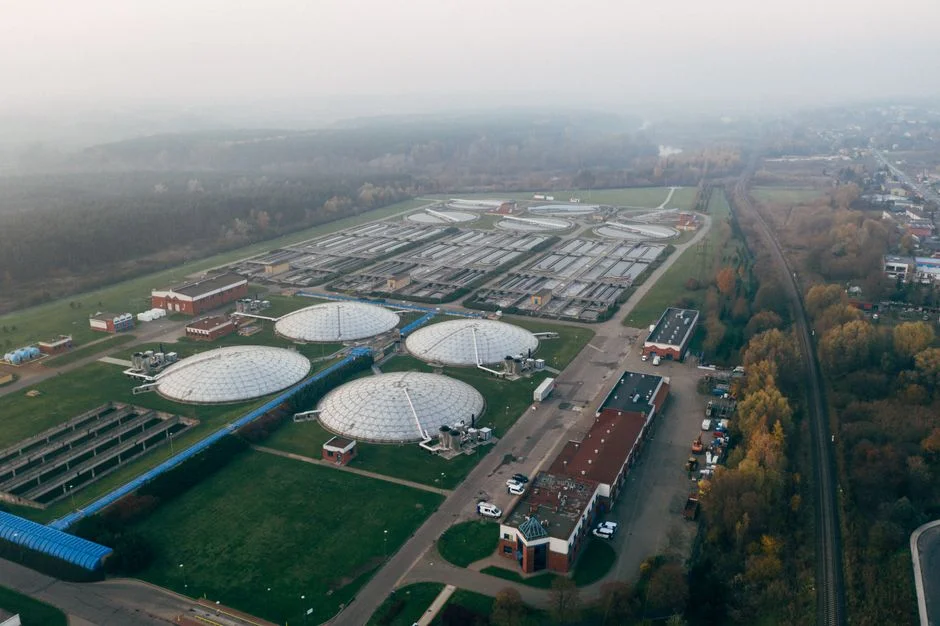
A denim DAF cell sits between the wash line discharge and either a reuse RO loop or a discharge biotreatment train. Upstream, install a rotary bar screen for lint removal with 2–5 mm openings — indigo wash water carries loose fibers, button fragments, and pumice fines from stone-wash that clog DAF nozzles within hours if not screened. A 4–8 hour equalization tank follows the screen to buffer pH swings (desizing at pH 12 vs. stone-wash at pH 10) and temperature swings (50 °C desizing vs. 70 °C post-stone rinse); without EQ, the DAF coagulant dose has to chase the influent and removal becomes noisy.
Equalized flow enters the DAF contact zone where coagulant, polymer, and recycle water are introduced in sequence. The float blanket is skimmed continuously into a sludge hopper; float solids typically run 2–5% dry solids (DS) and need dewatering before disposal. A plate-and-frame filter press on the float sludge produces a cake at 18–25% DS — handleable, transportable, and acceptable for landfill or incineration depending on local rules. PLC control of skimmer speed, recycle pump VFD, and coagulant dose (paced on inlet flow and TSS probe) is the difference between a DAF that hits spec and one that drifts.
Inline instrumentation on the DAF inlet should include pH, TSS, temperature, and flow. pH drives the acid-dosing loop; TSS drives polymer dose; temperature is logged for compliance and for tracking wash-line changes; flow paces the recycle pump. A DAF without these four signals is a DAF that has to be babysat, and a denim wash line is not a place where operators have spare cycles for manual tuning.
Frequently Asked Questions
What DAF removal rates can I expect on indigo denim wash water? A properly sized DAF with PAC or FeCl3 coagulant, anionic polymer, and 20–30% recycle delivers 50–70% COD removal, 80–95% TSS removal, and 60–75% color reduction on indigo wash water (HydropureWater field data, 2026). The wide ranges reflect variability between desizing effluent, stone-wash effluent, and combined flows.
Can DAF-treated denim water be reused in the wash line? Yes — but not after DAF alone. Closed-loop reuse requires DAF plus multi-media filtration and RO (60–75% recovery, with antiscalant) to bring TDS below 500 mg/L, color to negligible, and SS below 10 mg/L. For non-critical reuse such as floor wash or toilet flushing, DAF plus sand filter may be sufficient.
Why is alum less effective than PAC or ferric chloride on indigo wash water? Alum (aluminum sulfate) loses coagulation efficiency above pH 9.5 because Al3+ hydrolyzes to soluble aluminate, and sulfide in the wash water complexes with the remaining aluminum. PAC is pre-hydrolyzed and tolerates pH 10–11; ferric chloride forms a floc that is less sensitive to sulfide competition.
What is the typical DAF power draw per m³ of denim wash water? Expect 0.08–0.15 kWh/m³ at 20–30% recycle, dominated by the saturator pump and recycle pump. Pushing recycle to 40% raises power draw roughly 25–35% and should be matched with a VFD on the recycle pump for off-peak batching.
How often must the DAF float be skimmed and the sludge pressed? Skimming is continuous — the skimmer runs whenever the float blanket exceeds 30 mm. Sludge pressing cadence depends on float yield: for a 50 m³/d DAF at 2–5% DS, press daily; for lighter loads or larger equalization, every 2 days is typical. Float hopper should hold at least 24 hours of production between press cycles.