What Is a Remote Monitoring System for Sewage Treatment in 2026?
A remote monitoring system for sewage treatment in 2026 is an IoT/SCADA stack that uses field sensors (pH, DO, ORP, TSS, NH3-N, flow, level) wired to a PLC or cellular RTU — such as the Sensaphone Sentinel Pro with 64 Modbus registers and 12 I/O — which pushes data to a cloud dashboard via a 4G/LoRa gateway. Operators receive sub-15-minute status updates and SMS/email alarms on pump failure, overflow, or power loss, cutting unplanned downtime by 20–40% versus manual rounds (per the 2025 tubing-manufacturer IoT case study; Sensaphone product page, 2025-08).
The category is mature: Sensaphone has shipped remote monitoring hardware since 1985, giving the segment a 40-year operating track record. Modern 2026 systems are expected to support Modbus TCP/RTU, MQTT, and OPC UA on the protocol side — the three protocols referenced across the Digi and KETOS positioning of the top-ranking pages. SCADA is supervisory control (setpoint changes, trending, historian); a bare telemetry RTU only reports. A 2026 plant engineer should treat "remote monitoring" as a spectrum: an alarm-only RTU on the low end, a full cloud SCADA with historian and ML on the high end, and most retrofits sitting in the middle.
Why Sewage Plants Need Remote Monitoring: The 2026 Business Case
An overflow at 02:00 with no on-site operator is the single most expensive failure mode in municipal sludge handling, and it is the scenario a 2026 monitoring layer is built to prevent. In the tubing-manufacturer case study (2025-08), the wastewater plant sat in a remote corner of a larger facility where local alarms could not be seen or heard — overflow, aerator failure, and power loss all went unnoticed until physical damage had already occurred. The retrofit pushed status updates every 15 minutes by SMS and email and integrated cleanly with the existing infrastructure in under four weeks.
The macro driver is labor cost. Digi's water/wastewater brief (2025) flags "manual processes, outdated technology and surging labor and upkeep costs" as the structural pressure on the sector; KETOS (2025-05) frames the response as "more accurate maintenance scheduling, resource allocation, and strategic insight" from continuous data. Translated into defensible engineering numbers: 20–40% reduction in unplanned incidents and 15–30% fewer site visits are realistic outcomes for a properly instrumented plant. The most common failure modes that justify the spend are tank overflow, aerator motor failure, pump failure, AC power loss, wet-well high level, and chemical-dosing interruption — every one of them detectable with a USD 200–600 sensor and a USD 1,500 RTU.
System Architecture: From Sensor to SCADA Dashboard
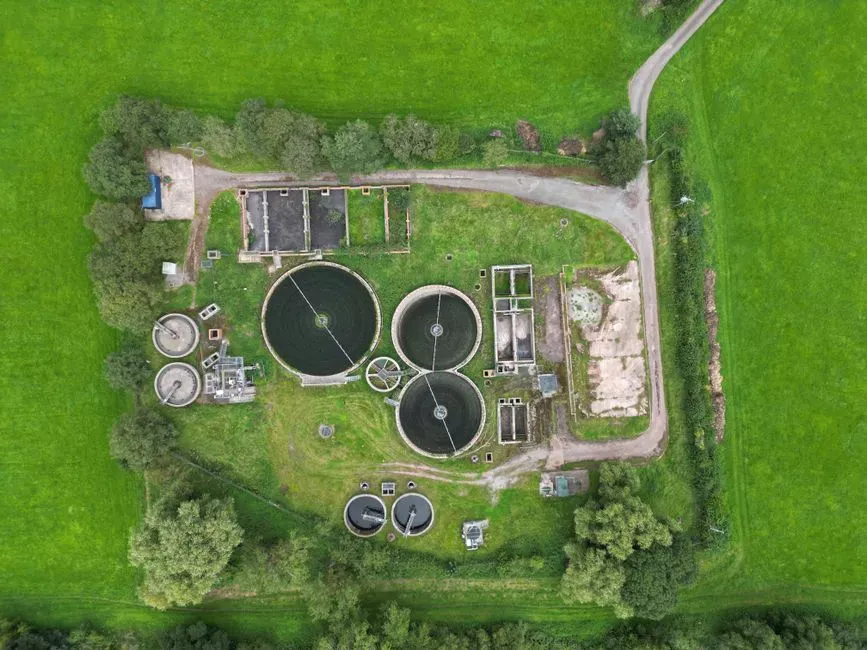
Data moves through four physical tiers, and specifying each correctly is the difference between a working system and a USD 50,000 paperweight. The table below names representative hardware at every tier so a 2026 buyer can match the bill of materials to plant size.
| Tier | Function | Representative hardware (2026) | Protocol |
|---|---|---|---|
| 1 — Field sensor | Measure pH, DO, ORP, TSS, NH3-N, flow, level | Endress+Hauser Liquiline, Hach sc, IFLS self-cleaning TSS | 4–20 mA / Modbus RTU |
| 2 — Local controller | Log, alarm, optionally control | Siemens S7-1500, Schneider M340, Sensaphone Sentinel Pro RTU | Modbus TCP/RTU |
| 3 — Communication gateway | Backhaul to cloud or on-prem SCADA | Digi IX40 / Connect Sensor XRT-M, MultiTech Conduit | 4G LTE, LoRaWAN, Ethernet |
| 4 — SCADA / dashboard | Visualize, alarm, trend, optional AI | Ignition, AVEVA, or vendor cloud (KETOS, Sensaphone, Azure IoT) | MQTT, OPC UA, REST API |
Choose a PLC (Siemens S7-1500, Schneider M340) when you need closed-loop control of aeration blowers, return-sludge pumps, or chemical dosing. Choose a cellular RTU like the Sensaphone Sentinel Pro (64 Modbus registers, 12 digital/analog inputs) when the site is unmanned and you only need alarm reporting plus 15-minute status pushes. Tier 3 is overwhelmingly 4G/LTE cellular in 2026 because most lift stations and packaged plants have no plant LAN; LoRaWAN or RS-485 Modbus covers the on-site hop. Tier 4 cloud or on-premise is a separate decision covered in the next section.
The arrows run sensor → RTU/PLC → gateway → cloud, typically on 4–20 mA at the analog edge, Modbus RTU/TCP from controller to gateway, and MQTT (or OPC UA) from gateway to dashboard. For a deeper treatment-plant-specific architecture dive, see the cloud-based SCADA for water treatment plants engineering guide.
Sensor & Instrumentation Specs for the Seven Critical Parameters
The minimum instrumentation set for a 2026 sewage plant monitor covers seven parameters. The table below is a copy-paste spec sheet for procurement — every row is a real engineering range, not a marketing number. Always add at least one redundant switch on safety-critical points (e.g. a high-level float plus a continuous level transmitter), as called out in the Sensaphone alarm-history best practice.
| Parameter | Typical range | Accuracy | Output | Mounting |
|---|---|---|---|---|
| pH | 0–14 | ±0.02 pH | 4–20 mA + Modbus | Equalization basin, outlet chamber |
| Dissolved oxygen (DO) | 0–20 mg/L | ±0.1 mg/L | 4–20 mA + Modbus | Aeration tank (membrane optical probe) |
| ORP | −1500 to +1500 mV | ±5 mV | 4–20 mA | Anoxic zone, chlorination contact |
| TSS / turbidity | 0–10,000 mg/L (self-cleaning) | ±5% reading | Modbus RTU | Influent (wiper/air-blast clean), effluent |
| NH3-N (ISE) | 0–1000 mg/L | ±5% or ±0.5 mg/L | Modbus / 4–20 mA | Aeration tank; 30–60 day cal cycle |
| Flow | 0.1–10 m/s | ±1–2% | Modbus / pulse | Magmeter on influent, ultrasonic on large trunk lines |
| Level | 0–10 m | ±0.2% FS | 4–20 mA / Modbus | Hydrostatic or ultrasonic in wet well / lift station |
Influent TSS probes must be self-cleaning (mechanical wiper or air-blast) because rag and grease foul an exposed optical face in days, not weeks. NH3-N ion-selective electrodes need 30–60 day calibration cycles; budget that into OPEX. Digital I/O should at minimum cover pump status, pump run-hours, pump cycle count, wet-well level, AC power, and a generic alarm per the KETOS minimum-monitored-point list (2025-05). For a deeper sensor-selection walk-through, see the real-time water quality monitoring system buyer's guide.
On-Premise SCADA vs Cloud SCADA: 2026 Trade-Off Matrix
Cloud SCADA cuts CAPEX 30–50% versus on-premise but adds 4G/ISP dependency and shared-responsibility cybersecurity obligations. The matrix below is the framework to defend the choice to a procurement committee — eight dimensions, two columns, no hand-waving.
| Dimension | On-premise SCADA | Cloud SCADA (2026) |
|---|---|---|
| CAPEX (5-yr) | USD 60K–250K incl. servers, licenses, panel PCs | USD 15K–80K (gateway + SaaS setup) |
| OPEX (annual) | IT staff time, VMware/Windows Server renewals | USD 2K–20K SaaS + cellular data plan |
| Cybersecurity baseline | Perimeter firewall, VLAN, air-gap common | IEC 62443 zone-conduit, TLS 1.3, SOC 2 vendor |
| Uptime dependency | Plant UPS / generator; no ISP needed | 4G primary + wired failover; 99.9% vendor SLA typical |
| Scalability | Server-bound, scale-up projects | Add sensors and sites without new servers |
| Mobile / remote access | VPN required | Browser + native iOS/Android apps |
| IT burden | Patch, backup, replace hardware every 5–7 yr | Vendor-managed; IT owns IAM and device certificates |
| Regulatory posture (2026) | Familiar to EU/US regulators; data residency easy | Increasingly accepted; IEC 62443 often required |
Reference IEC 62443 as the industrial-cyber baseline; 2026 tenders in the EU and Gulf are now requiring it for new SCADA procurements regardless of architecture. For plants retrofitting packaged skids such as the WSZ underground packaged sewage treatment plant, cloud is the default. For large municipal works with existing IT, on-premise or hybrid typically wins the political battle even when the cloud TCO is lower.
2026 CAPEX and OPEX: A Worked Cost Example
Vague "cost savings" claims do not survive a procurement review. The table below is a defensible 2026 cost range, itemized, for two plant sizes — small packaged retrofit vs full municipal upgrade. Treat these as engineering estimates to be confirmed by vendor quote.
| Cost line | 1,000 m³/day packaged plant | 10,000 m³/day municipal plant |
|---|---|---|
| Field sensors (7 parameters × 2 sites) | USD 6,000–12,000 | USD 30,000–60,000 |
| RTU / PLC + I/O | USD 3,000–6,000 | USD 18,000–35,000 |
| 4G gateway + cellular plan (yr 1) | USD 1,500–3,000 | USD 6,000–12,000 |
| Cloud SaaS or SCADA license (yr 1) | USD 2,000–5,000 | USD 12,000–25,000 |
| Installation + commissioning | USD 5,500–19,000 | USD 14,000–48,000 |
| Total CAPEX | USD 18,000–45,000 | USD 80,000–180,000 |
| Annual OPEX (data + SaaS + cal. + maint.) | USD 2,500–6,000 / yr | USD 12,000–25,000 / yr |
| Indicative payback | 12–18 months | 18–24 months |
Payback math is straightforward. One avoided site visit per week at a USD 150 loaded labor rate is roughly USD 7,800/yr per small plant; a single avoided spill fine (USD 10,000–50,000 per EPA 40 CFR 133 / state-equivalent enforcement actions) covers a year's OPEX for the larger plant. The KETOS "strategic insight" framing (2025-05) — better maintenance scheduling, fewer emergency callouts, longer equipment life — is the supporting narrative, but the line-item cost table is what gets a budget approved. The packaged equipment most commonly retrofitted is the WSZ underground packaged sewage treatment plant and the HydropureWater MBR membrane bioreactor, both of which arrive with the I/O landed to make this layer a clean add-on.
Procurement Checklist: 10 Questions to Ask Every Vendor
Walk into the vendor meeting with these ten questions printed. Any vendor that fumbles more than one is not ready for a 2026 plant deployment. Anchor MTTR and alarm-channel questions to the Sensaphone Sentinel Pro (64 Modbus, 12 I/O) as a real benchmark.
| # | Question | Acceptable answer (2026) |
|---|---|---|
| 1 | Modbus register count? | ≥ 64 holding + input registers, simultaneous read/write |
| 2 | Cybersecurity certifications? | IEC 62443-4-2 on the device, SOC 2 Type II on the cloud |
| 3 | Cellular fallback to wired? | Auto-failover LTE ↔ Ethernet within 60 s |
| 4 | Local-logging buffer when WAN is down? | ≥ 30 days at 1-min sample rate |
| 5 | Alarm channel count + escalation paths? | ≥ 12 inputs, SMS + email + voice tree |
| 6 | Dashboard role-based access? | RBAC with audit log; LDAP/AD or SAML SSO |
| 7 | API / OPC UA export to third-party SCADA? | OPC UA server or REST + MQTT broker included |
| 8 | On-site warranty + response SLA? | ≥ 3 yr hardware, 48 h onsite, advance replacement |
| 9 | Training included? | On-site commissioning + 2 operator sessions, recorded |
| 10 | MTTR + guaranteed spare-part / firmware horizon? | ≤ 24 h MTTR; ≥ 10 yr firmware + spare-part commitment |
Add a final row before signing: total lifecycle cost at year 7 and year 10, including SaaS inflation, cellular data plan, and calibration. If the vendor cannot answer nine of ten, walk away and shortlist the next one.
Frequently Asked Questions
What does a remote monitoring system for sewage treatment actually do? It collects sensor and equipment-status data 24/7 from a sewage plant, pushes it to a dashboard every 15 minutes, and fires SMS/email alarms the moment a parameter breaches a threshold — typically overflow, pump failure, aerator fault, or AC power loss.
How much does a remote monitoring retrofit cost in 2026? For a 1,000 m³/day packaged plant, expect USD 18,000–45,000 CAPEX and USD 2,500–6,000/yr OPEX. For a 10,000 m³/day municipal plant, USD 80,000–180,000 CAPEX and USD 12,000–25,000/yr OPEX. These are engineering estimates; confirm with a vendor quote.
Can remote monitoring replace on-site operators? No. It augments them. As the tubing-manufacturer case study (2025-08) framed it, on-site staff "cannot easily see or hear local alarms" in a remote corner of a plant — monitoring fills that gap, it does not eliminate the human.
Which sensors are non-negotiable? pH, dissolved oxygen, ORP, TSS/turbidity, NH3-N, flow, and level. Add a high-level float as a redundant safety switch on every wet well.
Cloud SCADA or on-premise? Pick cloud for greenfield and packaged retrofits where 30–50% CAPEX savings outweigh the 4G/ISP dependency. Pick on-premise when you already run a plant IT group, must keep data on-site, or face air-gapped regulator requirements. For most 2026 buyers, the answer is hybrid: cloud for analytics and alarms, on-premise for control loops. For an architecture-level deep dive, see the cloud-based SCADA for water treatment plants guide and the AI process control for wastewater treatment article for the next layer up.