Why Bristol Hospitals Need a 2026 Wastewater Compliance Reset
Three regulatory instruments converge on Bristol hospital estates teams in 2026. NHS Estates HTM 07-04 Safe Water in Healthcare Premises remains the UK design baseline for healthcare effluent, and its 2024–2026 review cycle is tightening pharmaceutical-residue monitoring at the point of discharge (per NHS Estates, 2024-09). The UK 5-Year National Action Plan on Antimicrobial Resistance 2024–2029 obliges NHS Trusts to evidence antibiotic-residue reduction in point-of-discharge effluent, not just in procurement policy (per DHSC, 2024-01). Wessex Water's 2026 trade-effluent consent regime layers a third binding constraint on top: BOD₅ typically <20 mg/L, COD <125 mg/L, TSS <30 mg/L, total nitrogen <15 mg/L, total phosphorus <2 mg/L, pH 6–10, and <10⁴ CFU/100 mL E. coli at the sewer connection (Wessex Water trade-effluent consent schedule, 2025-12). A Bristol estates engineer can take one of two routes to hit all three: build a pre-treatment train on-site that lets Wessex Water's downstream works do the final polish, or run a complete on-site plant that produces reuse-quality effluent. The capital decision turns on bed count, reuse opportunity, and consent-charge trajectory — a comparison a procurement board will want to see itemised rather than waved through.
Bristol Hospital Effluent Characteristics: What Makes It Different
Hospital wastewater is not domestic wastewater with a few extra chemicals; it is a separate engineering class. The Chlorella sp. LH2 study (Bioresources and Bioprocessing, 2024) reported untreated hospital wastewater at BOD₅ 192 ± 8.62 mg/L and COD 245 ± 9.15 mg/L, a BOD₅:COD ratio of 0.77 that confirms biodegradability but at roughly half the organic strength of raw municipal sewage. Pharmaceutical residues per Verlicchi (Springer, 2017) sit in the µg/L to ng/L range across antibiotics, cytotoxics, iodinated contrast media, and hormones — concentrations that pass straight through a coarse biological plant unchanged. Pathogen loading is similarly elevated: E. coli, Enterococcus, Pseudomonas aeruginosa, and SARS-CoV-2 RNA fragments remain detectable in surveillance published through 2025-08. Diurnal flow is the dimension most often undersized at design: morning surgical washdown and instrument reprocessing push instantaneous flow to 1.5–2.0× daily mean, which is why a 6–8 hour equalisation buffer is non-negotiable before any biological stage.
| Parameter | Typical Bristol hospital influent | Source |
|---|---|---|
| BOD₅ | 192 ± 8.62 mg/L | Chlorella sp. LH2 study, 2024 |
| COD | 245 ± 9.15 mg/L | Chlorella sp. LH2 study, 2024 |
| BOD₅:COD ratio | 0.77 | Chlorella sp. LH2 study, 2024 |
| Total nitrogen (untreated) | ~40–60 mg/L (typical design range) | Hospital wastewater characterisation, Verlicchi 2017 |
| Pharmaceutical residues | µg/L to ng/L across 60+ compounds | Verlicchi, Springer 2017 |
| Diurnal peak factor | 1.5–2.0× daily mean | HydropureWater field data, 2026 |
| Equalisation HRT required | 6–8 hours | HydropureWater field data, 2026 |
The Engineered Treatment Train That Works in Bristol
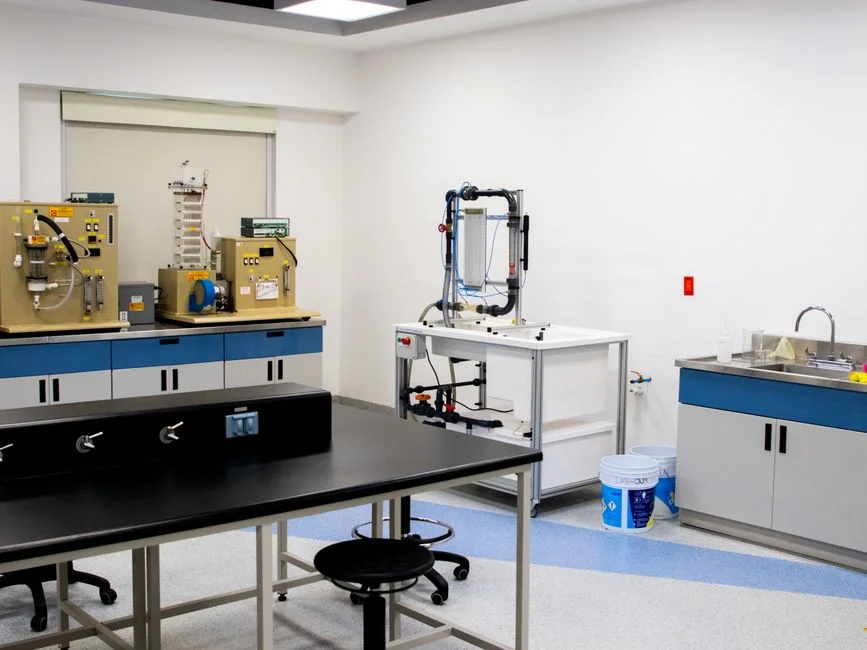
A reliable Bristol train has five stages in this order, and the order is not negotiable. Stage 1 — Headworks screening. A rotary mechanical bar screen for headworks with a 3 mm aperture captures rags, swabs, and surgical dressings before they blind downstream membranes; the GX series carries dual-overload protection so a single jam does not stop the train. Stage 2 — Flow equalisation. A 6–8 hour HRT buffer tank dampens the 1.5–2.0× diurnal peak, blends pH excursions from CSSD and endoscopy discharges, and gives the coagulant dosing contact time it needs to work. Stage 3 — MBR biological stage. A submerged MBR system with PVDF membranes at 0.1 µm pore size delivers >95% COD removal, >99% TSS removal, and roughly 60% footprint reduction versus conventional activated sludge (per MBR catalog, 2026). The flat-sheet PVDF flat-sheet membrane module is preferred over hollow-fibre in hospital duty because it tolerates the chemical cleaning regime needed when pharmaceutical residues accumulate on the membrane surface. Stage 4 — Disinfection. An on-site ClO₂ generator for hospital disinfection dosed at 0.5–2.0 mg/L residual with 15–30 minutes contact time, sized to bed count. Stage 5 — Sludge handling. Wasted biosolids are thickened in a lamella clarifier and dewatered on a plate-and-frame filter press to >22% DS cake for off-site incineration.
| Stage | Unit operation | Design loading / spec | Typical removal / output |
|---|---|---|---|
| 1 | Rotary bar screen, 3 mm | Peak flow 2× daily mean | Rag and dressing capture |
| 2 | Equalisation tank | 6–8 h HRT | Flow and pH dampening |
| 3 | Submerged MBR, PVDF 0.1 µm | MLSS 8,000–12,000 mg/L; flux 15–25 LMH | >95% COD, >99% TSS, >99% bacterial log |
| 4 | ClO₂ disinfection | 0.5–2.0 mg/L, 15–30 min contact | 99.99% pathogen kill, no THMs |
| 5 | Lamella + plate-and-frame press | Cake target >22% DS | ~95% volume reduction |
Disinfection Choice: ClO₂, Ozone, or UV for Hospital Effluent
Disinfection is the single decision a procurement board will challenge hardest, so the trade-offs need to be on the page. Chlorine dioxide (ClO₂) at 0.5–2.0 mg/L with 15–30 minutes contact delivers 99.99% bacterial kill, forms no THMs or HAAs across the 6–10 pH range a hospital effluent actually runs at, and leaves a residual that protects the sewer run to the Wessex Water treatment works — relevant for AMR control where downstream decay is part of the consent case. Ozone has a higher oxidation potential and is more effective against antibiotic-resistant organisms and pharmaceutical residues, but it leaves no residual and runs 30–60% higher on energy; the compact medical wastewater package system demonstrates the ozone envelope at the small-clinic scale. UV is chemical-free and effective on clear MBR permeate, but it inactivates rather than oxidises, so it does nothing for AMR residues and needs a polish step if the consent demands a sewer residual. Decision rule: ClO₂ where the hospital discharges to a long sewer run; ozone where the hospital reuses effluent for irrigation or cooling; UV only as a tertiary polish after MBR, never as the sole barrier.
| Option | Dose / intensity | Pathogen kill | AMR-residue oxidation | Sewer residual | Best fit |
|---|---|---|---|---|---|
| Chlorine dioxide | 0.5–2.0 mg/L, 15–30 min | 99.99% | Partial | Yes | Discharge to Wessex Water sewer |
| Ozone | 5–15 mg/L, 10–20 min | 99.9%+ | Strong | No | On-site reuse for irrigation/cooling |
| UV (254 nm) | 30–40 mJ/cm² | 99.9% | None | No | Polishing after MBR only |
On-Site Treatment vs. Wessex Water Trade-Effluent Consent

The binary question a Bristol estates manager will be asked to defend is: build a plant, or pay Wessex Water to take the effluent. Indicative 2026 ranges: Wessex Water trade-effluent consent charges for a 200-bed hospital typically run £45,000–£90,000 per year (engineering estimate, request formal Wessex Water quotation), plus capital sampling and monitoring commitments under the consent schedule. On-site treatment CAPEX for the same 200-bed case lands at £180,000–£420,000 depending on whether the spec is reuse-grade or consent-grade discharge, with OPEX £0.18–£0.62 per m³ across the IFAS/MBR operating envelope. Break-even sits in the 250+ bed band, before any reuse value is counted. The reuse upside is the variable that flips borderline cases: a 200-bed hospital reusing 80 m³/day for cooling or toilet flush recovers the consent fee differential in 3–5 years. Decision rule: below 150 beds, trade-effluent consent is normally optimal; 150–250 beds depends on reuse value; above 250 beds on-site treatment wins on cost and resilience.
| Option | Bed count | Indicative 2026 CAPEX | Annual cost | Strategic value |
|---|---|---|---|---|
| Wessex Water consent only | <150 | £0 (existing connection) | £15,000–£40,000/yr | Lowest CAPEX, no reuse |
| Wessex Water consent | 200 | £0 | £45,000–£90,000/yr (engineering estimate) | Higher OPEX, no reuse |
| On-site MBR + ClO₂ | 150–250 | £180,000–£320,000 | OPEX £0.18–£0.45/m³ | Optional reuse |
| On-site MBR + reuse | >250 | £280,000–£420,000 | OPEX £0.30–£0.62/m³ | Resilience, reuse revenue, AMR control |
Equipment Selection Matrix for a 50–500 Bed Bristol Hospital
The matrix below ties bed count to the specific equipment shortlist a procurement board can bench against supplier quotes. For trusts up to 80 m³/day the underground integrated sewage treatment package delivers a buried, no-operator footprint suitable for car-park or grounds siting. Above 80 m³/day the MBR is mandatory to hit consent-grade BOD₅ and TSS. ClO₂ generator sizing is given in the 50 g/h to 20,000 g/h envelope that the catalog covers (2026). Screening aperture tightens from 5 mm at small flow to 3 mm at full hospital scale to protect downstream membranes. The plate-and-frame filter press for biosolids dewatering is common across all tiers, and the automatic chemical dosing system is sized to the equalisation tank volume rather than bed count. All CAPEX bands are engineering estimates and should be replaced with formal quotes before going to procurement.
| Bed count | Daily flow (m³/day) | MBR capacity | ClO₂ generator | Screen aperture | Indicative CAPEX band |
|---|---|---|---|---|---|
| 50 | 15–25 | WSZ underground package | 50 g/h | 5 mm | £35,000–£70,000 (engineering estimate) |
| 100 | 30–50 | WSZ or compact MBR | 100–200 g/h | 5 mm | £70,000–£140,000 (engineering estimate) |
| 200 | 60–100 | Submerged MBR, 1 train | 300–500 g/h | 3 mm | £180,000–£320,000 (engineering estimate) |
| 350 | 100–180 | Submerged MBR, 2 trains | 800–1,500 g/h | 3 mm | £300,000–£480,000 (engineering estimate) |
| 500 | 150–250 | Submerged MBR, 2–3 trains | 2,000–5,000 g/h | 3 mm | £420,000–£680,000 (engineering estimate) |
Frequently Asked Questions
What consent limits does a Bristol hospital face in 2026? A typical Wessex Water trade-effluent consent in 2026 requires BOD₅ <20 mg/L, COD <125 mg/L, TSS <30 mg/L, total nitrogen <15 mg/L, total phosphorus <2 mg/L, pH 6–10, and <10⁴ CFU/100 mL E. coli at the sewer connection, per the Wessex Water trade-effluent consent schedule (2025-12).
Which equipment fits a small Bristol clinic under 50 beds? The compact medical wastewater package system integrates screening, biological treatment, and disinfection in a single skid sized for sub-25 m³/day flows.
Why is MBR preferred over conventional activated sludge for hospital effluent? The submerged MBR system with PVDF membranes removes >95% COD and >99% TSS in roughly 60% of the footprint, retains suspended solids and bacteria on the membrane side, and tolerates the variable loads hospital duty throws at it.
Does HTM 07-04 specify discharge parameters? HTM 07-04 Safe Water in Healthcare Premises sets the design framework for healthcare effluent but defers numerical discharge limits to the local sewerage undertaker's trade-effluent consent and to the EU Urban Waste Water Directive 91/271/EEC compliance baseline.
How does the 2024–2029 AMR Action Plan affect hospital wastewater? The UK 5-Year National Action Plan on Antimicrobial Resistance 2024–2029 requires NHS Trusts to demonstrate antibiotic-residue reduction in point-of-discharge effluent, which is why ClO₂ or ozone is preferred over UV where AMR control is part of the consent case (per DHSC, 2024-01).