Why Vietnam Is Adopting Zero Liquid Discharge in 2026
A zero liquid discharge (ZLD) system in Vietnam recovers 95-99% of industrial wastewater as reusable water and converts the remaining 1-5% into dry solids, helping plants meet QCVN 40:2014/BTNMT limits and avoid surface discharge entirely. For 2026 projects, a hybrid membrane + thermal train (UF + RO + mechanical vapor recompression or MVR evaporator) is the standard configuration for textile, steel, and power plants generating 50-500 m³/day, with typical CAPEX of USD 1,800-4,200 per m³/day and OPEX of USD 1.40-3.80 per m³ of feed.
Three forces converged in 2024-2025 to make ZLD a strategic procurement decision, not a corporate-sustainability headline. First, MONRE tightened enforcement of QCVN 40:2014/BTNMT in industrial parks, with provincial departments issuing compliance letters under Column A limits for new discharges (TDS 1,000 mg/L, COD 50 mg/L, total heavy metals 5 mg/L) and Column B for retrofits (TDS 2,000 mg/L, COD 150 mg/L) — and the 2023-2025 amendment cycle specifically lowered phenol from 0.5 to 0.2 mg/L, ammonia from 10 to 5 mg/L, and TDS to 1,500 mg/L for textile and steel sub-sectors. Second, freshwater scarcity in the Mekong Delta and Red River Delta pushed industrial water tariffs up 15-25% in Dong Nai, Binh Duong, and Long An parks per EVN 2024 utility reports, with peak-season salinity intrusion closing 8-12% of shallow industrial wells in 2024. Third, the 38+ southern industrial zones (VSIP, Amata, Deep C, Long Thanh) now require on-site water reuse for new FDI tenants in electronics, food processing, and semiconductor assembly — a clause that did not exist in 2018.
Vietnamese buyers should distinguish true ZLD from "near-ZLD" or minimum liquid discharge (MLD, typically 90-95% recovery with brine sent to a licensed off-site hauler). MLD remains the rational retrofit choice for plants with existing discharge permits and limited capex appetite in non-stressed provinces; true ZLD is the right answer for new builds in Dong Nai, Binh Duong, Hai Phong, and Ba Ria-Vung Tau, where the salt cake has no nearby licensed landfill and freshwater is the binding constraint. The ZLD roadmap detailed in the IC wastewater ZLD engineering specs covers the 2-20 m³/day semiconductor case; the same logic scales to 50-500 m³/day textile and steel projects once pretreatment capacity is matched.
How a Zero Liquid Discharge System Works: The Three Process Trains
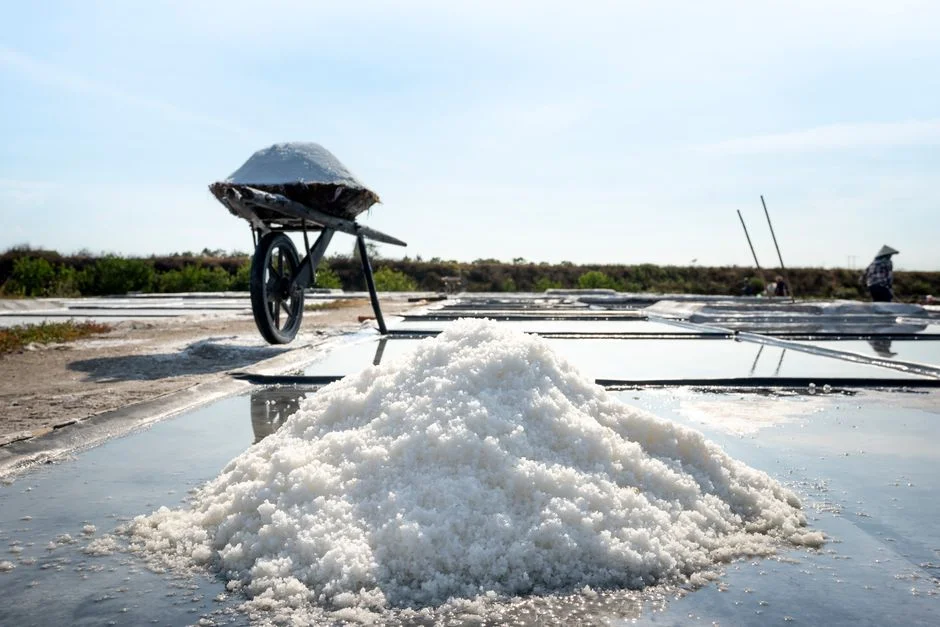
The canonical ZLD process is a four-stage chain: pretreatment (DAF or sedimentation + lime-soda softening) → membrane concentration (UF polishing followed by brackish-water RO, sometimes a second pass or an osmotic distillation stage) → thermal crystallization (MVR, multiple-effect evaporator, or forced-circulation crystallizer) → solid handling (filter press or decanter centrifuge for the salt cake). A correctly designed train at 10,000 mg/L feed TDS will produce 95 m³ of permeate at <50 mg/L TDS per 100 m³ of feed, leaving 5 m³ of brine at approximately 200,000 mg/L TDS that yields 0.5-1.0 tonne of wet salt cake per 100 m³ processed (Palit & Hussain 2023, ScienceDirect Ch. 2, pp. 33-50).
Three train configurations are bid in Vietnam in 2026. Membrane-only ZLD uses a brine concentrator (high-pressure RO up to 80-90 bar) followed by a crystallizer, and is technically viable only for feed TDS below 35,000 mg/L — pushing past that limit shortens RO membrane life from 3-5 years to 12-18 months. Thermal-only ZLD uses MEE or MVR with no RO, a legacy approach retained for very high-TDS streams (FGD wastewater, landfill leachate) where membrane scaling is uneconomical to control; it consumes 35-55 kWh/m³ of electrical equivalent and is the most energy-intensive of the three. Hybrid RO + thermal is the 2026 default for Vietnam industries because it pairs 70-75% RO water recovery (low energy, ~3-5 kWh/m³) with thermal finishing only on the 25-30% brine — a recovery of 95-99% overall at 12-22 kWh/m³ combined. Pretreatment equipment such as the DAF pretreatment unit and the industrial RO system covers the upstream half of this hybrid train.
| Train | Typical Feed TDS (mg/L) | Water Recovery | Energy Use (kWh/m³) | Best-Fit Industry in Vietnam |
|---|---|---|---|---|
| Membrane-only (BC + crystallizer) | < 35,000 | 95-98% | 8-14 | Electronics, food & beverage |
| Thermal-only (MEE / MVR) | 35,000-150,000 | 98-99% | 35-55 | FGD wastewater, leachate |
| Hybrid (RO + thermal) | 4,000-30,000 | 95-99% | 12-22 | Textile, steel, chemical, power |
Vietnam-Specific Design Considerations: Climate, Feed Variability, and Materials
A ZLD plant in Hai Phong or Ba Ria-Vung Tau is not a temperate-climate install with a Vietnamese label on the panel. The country sits in the humid tropical belt with coastal humidity 75-85% year-round, and the wet season (May-October) drives ambient wet-bulb temperatures 3-5°C above ISO 9001 reference conditions. This raises cooling-tower sizing by 15-20% versus dry-bulb datasheets and doubles condenser-fouling frequency in the May-October rainy season — plant operators in Dong Nai report MVR compressor trips every 6-9 weeks without monthly tube brushing, versus 14-18 weeks in dry provinces.
Feed variability is the second design pitfall. Textile dye-house effluents in Binh Duong swing 3-8× in TDS across shift changes (typically 4,000-12,000 mg/L) as the dye recipe changes; steel mill rinse waters carry chloride at 1,500-4,000 mg/L, which is aggressive to 304 stainless. The engineering rule for Vietnam is to size for 1.5× max instantaneous flow at 1.25× max TDS, with an automatic chemical dosing skid on the antiscalant line (typically 2-5 mg/L dose, setpoint-trimmed by feed conductivity) to keep RO membrane scaling index (LSI < 1.8, SDI < 3) under control. Material selection follows the climate: 316L stainless wetted parts (chloride > 1,000 mg/L), FRP or rubber-lined brine storage tanks, and salt-spray-rated NEMA 4X electrical enclosures for coastal provinces.
Power reliability is the third under-specified item. Industrial parks in Long An, Binh Phuoc, and parts of Hai Phong still log 4-12 voltage dips per month on the 22 kV feeder, which trips VFDs on RO high-pressure pumps and stalls crystallizer feed pumps. Specify UPS on the RO HP pump VFD, soft-start on crystallizer feed pumps, and islanding logic on the MVR compressor for any park where SAIDI exceeds 60 minutes/month.
Matching ZLD Trains to Vietnamese Industries: A Decision Matrix
No single ZLD train fits every Vietnamese industry. The decision matrix below is built from HydropureWater field data (2024-2025) and ties directly to where the four most common Vietnamese industrial feed profiles fall on the membrane-thermal spectrum.
Textile dyeing (Binh Duong, Dong Nai, Tay Ninh): feed TDS 4,000-12,000 mg/L with high color, sulfate 800-2,500 mg/L, and reactive-dye residual COD 400-900 mg/L. The standard train is DAF + softener → UF → RO (75% recovery) → forced-circulation MVR crystallizer, with the salt cake (mostly Na₂SO₄) sent to a filter press for landfill disposal. Typical capacity 100-300 m³/day, hybrid CAPEX USD 2,400-3,200 per m³/day.
Steel and metal finishing (Hai Phong, Ba Ria-Vung Tau, Phu My): feed TDS 8,000-30,000 mg/L with chromium, nickel, zinc, and free oil. The train starts with DAF for oil removal, pH adjustment and heavy-metal precipitation (NaOH raise to pH 9-9.5, then polymer flocculation), two-pass brackish RO at 70% recovery, and an MEE finishing stage to drive the final brine to < 1% moisture salt cake via a filter press for salt cake and sludge. Typical capacity 150-500 m³/day.
Power plant FGD wastewater (Vinh Tan, Formosa Ha Tinh, Mong Duong): chloride 15,000-25,000 mg/L, sulfate 5,000-12,000 mg/L, with suspended solids and selenium. The train is softening + clarifier → RO (60-65% recovery due to scaling) → falling-film MVR or spray dryer for zero moisture discharge. Falling-film MVR is preferred when co-generation steam is available; spray dryer is preferred for plants that want a solid powder, not a wet cake.
Electronics and semiconductor (Saigon Hi-Tech Park, Hanoi Hi-Tech): low-volume high-purity demand. Two-pass RO + EDI for the reuse loop, with ZLD only on the concentrate sidestream at 20-80 m³/day. The 2025-2026 reference plant in SHTP runs at 35 m³/day concentrate ZLD, with MVR evaporator at 11 kWh/m³.
Food and beverage (Mekong Delta, Binh Duong, Cu Chi): high BOD 1,500-4,000 mg/L, fats/oils, and variable TSS. The train uses an MBR pretreatment system before RO + MVR to control biological fouling on the membranes; CIP frequency drops from weekly to monthly with MBR in front.
| Industry | Feed TDS (mg/L) | Recommended Train | Capacity Range (m³/day) | Key Pretreatment |
|---|---|---|---|---|
| Textile dyeing | 4,000-12,000 | DAF + UF + RO + MVR crystallizer | 100-300 | Coagulation, color removal |
| Steel / metal finishing | 8,000-30,000 | DAF + precipitation + 2-pass RO + MEE | 150-500 | Heavy-metal precipitation, oil removal |
| Power FGD wastewater | 15,000-60,000 | Softening + RO + falling-film MVR / spray dryer | 50-200 | Lime-soda softening, clarifier |
| Electronics / semiconductor | 500-3,000 | 2-pass RO + EDI, ZLD on concentrate | 20-80 | UF polishing, mixed-bed |
| Food & beverage | 2,000-8,000 | MBR + RO + MVR | 100-400 | MBR biological, FOG stripper |
2026 Cost Benchmarks for ZLD Plants in Vietnam: CAPEX, OPEX, and ROI
The 2026 Vietnam market prices ZLD at the following installed CAPEX (USD per m³/day of feed capacity, FOB Ho Chi Minh port + on-site installation): membrane-only 1,800-2,600; thermal-only 2,800-4,200; hybrid RO + thermal 2,200-3,400. A 100 m³/day hybrid plant for a textile or steel project lands at USD 220,000-340,000 fully installed. These figures are bracketed by the 2026 multiple-effect evaporator operating cost analysis, which tracks the thermal half of the train in detail.
OPEX for 2026 in Vietnam (USD per m³ of feed, all-in) breaks down as: thermal energy 0.55-1.20 (steam or MVR electrical equivalent), electrical energy for RO and auxiliaries 0.30-0.65, chemicals (antiscalant 2-5 mg/L, CIP acid/alkali, polymer) 0.18-0.45, labor and routine maintenance 0.20-0.50. Total OPEX lands at USD 1.40-3.80 per m³ depending on feed TDS — the lower end applies to RO-dominated trains on feed below 8,000 mg/L TDS, the upper end to thermal finishing on 30,000+ mg/L FGD or leachate feeds.
Vietnam-specific cost drivers cut both ways. On the cost-down side, import duty on complete ZLD skids is 0-5% under ATIGA / ACFTA for ASEAN- and China-origin equipment, and installation labor runs 60-70% below EU or Japan benchmarks (typical site labor 1,200-1,800 man-hours for a 100 m³/day hybrid plant at USD 8-14/hour). On the cost-up side, MONRE environmental commitment report preparation, EPR liability bond, and salt-cake landfill tipping fees (USD 25-60 per tonne in Dong Nai and Ba Ria-Vung Tau) need to be carried in the budget.
ROI math is straightforward at current Ho Chi Minh industrial water tariffs of VND 17,000-24,000/m³ (≈ USD 0.65-0.95), plus discharge-fine avoidance of VND 500 million-2 billion/year for non-compliance events. For a 200 m³/day textile plant at USD 2.80/m³ OPEX, gross water savings against purchased freshwater plus discharge-fine avoidance yield a 3.5-6 year payback in water-stressed provinces; coastal electronics plants with stricter reuse requirements see 2.5-4 year payback.
| Cost Item | 2026 Vietnam Benchmark | Unit | Notes |
|---|---|---|---|
| CAPEX — hybrid RO + thermal | 2,200-3,400 | USD per m³/day | 100 m³/day plant = USD 220k-340k |
| CAPEX — membrane-only | 1,800-2,600 | USD per m³/day | Limited to TDS < 35,000 mg/L |
| CAPEX — thermal-only (MEE/MVR) | 2,800-4,200 | USD per m³/day | High-TDS, high-energy use |
| OPEX — thermal energy | 0.55-1.20 | USD per m³ feed | Steam or MVR kWh equivalent |
| OPEX — electrical | 0.30-0.65 | USD per m³ feed | RO HP pumps, auxiliaries |
| OPEX — chemicals + CIP | 0.18-0.45 | USD per m³ feed | Antiscalant, acid/alkali, polymer |
| OPEX — labor + maintenance | 0.20-0.50 | USD per m³ feed | Vietnam site labor USD 8-14/h |
| OPEX — total (hybrid) | 1.40-3.80 | USD per m³ feed | Range driven by feed TDS |
| Payback period | 3.5-6 | years | Textile/steel, water-stressed province |
Supplier Evaluation Checklist for ZLD Projects in Vietnam
The fastest way for a Vietnamese buyer to separate a credible ZLD vendor from a reseller is to demand evidence of in-house manufacturing and on-site pilot performance. Four checks are non-negotiable. First, require a 4-8 week on-site pilot test on actual plant feed — not a lab simulant — with measured flux (L/m²·h), recovery (%), crystallizer steam economy (kg steam per kg water evaporated), and salt-cake moisture content. Refuse any vendor who offers only a desktop simulation. Second, audit the factory: RO pressure vessels, evaporator bodies, and crystallizer shells should be fabricated in-house (welding procedure specifications, ASME U-stamp or equivalent), not assembled from bought-in components. Third, request a Vietnam or Southeast Asia reference list with site-visit permission — a serious vendor will allow you to inspect boiler capacity, salt-cake handling logistics, and water-reuse loop integration at a running plant. The Chinese ZLD manufacturer reliability assessment covers the factory-audit and reference-check workflow in more detail.
Fourth, confirm compliance documentation: a QCVN 40:2014 monitoring plan (24-hour composite sampling, online pH/COD/TSS meters at outfall), a MONRE environmental commitment report, EPC contractor ISO 9001 plus ASME U-stamp on pressure vessels, and a salt-cake disposal agreement with a licensed industrial landfill. Vietnam-based EPCs with ATIGA documentation and a local service team (target ≤ 8-hour response time to Hai Phong, Dong Nai, or Binh Duong) will out-perform pure-export vendors on commissioning and warranty support.
Frequently Asked Questions About Zero Liquid Discharge in Vietnam
What is the 2026 CAPEX for a ZLD plant in Vietnam? Installed CAPEX for a hybrid RO + thermal ZLD plant runs USD 2,200-3,400 per m³/day of feed capacity; a 100 m³/day textile or steel project lands at USD 220,000-340,000.
What recovery rate does ZLD achieve? Hybrid ZLD trains in Vietnam typically achieve 95-99% water recovery, producing permeate below 50 mg/L TDS and a 0.5-1.0 tonne wet salt cake per 100 m³ of feed at 10,000 mg/L TDS.
Which ZLD train fits textile dyeing wastewater? Hybrid UF + RO + MVR crystallizer at 70-75% RO recovery, sized for feed TDS 4,000-12,000 mg/L, is the standard 2026 selection for Binh Duong, Dong Nai, and Tay Ninh dye houses.
Does QCVN 40:2014 mandate ZLD? No. QCVN 40:2014/BTNMT sets Column A and Column B discharge limits (TDS 1,000-2,000 mg/L, COD 50-150 mg/L); ZLD is required only when no discharge is permitted under the local environmental commitment or industrial park rule.
What is the typical payback period for ZLD in Vietnam? 3.5-6 years for textile and steel plants in water-stressed provinces, based on HCMC industrial water tariffs of USD 0.65-0.95 per m³ and discharge-fine avoidance of VND 500 million-2 billion per year. For a deeper scale-specific walkthrough of IC and high-purity wastewater, see the IC wastewater ZLD engineering specs.