Skid mounted maintenance follows a fixed 7-step protocol: inspect, lubricate, calibrate, clean, test, document, and audit. Plants that run preventive work cut downtime by 30–50% and trim maintenance cost by 18–25% versus reactive repair (osapiens, 2026). The same cadence applies to compact wastewater and pure-water skids in remote or temporary service.
Why Skid Mounted Systems Need Specialized Maintenance
A skid mounted treatment plant stays reliable when crews inspect daily, lubricate to OEM hours, and calibrate sensors on a weekly-to-monthly cycle. They also clean on ΔP triggers, test at 100%/75%/50% design flow, log work in a CMMS, and close repeats with root-cause reviews—the decision rule behind every checklist here.
Skid-mounted wastewater treatment systems face stresses that fixed-site plants rarely see. Transit vibration loosens wiring, shifts pump alignment, and can crack frame welds, so mounting bolts and electrical lugs need a monthly torque check. Dense packaging also traps heat between pumps, panels, and dosing lines; most plants we size for remote sites schedule thermal scans more often than on distributed layouts.
Limited on-site craft skill makes a written preventive maintenance checklist and remote alarms non-negotiable. One clogged chemical dosing line can stop an entire train within hours and push effluent out of compliance. Mechanical, chemical, and PLC work therefore share one calendar, not three separate ones.
Skid Mounted Maintenance: The 7-Step Protocol
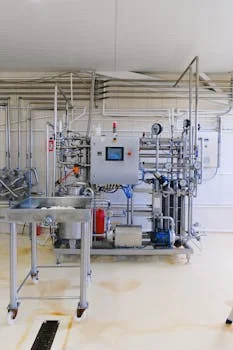
A structured 7-step maintenance protocol can reduce repeat equipment failures by 67% and raise measurable uptime when work orders stay auditable (OxMaint finding). The workflow below converts reactive call-outs into timed tasks with clear pass/fail limits.
- Step 1: Visual & Physical Inspection – Walk the skid daily for leaks, corrosion, loose fasteners, and abnormal wear. Capture timestamped photos whenever conditions drift from the baseline.
- Step 2: Lubrication & Mechanical Integrity – Follow OEM lubrication intervals. Pump bearings typically need oil every 2,000 operating hours with ISO VG 68 oil. Check shaft couplings for misalignment, wear, and vibration at the same visit.
- Step 3: Calibration of Sensors and Meters – pH, ORP, flow, and pressure sensors can drift up to 5% monthly under process load. In harsh service, recalibrate weekly; in milder duty, monthly checks usually hold drift below 5%.
- Step 4: Cleaning of Critical Components – Backwash multimedia filters when differential pressure (ΔP) across the bed exceeds 15 psi. Quarterly, descale membrane housings with a 2% citric acid solution to protect flux.
- Step 5: Performance Testing – Run flow tests at 100%, 75%, and 50% of design capacity. Confirm effluent still meets the design limit, for example Biochemical Oxygen Demand (BOD) below 30 mg/L.
- Step 6: Digital Documentation – Enter every action, calibration, and test result in a Computerized Maintenance Management System (CMMS). Digital logs can shrink audit prep from about three days to under two hours (OxMaint data).
- Step 7: Root Cause Review – After a major failure or repeat ticket, review prior work orders and rewrite the preventive checklist. That feedback loop can close 67% of repeat failures when findings become new tasks (OxMaint research).
Table: Key Maintenance Parameters and Frequencies
| Parameter/Component | Maintenance Task | Recommended Frequency | Typical Specification/Threshold |
|---|---|---|---|
| Mounting Bolts & Electrical Connections | Inspect & Tighten | Monthly | Visual check for looseness, torque to spec |
| Pump Bearings | Lubricate | Every 2,000 operating hours | ISO VG 68 oil |
| pH, ORP, Flow, Pressure Sensors | Calibrate | Weekly (harsh env.) / Monthly (std. env.) | Drift < 5% |
| Multimedia Filters | Backwash | As needed (ΔP trigger) | ΔP > 15 psi |
| Membrane Housings | Descale | Quarterly | 2% citric acid solution |
| Effluent Quality | Performance Test | Quarterly | BOD < 30 mg/L (example) |
Zone-by-Zone Maintenance Checklist
Zone-by-zone skid checklists stop crews from skipping dense corners that a fixed plant would leave to separate trades. Assign each zone an owner and a frequency before the first shift handover.
- Chemical Dosing Skid: Inspect diaphragm pump seals daily. Calibrate metering pumps weekly; about 90% of chemical feed errors still trace to air locks or crystallized lines. Verify tank levels daily. A PLC-controlled chemical dosing skid for precise reagent injection reduces manual stroke changes on multi-reagent trains.
- Filtration & Backwash System: Watch filter ΔP continuously and start backwash above 15 psi. Inspect media annually for fines, channeling, or breakdown. An automated backwash multi-media filter for skid integration cuts missed wash cycles on unmanned sites.
- Pumping & Flow Control: Test level-sensor auto-start monthly. Lubricate pump motors every six months per the manufacturer. Vibration above 4.5 mm/s usually means imbalance or bearing wear that needs shutdown, not another week of monitoring.
- SCADA & Instrumentation: Validate alarm setpoints quarterly against process and permit limits. Replace UPS batteries on a 3–5 year cycle. Keep PLC and HMI firmware current so interlocks and remote alerts stay trustworthy.
- Electrical Panel & PLC: Clean panel dust monthly to limit hot spots and arc risk. Retorque terminals quarterly because road and pump vibration backs screws out. Confirm grounding resistance stays below 1 ohm.
- Pre-Deployment Checks: After every move, inspect frame welds, re-torque flanges, and dry-run pumps, valves, and sequences before process water enters the skid.
Table: Zone-Specific Maintenance Tasks & Frequencies
| Skid Zone | Daily Tasks | Weekly Tasks | Monthly Tasks | Quarterly/Annually Tasks |
|---|---|---|---|---|
| Chemical Dosing | Check chemical levels, inspect pump seals | Calibrate metering pumps | Inspect diaphragm integrity | Replace tubing/diaphragms (annually) |
| Filtration & Backwash | Monitor ΔP across filters | — | Inspect backwash valves | Inspect media bed (annually) |
| Pumping & Flow | Visual pump inspection | — | Test auto-start level sensors | Lubricate motors (6 months), check vibration |
| SCADA & Instrumentation | Verify HMI status | — | — | Validate alarm thresholds, check UPS battery (3-5 years) |
| Electrical Panel & PLC | — | — | Clean dust, inspect terminal tightness | Confirm grounding resistance (annually) |
What Does Step Screen Maintenance Require?
Step screen maintenance centers on rake motion, spray cleaning, and differential level across the screen deck. Missed debris clears and dry bearings are the usual reasons a compact pretreatment skid blinds and floods the wet well.
Each shift, watch one full rake cycle and confirm bars return home without stalling. Clear rag mats before they fold into the drive. Weekly, check spray-bar nozzles for plugging, verify wash-water pressure against the OEM band, and listen for chain slap that signals stretch or missing lubrication. Monthly, inspect sprockets, seals, and the discharge chute; retorque guard fasteners after any road move. Log screen Δh or upstream level so a slow rise triggers cleaning before bypass opens. Pair the screen log with the same CMMS used for pumps so pretreatment faults do not sit outside the skid work-order stream.
What Belongs on a Chlorine Dosing Maintenance Checklist?
A chlorine dosing system maintenance checklist must cover tank level, leak detection, metering-pump calibration, residual analyzer checks, and suction-line gas locks. Skip any one of those and dose drifts even when the PLC still shows a healthy speed command.
Daily items: verify sodium hypochlorite or chlorine solution inventory, inspect pump heads and unions for weeping, and confirm the residual or ORP reading tracks the setpoint. Weekly items: run a drawdown calibration on each metering pump, prime through the calibration column, and clear crystallized salt from foot valves and injection quills. Monthly items: replace worn diaphragms or tubing on the OEM interval, test low-level and leak alarms, and back up PLC setpoints. According to the US EPA Nutrient Control Design Manual (2010), gravimetric feeders usually need little routine calibration. They also keep chemical inventory tighter than volumetric units when dose accuracy drives cost. Keep the same checklist beside the PLC-controlled chemical dosing skid for precise reagent injection so operators do not invent a second procedure.
How Do You Run Hypochlorite Skid Preventive Maintenance?
Hypochlorite skid-mounted systems preventive maintenance focuses on gas venting, crystallization control, and controlled flushing before any break-in work. Sodium hypochlorite off-gasses oxygen and forms salt crystals when solution sits static, which air-locks pumps and freezes ball valves.
According to Water Corporation DS 73-10 (2024), sodium hypochlorite gasses off and crystallises if left static. Off-gassing rises with concentration, temperature, light, and metal contact. Grade suction piping toward the calibration tube so bubbles purge before the pump head, and keep the tube isolation valve open in service so gas can escape. Flush dosing pipework with service water before opening equipment, and close the calibration-tube valve during flush so water cannot enter the bulk tank. Prefer duty/standby panels so one train stays online while the other is serviced. Use vented-ball valves where specified to keep seats wetted and limit caustic crystallisation. After idle storage, flush, drain, and air-blow lines; for winter layup, a 50 ppm chlorine flush still applies before the skid is drained dry.
Preventing Costly Failures: Data-Backed Best Practices

Targeted failure prevention on skid packages can avoid up to 42% of chemical waste when feed systems stay calibrated and can extend rotating-equipment life when NPSH and vibration limits are enforced. Treat the items below as hard stop limits, not optional tips.
- Prevent Pump Cavitation: Hold Net Positive Suction Head (NPSH) margin above 1.5 times NPSHR. Watch suction pressure for sudden drops. For pump lubrication frequencies that mirror skid duty, use the detailed DAF system maintenance checklist with lubrication specs and task frequencies.
- Avoid Chemical Overdosing: Calibrate metering pumps at least monthly. Earlier plant summaries linked as much as 42% of chemical waste to uncalibrated feed systems, which also risks effluent violations when residual climbs.
- Mitigate PLC Failure: Fit surge protection on control power, isolate PLC feeds from noisy motor circuits, and back up logic monthly so a corrupted card does not erase interlocks.
- Combat Microbial Growth in Idle Skids: Flush idle lines with a 50 ppm chlorine solution, then drain and blow down before storage. For related modular-unit faults after burial or relocation, see data-backed troubleshooting for underground and modular treatment units.
Selection checklist before you freeze the O&M plan
- Confirm OEM lubrication hours and oil grade for every pump and gear drive on the skid.
- Set ΔP, vibration, and sensor-drift alarms to the thresholds in the tables above.
- Provide a calibration column on every chemical feed pump that handles chlorine or hypochlorite.
- Document post-transport re-torque and dry-run steps in the mobilization package.
- Name a CMMS owner for root-cause updates after each repeat failure.
- Stock one year of diaphragms, seals, and critical sensors before unmanned deployment.
Who This Is For and Next Step
This guide is for plant engineers, EPC commissioning teams, and procurement leads who must keep compact skids compliant with limited craft labor. Look elsewhere if you need a full civil WWTP O&M manual or municipal collection-system maintenance. When you need a packaged train sized with matching dosing and filtration modules, request a skid treatment plant quote with maintenance scope included.
Frequently Asked Questions
How often should I service a skid mounted treatment plant?
Service a skid mounted treatment plant with daily visual walk-throughs, weekly sensor calibrations in harsh duty, monthly mechanical and electrical checks, and quarterly performance tests at 100%, 75%, and 50% design flow. Lubricate bearings on OEM hours, often near 2,000 operating hours with ISO VG 68 oil. Increase frequency after every transport move because vibration resets bolt torque and alignment baselines.
What is the most common failure in skid systems?
Uncalibrated chemical dosing pumps remain the most common skid failure mode, linked to about 38% of treatment upsets in a 2024 industry survey. Air locks, crystallized suction lines, and skipped drawdown tests drive most of that share. Weekly metering-pump calibration and daily seal checks cut the failure rate faster than adding redundant pumps alone.
Can I automate maintenance tasks on a skid system?
Yes. Link the CMMS to SCADA so high filter ΔP, low chemical level, vibration above 4.5 mm/s, and sensor drift beyond 5% open work orders without waiting for a walk-through. Keep human sign-off on lubrication, retorque, and root-cause reviews. Automation should raise alert speed, not replace the seven protocol steps.
What belongs on a chlorine dosing maintenance checklist?
Include daily tank level and leak checks, weekly pump drawdown calibration, monthly diaphragm or tubing service, analyzer verification, and alarm tests. Add suction-line purge through the calibration column whenever gas locking appears. Record dose, residual, and calibration volume in the CMMS so auditors can trace each shift.
How should hypochlorite skids be prepared for idle storage?
Flush hypochlorite lines before opening equipment, then drain and blow residual liquid with clean compressed air. A 50 ppm chlorine disinfection flush helps limit biofilm before long storage. Keep vents clear, close calibration-tube valves only during water flushing, and restore duty/standby rotation before returning the skid to continuous dose.