Why Oily Wastewater Is Hard to Treat: The Four Physical States of Oil in Water
Every oil-in-water separation problem starts with one question: what is the droplet size, and is the oil actually floating, dispersed, emulsified, or dissolved? That single fact decides whether a skimmer, a dissolved air flotation (DAF) unit, a biological reactor, or a membrane is the correct primary device. Coca, Gutiérrez, and Benito classify the four states in their 2011 Springer chapter as free oil above 150 μm, dispersed oil at 20–150 μm, emulsified oil at 5–20 μm, and dissolved or soluble oil below 5 μm. Free oil separates by gravity in minutes; emulsified and dissolved oil do not, which is why the wrong unit operation wastes both capex and chemicals.
Emulsified oil resists coalescence because surfactants, fine solids, and mechanical shear drive interfacial tension down and stabilize the zeta potential of each droplet, keeping them mutually repulsive. The Springer chapter identifies surface and interfacial tension, contact angle (wetting), and zeta potential as the four properties that control whether a given oil-in-water emulsion can be broken chemically or only by a membrane. Practical implication: a refinery desalter overflow with 200 mg/L of free oil can be skimmed, while a metalworking coolant with 1,500 mg/L of emulsified oil at 5–15 μm cannot — it needs a DAF system for oil and FOG removal plus chemical breaking or biological polishing to drop below today's 10–15 mg/L discharge envelope.
Source industries are explicitly petroleum refining, petrochemical, food processing (FOG from edible oil and dairy), leather, and metal finishing (per the Springer abstract). Each generates a different droplet population: refinery wastewater runs free and dispersed, metalworking runs emulsified, food runs FOG-heavy with high BOD, and petrochemical process water often carries dissolved hydrocarbons. Diagnose the state first, then specify the unit operation — not the other way around.
Oily Wastewater Treatment Methods Compared: Removal Range, Effluent Quality, and Best-Fit Application
The Arabian Journal of Chemistry's review groups oily wastewater treatment into six families: flotation, coagulation, biological, membrane, combined processes, and advanced oxidation. The table below populates that taxonomy with the operating numbers an engineer needs to shortlist a train. Removal percentages are typical, not best-case, and reflect 2026 field data for industrial — not municipal — streams.
| Unit Operation | Target Droplet Size | Influent Oil (mg/L) | Effluent Oil (mg/L) | Best-Fit Industry | Main Limitation |
|---|---|---|---|---|---|
| API / CPI gravity separator | >150 μm (free) | 500–10,000 | 50–150 | Refinery desalter, oil storage | Cannot remove emulsified oil; large footprint |
| Dissolved air flotation (DAF) | 5–150 μm | 50–1,000 | 10–30 | Refinery, food, metalworking, petrochemical | Needs coagulant; scum handling cost |
| Coagulation / flocculation (chemical) | 5–150 μm | 100–2,000 | 20–60 (pre-step) | All — almost always paired with DAF or settling | Sludge volume; dose sensitivity |
| Biological (ASP / MBBR / MBR) | <20 μm, dissolved | 10–100 | 1–10 (with MBR) | Refinery, petrochemical, food | Slow kinetics on long-chain HC; sensitive to temperature |
| UF / MF membrane | 0.01–10 μm | 5–100 | <5 | Metalworking, offshore produced water | Fouling by residual oil; CIP cost |
| Advanced oxidation (O₃, Fenton, UV/H₂O₂) | Dissolved / trace organics | <50 | <2 (with polishing) | Polishing on recalcitrant streams | High energy and reagent cost; usually final step |
The historical benchmark for DAF is Al-Shamrani et al. (2002), as cited in the Arabian Journal review: with aluminum sulfate coagulation ahead of flotation, an oil feed of 100 mg/L was reduced by flotation with the floated layer handling even higher feed concentrations. That result still anchors DAF design today — the chemistry did the breaking, the bubbles did the lifting. DAF alone rarely gets below 10 mg/L on a 500 mg/L emulsified feed; a downstream MBR polishing stage for oily wastewater is what closes the gap to 5 mg/L or less.
Step-by-Step Process Train: DAF → Biological → MBR for Industrial Oily Streams
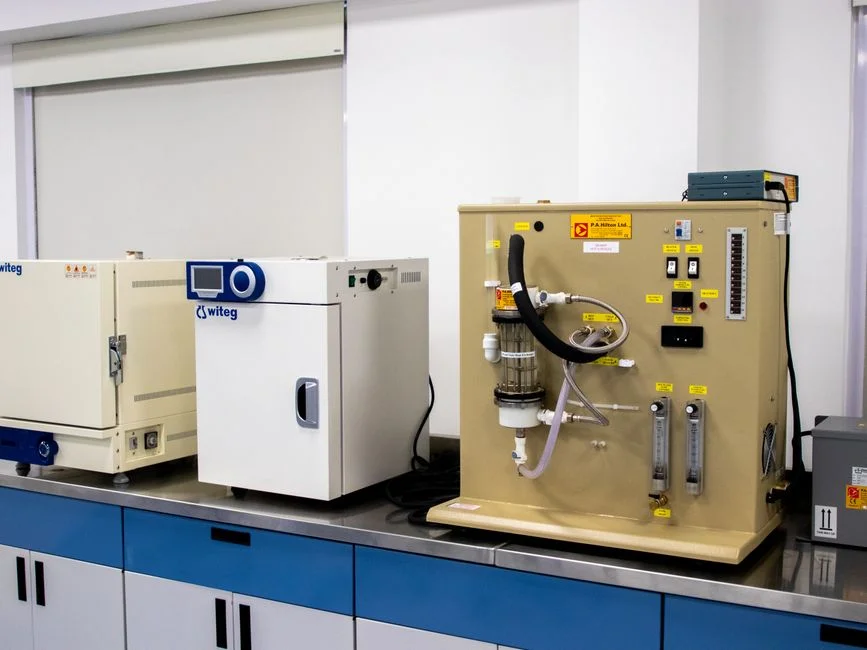
The dominant 2026 train for industrial oily streams is five stages: equalize, coagulate, float, biodegrade, polish. Each stage has a defensible operating window, and the windows line up — undersize one and the next stage carries the load.
- Equalization and pH control. A 4–8 hour equalization basin with pH adjusted to 6.5–7.5 stabilizes incoming emulsions so the chemical dose downstream is consistent. pH excursions above 8.5 or below 5.5 will defeat the coagulant and push emulsified oil straight through the DAF.
- Coagulation and flocculation. Polyaluminum chloride (PAC) at 50–200 mg/L handles a 100–500 mg/L oil feed; for higher feeds or tighter targets, dose to 250–400 mg/L and add an anionic polyacrylamide flocculant at 1–5 mg/L. Jar tests still beat any spreadsheet — a feed with 1,000 mg/L emulsified oil typically needs 150–300 mg/L PAC, not 50.
- Dissolved air flotation (DAF). Hydraulic retention of 20–40 minutes, recycle ratio of 20–40%, and an air-to-solids ratio (A/S) of 0.02–0.06 by mass. A properly tuned DAF removes 60–95% of emulsified oil and pushes TSS below 30 mg/L, which is what protects the downstream biology.
- Biological treatment (MBR or MBBR). HRT 6–12 hours for MBR, 12–24 hours for MBBR; F/M ratio 0.1–0.3 kg BOD/kg MLVSS·d. COD removal runs 85–95%, and the long-chain hydrocarbons that passed the DAF get oxidized here. For surfactant- and detergent-laden streams specifically, see the MBR for surfactant- and detergent-laden streams buyer guide for sizing caveats.
- MBR or UF polishing. An ultrafiltration or MBR membrane stage drives total oil below 5 mg/L and TSS below 1 mg/L — the quality needed for direct discharge under China GB 31573, US EPA 40 CFR 419, and EU BAT-AEL ranges. Dosing is supported by an automatic coagulant and flocculant dosing skid to keep chemistry consistent across shifts.
2026 Discharge Limits and Compliance: China GB 31573, US EPA 40 CFR 419, EU Industrial Emissions
Process selection without a discharge number is a waste of money — the regulator sets the floor, and the unit operation must meet it. Three jurisdictions define the 2026 envelope:
- China GB 31573 (petrochemical, 2026 enforcement). Total petroleum hydrocarbons (TPH) ≤10 mg/L in effluent to surface water; COD ≤60 mg/L. This is the design target most Asian exporters are working to today.
- US EPA 40 CFR 419 (refinery categorical). Oil and grease 15 mg/L daily maximum, 10 mg/L monthly average for the largest subcategories; BOD₅ and TSS limits vary by subpart. Most US refinery projects size biological trains to land consistently under 10 mg/L O&G so monthly averages hold.
- EU Industrial Emissions Directive 2010/75/EU. BAT-AEL for total hydrocarbons in refinery and petrochemical effluent typically falls in the 5–15 mg/L range depending on the BREF (Refinery BREF 2014, Common Waste Water and Waste Gas Treatment BREF 2016). BAT-AEL is a range, not a single number, and the lower end applies where the receiving water is sensitive.
Mapping these limits to a minimum train: 15 mg/L is reachable with DAF + biological on a moderate feed. 5–10 mg/L requires DAF + biological + MBR or UF polishing, with chemistry tightened to match. For the regulatory side-by-side and an updated 2026 compliance walkthrough, see the 2026 petrochemical wastewater discharge standard guide.
CAPEX and OPEX in 2026: What a Real Oily Wastewater Treatment Train Costs
Budget envelopes are what survive contact with procurement. The 2026 figures below are drawn from packaged skid pricing in China, the Gulf, and Southeast Asia, and assume carbon-steel epoxy tanks, 304/316 stainless on wetted parts, and a PLC skid with basic HMI — not explosion-proof or fully ASME-coded.
| Scope | Flow Range | CAPEX (USD) | OPEX Driver | OPEX Range |
|---|---|---|---|---|
| DAF unit only, skid-mounted | 4–50 m³/h | 18,000–85,000 | Polyacrylamide, electricity (recycle pump, saturator) | USD 0.05–0.12 / m³ |
| Packaged DAF + MBBR | 50–200 m³/h | 180,000–650,000 | Coagulant, flocculant, blower kWh, sludge hauling | USD 0.12–0.25 / m³ |
| Full train DAF + biological + MBR | 50–200 m³/h | 280,000–1,200,000 | Membrane CIP, polymer, blower, MBR cassette replacement (5–7 yr) | USD 0.18–0.40 / m³ |
Sludge handling is the line item most projects underestimate. Oily sludge is typically 2–4× the disposal cost of biological sludge on a dry-tonne basis because of the FOG content — landfills gate it behind waste-code checks, and incineration charges per calorific value. A filter press for oily sludge dewatering downstream of a high-efficiency sedimentation tank typically cuts sludge volume 75–85% and pays back inside 18 months at 100+ m³/d. For DAF-only project sizing and itemized budgets, the DAF system cost and sizing buyer's guide walks through line items, and the industrial DAF supplier buyer's guide covers vendor shortlisting for Middle East projects.
Common Failure Modes: DAF Foam Carryover, MBR Fouling, and Emulsion Breakthrough
Three failure modes account for most of the service calls on oily-water trains. Each is a symptom of a sizing or chemistry decision made upstream, and each has a specific fix.
- DAF foam carryover into downstream biology. Cause: surfactant overload or underdosed coagulant, with an A/S ratio set too high for the actual solids load. Fix: raise PAC dose by 20–30%, drop the recycle ratio to 20–25%, and verify the saturator pressure is holding 5–6 bar.
- Rising transmembrane pressure (TMP) on the MBR. Cause: residual emulsified oil that passed the DAF is fouling the membrane, accelerating in the first 30–60 days. Fix: install a pre-UF stage or add a coagulation-polishing step ahead of the MBR; expect 25–40% recovery in sustainable flux.
- Effluent oil still 20+ mg/L after DAF. Cause: feed oil exceeding 1,000 mg/L or a pH excursion outside 6.5–7.5. Fix: add equalization and automatic pH control with a dosing skid before the DAF — a 30-minute pH spike can waste an entire shift of chemistry.
Frequently Asked Questions
What is the best treatment for oily wastewater in 2026? A five-stage train — equalization, coagulation/flocculation, dissolved air flotation, biological treatment (MBR or MBBR), and MBR or UF polishing — is the 2026 default for industrial flows of 50–200 m³/h and reliably drives total oil below 5 mg/L to meet China GB 31573, US EPA 40 CFR 419, and EU BAT-AEL limits.
How does DAF remove emulsified oil that won't separate by gravity? DAF injects 20–40% recycle saturated with 5–6 bar air, releasing 10–50 μm micro-bubbles that attach to oil droplets preconditioned with PAC coagulant at 50–200 mg/L; the bubble–droplet aggregate floats in 20–40 minutes, achieving 60–95% oil removal on 5–150 μm emulsions.
Can a biological step alone hit a 10 mg/L oil discharge limit? Rarely. Activated sludge and MBBR oxidize dissolved hydrocarbons and drop oil to 5–15 mg/L, but emulsified oil slugs shock the biomass; pairing biology with DAF upstream and an MBR or UF downstream is what consistently delivers sub-10 mg/L total petroleum hydrocarbons.
What is the typical CAPEX for a 100 m³/h oily wastewater treatment train in 2026? A packaged DAF + biological + MBR train at 100 m³/h typically lands in the USD 280,000–1,200,000 capex range, with OPEX of USD 0.18–0.40 per cubic meter dominated by polymer, membrane CIP chemicals, and sludge disposal.