Confirm the controlling discharge route and POTW requirements
Mining and metals plants near Climax that discharge to a municipal sewer must comply with the Clean Water Act §307(b) pretreatment framework at 40 CFR Part 403, rather than treat the sewer as an NPDES surface-water outfall. EPA’s national standards apply to nondomestic dischargers whether or not the POTW has an approved pretreatment program and whether or not the discharger has a permit or control mechanism. The final equipment basis must therefore combine applicable categorical standards with the receiving POTW’s current sewer-use ordinance, permit or industrial-user control mechanism, monitoring requirements and enforcement terms. Site-specific wastewater testing remains necessary because the supplied research contains no verified Climax POTW limits.
The first task is to identify the legally responsible discharger and receiving POTW. A mine operator, mill owner, processing tenant or separate reclamation contractor may have different permit obligations even where they share a discharge point. Confirm the industrial user, responsible official, manufacturing or processing description, authorized discharge location and whether the POTW owns the industrial-user permit. A discussion of mining wastewater treatment for sewer compliance provides a useful structure, but its local values do not establish Climax requirements.
Keep NPDES requirements for direct surface-water discharges separate. A direct outfall may require an NPDES permit even when another stream enters the sewer. The pretreatment decision applies to the sewer discharge route, and it must not be conflated with the treatment of stormwater, leach-pad runoff or other outfalls.
| Compliance item | Evidence required before design | Engineering use |
|---|---|---|
| Receiving POTW and responsible industrial user | Current sewer-use ordinance, permit or industrial-user control mechanism, and named responsible official | Establishes the controlling authority, monitoring duties and enforcement route |
| Categorical classification | Process description identifying ore mining and dressing under Part 437, metal finishing under Part 433, or an applicable combination | Determines which categorical provisions must be evaluated |
| Local numerical limits | Verified pollutant limits, averaging periods, prohibited discharges and sampling point | Provides the final design targets after comparison with categorical requirements |
| Separate outfalls | Process-water map identifying sewer connections and direct surface-water discharges | Prevents application of the wrong permit and treatment route |
| Authorization status | Application status, permit effective date, renewal cycle and required pretreatment report schedule | Defines commissioning and compliance milestones |
EPA identifies pass-through, interference, corrosion, obstruction, toxic gases, heat and certain oil discharges as separate national concerns. Their application depends on POTW design and operating conditions, so request the controlling document rather than assuming one generic pH or metal limit settles the permit. A separate [mining pretreatment DAF versus lamella design](/blog/15776-kennewick-mining-pretreatment-daf-vs-lamella-and-process-design.html) can support process development, but it cannot substitute for the Climax-area authority’s current requirements.
Build the wastewater profile from discharge sources
Equipment sizing cannot be based on an average flow and one laboratory result. Build a source-by-source profile because batch discharges, runoff and process streams can produce different chemistry and hydraulic peaks within the same operating day. The engineering objective is to convert the profile into reproducible design inputs: flow duration, pollutant loads, precipitation behavior, solids properties and the operating envelope for downstream solids removal.
- Obtain flow-duration records covering average daily flow, the peak two-hour flow, batch dumps, shift changes, mill clean-outs, storm contributions and leach-pad contributions.
- Identify each discharge source, its operating frequency, volume range, destination and responsible production unit.
- Sample raw process water, acid mine drainage, spent solutions, leach-pad runoff and brine streams for pH, TSS, dissolved metals, sulfate and TDS.
- Include Pb, Cu, Zn, Cd, Ni and As in the metals inventory, while adding oil and grease where machining, vehicle washing or reagent handling can introduce them.
- Run jar tests to establish pH windows, coagulant requirements, settleability, colloid behavior and residual-metal targets.
The supplied 2026 mining and metals pretreatment guide identifies pH, suspended solids, Pb, Cu, Zn, Cd, Ni, As, sulfate and TDS as relevant variables. It also notes pH of 2–4 in raw acid mine drainage and spent process solutions and suspended solids from the hundreds to several thousand mg/L, so these values should be treated as source-specific observations rather than assumed Climax influent values.
| Source or condition | Field or laboratory input | Decision affected |
|---|---|---|
| Process water and spent solutions | Continuous pH; flow; dissolved metals; TDS; sulfate | Precipitation reagent demand, equalization and polishing |
| Acid mine drainage | pH, flow, dissolved metals, sulfate, TDS | Equalization, lime or caustic demand and sulfide-polishing need |
| Leach-pad runoff | Flow duration, pH, metals, TSS and sulfate | Equalization and maximum hydraulic loading |
| Brine or concentrate streams | TDS, sulfate, metals, flow and chemistry | Reagent strategy, solids handling and discharge compatibility |
| Batch dumps and clean-outs | Volume, discharge duration, chemistry and frequency | Equalization volume and treatment turndown |
| Oily or colloidal streams | Oil and grease, particle distribution, emulsification and floc behavior | DAF selection and polymer testing |
Do not infer the precipitation pH window or final residual from vendor literature. Use site testing to determine the chemistry. The [municipal mining-wastewater treatment comparison](/blog/15768-mbr-vs-activated-sludge-for-mining-wastewater-in-mousie.html) illustrates why source characterization must precede equipment selection: different discharge sources can impose different hydraulic and contaminant demands on the same treatment train.
Set the compliance envelope before sizing equipment
The applicable compliance envelope consists of the more stringent applicable requirement after the federal categorical standard is compared with the controlling POTW limit. EPA’s 40 CFR Part 403.5 prohibitions remain enforceable even where a local numerical limit is absent, and the receiving authority must define how pass-through and interference are evaluated for the site.
For 40 CFR Part 437, the supplied 2026 pretreatment guide reports zinc at 1.0 mg/L daily maximum and 0.5 mg/L monthly average. The same guide describes representative 2026 POTW zinc limits of 0.3–1.0 mg/L monthly average, but those values are not a verified Climax limit. For metal finishing, the guide reports Part 433 copper at 3.38 mg/L daily maximum and 2.07 mg/L monthly average, and total chromium at 2.77 mg/L daily maximum and 1.71 mg/L monthly average.
EPA prohibits corrosive discharges that damage POTW structures and, in no case, discharges below pH 5.0 unless the works is specifically designed to accommodate them, according to the EPA pretreatment standards page. Pass-through, interference, heat, oil, obstruction and toxic-gas provisions are independent requirements. A plant should not treat a categorical metal limit as permission to discharge outside those conditions.
| Requirement source | Supported value or condition | Verification needed |
|---|---|---|
| 40 CFR Part 437, as reported in the 2026 mining and metals guide | Zinc: 1.0 mg/L daily maximum; 0.5 mg/L monthly average | Confirm applicable subcategory, local limit and averaging basis |
| 40 CFR Part 433, as reported in the 2026 mining and metals guide | Copper: 3.38 mg/L daily maximum; 2.07 mg/L monthly average; total chromium: 2.77 mg/L daily maximum; 1.71 mg/L monthly average | Confirm that metal-finishing provisions apply to the process and identify any local limit |
| Representative 2026 POTW zinc limits in the same guide | 0.3–1.0 mg/L monthly average | Replace with the receiving POTW’s verified requirement; do not use this range as a Climax limit |
| EPA general prohibition | No discharge below pH 5.0 where it causes corrosive damage, unless the POTW is specifically designed to accommodate it | Confirm POTW materials, local pH range and any permit-specific condition |
Before releasing equipment procurement, request the exact local maximum-day definition, monthly-average calculation, sampling point, monitoring frequency, reporting protocol, resampling rules and enforcement triggers. Also establish whether analytical results are total or dissolved metals, since this distinction affects precipitation and filtration performance. The [DAF and clarifier comparison for chemical wastewater](/blog/13872-daf-vs-clarifier-for-chemical-wastewater-in-ridgeland-2026.html) can help organize these acceptance criteria, but it does not supply the missing local permit.
Select the treatment train from flow chemistry to final polishing
The treatment train should follow the waste profile: equalize variable flows, control pH, precipitate metals, remove the resulting solids, polish the effluent and preserve a controlled sludge route. Each stage needs a measurable purpose so the train can be commissioned against the permit rather than equipment names alone.
- Equalization: The 2026 mining and metals pretreatment guide specifies 8–24 hours of average daily flow to damp batch discharges from shift changes, dump-leach cycles and mill clean-outs. Confirm the selected detention against the actual batch volume and discharge duration.
- pH adjustment and reagent feed: Use staged, PLC-controlled pH adjustment and coagulant feed. The guide identifies lime and sodium hydroxide as workhorses, with lime producing 3–5 times more sludge; it also reports staged dosing where influent pH varies by more than 2 pH units.
- Metal precipitation: Use hydroxide precipitation as the default and evaluate sulfide polishing where the verified residual target is below 0.1 mg/L. The 2026 guide reports sulfide residuals of 0.01–0.05 mg/L for Cu, Zn, Cd and Ni, compared with 0.5–2.0 mg/L for hydroxide, but also notes 2–4 times higher reagent cost and the need for sealed reactors and scrubbed vents.
- Solids removal: Choose DAF for free oil, grease and fine colloidal material; choose lamella when the primary solids are metal-hydroxide flocs, hydraulic loading is comparatively high or footprint is constrained.
- Final polishing: Use multimedia filtration as a residual-TSS barrier and size it around the backwash cycle. The cited treatment sequence targets residual TSS below 10 mg/L.
- Sludge handling: Characterize the precipitate, equalization-basin solids, DAF or lamella sludge and filter backwash. The cited plate-and-frame result is 25–35% dry solids, but disposal classification, leachability and destination still require confirmation.
An automatic chemical-dosing system for staged pH and coagulant control should be evaluated as part of the process-control package, not as an isolated accessory. Confirm reagent strength, storage, containment, duty/standby arrangement, control logic and the required pH band. Likewise, an plate-and-frame filter press for metal-bearing sludge requires cake-characterization and disposal inputs before its final configuration is accepted.
| Treatment stage | Design input | Acceptance evidence |
|---|---|---|
| Equalization basin | Average daily flow, batch volume, discharge duration | Demonstrated attenuation of the selected batch peak |
| pH and coagulant feed | Influent pH range, jar-test chemistry, reagent demand | Controlled pH and verified dose response during commissioning |
| Hydroxide or sulfide precipitation | Target metal, residual limit, reagent and off-gas hazards | Parameter-specific residual-metal results at the sampling point |
| DAF or lamella | Peak two-hour flow, solids type, loading and footprint | TSS, oil and grease, turbidity and carryover under peak conditions |
| Multimedia filtration | Residual TSS, flow and backwash cycle | Filtrate TSS and stable differential-pressure operation |
| Sludge dewatering | Solids inventory, chemical conditioning and disposal route | Cake solids characterization and accepted destination |
Filtration is not the end of the compliance train. If the filter fails, the downstream discharge still needs a controlled response. The operator interface should therefore link basin level, pH, chemical dose, solids-removal performance, filtrate quality, sludge level and backwash status.
Choose DAF or lamella using acceptance criteria
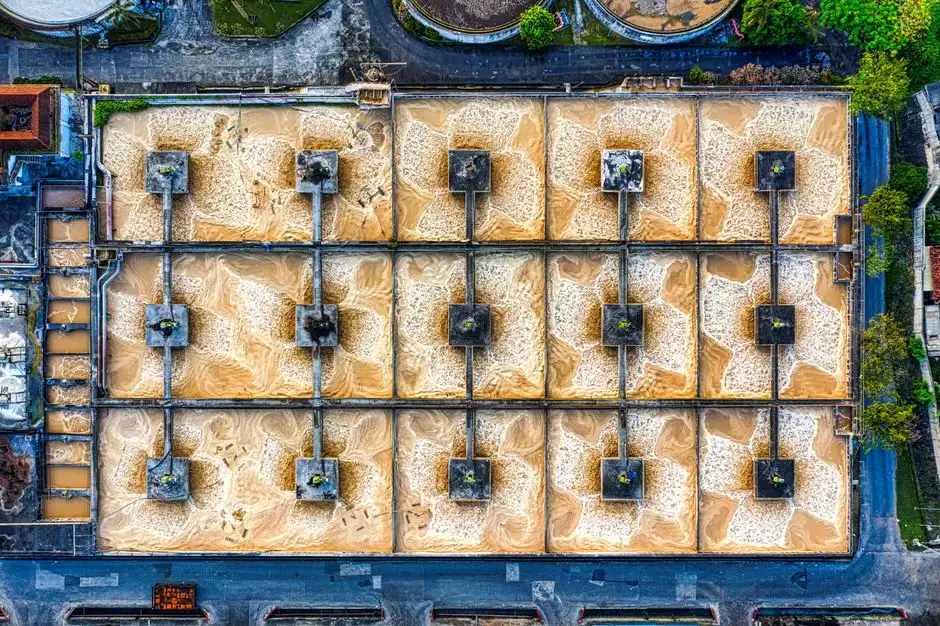
DAF is the stronger fit when free oil, grease or fine colloidal metals are present; lamella is generally stronger for dense metal-hydroxide sludge, higher hydraulic loading or a constrained footprint. The choice must be tied to the peak two-hour flow, verified pollutant loads and the controlling discharge limit—not to a generic removal percentage.
The supplied 2026 guide reports DAF hydraulic loading of 5–25 m/h, a range of 4–300 m³/h across 13 cited models, TSS removal of 90–98% and oil and grease removal of 85–95%. It reports lamella surface loading of 20–40 m/h and a footprint roughly one-third that of a conventional clarifier. The same source states that lamella handles metal-bearing hydroxide sludge well but is less effective than DAF for free oil and colloidal fines.
| Decision criterion | Prefer DAF when | Prefer lamella when |
|---|---|---|
| Primary wastewater character | Oil, grease or fine colloidal metals are present | Metal-hydroxide floc is the dominant separated phase |
| Hydraulic basis | The selected unit can handle the peak two-hour flow and batch buffering | Higher surface loading and a smaller footprint are advantageous |
| Reported performance in the 2026 guide | 90–98% TSS removal and 85–95% oil/grease removal | 20–40 m/h surface loading; roughly one-third the footprint of a conventional clarifier |
| Performance risk | Require evidence for colloidal-metal carryover and float stability | Require evidence for free oil, colloidal fines and floc carryover |
| Final acceptance | Meet the verified local limit at peak loading | Meet the verified local limit at peak loading |
Set a DAF system for oily and colloidal mining wastewater acceptance test around residual TSS, oil and grease, metals and float stability. For the lamella clarifier for metal-hydroxide sludge, require clarification performance, sludge-blanket control and metal carryover evidence at the verified design load. Neither option has a supported Climax-specific performance guarantee.
The guide calls for design around the peak two-hour flow with 20–30% turndown capacity and retention of buffer capacity during batch discharges. Confirm this against equalization performance and the selected equipment’s operating envelope. Further procurement detail is available in the [DAF or clarifier decision guide for mining and metals wastewater](/blog/8135-daf-or-clarifier-for-mining-metals-wastewater-in-montgomery-us-2026.html).
Frequently Asked Questions
What documents and test data are needed before requesting a treatment quotation?
Request the POTW sewer-use ordinance, current industrial discharge permit or control mechanism, categorical classification, flow-duration records, source-by-source pollutant analyses, jar-test results, local sampling requirements and sludge-disposal constraints. These inputs define the equipment duty, performance targets and compliance scope. The [mining pretreatment DAF versus lamella design](/blog/15776-kennewick-mining-pretreatment-daf-vs-lamella-and-process-design.html) can serve as the worksheet structure.
Should equipment be sized to the federal categorical standard or the local sewer limit?
Use the more stringent applicable requirement. The 2026 guide reports Part 437 zinc at 1.0 mg/L daily maximum and 0.5 mg/L monthly average, while representative POTW limits may be lower. Obtain the exact Climax-area POTW limit, averaging period and sampling point before final sizing; do not treat the representative 0.3–1.0 mg/L monthly-average range as a verified local requirement.
How much does a mining pretreatment system cost?
The supplied research does not provide a defensible equipment price for a Climax-area installation. Request a quotation based on the verified flow profile, peak two-hour flow, pollutant loads, equalization detention, precipitation chemistry, selected solids-removal method, controls, polishing, sludge dewatering, installation scope and performance tests. Pricing without those inputs is not comparable.
How should a supplier be selected for DAF or lamella equipment?
Require the supplier to document design flow and loading, equalization assumptions, reagent consumption, control logic, solids performance, turndown, utilities, maintenance and acceptance testing. Ask how the proposed unit addresses the site’s oil, colloid and hydroxide-floc characteristics and how the train complies with the receiving POTW’s verified limits. For additional route and equipment checks, see the [Climax-to-Greenville sewer compliance workflow](/blog/15766-mining-wastewater-treatment-for-greenville-sewer-compliance.html).