Start with the property's wastewater profile
A Daegu hotel or resort has three credible routes: connect to the public sewer if permission and hydraulic capacity allow; install an underground A/O package plant for compact, automated treatment; or select an MBR membrane bioreactor where tighter solids separation, a smaller footprint, or reuse potential is required. The correct choice depends on measured hotel wastewater flows, wastewater composition, available area, reuse targets, and Daegu’s written discharge conditions. Pool, spa, laundry, kitchen, and guest-room flows must be assessed separately because a sewer connection or treatment capacity based only on occupied rooms can be misleading.
Hotel Susung illustrates that complexity. Its listing identifies indoor and outdoor pools, a spa, restaurant, gym, conference rooms, and daily housekeeping, alongside guest rooms and amenities such as a sauna, steam room, and hot tub (trivago, Hotel Susung listing, accessed 2026). Those amenities create ordinary sewage plus backwash, cleaning discharge, food-service waste, and potentially chemically treated wash water. None of the supplied research establishes the property’s flow or sewer availability, so the listing is a workload example, not a design basis.
Before requesting a hotel sewage treatment plant quotation, complete the following property decision sheet. Each blank must be supported by meter data, operating records, the supplier’s site survey, or written information from the relevant authority.
| Procurement input | Record for the property | Evidence required |
|---|---|---|
| Average daily wastewater flow | Not established | Metered history or verified fixture and occupancy calculation |
| Peak flow | Not established | Diurnal metering, event logs, and simultaneous discharge assumptions |
| Guest-room sewage | Not established | Occupied rooms, fixture counts, and operating schedule |
| Kitchen and food-service discharge | Not established | Floor plan, fixture inventory, grease-management method, and cleaning practices |
| Laundry and housekeeping discharge | Not established | Laundry volume, linen loads, detergents, and discharge route |
| Pool and spa discharge | Not established | Makeup, backwash, drain, and chemical-treatment records |
| Cleaning chemicals | Not established | Product safety data sheets and segregation requirements |
| Seasonality and expansion | Not established | Occupancy forecast, events, pool operation, and future room additions |
| Reuse destinations | Not established | Toilets, irrigation, cooling, laundry, or other end uses with required quality |
The published WSZ capacity band is 1–80 m³/h, while the MBR catalog range is 10–2,000 m³/day (HydropureWater product catalog, accessed 2026). These are equipment-selection boundaries, not substitutes for the property’s measured design flow. Calculate the hotel wastewater flow from verified daily discharge, peak factors, and process-waste schedules; then confirm that the selected route can handle both the recurring peak and concentrated pool or laundry events.
Decide whether public sewer access is realistic
Public sewer connection should be pursued first only when the competent Daegu authority confirms that discharge is permitted and the receiving system can accept the property’s flow and wastewater characteristics. The supplied research does not establish Daegu sewer-acceptance limits, connection procedures, pretreatment rules, monitoring requirements, or fees, so none can be assumed during procurement.
Send the authority a site-specific request covering the property address, floor plans, estimated peak flow, wastewater streams, proposed connection point, pretreatment concept, and intended discharge or reuse. Ask for the applicable acceptance limits in writing, connection procedures, required pretreatment, monitoring expectations, fees, and documents needed for approval. If reuse is planned, request separate confirmation rather than treating permission to discharge as permission to reuse.
Location helps route planning but does not prove service availability. Hotel Susung is listed at 106-7 Yonghak-ro, Daegu, 3.4 miles from Daegu city center and 3.6 miles from Daegu Samsung Lions Park; the listing also describes steep hill access (trivago, Hotel Susung listing, accessed 2026). That information may matter when surveying a connection route, but it does not establish the presence, elevation, invert level, or remaining capacity of a public sewer.
Compare the complete alternatives rather than pricing the connection alone. The sewer case must include the connection works, required pretreatment, monitoring, operating responsibility, and compliance risk. The on-site case must include buried works, treatment, sludge handling, reuse treatment, site restoration, and authority submissions. The public sewer versus package plant decision method is useful as a procurement sequence, but Daegu requirements must replace the jurisdiction-specific assumptions.
Compare underground A/O and MBR treatment routes
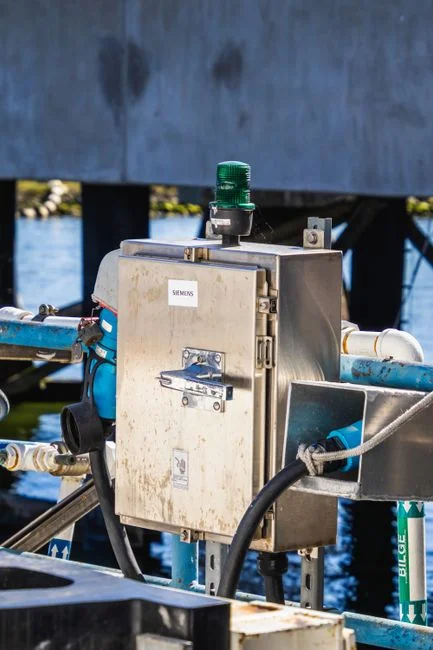
The WSZ underground A/O package integrates anoxic and aerobic contact oxidation, sedimentation, and disinfection in one buried unit; the catalog describes automatic operation without an operator, a 1–80 m³/h capacity range, and installation below grade with landscaping above (HydropureWater WSZ catalog, accessed 2026). This route is a candidate when the verified flow falls within its range, the treatment train can accommodate the hotel’s wastewater composition, and below-grade installation suits the site.
The MBR combines activated sludge with submerged PVDF membrane filtration. Its published range is 10–2,000 m³/day, filtration is stated at below 1 μm, and the catalog states that it uses 60% less footprint than conventional systems (HydropureWater MBR catalog, accessed 2026). Compare an MBR membrane bioreactor when solids separation, compact installation, or reuse potential is a defined project requirement.
| Decision criterion | Public sewer | Underground A/O package | MBR |
|---|---|---|---|
| First condition | Authority confirms permission and hydraulic suitability | Verified flow and composition fit the package | Treatment objective justifies the added process complexity |
| Published equipment boundary | Not established | 1–80 m³/h | 10–2,000 m³/day |
| Integrated process | Depends on authority and site requirements | Anoxic/aerobic contact oxidation, sedimentation, and disinfection | Activated sludge with submerged PVDF membrane filtration |
| Site arrangement | Connection route and any required pretreatment | Buried unit with landscaping above | Compact arrangement; catalog states 60% less footprint than conventional systems |
| Reuse issue | Confirm any reuse restriction and required quality | Define downstream polishing separately | Define downstream disinfection or polishing separately |
| Unresolved procurement items | Limits, procedures, pretreatment, monitoring, fees | Design flow, process suitability, installation, guarantees | Design flow, reuse quality, pretreatment, operation, guarantees |
Neither catalog route automatically produces water acceptable for the intended reuse. Define each endpoint—such as toilet flushing, irrigation, cooling, laundry, or pool-area washing—and its required quality first. Add water reuse pretreatment as a separate design step, including any required residual disinfection. During later supplier review, the hotel A/O versus MBR comparison framework can structure the comparison, while the MBR membrane cleaning guide can inform the maintenance scope if MBR is selected.
Verify permits, reuse and operating requirements
Equipment selection does not establish compliance; the bid basis must be tied to written Daegu requirements. The HydropureWater South Korea guide hub, accessed 2026, describes its guides as combining local discharge standards, engineering specifications, and cost benchmarks for industrial and municipal wastewater projects. Use that hub as a research starting point, not as proof that a Daegu hotel route is compliant.
Before finalizing the bid, request written confirmation from the competent authority of the discharge requirements, sewer pretreatment rules, reuse restrictions, monitoring obligations, sludge handling, and submission documents. Ask each bidder to identify which parts of its proposal depend on those confirmations and which performance commitments it can accept without them. A quotation without this boundary can conceal an unpriced permit, monitoring, civil-work, or treatment obligation.
Pool, spa, and laundry streams may need separate assessment for solids, disinfectants, detergents, or chemicals. For high-quality polishing or reuse stages, the HydropureWater UF catalog describes 2,000–40,000 L/h capacity, 0.03 μm PVDF membranes, and automatic backwash (HydropureWater UF catalog, accessed 2026). The ultrafiltration system for reuse pretreatment may therefore be relevant as a downstream option, but its selection must follow the specified reuse water quality and a stream-by-stream process review.
Write acceptance criteria around measurable requirements: applicable discharge limits, turbidity or solids performance where relevant, disinfection, reuse-water quality, automatic controls, alarm functions, operating availability, maintenance access, sludge removal, and documented commissioning tests. Avoid an undefined statement such as “reuse ready.” Identify the parameter, test method, acceptance condition, responsible party, and evidence required.
Build the supplier RFQ and acceptance checklist
A comparable RFQ must include the property’s operating and site data; otherwise suppliers will price different assumptions. The hotel should provide measured flows, fixture and process-waste inventories, operating schedules, effluent and reuse requirements, site survey access, available power and drainage information, installation constraints, testing expectations, and required local submissions. The authority should confirm applicable discharge and sewer rules. The supplier should define the process, capacity basis, guarantee boundaries, exclusions, and commissioning evidence.
| RFQ package | Bidder response required | Acceptance check |
|---|---|---|
| Measured flows and wastewater inventory | State the design-flow basis and event assumptions | Recalculations reconcile with hotel records |
| Proposed process and capacity | Identify every treatment and pretreatment stage | Capacity covers the stated average, peak, and process discharges |
| Effluent and reuse quality | List guaranteed parameters and test methods | Requirements match written authority and reuse criteria |
| Site and installation | Provide footprint, burial depth, access, and civil works | Arrangement fits the surveyed site and construction constraints |
| Utilities and automation | State power, control, remote-monitoring, and routine-maintenance requirements | Responsibilities and exclusions are unambiguous |
| Commissioning | Define tests, sampling, training, documentation, and acceptance | Tests demonstrate the guaranteed performance |
| Local submissions | List permits, technical drawings, and authority documents supplied | Submission responsibility is assigned |
| Commercial exclusions | Separate equipment, civil work, pretreatment, reuse equipment, sludge handling, and authority charges | Bids can be compared on the same scope |
Require every bidder to present the same decision structure: proposed flow basis, process train, treatment capacity, footprint, utilities, automation, installation method, commissioning tests, performance guarantees, and exclusions. Compare technically equivalent A/O, MBR, and sewer bids against the same requirements. Do not accept a generic “hotel wastewater treatment plant” quotation without identifying the design flow, treatment scope, site works, compliance basis, and performance evidence.
Frequently Asked Questions
Should a Daegu hotel connect to the sewer or install an on-site treatment plant?
Choose the sewer if the competent authority confirms permission, hydraulic suitability, applicable pretreatment, and acceptable operating obligations. Choose an on-site route if sewer access is unavailable, unsuitable, or too burdensome and the property’s measured flow, footprint, discharge, and reuse requirements match a package system.
How should a hotel wastewater flow calculation size the treatment system?
Use metered average and peak flows, occupancy, fixture counts, laundry and kitchen schedules, pool backwash, and simultaneous discharge assumptions. Do not size from guest-room flow alone or directly from the equipment’s published capacity band. The Hotel Susung amenity listing demonstrates why separate process streams must be identified, but it supplies no flow data.
What should buyers request when comparing Daegu wastewater treatment equipment suppliers?
Require one response format covering design-flow basis, treatment train, capacity, footprint, utilities, automation, installation, commissioning tests, guarantees, exclusions, and local submissions. Give each bidder the same measured-flow and site-input package so that an A/O package, MBR, and sewer proposal can be compared on equivalent scope.
What costs and compliance details must be confirmed locally before procurement?
Request itemized quotations covering equipment, civil works, pretreatment, reuse treatment, sludge handling, installation, commissioning, monitoring, authority submissions,