Establish the discharge route before selecting treatment equipment
Samsung’s Taylor expansion should be designed as a legal discharge-and-reuse project rather than a brownfield acquisition with an automatic permit transfer. A combined process and sanitary flow above 50,000 gallons per day generally places a fab in individual TCEQ TPDES territory, according to Samsung Texas Plant Acquisition: 2026 Wastewater Compliance & Treatment Guide (HydropureWater, 2026). The project team must resolve direct discharge, POTW pretreatment, or reuse-only treatment before buying equipment, as each route changes monitoring, pretreatment obligations, and treatment objectives. The same guidance requires change-of-ownership paperwork within 30 days of closing under 30 TAC 305.064, although a new or expanded Taylor operation must also confirm whether its permit authorizes the added process load.
The permit route for this expansion is a new-build decision rather than a transfer exercise. Confirm the legal operator, SIC code, process description, proposed discharge point, and whether the flow is process wastewater, sanitary wastewater, or a combination. The Texas fab wastewater compliance guide describes the 50,000-gallon-per-day threshold as the clearest boundary between an individual TPDES permit and possible coverage under the multi-sector general permit, but eligibility still depends on the site’s SIC code and process description.
Identify the receiving stream before converting design values into enforceable limits. Under Samsung Texas Plant Acquisition: 2026 Wastewater Compliance & Treatment Guide (HydropureWater, 2026), 30 TAC Chapter 307 is the receiving-water floor; federal categorical maxima do not establish the permitted limit when basin-specific criteria are tighter. If the chosen route is reuse-only, document whether any residual discharge remains and whether cooling-tower makeup is the intended reclaimed-water application. The decision record should also identify whether pretreatment under 40 CFR Part 403 applies if a POTW receives the flow.
Map semiconductor wastewater into treatment streams
Semiconductor fabrication wastewater requires source segregation because copper, fluoride, acidity, abrasive solids, and soluble organics respond to different removal mechanisms. The design basis in Samsung Texas Plant Acquisition: 2026 Wastewater Compliance & Treatment Guide (HydropureWater, 2026) maps CMP rinse, acidic etch waste, photoresist-stripper residues, and general rinse water to separate treatment functions; combining them behind one oversized unit train obscures both contaminant peaks and reuse quality.
- Segregate copper-bearing CMP rinse and abrasive slurry from sanitary wastewater. Route this stream through solids removal, copper precipitation, and clarification; use dissolved air flotation for slurry and oil intrusion before copper-removal stages.
- Equalize acidic etch wastewater and control neutralization with PLC-operated acid or caustic dosing. The supplied reference sequence uses equalization for 6–12 hours of hydraulic variation and pH adjustment to 6.5–7.5, according to HydropureWater’s 2026 guide.
- Keep photoresist-stripper and solvent residues separate enough to assess biological treatment, membrane polishing, and solvent recovery. The same reference sequence uses an MBR membrane bioreactor for COD and BOD removal and organic-solvent polishing.
- Apply 40 CFR Part 469 as the semiconductor-manufacturing categorical framework, then apply site-specific permit conditions and 30 TAC Chapter 307 criteria for the actual receiving stream.
| Fab stream | Primary contaminants | Required treatment function | Design information to verify |
|---|---|---|---|
| CMP rinse and abrasive slurry | Copper, TSS | Solids removal followed by copper precipitation and clarification | Copper mass loading, solids settleability, copper-bearing sludge destination |
| Acidic etch wastewater | Low pH, fluoride, sulfate | Equalization, controlled neutralization, fluoride removal where required | Acid-base demand, fluoride concentration, precipitation chemistry |
| Photoresist-stripper and solvent residues | COD, BOD, soluble organics | Segregation, biological treatment and membrane polishing; evaluate distillation recovery | Organic load, solvent inventory, distillate purity, concentrate handling |
| General rinse wastewater | Mixed dilute contaminants | Treatment consistent with discharge or reuse route | Flow variability, constituent profile, reuse-quality requirements |
Fluoride removal requires more than simple neutralization. The 2026 reference sequence adds calcium precipitation to form calcium fluoride or ion exchange where receiving-water limits or RO membrane protection require it; the project must select the method after receiving-stream and influent data are confirmed.
Build a treatment train around the reuse target
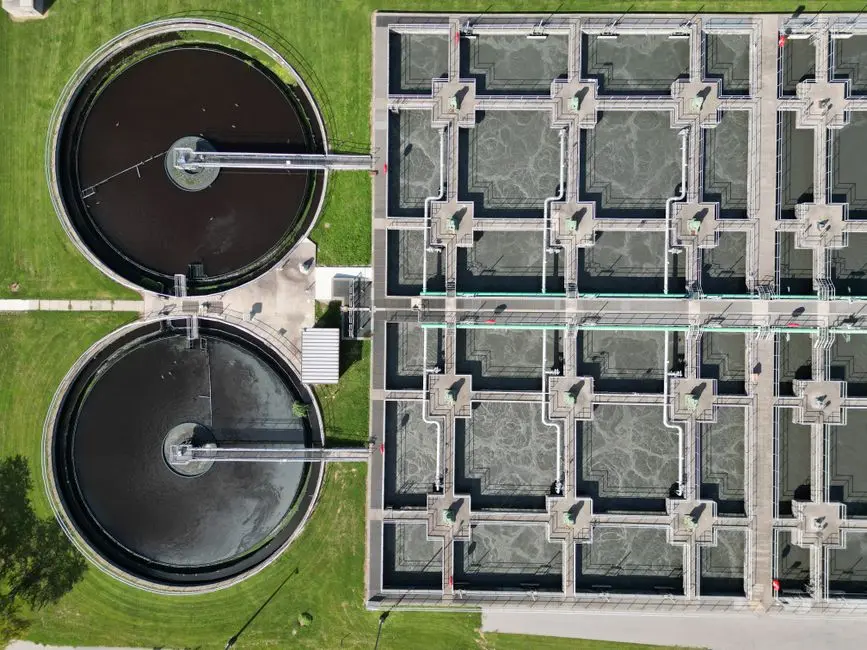
The least-complex compliant treatment train depends on whether process control or high-percent industrial wastewater reuse is the governing objective. The reference sequence progresses from equalization and neutralization through DAF, coagulation and lamella clarification, MBR, disinfection, and two-pass RO polishing (HydropureWater, 2026). This arrangement supports either permitted discharge or reclaimed cooling-tower makeup, so the reuse decision determines whether RO, additional pretreatment, and concentrate management belong in the base scope.
For copper removal, the supplied sequence raises pH to 9–10 and uses lamella surface loading of 20–40 m/h, with copper precipitated as hydroxide sludge. A high-efficiency lamella sedimentation tank can then separate the precipitated solids. These are design-reference values from HydropureWater’s 2026 guide, not permit limits or Taylor-specific commitments. Calcium precipitation or anion exchange is added upstream where fluoride limits or RO protection require it.
For cooling-tower makeup reuse, the reference design uses a two-pass industrial reverse osmosis system, with permeate conductivity below 50 µS/cm and sulfate rejection above 99% (HydropureWater, 2026). These are equipment-selection targets, not automatically enforceable discharge limits. The final RO feed, recovery, and concentrate route must be tied to the verified reuse percentage and receiving-water constraints.
| Design objective | Treatment emphasis | Scope decision | Key acceptance evidence |
|---|---|---|---|
| Permitted discharge | Neutralization, DAF, clarification, required fluoride and copper removal, biological or membrane polishing as needed | Omit RO only if the verified permit and reuse decision do not require it | Site-specific permit limits; startup and whole-effluent performance data |
| Cooling-tower makeup reuse | Base train plus pretreatment, two-pass RO and concentrate management | Set the reuse percentage and recovery requirement before final sizing | Permeate conductivity, sulfate rejection, recovery, off-spec rate and concentrate route |
| ZLD alignment | Treatment train plus evaporation or crystallization | Evaluate only as a separate capital scenario | Residual mass balance, concentrate handling, energy demand and disposal route |
ZLD should not be inferred from the present Austin permit. According to HydropureWater’s 2026 guide, that permit does not require ZLD, while adding an evaporator or crystallizer multiplies base-train CAPEX by 1.5x–2.5x. The Taylor team should compare discharge control and high-percent reuse against a separately costed ZLD-aligned scenario rather than embedding every option in one treatment estimate.
Turn the permit and influent data room into a capital plan
A defensible fab expansion estimate begins with regulatory records and measured wastewater variability, not a generic treatment package. Request the current TPDES permit, permittee name, discharge authorization, Discharge Monitoring Report history, Notices of Violation, enforcement actions, Agreed Orders, and EPCRA Section 313 TRI history. The 2026 acquisition guidance states that DMR history, the NOV ledger, and open enforcement matters transfer with the operator; it also identifies eight quarters of DMRs as the requested diligence record. Verify those records against the Taylor operation rather than assuming Austin’s compliance history governs the expansion.
Separate enforceable obligations from design targets in every cost estimate:
- Permit obligations: receiving stream, discharge point, flow, subcategory, monitoring frequencies, whole-effluent-toxicity requirements, and applicable 30 TAC Chapter 307 criteria.
- Design targets: pH range, copper and fluoride removal goals, TSS, organics, permeate conductivity, and reuse percentage established by the process and treatment team.
- Unverified assumptions: peak flow, contaminant peaks, fouling tendency, operating availability, and sludge or concentrate disposal route that still require site data.
Use the supplied 1,500 m³/day reference design and $1.5 million–$6 million Phase 1 CAPEX range only for initial screening (HydropureWater field data, 2026). That estimate excludes an evaporator and depends on influent variability, discharge versus reuse objectives, and existing segregation discipline. Each proposal should identify its intended wastewater stream, removal target, PLC control philosophy, duty cycle, utility demand, sludge or concentrate route, and performance-test method. Stream segregation is particularly important: the 2026 reference identifies it as the factor capable of moving a retrofit estimate across its stated range. Further equipment-definition guidance is available in the semiconductor wastewater treatment design reference.
Define acceptance criteria before commissioning

Commissioning should test the selected discharge-and-reuse route, not merely demonstrate that individual pumps and meters operate. Set construction and operational verification around the site-specific TPDES permit, 40 CFR Part 469 requirements, and applicable 30 TAC Chapter 307 criteria. Include an explicit cross-check between each equipment guarantee and the enforceable permit limit so that a treatment target is not mistaken for regulatory approval.
- Confirm construction readiness: verify stream segregation, equalization capacity, chemical storage, PLC I/O, alarms, sample points, and drainage arrangements.
- Run startup testing: demonstrate pH control, copper removal, fluoride control, TSS removal, organic-solvent treatment, and disinfection using representative wastewater.
- Verify reuse performance: challenge the industrial reverse osmosis system against the agreed conductivity, sulfate-rejection, recovery, and concentrate-disposal criteria.
- Perform discharge verification: where discharge is selected, conduct whole-effluent-toxicity testing consistent with the supplied semiconductor-industry expectations; do not substitute individual chemistry results for the complete acceptance criterion.
- Complete regulatory review: document operator training, chemical-safety controls, spare strategy, calibration, monitoring records, startup reports, and unresolved deviations before treating the expansion’s treatment system as operational.
Any disinfection system included in the train should be sized and verified against the selected reuse or discharge basis; the reference sequence identifies chlorine dioxide or UV as a possible stage. The relevant chlorine dioxide generator proposal should state its production range, control logic, chemical feed arrangement, and site-specific performance-test method rather than relying on unit capacity alone.
Frequently Asked Questions
What is the screening budget for wastewater treatment at the Taylor fab expansion?
HydropureWater’s 2026 reference uses $1.5 million–$6 million for a 1,500 m³/day fab-scale train without an evaporator. That is a screening range, not a bid. Request a flow-by-flow estimate based on verified peak and average flows, stream segregation, discharge or reuse objectives, utilities, sludge and concentrate handling, and site installation conditions. Adding an evaporator or crystallizer for ZLD alignment multiplies the base-train CAPEX by 1.5x–2.5x under the same reference.
How should an equipment supplier be selected for semiconductor fabrication wastewater?
Require a stream-specific proposal rather than a generic treatment claim. The supplier should identify the wastewater source, removal targets, PLC controls, duty cycle, utilities, sludge or concentrate route, guarantees, and acceptance-test method. Also request evidence that pH, copper, fluoride, TSS, organics, disinfection, and RO performance are linked to the verified Taylor permit and reuse basis.
What flow and contaminant data are needed to size the treatment train?
Obtain verified average and peak flows, diurnal and batch data, constituent mass loadings, variability by production condition, and the required cooling-tower reuse percentage. The 2026 reference states that stream segregation can move a retrofit estimate from the bottom to the top of its CAPEX range, so the buyer should provide each supplier with the same segregated flow and contaminant basis.
What compliance risks should be resolved before final equipment procurement?
Confirm