Confirm the POTW Route and Applicable Limits
Mining and metals plants that discharge to a sewer operate under the Clean Water Act §307(b) pretreatment program in 40 CFR Part 403, with enforcement administered by the receiving publicly owned treatment works (POTW). Ore mining may be subject to 40 CFR Part 437, while plating, pickling, or anodizing may require 40 CFR Part 433 treatment. A defensible design starts by confirming the receiving POTW, its sewer-use ordinance, the industrial user permit, and the applicable categorical subcategory before selecting equipment. No Blackmont-specific ordinance, permit, or local limits were supplied, so the responsible authority must be identified before final sizing.
Use the supplied 2026 POTW examples only as screening values: zinc of 0.3–1.0 mg/L monthly average and copper of 0.3–0.5 mg/L monthly average. They are not substitutes for the receiving authority’s written limits. The relevant sewer requirements should also identify sampling locations, averaging periods, monitoring frequencies, upset provisions, fees, pretreatment charges, and consequences of noncompliance. Record the classification basis as well: mining operations generally fall under ore mining and dressing, while operations with plating, pickling, or anodizing may also fall within metal finishing.
The mining and metals wastewater pretreatment guide provides the broader regulatory sequence, but the engineering basis must remain the current POTW ordinance and issued industrial user permit.
| Worksheet input | Evidence to obtain | Design consequence |
|---|---|---|
| Receiving POTW | Written confirmation of the sewer receiving point and responsible pretreatment authority | Defines who reviews and enforces the industrial user permit |
| Controlling local limits | Current sewer-use ordinance and applicable permit limits, including averaging periods | Sets the required effluent performance; example ranges cannot be used as final specifications |
| Categorical basis | Applicable 40 CFR Part 437 subcategory or 40 CFR Part 433 category, as applicable | Identifies federally applicable pretreatment requirements and monitoring obligations |
| Monitoring and enforcement | Sampling point, monitoring frequency, compliance schedules, upset provisions, and reporting forms | Sets the location of treatment, sampling equipment, controls, and recordkeeping |
| Approval status | Application, correspondence, approvals, and permit conditions | Provides the compliance baseline against which equipment is guaranteed |
Characterize the Waste Before Fixing the Flow
Representative sampling determines whether equalization, precipitation, clarification, filtration, or disinfection is justified. Request sampling across dump-leach releases, mill clean-outs, shift changes, storm events, and runoff conditions instead of relying on one grab sample. For each event, obtain flow, pH, temperature, suspended solids, and the metals and other constituents required by the POTW.
The supplied mining and metals pretreatment research identifies recurring conditions that control equipment selection: low pH, high suspended solids, dissolved Pb, Cu, Zn, Cd, Ni, and As, together with elevated sulfate and total dissolved solids. These are screening categories, not proof of site conditions. The site dataset must establish concentrations, mass loading, variability, and the proportion of each source stream entering the sewer connection.
Determine whether oil, grease, or colloidal fines are present. If they are, dissolved air flotation may need to precede or replace conventional clarification; if the stream is mainly metal-hydroxide solids with high flow and a constrained footprint, a lamella clarifier may be more suitable. This decision must follow the waste characterization rather than a preferred equipment model.
Use the worksheet to connect every source stream to a sampling record and proposed control step:
- Source and event: dump-leach, mill clean-out, shift discharge, stormwater, or another identified stream.
- Representative data: laboratory results, sampling method, date, flow, pH, and required metals and solids parameters.
- Treatment trigger: pH correction, equalization, precipitation, flotation, clarification, filtration, disinfection, or no discharge.
- Unresolved input: missing flow data, unidentified metals, disputed sampling, or an undefined disposal route.
Build an Equalization and Chemical-Control Front End
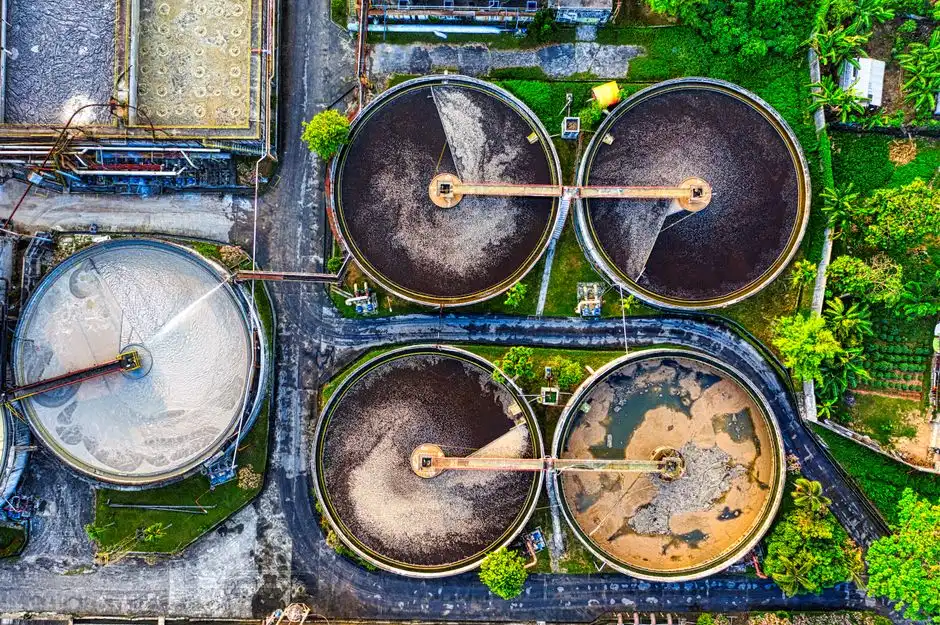
Equalization damps batch and upset flows before they reach pH control and solids separation. The supplied sizing guidance calls for 8–24 hours of average daily flow and states that a four-hour basin will pass upstream process spikes into the clarifier. That basis is more defensible than sizing from a single average flow, but the final volume should reflect the documented discharge pattern, operating schedule, and response time required by the POTW.
The chemical-control front end establishes the reaction conditions selected by jar testing. Lime or sodium hydroxide can be used for pH adjustment, but reagent choice requires testing and operating-cost review. The supplied comparison notes that lime generates more sludge, while sodium hydroxide may be advantageous for high-TDS streams. Record reagent purity, storage requirements, dosing rate, expected consumption, and residual handling rather than treating reagent selection as a generic alkalinity decision.
The supplied target is pH 6.5–9.0 for nearly every POTW instantaneous range, with PLC-controlled automatic dosing capable of maintaining pH within ±0.2. These values are design screening references, not proof that the Blackmont-area authority accepts that range. Confirm the permitted instantaneous pH range and design the control system around it. Where influent pH varies materially, staged reactors and separate feed loops should be evaluated so one dose cannot overwhelm the precipitation stage.
| Front-end worksheet item | Sizing or selection input | Required verification |
|---|---|---|
| Equalization volume | Average daily flow; documented batch peaks; operating schedule | Hydraulic model showing the selected detention basis and controlled discharge profile |
| pH correction | Influent pH range, reaction demand, alkalinity, TDS | Jar-test report and reagent consumption calculation |
| Dosing controls | Permitted pH band, tank configuration, chemical delivery rate | PLC functional description, pH-probe calibration plan, and alarm setpoints |
| Chemical storage | Reagent type, consumption, delivery schedule, containment requirements | Tank sizing calculation, SDS review, and secondary-containment drawing |
| Downstream protection | Maximum pH swing, expected metal concentrations, polymer use | Mass-balance check confirming that peaks remain within equipment and permit assumptions |
An automatic chemical dosing system can be evaluated as part of this front end, but its acceptance criteria should reference the confirmed pH band, alarm response, probe calibration, and reagent-consumption monitoring.
Select Precipitation and Solids Separation
Hydroxide precipitation is the default because the chemistry is established, while sulfide polishing is indicated when the confirmed limit requires residual metals below 0.1 mg/L. The supplied residual benchmarks are 0.5–2.0 mg/L for hydroxide precipitation and 0.01–0.05 mg/L for sulfide. These values support a process decision but do not replace jar testing or site-specific performance data.
Sulfide treatment has additional operating and containment requirements. The supplied source states that sulfide reagent cost is 2–4 times higher and requires sealed reactors with H₂S control and scrubbed vents. A practical compromise may be bulk hydroxide precipitation followed by sulfide polishing, but neither the scope nor the split flow should be fixed without the confirmed limit and test results.
Properly controlled precipitation systems achieve 85–95% total metals removal, with polymer aid specified at 0.5–3 mg/L. Use those figures to define a preliminary test program: establish target residual metals, determine reaction pH and reagent dose, evaluate settling or flotation, and measure the filtrate against the actual permit limit.
DAF is the preferred solids-separation route when oil, grease, or colloidal fines dominate. Its supplied range is 5–25 m/h hydraulic loading, 4–300 m³/h, and 13 models, with 90–98% TSS removal and 85–95% oil and grease removal. Lamella clarification is suited to mainly metal-hydroxide sludge, high flow, or constrained footprints; its supplied surface-loading range is 20–40 m/h. A DAF system for mining wastewater and a high-efficiency sedimentation tank should be compared against the actual waste profile, not selected from flow alone.
| Decision condition | Preferred route | Worksheet sizing basis | Approval or test evidence |
|---|---|---|---|
| Residual metals do not require sulfide-level polishing | Hydroxide precipitation followed by clarification | Reaction volume from jar-tested dose and residence-time data; clarification loading from selected surface or hydraulic loading | Jar-test report, mass balance, solids carryover calculations, and equipment drawings |
| Confirmed limit requires very low residual metals | Hydroxide treatment with sulfide polishing | Slipstream or full-flow basis to be established by testing | Residual-metal test data, reagent calculation, sealed-reactor and H₂S-control specification |
| Oil, grease, or colloidal fines are significant | DAF before or instead of conventional clarification | Supplied DAF hydraulic loading of 5–25 m/h and flow range of 4–300 m³/h | Oil-and-grease, TSS, flotation, and filtrate results; final POTW limit comparison |
| Metal-hydroxide sludge dominates at high flow or the footprint is constrained | Lamella clarification | Supplied surface loading of 20–40 m/h | Surface-area calculation, sludge blanket review, and solids carryover test |
The DAF versus lamella clarifier comparison is useful for screening, but the equipment proposal should contain the selected hydraulic basis, reagent demand, solids yield, and expected filtrate quality.
Filter, Dewater and Verify the Sewer-Ready Effluent

Filtration protects the sewer discharge from solids carryover after clarification. The supplied multimedia-filter benchmark is a 1–2 m/h filtration rate, differential-pressure-triggered backwash, and residual TSS below 10 mg/L. Treat that performance as a benchmark and verify final effluent against the confirmed POTW limit; a filter cannot compensate for an undersized clarifier or an improperly controlled chemical feed.
Metal-bearing sludge is part of the treatment design. The supplied filter-press benchmark is 25–35% dry solids. Obtain a waste characterization and a written disposal route for the metal-bearing sludge rather than assuming landfill acceptance. The disposal decision should identify applicable requirements, testing needed for the receiving facility, dewatering filtrate destination, and whether metal recovery is feasible.
Disinfection is ordinance-driven. The supplied chlorine-dioxide range is 1–5 mg/L where the POTW requires disinfection. Do not include it as a universal step: request the local requirement, required residual, contact criteria, monitoring method, and any prohibition on other disinfectants.
The POTW package connects design assumptions to evidence. At minimum, assemble the industrial user permit application; representative influent data; jar-test results; equipment drawings; controls narrative; calibration plan; sampling protocol; sludge-disposal plan; and startup test plan. For a fillable compliance record, each row should name the permit input, selected unit operation, sizing calculation, acceptance criterion, responsible party, document reference, and open decision.
| Compliance package component | Required content | Approval link |
|---|---|---|
| Jurisdiction record | POTW confirmation, ordinance, industrial user permit, categorical classification, and correspondence | Identifies every governing requirement |
| Representative influent dataset | Source-by-source sampling results, flow record, pH, metals, solids, and required monitoring parameters | Establishes design loads and sampling representativeness |
| Process design | Unit-operation selection, hydraulic calculations, chemical demand, controls narrative, and equipment drawings | Shows how the train will meet the permit |
| Performance evidence | Jar tests, pilot results if required, startup test protocol, calibration records, and sampling procedure | Defines verification and acceptance |
| Residuals management | Metal-bearing sludge characterization, disposal route, filtrate return point, and handling plan | Prevents an unresolved waste stream from delaying approval |
The plate-frame filter press should be evaluated against sludge characteristics, target dry solids, filtrate-return capacity, and the confirmed disposal route.
Frequently Asked Questions
What inputs are required before a mining or metals pretreatment train can be sized near Blackmont?
<Frequently Asked Questions
How do I size a pretreatment system for a mining wastewater discharge near Blackmont?
Sizing must be based on the peak hydraulic flow rate (measured in gallons per minute, GPM) and the mass loading of total suspended solids (TSS) and heavy metals. You should calculate the 95th percentile flow rate from historical site data to ensure the system handles storm events or surge production periods without exceeding the hydraulic retention time (HRT) required for effective particle settling or chemical reaction.
For Blackmont-area operations, you must cross-reference your calculated peak flow against local sewer capacity constraints. Ensure the system design accounts for a safety factor of 1.25x the maximum expected throughput to accommodate potential future production increases or seasonal groundwater infiltration.
Should a mining plant use DAF or a lamella clarifier before sewer discharge?
The choice depends on the specific gravity and nature of your contaminants. Dissolved Air Flotation (DAF) is typically superior for removing oil, grease, and low-density suspended solids that have a specific gravity near 1.0, often achieving 80-90% removal efficiency for non-settleable pollutants.
Conversely, a lamella clarifier is preferred for high-density mineral particulates, metal precipitates, and heavy silts. If your wastewater contains high concentrations of heavy metals or mineral fines, a lamella clarifier provides a smaller footprint and more reliable solids separation for particles with a specific gravity significantly greater than water.
What inputs should I request from a wastewater equipment supplier before requesting a price?
You must provide a comprehensive laboratory analysis of your wastewater, including pH, temperature, TSS, total dissolved solids (TDS), and specific concentrations of regulated metals (e.g., arsenic, lead, selenium). Additionally, provide the local POTW’s discharge permit limits, your required processing capacity (in GPD), and the available physical footprint for the equipment installation.
Ask the supplier to provide a process flow diagram (PFD), an estimated chemical dosing rate (mg/L), expected sludge generation volume (gallons per day), and a guaranteed performance specification regarding the final effluent quality relative to the Blackmont sewer limits.
How much does mining wastewater pretreatment cost per day?
Daily operational costs generally range between $0.05 and $0.25 per gallon treated, depending on the complexity of the contaminant profile and the required chemical coagulation or flocculation dosages. This figure includes electricity for pumps and mixers, chemical reagents, and sludge dewatering and disposal fees.
For a typical 50,000 GPD facility, you should budget for $2,500 to $12,500 per day in operational expenses. Note that sludge disposal costs vary significantly by region and waste classification, so obtaining a hazardous vs. non-hazardous waste determination is critical for accurate daily cost forecasting.
Can federal categorical limits be used instead of local POTW sewer limits?
No, you must comply with the most stringent applicable limit. Under the Clean Water Act, if a local Publicly Owned Treatment Works (POTW) has established specific local limits to protect their infrastructure or biological treatment processes, those local limits take precedence over federal categorical pretreatment standards (such as 40 CFR Part 440).
While federal standards set a baseline for the mining industry, the Blackmont sewer authority may impose stricter local limits on parameters like pH (typically 5.5 to 9.5), temperature, or specific heavy metals to prevent interference with their plant operations or pass-through of pollutants into receiving waters. Always verify your discharge permit requirements directly with the local municipal wastewater authority.