Fix the discharge route and permit basis
Wastewater from a TSMC fab in Germany must be segregated at the tool or drain level, characterized before design, treated to confirmed site and sewer requirements, and discharged only through the route authorized in the German permit. The likely concept separates high- and low-concentration ammonia, fluoride-bearing process water, organics, suspended solids, and sanitary wastewater, applying only the unit operations required by each stream. TSMC’s Fab 20 inspection of approximately 1,000 tools and 5,887 drain ports supports tool-level routing, while its reported 40% conductivity and 30% chemical-use reductions are benchmarks—not German discharge limits.
A direct discharger releases treated wastewater to surface water or groundwater; an indirect discharger sends it through the public sewer to a municipal sewage treatment plant. The applicable framework includes WHG §§58–59, the AbwV—including Annex 36 for semiconductor and flat-panel display manufacturing—and facility approval under the BImSchG and 4. BImSchV. The wastewater permit must be coordinated with facility approval rather than treated as an equipment approval in isolation. The TSMC Germany wastewater treatment guide provides the project-specific context for that permitting sequence.
Do not assume that indirect discharge is the authorized TSMC route. Confirm the route with the competent Wasserbehörde and the receiving sewer operator, and obtain written sewer conditions before fixing process capacity or equipment scope. A sewer agreement may impose handover values beyond the AbwV limits that apply at the site boundary. The final permit, approved facility description, sewer conditions, and applicable Analysen- und Messprogramm should therefore be treated as design inputs, not post-installation compliance documents.
| Decision | Evidence required | Effect on equipment selection |
|---|---|---|
| Direct or indirect discharge | Written decision from the competent Wasserbehörde and receiving sewer operator | Sets the discharge boundary, treatment scope and sampling points |
| Wastewater permit | Permit under the applicable WHG provisions, coordinated with BImSchG facility approval and 4. BImSchV | Defines applicable AbwV requirements, including Annex 36 where relevant |
| Sewer acceptance | Written sewer conditions and Übergabewerte from the Kläranlage operator | Controls pretreatment performance required before handover |
| Compliance programme | Approved Analysen- und Messprogramm defining parameters, methods, points and frequency | Sets instrumentation, sampling infrastructure and acceptance testing |
Build a tool-level wastewater segregation map
Tool-level drain diversion must precede capacity commitment, as demonstrated by TSMC’s Fab 20 Phase 1 inspection of approximately 1,000 tools and 5,887 drain ports (TSMC ESG, 2025-06-02). For the German fab, use that precedent to inspect tool configurations, drain behavior, discharge frequency, and the concentrations that justify diversion. The output should be a controlled routing matrix rather than a general list of treatment technologies.
Keep sanitary wastewater hydraulically separate from process water. The supplied German guidance assigns sanitary flow to collection and biological treatment before discharge to a Kläranlage, while process and sanitary streams follow different downstream paths (HydropureWater, TSMC German Fab Wastewater Treatment: 2026 Compliance Guide, 2026). Within the process system, separate concentrated ammonia, dilute ammonia, fluoride-bearing water, general organics, and suspended solids. Combining them requires a documented process reason; otherwise, mixing can increase treatment load or undermine a concentration-based diversion rule.
| Management zone | Unresolved design input | Permit or procurement dependency |
|---|---|---|
| High-concentration ammonia | Tool drain concentration, batch flow, flow duration and ammonia loading | Destination and acid use must be accepted in the permit and process description |
| Low-concentration ammonia | Concentration range, nitrogen balance, COD and hydraulic load | Biological acceptability and final nitrogen limit must be confirmed |
| Fluoride-bearing process water | Fluoride loading, precipitation chemistry and solids properties | Sewer fluoride condition and residue-handling route |
| General organics and suspended solids | COD, solids, batch discharges and toxicity indicators | Equalization, biological loading and bypass-prevention requirements |
| Sanitary wastewater | Fixture flows, process-area showers and separate collection route | Collection, biological treatment and sewer handover conditions |
Before issuing an equipment sizing request, require characterization by tool, drain, batch, and contaminant. Record average flow, peak flow, batch duration, discharge timing, and relevant chemistry. This is necessary because a concentration threshold alone does not establish hydraulic capacity, while an average flow does not represent a short tool discharge. The routing matrix should identify the default destination, diversion trigger, permitted bypass condition, and owner for updating the database as tools and recipes change.
Match each stream to its treatment unit
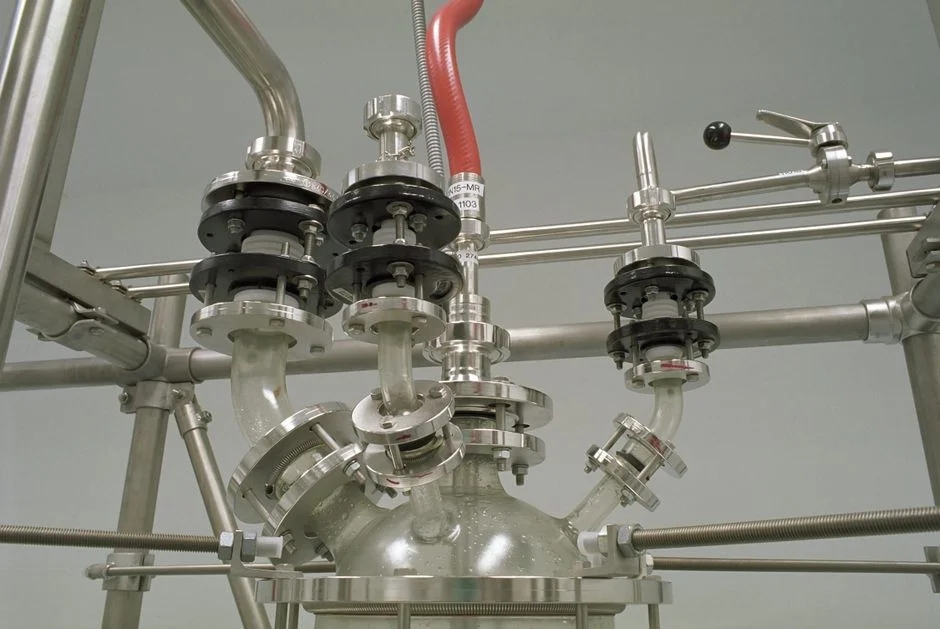
TSMC’s Fab 20 treatment architecture separated low-concentration ammonia for biological treatment from high-concentration ammonia treated by a degassing membrane that converts ammonia nitrogen into ammonium sulfate (TSMC ESG, 2025-06-02). For the German site, that supports a concentration-dependent selection: stripping or membrane degassing with acid scrubbing for concentrated ammonia, and biological treatment for dilute ammonia only where characterization and the permit support it.
Fluoride-bearing process water requires precipitation and solids separation. The choice between dissolved air flotation and a clarifier must be resolved against fluoride loading, precipitate properties, required recovery, and available footprint. Chemical addition should be automated; a PLC-controlled chemical dosing system can be evaluated for coordinated dosing, interlocks, alarms, and reagent-consumption records. The resulting fluoride-containing residue must remain in the project scope for characterization, dewatering, storage, and an approved disposal route.
Residual COD and suspended solids can be handled by an MBR or SBR architecture, with ultrafiltration added where the required effluent quality includes a low-solids barrier or reuse preparation. An integrated MBR membrane bioreactor should be assessed against the actual membrane area, aeration demand, sludge removal, peak loading, and recovery performance; those parameters cannot be finalized without site data. TSMC reported that its Fab 20 approach avoided reverse osmosis for qualifying mixed streams by segregating concentrations more precisely (TSMC ESG, 2025-06-02).
| Stream and design condition | Likely unit operation | Selection hold point |
|---|---|---|
| High-concentration ammonia | Stripping or membrane degassing with acid scrubbing | Confirm concentration, loading, acid demand and ammonium-sulfate handling |
| Dilute ammonia with compatible COD and biology | Biological treatment | Confirm nitrogen balance, biodegradability and permitted final condition |
| Fluoride-bearing water | Precipitation followed by solids separation | Resolve fluoride load, DAF versus clarifier selection, sludge recovery and footprint |
| Residual COD and suspended solids | MBR or SBR, with ultrafiltration where required | Confirm peak loading, membrane area, aeration and sludge-removal performance |
| Defined fab or on-site reuse | Ultrafiltration, then RO or ion exchange where required | Obtain the reuse specification and product-quality criteria first |
| Precipitation and biological residues | Sludge collection, characterization and dewatering | Confirm waste code, moisture basis, storage and permitted handling route |
Keep reverse osmosis and ion exchange conditional. They are polishing technologies justified by a defined fab or on-site reuse specification, not default components of every German treatment train. The supplied guidance also identifies ultrafiltration as a solids barrier before RO. Inclusion in the design should therefore follow an approved reuse demand, quality target, and concentrate-disposal route.
Turn the concept into a procurement-ready verification sheet
Equipment authorization should require a stream-by-stream mass balance, raw wastewater characterization, peak and batch flow data, permit limits, sewer handover conditions, and reuse specifications. These documents convert the treatment concept into enforceable supplier scope. A quotation based only on nominal wastewater flow is not adequate because batch tool discharges can govern equalization, transfer, and treatment capacity.
PLC-controlled diversion, automatic chemical dosing, monitoring, alarms, retention, and bypass prevention form the critical interface with fab utilities. Specify fail-safe routing, diversion-status indication, chemical inventory interlocks, retention capacity, spill-response isolation, and traceable operating data. For reuse, define sampling points and quality checks against the approved reuse specification. For discharge, align instrumentation and sampling infrastructure with the applicable Analysen- und Messprogramm.
| Verification item | Required information | Information owner | Procurement hold point |
|---|---|---|---|
| Mass balance and characterization | Stream flows, concentrations, batch data and contaminant mass loading | Fab process engineers and EHS | No final capacity release without completed sampling plan |
| Permit and sewer conditions | Authorized route, limits, sampling requirements and handover values | Regulatory lead and sewer operator | No equipment specification against an assumed route |
| Control and diversion performance | Routing logic, interlocks, alarms, retention and bypass protection | Utilities, controls and safety leads | Reject untested or manual-only diversion |
| Residues and reuse | Sludge handling route and approved reuse quality specification | EHS and facilities engineering | Do not release dewatering or RO scope without destination and quality basis |
TSMC reported 40% lower discharged conductivity and 30% lower chemical-reagent use at Fab 20 Phase 1 in June 2025 (TSMC ESG, 2025-06-02). These are operating results, not German permit limits. Apply the same evidence discipline to treatment suppliers: verify demonstrated performance for the relevant stream and loading.
Verify performance without copying another fab's limits
The applicable German Analysen- und Messprogramm must define the permitted sampling points, parameters, methods, and frequency; another fab’s KPI does not replace it. Confirm whether measurements apply at the site boundary, sewer handover, or another authorized point, and ensure the monitoring system records the results required for permit compliance.
Commissioning should verify steady-state and batch performance, diversion accuracy, reagent consumption, sludge generation, reuse quality, and compliance at the authorized discharge point. Divert incorrect concentrations, confirm the response of chemical dosing, and demonstrate retention and bypass prevention under the relevant operating cases. These checks should be tied to the accepted mass balance, permit limits, and sewer conditions.
Document the provenance of every acceptance target. TSMC’s 40% conductivity and 30% chemical-use reductions were achieved at Fab 20 Phase 1 in June 2025 (TSMC ESG, 2025-06-02); they are not promised results for a German facility. The German acceptance case should instead use enforceable limits, site characterization, agreed handover conditions, and an authorized reuse specification.
Frequently Asked Questions
What information is required to size treatment equipment for the German fab?
Final capacity requires raw wastewater characterization, peak and batch flows, permit limits, and written sewer conditions. Ask the supplier to identify which capacity assumptions remain provisional and to state the additional data needed before equipment selection is released.
How should an engineer select a wastewater treatment supplier?
Require evidence of demonstrated fit for the relevant stream and contaminant loading, not merely compliance with a general wastewater specification. Check references for comparable ammonia, fluoride, COD, batch-drain, and residue conditions, and require the performance test to match the German project’s acceptance basis.
Can TSMC’s Fab 20 wastewater results be used as German discharge targets?
No. TSMC’s 40% conductivity and 30% chemical-use reductions at Fab 20 Phase 1 in June 2025 are corporate operating results, not German limits. The binding acceptance basis is the German permit, coordinated facility approval, applicable Analysen- und Messprogramm, and written sewer conditions.
What cost and delivery information should be requested before authorizing equipment?
The supplied research provides no site-specific budget or delivery schedule for this project. Request a project-specific quotation covering segregation and collection, treatment units, controls, sludge handling, sampling, commissioning, performance tests, exclusions, and utility interfaces. Confirm the quoted schedule against the permit and facility-approval milestones.