Which Treatment Fits Indianapolis Petroleum Wastewater?
For most Indianapolis petroleum facilities with emulsified oil, free oil, FOG, or non-settleable solids, DAF is usually the stronger primary treatment choice in 2026. It captures buoyant and colloidal material in roughly 15–25 minutes, while a conventional clarifier typically requires 1.5–3 hours and depends on solids settling. A clarifier remains economical when the wastewater contains dense, settleable inorganic solids, flow and pH are stable, and an existing basin is available. The final choice must follow wastewater characterization, current IDEM 327 IAC 5 requirements, and the receiving POTW's limits—not a generic oil-removal assumption.
That first answer is conditional, not universal. A petroleum facility may be comparing a desalter or process-water stream, tank or truck washwater, oily stormwater, equipment washing, or heavy inorganic solids. Each source has a different contaminant physics and therefore requires a different sampling program. The relevant distinction is not simply whether the waste contains oil, but whether the oil is free, emulsified, or tightly associated with solids.
The refinery-specific evidence trail reinforces that discipline. A DOE Office of Scientific and Technical Information report, “Trace organics variation across the wastewater treatment system of a Class-B refinery and estimate of removal of refractory organics by add-on mixed-media filtration and granular activated carbon at pilot scale,” traces organic variation across the refinery treatment system and evaluates downstream mixed-media filtration and granular activated carbon at pilot scale. It supports testing for refractory organics; it does not establish a universal DAF or clarifier performance value for an Indianapolis plant.
This article therefore addresses only primary treatment. It does not attempt to design biological polishing, membrane treatment, reuse, or zero-liquid-discharge operations. That boundary matters because primary equipment should be selected around the contaminants it can physically remove, while the downstream train is assessed separately; see MBR versus conventional activated sludge for petroleum wastewater.
Classify the Wastewater Before Comparing Equipment
Oil and grease is not a sufficient design parameter. A defensible characterization package must distinguish free oil from emulsified oil and pair that result with TSS and particle-size distribution. Otherwise, a bidder can select equipment on a bulk O&G result while missing the form that determines whether the contaminants float, settle, or remain dispersed.
Request pH, temperature, conductivity, metals, flow, and a batch-versus-continuous operating profile as well. The supplied commercial wastewater comparison identifies pH instability and emulsions as conditions that can defeat gravity clarification, while the DOE OSTI refinery study supports evaluating refractory organics along the treatment train. The latter is a reason to characterize the wastewater more deeply—not a source of a generic refinery performance guarantee.
| Wastewater source or contaminant form | Selection-relevant characteristics | Information to request from each bidder |
|---|---|---|
| Tank or truck washwater | Batch discharge; possible surfactants, free oil, and variable solids | Batch volume, duration, O&G form, TSS, particle-size distribution, and equalization basis |
| Oily stormwater or runoff | Dilution-dependent oil and solids load; potential episodic discharges | Worst-case event quality, sampled flow, and proposed isolation or equalization |
| Refinery process wastewater | May combine oil, refractory organics, and suspended material | Source-by-source sampling, pH, temperature, metals, TSS, and removal targets |
| Vehicle or equipment washing | Free oil may coexist with fine solids and wash additives | Flow profile, surfactant use, grit load, TSS, and O&G characterization |
| Heavy inorganic or metal-bearing solids | Potential lime sludge or metal hydroxide requiring controlled precipitation and settling | Solids density, settleability, pH response, metals, and residual carryover |
Map each stream separately before equalizing it. A single blended sample can conceal a small, high-strength wash discharge that determines peak loading. The DOE OSTI Class-B refinery study also does not justify treating all refinery streams identically: the correct unit depends on the contaminant fraction present at the proposed inlet.
DAF and Clarifiers Work on Different Separation Mechanisms
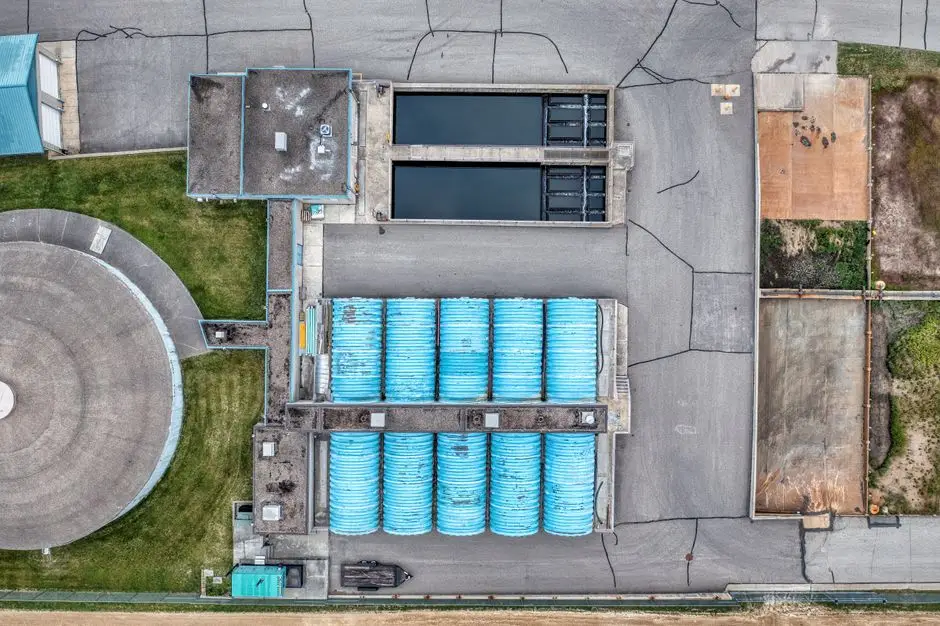
Dissolved air flotation removes material by attaching microbubbles to suspended particles, oil droplets, and floc; the resulting float is removed by a skimmer while clarified water exits below. The supplied commercial source gives typical DAF values of a 10–30% pressurized recycle stream, 4–6 bar saturation pressure, 10–80 μm bubbles, 3–5 minutes of flotation contact, and 15–25 minutes total hydraulic residence. These are typical values, not performance guarantees for refinery wastewater.
A conventional clarifier relies on gravity settling. Solids must remain sufficiently dense and flocculated to separate during the stated 1.5–3 hour hydraulic residence. A lamella plate separator adds inclined separation area, increasing effective surface loading without changing the underlying requirement that the particles settle. The supplied source documents lamella surface loading at 20–40 m/h and identifies 55–60° plate inclination.
That distinction explains the equipment behavior. A high-efficiency lamella clarifier can increase capacity for dense, settleable solids in a suitable gravity-separation application. It does not make emulsified oil or non-settleable solids settle reliably. For those contaminants, the industrial dissolved air flotation system changes the separation mechanism by giving low-density or fine material enough buoyancy to reach the surface.
DAF is not automatically free of chemistry demands. Coagulation or flocculation may still be needed to create attachable floc or disrupt an emulsion. Conversely, a clarifier may use less polymer in absolute terms while requiring tighter pH control, effective mixing, and enough residence time for the selected solids to settle. The decision is therefore based on separation physics and wastewater chemistry, not simply the shorter residence time.
DAF vs. Clarifier: Engineering Parameters for Petroleum Service
The engineering comparison below is a screening tool, not a final sizing basis. The ranges come from the supplied commercial chemical-wastewater source and are described there as order-of-magnitude values for chemical-plant service; they require confirmation against source-specific petroleum wastewater tests and the final proposal.
| Parameter | DAF | Conventional circular clarifier | Lamella clarifier |
|---|---|---|---|
| Separation mechanism | Microbubble attachment and flotation | Gravity settling | Gravity settling with inclined plates |
| Typical hydraulic residence | 15–25 minutes | 1.5–3 hours | 30–60 minutes |
| Conventional surface loading | Not stated in the supplied source | 1–3 m/h | 20–40 m/h |
| Polymer screening range | 5–20 mg/L | 0.5–3 mg/L high-molecular-weight flocculant | 0.5–3 mg/L high-molecular-weight flocculant |
| Footprint and civil impact | Relatively compact skid potential; utilities, tankage, controls, and civil work still apply | Major basin, rake, scum baffle, and civil footprint | Civil-heavy when new; plates can fit suitable existing basins |
| Retrofit potential | Can replace selected clarifier internals or be installed as a separate skid | Retrofit depends on basin condition | Plate packs can increase effective area in an existing basin |
| Primary strength | Free oil, emulsified oil, FOG, fine solids, and floatable contaminants | Dense, stable, settleable solids under steady conditions | Dense settleable solids where greater effective area is justified |
| Main failure conditions | Poor bubble attachment, unstable conditioning, oil adhesion problems, or inappropriate recycle design | Emulsions, non-settleable solids, pH instability, resuspension, or hydraulic overload | Same settling limitations as gravity clarification |
| Downstream role | Primary oil and floatable-solids removal before polishing | Primary solids removal under stable gravity-separation conditions | Clarification or polishing of suitable residual solids |
The commercial source reports 80–95% TSS removal for suitable DAF service. That claim should not be transferred to every refinery stream: performance depends on the wastewater, conditioning, hydraulic loading, and equipment design. It is a literature claim, not a site guarantee.
Lower clarifier polymer demand does not prove lower total operating cost. Compare solids handling, compressed-air and pumping demand, chemical sensitivity, maintenance, downstream carryover, and recovered-material handling. An automatic chemical dosing system should therefore be evaluated as part of the process, not as an accessory selected independently of the wastewater.
Match Each Petroleum Wastewater Profile to a Treatment Decision
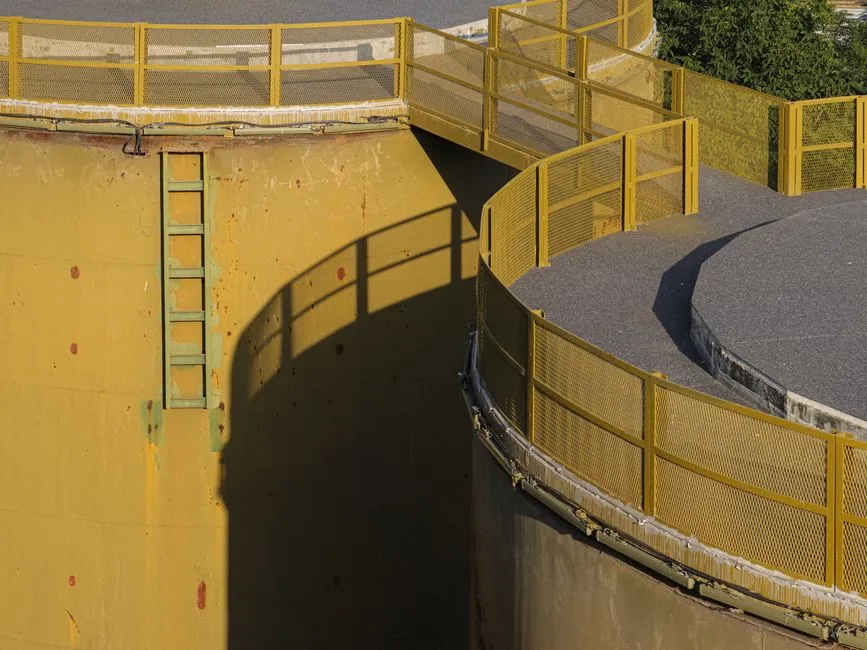
The wastewater profile determines the unit operation. Emulsions and fine solids point toward flotation; dense inorganic solids can justify gravity clarification; mixed contaminant loads often require two stages. Equipment selection should follow the physical form and variability of the waste, not the source label.
| If the characterized stream contains | Preferred treatment decision | Reason and engineering check |
|---|---|---|
| Emulsified oil or a stable oil-in-water cut | DAF, normally with conditioning as required | Oil droplets need buoyancy rather than long settling time; verify bubble attachment and skimming |
| Fine, colloidal, or non-settleable solids | DAF | Flotation can capture fine material that risks passing through a clarifier overflow |
| Dense metal hydroxides or lime sludge | Clarification, with lamella where the basin and loading justify it | Confirm settleability, pH control, solids density, and resuspension risk |
| Mixed emulsion and inorganic load | DAF followed by clarification | Recover oil and floatable solids first; polish residual settleable solids under controlled chemistry |
| Stable flow, stable pH, and an available basin | Existing clarifier or lamella upgrade | The existing civil asset may reduce the need for new construction, subject to structural and hydraulic review |
| Footprint-constrained site with a reusable basin | Existing-basin DAF retrofit | Replace or modify internals only after confirming basin integrity, piping, and operating access |
The supplied source gives a typical DAF polymer range of 5–20 mg/L, compared with 0.5–3 mg/L high-molecular-weight flocculant for lamella and circular clarification. These are screening ranges, not doses to put into a purchase order. DAF may still require coagulation or flocculation; the correct chemistry must be established from the wastewater.
Batch production and shock loading require additional scrutiny. A 2024 SSRN paper investigated DAF followed by modified moving-bed biofilm reactors for synthetic oily wastewater, but pilot results do not replace a site trial. A two-stage train remains site-specific: DAF can remove recoverable oil and floatable solids first, while clarification can polish residual settleable solids under controlled chemistry. More detail is available in DAF system engineering for oil refinery wastewater.
- Characterize each source and establish equalization requirements.
- Select DAF, clarification, a hybrid train, or an existing-basin retrofit.
- Provide pH control and chemical conditioning as the data justify.
- Verify removal performance against the permit and receiving-POTW limits.
- Size the final equipment using verified flow, peak, solids, and site data.
Indianapolis Compliance, Cold Weather, and Retrofit Constraints
Indiana pretreatment compliance depends on the current rule and the facility’s applicable categorical category. The supplied commercial source identifies IDEM 327 IAC 5 as the categorical framework and states a general discharge-sampling-point pH window of 5–10. A buyer should confirm the current rule text, plant-specific category, and sampling requirements rather than treating that screening window as a permit limit.
For Indianapolis sewer connections, the same source identifies FOG caps of 100–200 mg/L in the Belmont and Southport POTW districts, along with local limits for copper, nickel, zinc, and total chromium. The current receiving-POTW ordinance and permit control. A treatment train should therefore be evaluated against measured discharge concentrations, sampling requirements, and surcharge or enforcement provisions, not against a generic “oil-removal” target.
Site constraints can change the feasible solution. A DAF skiffed system may fit a constrained industrial lot more readily than a new concrete clarifier, but it is not automatically cheaper once utilities, controls, chemical equipment, civil work, installation, and sludge removal are included. Conversely, an existing basin can make a gravity or flotation retrofit economically attractive if its structure and hydraulics are suitable.
Ovivo’s 2025 municipal product literature states that MicroRise Circular DAF can upgrade existing clarifiers, including through retrofit projects. The supplied commercial source describes a typical 2–4 week retrofit outage for replacing launders, rake hardware, and flotation internals and installing whitewater saturation and skimming. Those activities affect construction planning and production risk.
Cold weather is a system-level consideration. The supplied source argues that slower downstream biological polishing can increase the value of reliable primary oil and solids removal. DAF’s shorter separation stage should still be evaluated against the entire plant train, including viscosity, heating requirements, biological loading, and freeze protection. For hydraulic review, data-driven DAF capacity calculation provides a useful sizing discipline, but only site data can establish the final capacity.
Build a Vendor Scope That Supports a Defensible Purchase

Issue every bidder the same evidence package: wastewater characterization, flow, temperature, pH, oil and grease, TSS, metals, and operating-hour data. Include batch volume and duration, current and proposed equalization, downstream treatment, discharge point, permit conditions, and site constraints. A vendor cannot defend equipment sizing from an average flow alone.
Request a proposed process flow, P&ID, equipment sizing basis, materials of construction, controls philosophy, chemical-consumption estimate, sludge-handling approach, installation boundary, utility requirements, and commissioning acceptance test. Require bidders to identify which values came from the wastewater data, which came from vendor literature, and which remain assumptions.
Where emulsions, variable batches, or unresolved contaminants materially affect selection, require a source-specific pilot or performance demonstration. Distinguish vendor literature from independent evidence. The bid should also show how the proposed design addresses current IDEM requirements and the receiving POTW’s rules; the screening ranges in this article are not permit limits.
HydropureWater’s stated DAF range of 4–300 m³/h across 13 standard models is a vendor-screening fact, not a final selection. Final sizing requires verified average and peak flow, batch duration, hydraulic reserve, solids loading, recovery performance, and physical site constraints. Any recovered oil or sludge system should be included in the industrial sludge filter press scope where solids dewatering is required.
Frequently Asked Questions
How should an Indianapolis refinery compare the cost of DAF and a clarifier?
Ask each bidder for an installed-scope comparison. DAF costs should identify the skid, air-saturation equipment, pumps, controls, chemical equipment, utilities, civil work, sludge removal, and production outage. Clarifier costs should identify the basin, rake, plates where applicable, polymer conditioning, site work, and disposal. Compare recovered-oil handling and downstream carryover as well. No supported quotation was provided for a petroleum facility in Indianapolis, so request a site-specific quotation rather than applying an invented price range.
What data should be used to size DAF or a clarifier?
Provide average and peak flow, batch duration and frequency, wastewater characterization, hydraulic recovery, solids loading, and required removal performance. Include the equalization basis and downstream hydraulic demand. Treatment capacity alone does not establish equipment size because oil form, particle characteristics, batch variability, and recovery cycle can change the required tankage, surface area, and hydraulic reserve.
How should a supplier be selected for petroleum pretreatment?
Check for source-specific evidence, a complete P&ID, equipment sizing calculations, materials and corrosion review, controls scope, maintenance requirements, commissioning support, and a clear performance-test protocol. Require a pilot where emulsions or batch shocks remain unresolved, and ask bidders to distinguish independent evidence from vendor literature. Include permit-aware design inputs in the technical bid rather than relying on a generic equipment-selection statement.
Does choosing DAF guarantee compliance with Indianapolis pretreatment requirements?
No. Treatment technology and legal compliance are separate decisions. A DAF, clarifier, or hybrid train can reduce oil and solids, but discharge eligibility depends on current permit terms, measured wastewater characteristics, the receiving POTW’s ordinance, and the applicable IDEM category. Obtain the current receiving-POTW rules and permit, then write acceptance criteria into the purchase specification.