
Determine Whether a Decanter Fits the Hotel Wastewater Stream
A decanter centrifuge for hotel wastewater design should begin with stream segregation: the machine may suit a continuous, solids-bearing stream, but it cannot treat the dissolved organic load in all hotel effluent. A two-phase unit separates suspended solids from liquid, while a three-phase unit can separate oil, water, and solids where the phases are compatible. Hotel kitchen wastewater requires specific characterization for free oil, emulsified oil, fats, solids, cleaners, and temperature before a tricanter is justified. A centrifuge removes the solid phase, not dissolved COD; biological or other dissolved-load treatment remains necessary. Generic sludge data cannot substitute for representative hotel-wastewater testing, so the vendor must demonstrate performance under defined feed conditions, sampling points, test duration, and acceptance criteria.
Begin by separating sanitary sewage, laundry wastewater, kitchen wastewater, cooling or boiler blowdown, cleaning wastewater, and any storm or groundwater that may enter the collection system. Record the proposed centrifugation stream and confirm whether the machine receives the entire hotel flow or only a selected solids-bearing stream. A continuous centrifuge is difficult to justify for intermittent, low-volume discharges or a dilute stream whose solids load could be handled more economically by another solids-handling method.
The key technical distinction is between suspended and dissolved material. A decanter uses centrifugal force to move denser suspended solids to the bowl wall; it does not remove dissolved COD. Biological treatment, chemical treatment, membranes, or other downstream processes must address dissolved organics. If the objective is hotel sludge dewatering after biological treatment, the relevant design basis is the sludge produced by that process—not the raw hotel wastewater flow.
A three-phase decanter is appropriate only when the feed contains two immiscible liquid phases that can be separated alongside solids. Kitchen streams can contain free oil, emulsified oil, fats, detergents, food particles, and variable temperatures. If emulsions or cleaners impair phase separation, DAF pretreatment for hotel wastewater may be required before the centrifuge. For a broader treatment approach, integrated sewage treatment may be more appropriate than a stand-alone centrifuge.
| Hotel stream or objective | What the centrifuge can address | Decision before quotation |
|---|---|---|
| Sanitary sewage | Suspended solids separation, generally after biological treatment for dissolved organics | Identify the actual sludge source and whether flow is sufficiently continuous |
| Laundry wastewater | Selected suspended solids; not dissolved detergents or COD | Document detergents, temperature, loading variation, and discharge route |
| Kitchen wastewater | Solids and, where suitable, a separated oil phase | Characterize free, emulsified, and solids-associated oil, cleaners, and temperature |
| Cleaning, cooling, or boiler blowdown | Suspended solids where feed chemistry is compatible | Exclude incompatible batch dumps or characterize them separately |
| Whole-building wastewater | Not a substitute for biological or dissolved-load treatment | Define the complete treatment train and receiving constraints |
Do not apply generic sludge or frozen-food benchmarks directly to hotel wastewater. The decanter centrifuge design for food wastewater provides useful design questions, but its examples are not hotel-project guarantees. For hospital wastewater, the decanter centrifuge design for hospital wastewater similarly requires a source-specific basis. The hotel buyer should ask the supplier to demonstrate performance on the actual stream proposed for the machine.
Build a Representative Design Basis
The supplier should size the centrifuge from measured stream conditions, not from the hotel’s total daily water use. The design worksheet must distinguish average flow, peak flow, design-hour flow, continuous flow, batch dumps, and cleaning cycles; a peak hydraulic event does not automatically justify continuous solids-handling capacity. If laundry or kitchen discharges are intermittent, record their frequency, duration, temperature, and solids profile rather than averaging them into an apparently continuous feed.
For solids, specify TSS and the settleable-solids fraction. Include particle-size distribution, particle shape, density difference between solids and liquid, and wastewater viscosity because the decanter centrifuge overview in Wikipedia identifies these characteristics as influences on sedimentation. A total TSS number does not show whether the hotel stream contains coarse, readily settled material or fines likely to report to centrate. Fats, oils, and grease require a separate analysis covering free oil, emulsified oil, and solids-associated oil, together with detergents and cleaning chemicals that may interfere with phase separation.
Temperature and operating schedule belong in the same worksheet. Record wastewater temperature during normal operation, during cleaning cycles, and at any proposed three-phase operating point. State whether the machine will operate continuously, intermittently, or across mixed-temperature feeds. Receiving constraints should be defined before selecting the equipment: required centrate TSS, solids-capture objective, cake dry matter, discharge route, odor control, reuse limits, and downstream biological or pretreatment requirements.
ANDRITZ states that its decanter portfolio spans 0.1–500 m³/h, depending on application and operating conditions. That range demonstrates that machine scale varies widely; it is not a hotel sizing recommendation and does not establish the correct capacity for any particular property. ANDRITZ also states that conditioning, including polymer type and dosage, affects sludge-separation performance, although high separation can be achieved in many applications without slurry pre-conditioning. Specify whether chemical conditioning is permitted, who owns dosing control, and how chemical use will be measured. An automatic chemical dosing system should be evaluated against the selected polymer and actual feed variability rather than added by default.
| Design-basis field | Evidence required from the hotel | Why it affects selection or acceptance |
|---|---|---|
| Hydraulics | Average, peak, design-hour, batch-dump, and cleaning-cycle flow | Determines whether continuous capacity and feed control are justified |
| Solids | TSS, settleable fraction, particle size, shape, density difference, viscosity | Defines separation difficulty and centrate risk |
| Fats, oils, and grease | Free, emulsified, and solids-associated oil; detergent and cleaner inventory | Establishes whether two-phase or three-phase separation is technically credible |
| Operating conditions | Temperature, operating schedule, feed variability | Sets test conditions and operating limits |
| Receiving requirements | Centrate TSS, capture, cake dry matter, disposal or reuse route | Defines the measurable performance obligation |
| Conditioning | Permitted chemicals, polymer type and dosage, dosing method | Affects separation, chemical demand, and downstream compatibility |
Match the Decanter Configuration to the Separation Job

A conventional two-phase decanter separates suspended solids from liquid; a three-phase decanter separates solids and two immiscible liquids in one step. The feed enters the rotating bowl, denser solids collect at the bowl wall, and the scroll conveys them through the cylindrical section and along the beach to discharge at the conical end. Clarified liquid leaves through the liquid-discharge arrangement. Wikipedia describes the paring disc as an internal centripetal pump, while adjustable weir discs or weir plates set the pond depth and bowl filling volume.
Specify two-phase separation for a mainly solids-bearing stream where a separated liquid phase is not required. Specify three-phase separation only after the pilot demonstrates that the oil and water phases are sufficiently immiscible and that emulsions, cleaners, and solids do not defeat recovery. A tricanter adds mechanical complexity, phase-control requirements, and separate discharge handling; those burdens must be tied to a measurable oil-recovery or centrate-oil benefit.
Bowl length-to-diameter ratios of 2, 3, and 4 are described as commonly used heuristics in Wikipedia. At the same diameter, a longer bowl can provide greater solids-conveying capacity and suspension volume, improving fine-solids settling. The ratio is not a substitute for feed characterization because geometry must still be matched to residence time, cake structure, throughput, and centrate quality.
Orientation is an installation and duty decision. Wikipedia states that vertical configurations can support higher-temperature or higher-pressure operation because of their orientation and rotational seals, but they cost more than the horizontal configuration, which is non-pressurised and open. It also reports lower vibration-related noise for vertical machines. A horizontal orientation is the conventional open-duty choice; justify another configuration with defined pressure, temperature, sealing, space, or vibration requirements.
Energy features should remain conditional alternatives. ANDRITZ reports up to 15% energy savings from its High Hydraulic Pressure design, up to 30% from TurboJet weir plates as a standalone feature, and another 5% from direct drive. These are manufacturer claims, not hotel-project savings. Request the calculated basis, applicable operating point, and measured pilot consumption for any offered feature.
Optimize the Variables That Control Performance
Centrate clarity, cake dryness, solids capture, and throughput cannot be optimized independently. Wikipedia describes decanter centrifuges as operating at approximately 1,000–4,000 G, but that does not mean a hotel application should automatically use the upper end. Higher G-force improves solids separation while potentially hindering dry-cake conveyance on the beach. The correct value must emerge from testing against the hotel’s required centrate limit and cake-disposal route.
Feed rate is a central control. Wikipedia reports that higher volumetric throughput can reduce liquid clarity because particles have less effective separation time. Set feed rate from the required centrate quality at representative solids loading, not simply from average daily flow. Differential speed is the relative motion between bowl and scroll: increasing it can increase solids transport and reduce cake residence time, while too little differential speed can impair conveyance. The optimum must balance transport, cake thickness, dryness, and torque demand.
Pond depth creates a direct trade-off. Wikipedia states that a shallow pool can maximize centrifugal separation, while a deeper pool provides a thicker liquid buffer that may reduce fine-particle carryover when the cake layer is too thick. The pool should therefore be tested for the actual hotel feed. A value copied from a generic sludge duty is not a design input.
Beach and cone angles must match cake behavior. Wikipedia notes that a lower cone angle can reduce slippage force and scroll wear for soft or difficult-to-compact solids, while cone geometry also affects the torque needed to move compact material. The right angle depends on observed cake structure, compaction, and drive load rather than a single preferred setting.
Variable hotel flows favor adjustable controls for bowl speed, scroll speed, pond depth, and feed rate. ANDRITZ identifies immediate changes to process settings, adjustable pond depth, and automatic control as useful features. The procurement specification should require controls for the operating conditions actually expected, not assume that automatic control can compensate for an unsuitable feed.
| Control variable | Direction of effect | Acceptance check |
|---|---|---|
| Feed rate | Higher throughput can reduce liquid clarity | Centrate TSS and solids capture at defined feed rates |
| Differential speed | Higher values can improve transport but shorten cake residence time | Capture, cake dry matter, torque, and discharge stability |
| Pond depth | Shallower separation pool may improve force; deeper pool may reduce fine carryover | Fine-particle recovery and centrate clarity across settings |
| G-force | More force aids dewatering but can hinder cake conveyance | Centrate quality and cake transport together |
| Beach/cone angle | Affects slippage, wear, compaction, and torque | Observed cake structure and steady discharge |
Place the Centrifuge Within the Complete Treatment Train
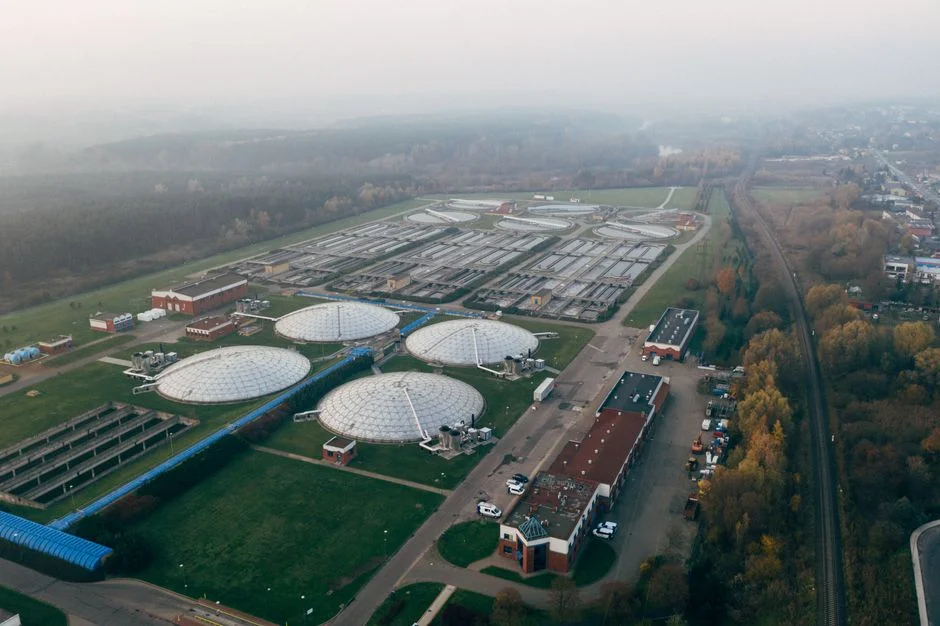
The centrifuge should occupy a defined solids-handling role in the treatment train, not conceal an unresolved wastewater problem. Start with source characterization, then recover or remove floatable material where necessary, apply biological treatment for dissolved organics, condition solids if required, dewater, and arrange cake disposal or reuse. Each step should have its own outlet and receiving constraint.
For kitchen wastewater with substantial free oil, grease, or floatable material, DAF pretreatment for hotel wastewater may protect the centrifuge by reducing floatable load before solids separation. Suitability must be confirmed through wastewater chemistry and pilot results. HydropureWater reports a DAF range of 4–300 m³/h across 13 standard models; that is a product range, not evidence that a DAF unit is suitable for a specific hotel or that it replaces centrifuge sizing.
A centrifuge does not replace biological treatment for dissolved COD. Where the hotel needs biological treatment as well, integrated MBR wastewater treatment can be evaluated as part of the wider train, while the centrifuge may dewater the resulting sludge. Alternatively, a plate and frame filter press may be more economical for batch operation, smaller flows, simpler control, or a defined dewatering campaign. Compare the complete service, including labor, washdown, cake handling, downtime, and disposal—not only the quoted machine price.
Layout review must include cake discharge and storage, odor control, chemical storage, access for maintenance, washdown, noise, vibration, utilities, and safe handling of separated oil if three-phase operation is proposed. For a broader hotel treatment train, packaged wastewater treatment for a hotel illustrates why receiving constraints and operating conditions should be established before equipment selection.
Turn Pilot Results into a Purchase and Acceptance Protocol
Representative pilot testing converts a supplier’s separation claims into enforceable project obligations. The pilot must use the actual hotel wastewater stream proposed for the centrifuge, not clean water, unrelated sludge, or a synthetic feed with a convenient solids profile. If the selected stream is blended, the specification should state the blend and how it represents normal and worst operating conditions.
The test record must state feed rate, feed composition, wastewater temperature, duration, sampling points, operating settings, and acceptance criteria. Measure centrate TSS, solids capture, cake dry matter, centrate oil content where three-phase separation is proposed, net energy use, polymer consumption, and operational stability. Include the complete mass balance so that centrate, oil, and cake measurements can be checked rather than accepted as isolated readings.
Every guarantee should be conditional on a defined feed composition, wastewater temperature, feed rate, test duration, and sampling method. This prevents a result from one feed rate or operating condition becoming an unrestricted project promise. Bid comparisons should use the same test basis and include centrate quality, cake dryness, capture, energy, chemicals, labor, continuous-operation capability, maintenance, and final cake-disposal route.
ANDRITZ reports more than 80% TSS capture in its stated pig-manure application. That figure is application-specific and cannot be presented as a hotel-wastewater guarantee. The same rule applies to all generic sludge benchmarks, including the 2024 wastewater-sludge-model findings referenced in the supplied frozen-food guide. Those data can inform test questions, but they do not establish hotel performance.
| Acceptance item | Required test record | Purchase obligation |
|---|---|---|
| Centrate quality | Representative feed, temperature, feed rate, duration, and sampling method | Conditional TSS and solids-capture guarantee |
| Cake | Dry-matter measurement and discharge observation | Conditional cake dry-matter and handling requirement |
| Three-phase separation | Centrate oil content and recovered-oil stream | Conditional oil-separation guarantee |
| Operating cost | Net energy and polymer consumption | Measured consumption under the agreed test basis |
| Reliability | Operating duration and recorded interruptions or instability | Acceptance remedy for failure to meet agreed stability criteria |
For final equipment selection, ask each bidder to state which measured result establishes the guaranteed value, which sample method produced it, and what happens if the operating condition changes. A defensible acceptance protocol makes the pilot result traceable to the purchased machine and prevents generic sludge performance from becoming an unsubstantiated project promise.
Frequently Asked Questions
How much does a decanter centrifuge for hotel wastewater cost?
There is no defensible price in the supplied research for a hotel installation. Request a quotation based on the measured feed flow, TSS, particle characteristics, fats and oils, temperature, operating schedule, centrate TSS, cake dry matter, and disposal route. Ask the supplier to separate the machine, foundations and utilities, controls, pretreatment, chemical dosing, commissioning, spares, and annual operating-cost assumptions so that the bids use a comparable scope.
What flow rate and solids loading should be used to size the machine?
Do not size from average daily water use. Give the supplier continuous, peak, design-hour, batch-dump, and cleaning-cycle flow, then provide TSS, settleable solids, particle-size distribution, density difference, viscosity, temperature, and any oil load. The pilot should demonstrate whether the selected feed rate meets the required centrate TSS and solids-capture target; ANDRITZ’s 0.1–500 m³/h portfolio range is not a hotel sizing recommendation.
Should the hotel specify a two-phase or three-phase decanter?
Use a two-phase machine when the objective is solids separation without a separate oil product. Require three-phase operation only when pilot data demonstrate stable separation of oil, water, and solids and the recovered-oil stream has a defined destination. Characterize free oil, emulsified oil, solids-associated fat, detergents, and cleaners first; a tricanter should not be selected from the presence of grease alone.
Is pilot testing mandatory before purchasing a centrifuge?
It is the practical control for the project because hotel wastewater composition and operating conditions can differ from generic sludge data. Require representative testing and define feed rate, composition, temperature, duration, sampling points, and acceptance criteria in the purchase specification. Make the final guarantee conditional on that same test basis, with a remedy for failure to achieve the agreed centrate TSS, solids capture, cake dry matter, and three-phase oil result where applicable.