
Start with the receiving POTW and the controlling limit
Food and beverage plants near Cherryfield meet pretreatment limits by first identifying the receiving publicly owned treatment works, the applicable EPA categorical standard, and site-specific local limits. The treatment train is then matched to the connection-point requirements for fats, oils and grease, organics, pH, solids, heat, and slug loads. No equipment should be selected from generic ranges alone: the plant must obtain current permits, influent data, BMP requirements, surcharge rules, and enforcement procedures. This permit-discovery sequence is the first step in a Cherryfield-area sewer-limit framework.
The receiving POTW and the physical connection point determine who controls the discharge and what the equipment must achieve. Confirm whether the POTW administers a locally authorized industrial pretreatment program or operates under direct federal oversight. The supplied HydropureWater source identifies this jurisdiction check as “step zero” of equipment sizing because the audit trail and reporting path depend on it.
Apply the legal hierarchy in this order:
- If the plant’s process and product fall within an EPA categorical pretreatment standard at 40 CFR Parts 405–471, the matching subcategory controls.
- For a parameter not covered by the categorical standard, apply the POTW’s site-specific local limit under 40 CFR 403.5(c).
- Apply the general prohibitions under 40 CFR 403.5(b) to prohibited or interfering discharges, including FOG, corrosivity, heat, flammable or explosive loads, and slug discharges.
Silence in a local-limits letter is not authorization. Request written clarification before freezing the design.
| Decision layer | What it establishes | Evidence needed before sizing |
|---|---|---|
| EPA categorical standard | National requirements for a matching industrial subcategory | Product and process classification; applicable subcategory |
| Site-specific local limit | POTW-imposed numerical and narrative requirements at the connection point | Current IU-specific local-limits letter |
| General prohibitions | Restrictions on discharges that cause interference or pass-through | Written POTW interpretation of applicable prohibitions |
| NPDES compliance link | How an industrial discharge can affect the POTW’s permit | Current POTW NPDES permit and enforcement plan |
Request the five documents that define the compliance envelope
Five written artifacts define the compliance envelope for an industrial user pretreatment program, and none should be replaced by a supplier’s generic permit checklist.
- IU-specific local-limits letter: Obtain numerical and narrative limits at the connection point, BMP requirements, spill-prevention controls, chemical-handling constraints, and sampling requirements.
- Sampling protocol: Confirm whether monitoring requires a 24-hour flow-proportional composite or grab samples, the monitoring frequency, flow proportionality, preservation requirements, and chain-of-custody procedure.
- Surcharge schedule: Request current rates for BOD, TSS, FOG, and flow above applicable thresholds. These rates allow capital and operating scenarios to be compared against actual exposure.
- Enforcement response plan: Obtain the escalation path from a Notice of Violation through a compliance order and permit-revocation process.
- Current POTW NPDES permit: Cross-check the industrial-user letter against the POTW’s current permit conditions and identify the responsible state and federal oversight path.
The food and beverage pretreatment guide for West Plains provides a related request list, but Cherryfield-area buyers must obtain the documents from their own receiving POTW rather than transfer local terms from another municipality.
| Document | Procurement use | Missing-document consequence |
|---|---|---|
| Local-limits letter | Sets the connection-point design basis | No defensible performance guarantee |
| Sampling protocol | Defines the monitoring and reporting method | Uncertain evidence of compliance |
| Surcharge schedule | Quantifies operating exposure | Incomplete operating-cost comparison |
| Enforcement plan | Defines escalation and response gates | Weak compliance-risk planning |
| NPDES permit cross-check | Links industrial limits to POTW obligations | Potential pass-through or interference issue |
Characterize the wastewater that can actually vary
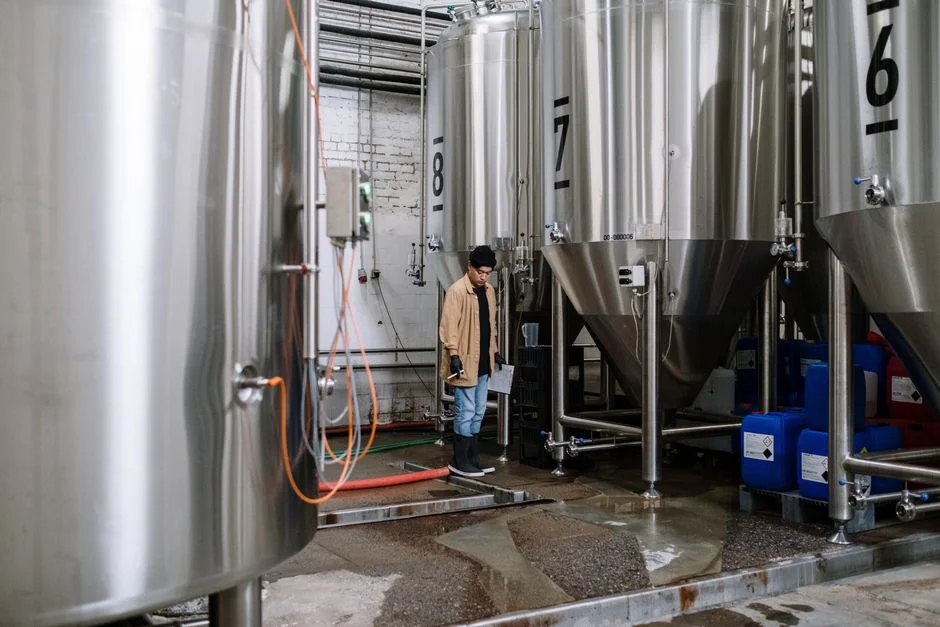
Food-processing wastewater must be characterized across representative production and sanitation cycles because average flow and a single laboratory sample can conceal the events that drive permit exceedances.
Separate production wastewater from washdown, floor-washing, and CIP streams. Map acidic cleaners, caustic cleaners, sanitizers, and product changes to their pH effects and chemical demand. The IWS source identifies variable pH, organic load, and FOG as defining challenges in food and beverage wastewater. Crystal Clean likewise reports that processing streams differ according to product, while CIP, floor washing, and sanitization add variable chemical composition. Its food and beverage wastewater guidance, accessed in 2026, notes that a dairy operation or brewery can produce BOD 10 to 20 times higher than domestic sewage; that comparison is an industry example, not a Cherryfield limit.
Measure flow duration, peak discharge, FOG, BOD, TSS, and pH across representative operating states. Identify off-spec batches, high-strength condensates, and concentrated CIP events that could create a slug load. Each event needs an isolation, rework, or controlled-discharge response approved as part of the operating plan.
Use the confirmed limit and sampling method to calculate the required removal basis. Raw concentration, permitted concentration, and removal percentage are not interchangeable. For buried treatment options for food processing, site constraints and disposal pathways must be assessed alongside the permit basis.
| Variable | Operational source | Design consequence |
|---|---|---|
| Flow and duration | Production, washdown, shift changes | Equalization volume and peak treatment capacity |
| pH | Product changes, acids, caustics, sanitizers | Neutralization demand, chemical storage, controls |
| FOG | Cooking, rendering, equipment washing | DAF capture basis and float handling |
| BOD and TSS | Food solids, product loss, starches | Biological loading and solids separation |
| Slug risk | Concentrates, failed batches, CIP dumps | Isolation, rework, controlled discharge |
Build the treatment train around FOG, organics and hydraulic shocks
A staged train should address each risk at the point where it is most economical to control, rather than assigning every variable to one final treatment unit.
- Fine screening: Remove rags, plastics, fibrous packaging, and CIP solids before they foul pumps, DAF nozzles, or biological systems. The supplied GX rotary bar-screen design basis uses 2–6 mm spacing.
- Equalization and pH control: Buffer hydraulic and organic loading and provide a route to rework off-spec batches. The supplied design basis is 6–24 hours of residence, holding loading within ±15% of the daily mean.
- Conditioned DAF: Remove FOG, oil, colloids, and suspended solids. The supplied envelope is 85–95% FOG removal and 70–90% TSS removal for raw FOG of 500–2,000 mg/L, with hydraulic loading of 5–15 m³/h per m² and 20–30% recycle.
- Biological treatment: Add biological treatment when the confirmed BOD or ammonia limit requires further organic removal. The supplied MBR envelope is 8,000–12,000 mg/L MLSS, an F:M ratio of 0.05–0.15 lb BOD/lb MLVSS·d, and effluent BOD below 30 mg/L and TSS below 30 mg/L.
- Disinfection: Add it only where the permit or POTW protocol requires it. The supplied options are chlorine dioxide at 0.5–2.0 mg/L residual after 30 minutes or UV at 30 mJ/cm² for fecal coliforms.
Use PLC-controlled chemical dosing for pH adjustment and DAF conditioning. The supplied target is pH 6.0–9.0 standard units with high and low alarms. Treat high-temperature and high-ammonia streams as source-control or side-stream problems rather than relying on the final biological unit to absorb every upset. Further unit-operation matching is described in Wastewater Treatment Stages Explained: 5-Step Engineering Process.
| Risk | Primary control | Status |
|---|---|---|
| Solids and packaging debris | Fine screening | Conditional on stream contents |
| Hydraulic and organic shocks | Equalization | Strongly justified by variable loading |
| FOG and colloidal solids | Conditioned DAF | Mandatory where FOG risk and limits require removal |
| pH extremes | Neutralization and blending | Required where permit or general prohibitions apply |
| Residual BOD or ammonia | Biological treatment | Limit-dependent |
| Disinfection | Chlorine dioxide or UV | Permit-dependent |
Size the DAF from the confirmed limit, not a generic flow table
A transparent DAF calculation lets procurement evaluate whether a supplier’s flotation area reflects the confirmed limit and peak flow rather than a catalog selection.
The supplied worked example uses raw FOG of 1,200 mg/L and a local limit of 150 mg/L. Required removal is:
(1,200 − 150) ÷ 1,200 = 87.5%
At a peak flow of 30 m³/h and a hydraulic loading of 10 m³/h per m², the flotation area is 3.0 m². At 5 m³/h per m², it is 6.0 m². These figures come from the HydropureWater Cherryvale pretreatment source, dated 2026, and are an engineering illustration—not a Cherryfield permit limit.
Use the more conservative hydraulic-loading basis when raw FOG exceeds 2,000 mg/L or FOG variability is high. The supplied source identifies a pre-DAF grease trap or stepped-down DAF loading as options under that condition. Neither changes the governing limit; each changes how reliably the train reaches it.
The final design must reflect the confirmed local limit, current influent characterization, peak flow, and chemical-conditioning basis. Require the proposal to include automatic skimming, recycle, controls, and appropriate redundancy. A food-processing DAF system should be evaluated against these site inputs rather than a generic flow table.
| Calculation step | Worked example | Procurement question |
|---|---|---|
| Raw FOG | 1,200 mg/L | Is the value current and representative? |
| Local limit | 150 mg/L | Is it the confirmed connection-point limit? |
| Required removal | 87.5% | Does the guarantee use this same basis? |
| Peak flow | 30 m³/h | Does it include washdown and CIP peaks? |
| Flotation area | 3.0 m² at 10 m³/h per m²; 6.0 m² at 5 m³/h per m² | Which loading and operating margin are offered? |
Control solids, chemicals and the compliance record
Treatment performance is only defensible when the plant can show how residual solids were handled, how chemicals were dosed, and what action followed each excursion.
Route DAF float and waste activated sludge to sludge dewatering. The supplied design basis is 20–35% dry-solids cake through a plate-and-frame filter press. Consider a high-efficiency sedimentation tank ahead of the press when float dry solids fall below 3%, consistent with the supplied source. Verify the disposal route before selecting equipment; the source identifies EPA SW-846 Method 9095, the paint-filter test, as a relevant check for applicable waste.
Specify a PLC-controlled chemical dosing system with alarms, flow instrumentation, differential-pressure or level trends, and an electronic operations log. Manual readings alone may not establish what occurred during a sampling event.
Map each exceedance to a defined response: pause the affected discharge, isolate or rework the batch, inspect upstream controls, and notify the POTW according to the permit and enforcement plan. The plate-and-frame filter press proposal should identify cake consistency, filtrate handling, cleaning requirements, and the owner-approved operating envelope.
Compare equipment choices by risk, footprint and compliance margin
Equipment comparison should begin with the wastewater risk and confirmed connection-point limit, not with a generic claim of superior effluent quality.
| Criterion | What the buyer should compare | Reject when |
|---|---|---|
| Permit fit | Confirmed local limit, categorical standard, BMPs, monitoring method | The offer cites only a generic discharge standard |
| Guaranteed performance | Raw influent, required removal, peak flow, test method | Performance has no influent or test boundary |
| Hydraulic variability | Equalization, recycle, peak-flow and upset response | Equipment is selected from average flow |
| Controls and monitoring | Alarms, trends, sampling provisions, electronic records | Compliance relies only on manual entries |
| Contingency | Redundancy, expansion, maintenance access, operator capability | No scenario is defined for an off-spec batch |
| Service and schedule | Documented support, commissioning, training, delivery commitments | Compliance dates or deliverables remain vague |
Compare DAF, conventional clarification, and biological polishing for FOG capture, solids removal, hydraulic variability, chemical demand, and ability to maintain the confirmed limit. Treat MBR as a higher-control option where biological treatment and solids separation must be combined in a compact footprint. The supplied product description claims filtration below 1 μm and a footprint 60% smaller than conventional systems; these are product claims, not Cherryfield permit limits.
Compare integrated packaged trains with componentized equipment only after resolving control complexity, expansion, redundancy, maintenance access, and operator capability. Include chemicals, aeration or recycle power, sludge hauling, media replacement, membrane cleaning, odor control, remote monitoring, and operator labor. Use the MBR and conventional activated-sludge comparison as a technical reference, not as a substitute for food-processing wastewater testing.
Build the budget from compliance risk and operating cost
A defensible pretreatment budget separates compliance-driven capital, variable operating costs, and production-contingency costs.
- Build base, peak, and off-spec scenarios from current production schedules, measured influent data, and confirmed connection-point limits.
- Model BOD, TSS, FOG, and flow surcharges above the POTW’s thresholds using the current surcharge schedule.
- Include equalization volume, DAF footprint, chemical consumption, biological aeration, sludge dewatering, maintenance, monitoring, and disposal in total cost of ownership.
- Test how an undersized train performs against each wastewater scenario, including the consequences of surcharge and permit exposure.
- Carry contingency for production changes, new products, seasonal output, and revised POTW limits.
The Crystal Clean source, accessed in 2026, notes that treatment needs change when product lines, seasons, or local limits change. That makes scenarios more useful than a single budget number. The supplied 2026 water-treatment construction cost benchmarks may frame an estimate, but they cannot replace a site-specific quantity takeoff.
| Budget category | Required inputs | Output for decision-making |
|---|---|---|
| Capital treatment | Limits, flows, influent characterization, treatment objectives | Unit sizing and equipment scope |
| Chemicals and utilities | Average loading, operating hours, utility rates | Variable operating cost |
| Solids handling | Sludge characteristics, dewatering basis, disposal route | Equipment and hauling allowance |
| Compliance | Monitoring method, reporting burden, surcharge schedule | Operating and exposure allowance |
| Contingency | Production scenarios and future limit changes | Risk-adjusted budget |
Use a compliance calendar and escalation plan
Compliance control depends on assigning owners and predefined decision gates before an excursion becomes a regulatory event.
- Assign responsibility for monitoring, chemical inventory, calibration, inspections, log review, sampling, chain of custody, and regulatory correspondence.
- Trend flow, pH, FOG, BOD, and TSS against operating conditions and permit thresholds.
- Review new products, CIP chemistry, production shifts, and drainage changes with the POTW and the pretreatment design authority.
- Preserve the local-limits letter, permit, monitoring results, calibration records, training, corrective actions, and vendor reports in one audit-ready system.
- Define escalation owners and decision gates for a Notice of Violation, formal compliance order, and permit-revocation response.
Warning signs include repeated parameter approaches to the limit, unexplained flow peaks, chemical-dosing alarms, inconsistent sampling records, and treatment units operating outside their approved envelope. A lead online monitoring guide for industrial wastewater can support instrument architecture, but the monitoring design must follow the POTW’s written sampling protocol. NPDES compliance begins at the connection point and depends on a complete, defensible record.
Frequently Asked Questions
How much should I budget for a food-processing pretreatment system?
No universal price can be inferred from the supplied research. Request a scenario-based budget based on the confirmed local limits, peak and average flow, current influent characterization, treatment objectives, equalization requirement, sludge-disposal route, chemical consumption, utilities, monitoring, and operator labor. Require separate base, peak, and off-spec cases, plus clearly identified contingency.
Which pretreatment equipment should I request in a vendor quotation?
Request screening, equalization, pH control, DAF, biological treatment, and disinfection only as justified by the wastewater profile and permit. Require the quotation to identify the governing parameter, design flow, influent basis, removal guarantee, controls, monitoring provisions, sludge route, and excluded conditions. This avoids paying for equipment that solves a risk the site does not have while leaving a documented risk untreated.
How do I size a DAF system for a food plant?
Use the confirmed raw FOG, permitted concentration, required removal percentage, peak flow, and selected hydraulic-loading basis. The supplied 30 m³/h example yields 3.0 m² at 10 m³/h per m² and 6.0 m² at 5 m³/h per m²; treat it as an illustration, not a final Cherryfield design. Ask the supplier to repeat the calculation with the plant’s confirmed inputs and state its operating margin.
Can another plant’s permit limits be copied for a Cherryfield facility?
Only the applicable EPA categorical standard may carry across qualifying facilities. POTW local limits, BMPs, monitoring rules, surcharge thresholds, and enforcement procedures must be obtained for the actual receiving POTW in writing. A supplier’s generic permit matrix is not a substitute for the current IU-specific local-limits letter and sampling protocol.
What should happen when a pretreatment system is undersized or an off-spec batch occurs?
Stop or isolate the affected discharge, divert the batch for rework or approved off-site treatment, and prevent the slug from entering the sewer. Inspect upstream controls and chemical dosing, verify treatment performance, and notify the POTW as required by the permit and enforcement plan. Preserve the batch record, alarms, operating trends, corrective action, and release authorization so the event can be reconstructed.