What Makes a Namangan Data Center Treatment Design Different?
A Namangan data center needs separate treatment trains for cooling-tower blowdown, sanitary sewage, boiler or humidification bleed, and makeup-water pretreatment. Cooling blowdown is usually the largest recoverable stream: at 4 cycles of concentration it equals 25% of makeup, while 6 CoC reduces it to 20%—a 20% reduction, not 50%. A practical train typically combines solids removal, hardness or scale control, disinfection where reuse requires it, and filtration or RO when reuse as cooling makeup is justified. Sanitary sewage requires biological treatment and should not be blended with blowdown beforehand. Exact flows, water chemistry, reuse targets, discharge routes and permits must be established from Namangan-specific data; Tashkent figures are benchmarks, not substitutes for local testing.
Namangan design work must begin with the selected water source, its seasonal variability, the cooling configuration, intended IT load and the sewer, waterbody or on-site reuse route. The source and discharge route determine which contaminants matter and whether the project can discharge, reuse or must close the loop.
The supplied HydropureWater benchmark for the Chirchiq–Bozsu source envelope reports TDS of 350–700 mg/L, hardness of 180–300 mg/L as CaCO₃ and silica of 8–20 mg/L. These are Tashkent benchmark values, not Namangan water chemistry. Namangan lies in a different catchment, so these figures cannot be transferred without local verification (HydropureWater, 2026).
The minimum Namangan input register is: source-water TDS, hardness, silica, TSS and turbidity; cooling-tower makeup, evaporation, blowdown and drift; sewer discharge temperature and chemistry; and requirements for each intended reuse. Technology selection should then reflect source reliability, discharge restrictions, water cost, reuse value, operator capability and local permit conditions—not water scarcity alone.
The data center wastewater and cooling-blowdown treatment guide provides a useful comparison framework, while the Maianga 2026 data center treatment guide should be treated as a separate regional reference rather than a source of Namangan inputs.
Separate the Four Wastewater Streams Before Sizing Equipment
Separate treatment prevents one stream’s chemistry or biology from determining the performance of another. Makeup water should be characterized and pretreated before entering the cooling loop; cooling blowdown should pass through its own solids-removal and chemistry-control train; sanitary sewage requires biological treatment; and boiler or humidification bleed requires a route selected from measured chemistry.
The regional benchmark identifies cooling blowdown at 2,400–6,400 mg/L TDS and 25–32 °C in summer, with phosphonates, dispersants and biocides. It identifies sanitary sewage at BOD₅ of 200–300 mg/L and TSS of 200–250 mg/L, with fecal coliform present (HydropureWater, 2026). These values support preliminary stream separation only; Namangan sampling must establish the design basis.
Cooling blowdown primarily needs solids separation, pH and corrosion control, scale prevention and disinfection or membrane treatment. Sanitary sewage needs an anoxic/oxic biological train, followed by solids removal and disinfection. Combining these streams before treatment would impose sewage organic loading on the blowdown train and introduce pathogens into a reuse stream. The underground integrated sewage-treatment system addresses the sanitary train; the DAF system for cooling-tower blowdown addresses the physical-removal duty.
| Stream | Primary design issue | Required treatment basis | Initial destination |
|---|---|---|---|
| Makeup water | TDS, hardness, silica, TSS and turbidity | Source analysis; filtration and scale control as required | Cooling tower or defined pretreatment train |
| Cooling-tower blowdown | Concentrated salts, suspended solids, chemicals and biocide residual | Measured flow and chemistry; solids separation and targeted polishing | Discharge or separately verified reuse |
| Sanitary sewage | BOD₅, TSS and pathogens | Biological treatment, solids separation and disinfection | Defined discharge or reuse route |
| Boiler or humidification bleed | Potentially high TDS and silica; intermittent flow | Measured chemistry and makeup compatibility | Makeup, blowdown train or separate disposal after verification |
Blending may be considered only after each stream independently meets the intended discharge or reuse requirements. Boiler bleed should not be sent to cooling makeup solely because its flow is low; silica, conductivity and treatment chemistry must first confirm compatibility.
Size Cooling Blowdown from CoC, Makeup and Measured Losses
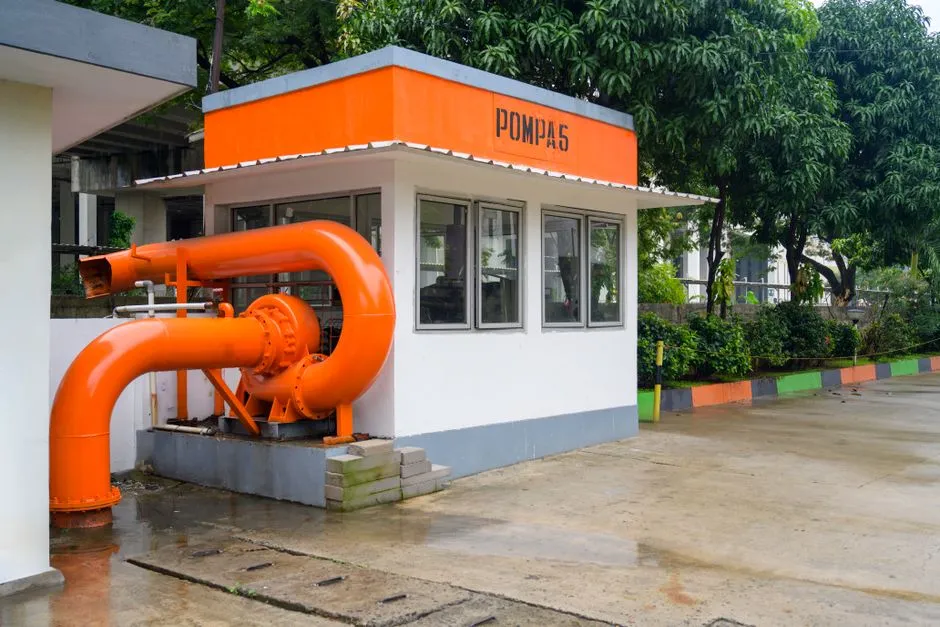
Cycles of concentration is the ratio of dissolved-solids concentration in circulating cooling water to that in makeup water. Under the ideal balance, blowdown as a fraction of makeup is 1/(CoC−1): at 4 CoC this is 1/3, or 25%, and at 6 CoC it is 1/5, or 20% (Genesis Water Tech, 2025).
The economic correction is essential: moving from 4 to 6 CoC reduces blowdown by 5 percentage points of makeup, approximately 20%, not 50%. The same source warns that scaling and biological risks increase materially above approximately 5–6 CoC without advanced treatment. Consequently, higher CoC must be justified by the verified chemistry and an operating plan that includes corrosion, scale and microbiological control.
HydropureWater’s regional benchmarks provide sensitivity checks: 1,800–2,100 m³/month of blowdown for a 5 MW site at 4 CoC and 3,800–4,200 m³/month for a 10 MW site; daily planning references are 60–140 m³/day average and a 200 m³/day peak-day allowance for a 10 MW campus (HydropureWater, 2026). These are Tashkent-derived benchmarks, not Namangan design flows.
| Cooling-water parameter | Equation or field requirement | Design treatment |
|---|---|---|
| Cycles of concentration | Conductivity in circulating water divided by conductivity in makeup | Confirm with representative makeup and circulating-water samples |
| Ideal blowdown ratio | 1/(CoC−1) | 4 CoC: 25%; 6 CoC: 20% |
| Actual blowdown | Measure makeup, blowdown, evaporation, drift and emergency dumps | Actual blowdown can exceed theoretical calculations by 15–30% because of unmeasured losses and emergency discharges (Genesis Water Tech, 2025) |
| Equipment duty | Measured peak blowdown, not IT load alone | Check hydraulic and contaminant loading; retain modular expansion space |
Final sizing requires meter reconciliation and raw-water testing. The cited spring TSS range of 25–60 mg/L applies to the Tashkent benchmark, not Namangan. Pretreatment selection should reflect verified solids loading; a multi-media filter or industrial water softener should be specified only after the corresponding filtration and hardness duties are confirmed.
Choose a Blowdown Treatment Train That Fits the Reuse Target
Treatment configuration should follow the required end use, not a preferred technology. A discharge-only project may justify solids removal and controlled dosing. Cooling-makeup reuse may require filtration, softening or antiscalant and membrane treatment. Irrigation or other non-potable reuse requires its own water-quality and disinfection basis. Zero-liquid-discharge should be reserved for prohibited discharge or binding closed-loop requirements.
The supplied regional comparison reports installed costs for 5–10 MW facilities of $35K–$60K for DAF with PLC-controlled chemical dosing, $220K–$480K for DAF with softener or antiscalant and BWRO, and $1.2M–$3.5M for full ZLD using an RO preconcentrator, MVC and crystalliser (HydropureWater, 2026). These are regional reference ranges, not Namangan quotations, and exclude any conclusion about local freight, taxes, civil works or site conditions.
| Configuration | Reference installed cost | Principal operating issue | Suitable outcome |
|---|---|---|---|
| DAF plus PLC-controlled chemical dosing | $35K–$60K | Chemical dosing accounts for about 20% of OPEX; sludge requires removal | Compliance-oriented discharge, subject to the verified permit route |
| DAF plus softener or antiscalant and BWRO | $220K–$480K | RO membrane replacement every 3–5 years; antiscalant and sludge disposal | Cooling-makeup reuse at 75–80% recovery |
| Softener plus lamella clarifier plus chlorine dioxide plus partial RO | Use a current site-specific quotation | Salt regeneration, chlorine-dioxide precursor and partial-RO membrane cycle | Cooling makeup or irrigation only after permeate meets applicable requirements |
| RO preconcentrator plus MVC plus crystalliser | $1.2M–$3.5M | MVC benchmark: 15–25 kWh per 1,000 US gallons; crystalliser solids handling | Closed-loop zero liquid discharge where discharge is prohibited or contractually required |
The BWRO route at 75–80% recovery leaves concentrate as the controlling disposal stream. A discharge permit or documented concentrate route must therefore be secured before equipment selection. Partial RO at 50–85% recovery can reduce raw-water demand, but reuse cannot be authorized solely because the equipment produces permeate; the measured permeate and downstream reuse-water quality must satisfy current requirements.
DAF capacity must be checked against measured peak blowdown and expected solids loading. The DAF system should accommodate the hydraulic and contaminant duty, while an high-efficiency sedimentation tank may support a solids-separation duty. For advanced treatment, an industrial RO system for blowdown reuse should be evaluated against concentrate disposal rather than purchase recovery alone.
Where full ZLD remains under consideration, the thermal and solids stages materially change operating complexity. They should not be installed as a default response to ordinary blowdown. A modular civil layout is preferable: it allows filtration, softening or membrane stages to be added without redesigning the whole train.
Protect Microbial Control, Equipment Life and Reuse Quality
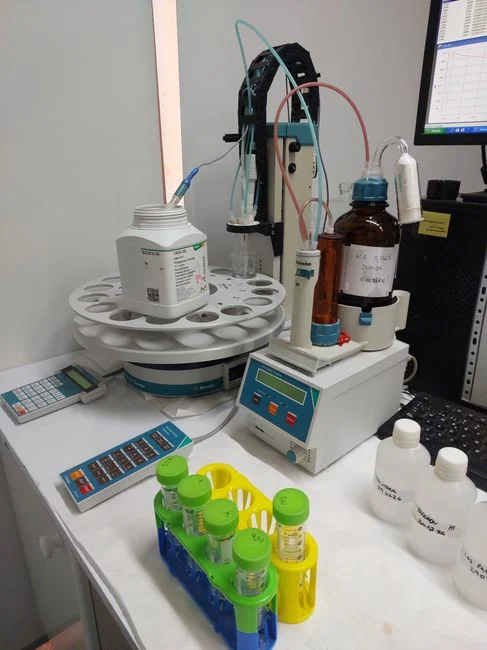
Microbial control must protect the cooling loop and any downstream reuse without creating chemical conflicts in the treatment train. Chlorine dioxide is used for industrial cooling-loop and process-water disinfection; the supplied equipment configurations span 50–20,000 g/h (HydropureWater, 2026). Capacity selection is not a dosage decision: an engineered application rate and residual target are required from the verified chemistry, demand and contact conditions.
The regional reuse benchmark is fecal coliform at or below 1,000 CFU/100 mL, BOD at or below 50 mg/L and turbidity below 1 NTU (HydropureWater, 2026). These are comparison criteria, not confirmed Namangan legal limits. Current local requirements must be obtained in writing for each proposed reuse.
Higher CoC also increases scaling and biological risk above approximately 5–6 CoC without advanced treatment (Genesis Water Tech, 2025). Fouling, microbiologically influenced corrosion and deposits can therefore shorten equipment life even when the WUE metric improves. A chlorine dioxide generator should therefore be integrated with cycle control, chemical inventory and residual monitoring rather than selected as a standalone disinfection box.
Sludge is part of the treatment design, not a disposal afterthought. Dewatering, licensed routing and receiving-facility documentation belong in the permit and procurement package. The plate-frame filter press addresses dewatering duty, while filtration technology such as an ultrafiltration system should be justified by measured suspended solids and downstream fouling risk.
Use online or calibrated measurements for conductivity, pH, suspended solids, flow and disinfection residual. These measurements are needed to close the water balance, report WUE, demonstrate recovery and provide operating evidence for permit compliance. WUE alone does not distinguish consumption from reuse; Genesis Water Tech states that WUE is annual site water usage divided by IT equipment energy (2025).
Build the Namangan Permitting and Procurement Plan in Parallel
The permit pathway and equipment procurement must progress together because missing treatment details can delay both. HydropureWater’s Uzbekistan framework describes environmental-impact scoping through UzNature and water-use or discharge consent through the water-resources authority, with the two submissions required before commissioning (HydropureWater, 2026). The responsible agencies and submission sequence should be confirmed locally rather than copied from the Tashkent case.
The cited regional planning reference gives a 6–10 month total planning duration and $4K–$10K in one-time permit costs (HydropureWater, 2026). These are Tashkent-derived benchmarks, not guaranteed Namangan timelines or fees. They are suitable for preliminary planning only; Namangan’s regulator must confirm the actual route, review sequence and cost.
The engineering package should contain:
- Hydraulic calculations, including measured peak flows and the complete water balance.
- Equipment data sheets, materials, controls and utility requirements.
- Chemical-dosing sequence, storage and safety controls.
- Representative source-water and discharge analyses.
- Reuse assessment defining recipients, quality requirements and operating controls.
- Sludge dewatering, transport and receiving-facility plan.
- Discharge route, receiving-system capacity assessment and monitoring plan.
Early confirmation of sewer or waterbody capacity is critical because cooling blowdown may contain elevated salts, metals, biocides, corrosion inhibitors and altered pH (Water Utility Report, 2026). The Hungarian wastewater-requirements guide illustrates the need to clarify receiving-system limits, while the German wastewater-requirements guide supports treating regulatory verification as a procurement workstream rather than a post-award exercise.
Do not treat the cited SanPiD-equivalent reuse criteria or agency structure as binding in Namangan without current regulatory confirmation. The procurement schedule should contain approval gates for source-water results, discharge consent, reuse acceptance, concentrate routing and sludge handling.
Commission the Site in Five Controlled Stages
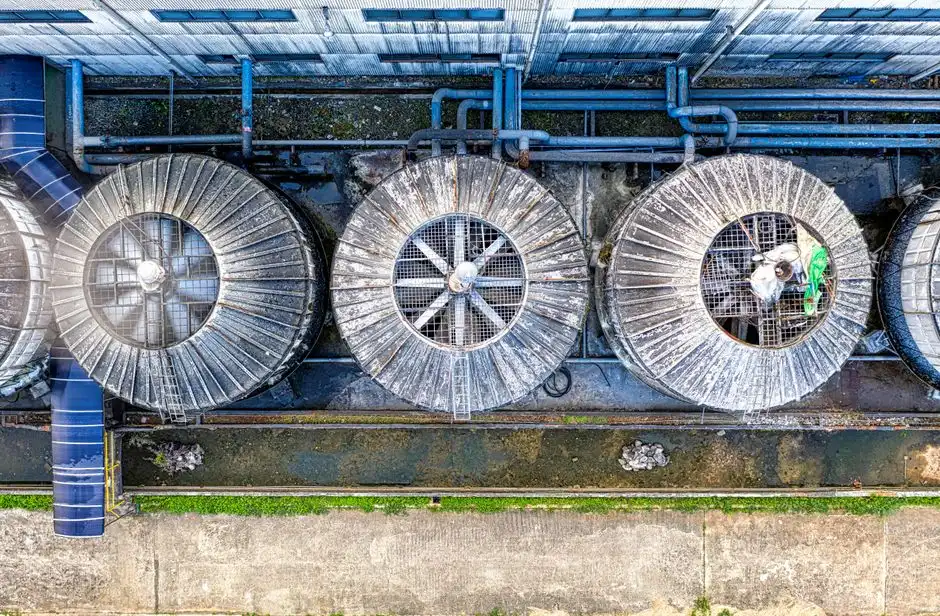
Commissioning should convert assumptions into verified operating evidence rather than demonstrate that purchased equipment can start. Baseline measurement, existing-system optimization and source-water testing come before final process selection; then treatment performance, reuse and compliance are verified at defined control points.
| Stage | Controlled activity | Acceptance evidence |
|---|---|---|
| 1. Establish the baseline | Meter makeup, evaporation, blowdown, drift, sewage and sludge flows; test parameters for each train | Reconciled water balance and representative Namangan analyses |
| 2. Optimize cooling operation | Eliminate unnecessary once-through cooling, tighten blowdown triggers, repair leaks and review chemical programs | Measured reduction in avoidable losses without increased scaling or corrosion |
| 3. Confirm the treatment train | Check source-water results, equipment guarantees, site-specific mass balance and complete sludge route | Approved process design, performance guarantees and documented waste route |
| 4. Perform commissioning tests | Test makeup, cooling, treatment, reuse and discharge points before introducing treated blowdown into the loop | Hydraulic and water-quality results at each control point |
| 5. Verify performance | Measure WUE, recovery, membrane or media performance, disinfection, concentrate handling and reporting | Acceptable operating data tied to the permit and financial model |
Financial approval should be based on total avoided costs, not recovered volume alone. Genesis Water Tech’s cited 3–5 year payback example depends on avoided fines, water costs and other lifecycle costs being included (2025). The Namangan business case must therefore use local water tariffs, confirmed discharge costs, chemical demand, sludge routing, membrane replacement, energy and operator labor. The 2026 cooling-blowdown treatment framework supports staged implementation, while the RO versus alternative wastewater treatment methods guide can inform the final architecture review.
Frequently Asked Questions
What wastewater and cooling blowdown treatment does a data center in Namangan, Uzbekistan need?
It needs separately engineered trains for cooling-tower blowdown, sanitary sewage, boiler or humidification bleed, and makeup-water pretreatment. The final train should follow measured Namangan flows and chemistry, the intended cooling-makeup or other reuse, and a confirmed discharge route. Sanitary sewage requires biological treatment; blowdown requires solids separation and chemistry control; membrane and zero-liquid-discharge stages should be justified by reuse quality and residual-disposal requirements.
How much does wastewater and cooling blowdown treatment cost for a Namangan data center?
The supplied 5–10 MW regional reference ranges are $35K–$60K for DAF with dosing, $220K–$480K for DAF with softener or antiscalant and BWRO, and $1.2M–$3.5M for full ZLD (HydropureWater, 2026). These are not Namangan bids. Request quotations using measured flows, analyses, duty/standby requirements, local civil scope, utility conditions, controls integration, sludge handling, guarantees, delivery schedule and lifecycle-cost assumptions.
What should determine cooling-blowdown equipment sizing?
The primary input is measured blowdown, derived from makeup and the operating cycles of concentration, with evaporation, drift, unmeasured losses and peak factors checked separately. The 1/(CoC−1) relationship gives the ideal blowdown fraction, but Genesis Water Tech reports actual blowdown can exceed theory by 15–30% because of unmeasured losses and emergency discharges (2025). DAF and treatment capacity should therefore follow reconciled field flow and contaminant loading, not nominal IT load alone.
How should a Namangan treatment supplier be selected?
Require evidence of verified capacity at the measured peak duty, Namangan service capability, controls integration, chemical and membrane compatibility, sludge handling, performance guarantees and lifecycle-cost evidence. Also ask for permitted-outlet references, delivery commitments, operator training, spare-parts strategy and the evidence supporting recovery or reuse claims. A compliant process description must be demonstrated, not merely asserted in a proposal.
Can cooling blowdown be reused without ZLD, and when is DAF alone credible?
Yes, but the reuse endpoint controls the required treatment. DAF alone may be credible for a compliant discharge route when it satisfies the confirmed flow, solids and chemical-control duties. Cooling-makeup reuse may additionally require filtration, softening or antiscalant, disinfection and membrane treatment; irrigation reuse requires verified quality and applicable health criteria. ZLD remains a higher-complexity option for prohibited discharge or binding closed-loop requirements. The data center wastewater treatment guide provides a useful comparison structure, but Namangan chemistry and regulation must determine the decision.