What Treatment Does an Álvaro Obregón Data Center Actually Need?
Treatment for a data center in Álvaro Obregón must match the final destination—direct discharge, sewer discharge, on-site reuse or higher-purity reuse—not the generic label “data center wastewater.” Cooling tower blowdown, equipment wash water, cleaning discharges, treatment residuals, stormwater and domestic sewage have different flows, temperatures and contaminants, so they should be characterized and routed separately. At 4 cycles of concentration, cooling blowdown equals 25% of makeup-water volume; at 6 cycles, it equals 20% (Genesis Water Technologies, 2026). The practical sequence is to complete a water balance, sample each stream, confirm the receiving route, reduce waste, then select treatment against measured acceptance criteria.
The Mexico wastewater, discharge, reuse and permit requirements framework must be adapted to the actual site. The 2026 Mississippi Department of Environmental Quality outline identifies cooling tower blowdown, thermal discharges, equipment wash water and indirect discharges to publicly owned treatment works as distinct pathways that may require permit coverage. It also warns that large campuses can place substantial hydraulic and pollutant loads on wastewater systems, particularly when concentrated blowdown or startup and maintenance slug loads are discharged (Mississippi Department of Environmental Quality, 2026).
That U.S. outline is useful for identifying engineering and regulatory risks, but it does not establish Mexican law. The responsible water authority, sewer utility and site conditions in Álvaro Obregón must be consulted to verify source-water quality, sewer capacity, discharge criteria, reuse rules and applicable permits. A treatment train cannot responsibly be specified until those inputs are documented.
Build the Water Balance Before Selecting Equipment
Makeup-water flow, evaporation and blowdown must be measured separately before treatment capacity is selected because the design flow depends on actual operation, not only on IT load. Genesis Water Technologies defines Water Usage Effectiveness (WUE) as annual site water usage divided by IT equipment energy; examples in that 2026 source are 0.47 gal (1.8 L)/kWh and an industry range of 0.47–0.65 gal (1.8–2.5 L)/kWh. These are illustrations, not performance targets for Álvaro Obregón. WUE also does not measure discharge-water quality or distinguish consumption from recoverable discharge.
For an evaporative cooling system, the supplied relationship for blowdown as a fraction of makeup-water volume is 1/(CoC−1). This gives 25% at 4 CoC and 20% at 6 CoC. Moving from 4 to 6 CoC therefore reduces blowdown by 20%, not 50%. The same 2026 source warns that biological and scaling risks increase above 5–6 CoC without advanced treatment, so concentration cannot be raised independently of chemistry and equipment condition.
Preliminary balances should also recognize that actual blowdown may exceed theoretical calculations by 15–30% because of unmeasured losses and emergency dumps (Genesis Water Technologies, 2026). Meter each relevant stream and separate consumptive evaporation from discharge that may be recovered for process uses or advanced cooling makeup.
| Water-balance item | Measurement needed | Engineering use |
|---|---|---|
| Makeup water | Continuous or time-stamped flow metering by source | Establishes withdrawals and the base for the cooling balance |
| Evaporation | Calculated from the water balance and checked against operating data | Defines consumptive loss rather than recoverable discharge |
| Cooling blowdown | Continuous flow and routine operational records | Determines treatment and disposal capacity |
| Wash and cleaning streams | Event-based flow and volume records | Supports segregation and slug-load sizing |
| Final discharge and reuse | Destination, volume and quality by stream | Closes the balance and tests the recovery scenario |
The data center cooling blowdown treatment roadmap and cooling-water chemistry guidance provide transferable process principles. Neither substitutes for a site-specific Álvaro Obregón balance.
Characterize the Contaminants That Control Treatment Design

Cooling blowdown usually contains salt and dissolved solids, while facility wastewater compositions can differ enough that sampling is required rather than assumed (Black & Veatch, 2026). The Mississippi Department of Environmental Quality’s 2026 screening list adds elevated temperature, salts, nutrients, metals, treatment chemicals and emerging contaminants. Those are screening categories, not a substitute for site analysis or Mexican acceptance criteria.
Build a sampling plan around conductivity or total dissolved solids, pH, suspended solids, temperature and every chemical used in the cooling-water program. Use routine samples to establish a baseline, but also sample startup, maintenance, cleaning and emergency events because intermittent washes can create slug loads. The 2026 MDEQ outline specifically warns that contractor cleaning products may be proprietary or variable, making pollutant characterization difficult.
Nitrate is a conditional concern rather than an assumed universal limit. MDEQ states that cooling tower blowdown and other streams may contain elevated nitrate relative to source water under certain conditions, particularly where evaporative cooling, reclaimed water, on-site management or indirect POTW discharge is involved (Mississippi Department of Environmental Quality, 2026). The site analysis must establish whether this pathway applies.
Chemical compatibility also determines whether biological treatment is feasible. Azoles and glutaraldehyde used as biocides may interfere with microbes used at a receiving treatment works, according to MDEQ (2026). Document product type, dose, residual concentration and discharge timing before selecting a biological process or sending water to a sewer utility.
| Measured condition or stream | Decision affected | Treatment implication |
|---|---|---|
| Elevated dissolved solids or conductivity | Sewer acceptance and cooling-makeup reuse | Assess physical removal limits; consider RO only if the reuse target requires desalination |
| Suspended solids, oil, grease or floatable material | Pretreatment and downstream protection | Use physical separation and filtration before sensitive processes |
| High temperature | Direct discharge and utility acceptance | Evaluate cooling or segregation before biological treatment |
| Cooling biocides or other treatment chemicals | Utility acceptance and biological compatibility | Establish residuals, dose controls and possible deactivation or segregation |
| Variable wash and cleaning discharges | Pretreatment sizing and slug control | Segregate streams, equalize where appropriate and define emergency controls |
The water-treatment valves, media and associated parts should therefore be selected only after the chemistry and control strategy are known. The U.S. regulatory discussion is useful for identifying hazards, but applicable Álvaro Obregón obligations must come from the responsible local authorities.
Compare Discharge, Sewer Pretreatment and Reuse Pathways
The preferred pathway depends on the receiving authority’s acceptance conditions, the sewer interceptor’s capacity, the final reuse quality and the reliability required by operations. Black & Veatch’s alternatives framework asks four useful questions: Can the blowdown be discharged directly to a receiving body? Can it enter the local wastewater treatment plant without additional treatment? Is on-site treatment necessary? Can the interceptor handle the proposed flow (Black & Veatch, 2026)? Those questions must be answered with the relevant Mexican authority and utility, not imported from another jurisdiction.
For sewer pretreatment, test hydraulic capacity and operational tolerance for temperature, salinity, solids, chemicals and slug loads. A sewer connection that can accept average flow may still be unsuitable if startup or cleaning events produce incompatible peaks. For direct discharge, obtain the applicable receiving-water, temperature and monitoring requirements before selecting treatment.
Lower-grade reuse can include irrigation, toilet flushing and outdoor equipment washing after the water meets the corresponding quality and operational requirements (Genesis Water Technologies, 2026). These routes need source-specific treatment and user acceptance; they do not establish a disposal route for contaminated wash water. Advanced reuse, including blowdown-to-cooling-makeup, requires lower dissolved solids and therefore warrants RO or an equivalent desalination process only after source chemistry, scaling, recovery and residual treatment have been evaluated.
Multiple facilities in one watershed can collectively create thermal, salinity and wastewater-capacity constraints even when individual permits appear adequate, MDEQ reported in 2026. That is another reason to obtain current local information. The research also identifies regulatory gaps in the United States, which supports closer local verification in Mexico rather than assuming U.S. permit rules apply.
| Route | Acceptance question | Treatment boundary |
|---|---|---|
| Direct discharge | What receiving-body, temperature, salinity and monitoring limits apply? | Determine the required physical, thermal and chemical controls before design |
| Sewer discharge or pretreatment | What flow, slug, temperature, solids and chemical limits will the utility accept? | Install only the pretreatment needed to satisfy written acceptance conditions |
| Low-grade reuse | Can treated blowdown meet the selected use’s water and operational requirements? | Physical separation and filtration may be sufficient, subject to measured quality |
| Advanced reuse | What dissolved-solids concentration and recovery are required? | Evaluate RO or equivalent after scaling and pretreatment analysis |
The location-specific data center wastewater guide illustrates why treatment boundaries must follow local infrastructure and reuse conditions. The Oasco wastewater decision framework offers a transferable way to structure that comparison.
Match Each Unit Operation to Its Actual Job
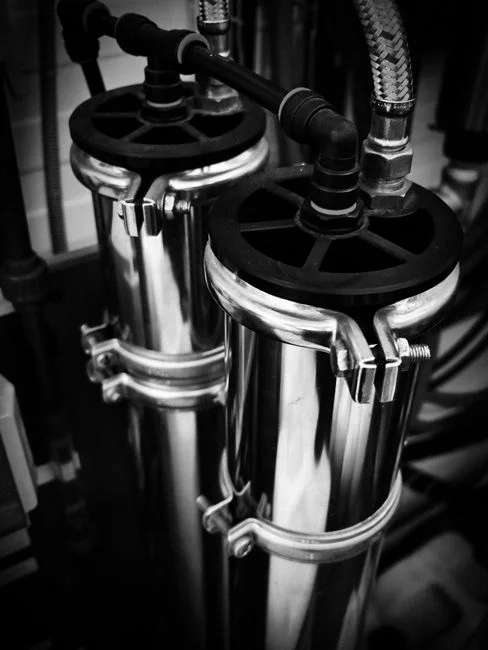
Each treatment technology should solve a defined contaminant or reuse problem; catalog flow ranges establish what equipment is available, not the required capacity for an Álvaro Obregón facility. DAF performs physical separation of suspended solids, FOG, oil and grease, and floatable or colloidal material. The supplied DAF catalog covers 4–300 m³/h across 13 standard models, so flow selection must follow measured stream data. An DAF system for cooling blowdown pretreatment is relevant where floatable contamination must be removed before filtration or biological treatment.
Multi-media filtration handles suspended solids, turbidity and colloidal protection ahead of sensitive equipment, with automated backwash described in the supplied source. UF provides a barrier against bacteria, colloids and suspended solids without chemical addition. The supplied UF system covers 2,000–40,000 L/h, uses 0.03 μm PVDF membranes and accepts turbidity up to 300 ppm. An UF system for wastewater polishing and RO pretreatment should be assessed against actual turbidity, loading and required permeate quality.
RO performs desalination and produces low-dissolved-solids permeate. The supplied catalog reports recovery rates up to 95%, but that figure does not establish site recovery; feed chemistry, scaling, pretreatment and operating controls determine it. MBR combines biological treatment with fine filtration; the supplied catalog covers 10–2,000 m³/day and provides filtration below 1 μm. It is appropriate only where the organic load, biological objective and effluent target justify that treatment and operating capability.
| Unit operation | Actual job | Selection condition |
|---|---|---|
| DAF | Physical removal of suspended solids, FOG, oil, grease and floatable material | Use when measured contaminants justify physical separation |
| Multi-media filtration | Suspended-solids and turbidity removal; protection of downstream equipment | Use as pretreatment or polishing where hydraulic and contaminant loading are established |
| UF | Barrier against bacteria, colloids and suspended solids without chemical addition | Use for polishing or pretreatment subject to feed-water compatibility |
| RO | Desalination and very low-dissolved-solids permeate | Use when the reuse target and source chemistry justify it |
| MBR | Biological treatment plus fine filtration | Use where biological treatment and sub-micron filtration are both required |
| Automatic dosing | Controlled injection of coagulants, flocculants, pH adjusters and specialty chemicals | Use only after control strategy and chemical-compatibility review |
| Sludge dewatering | Management of separated solids | Add after solids generation and mass loading are established |
The supplied dosing system provides PLC-controlled injection, but automation does not remove the need to define chemical compatibility and interlocks. Likewise, a plate-and-frame filter press should be selected only after residual solids production, dewatering performance and disposal are defined.
Implement Blowdown Recovery in Phases
A phased implementation limits the risk of installing advanced treatment before the discharge route and source chemistry are verified. The sequence below converts a water-balance concept into an executable design.
- Measure and characterize. Install flow metering and establish water-quality baselines during normal, startup and maintenance operation. Include wash, cleaning and emergency events.
- Optimize existing systems. Repair leaks, eliminate unnecessary once-through cooling, optimize controls, remove suspended-solids triggers and document emergency-dump practices.
- Reduce and segregate waste. Keep cleaning chemicals and equipment wash streams separate from cooling blowdown unless the selected process is explicitly designed for the combined load.
- Apply physical separation and targeted treatment. Use filtration and, where justified by oil, grease or floatable solids, DAF. Follow with treatment selected for the confirmed reuse or discharge criteria.
- Evaluate advanced integration. Consider blowdown-to-makeup reuse only after source chemistry, recovery, scaling, residual chemicals and operator capability have been validated.
The multi-media filtration approach for pretreatment and RO system for advanced desalination belong at different points in that sequence. Filtration may protect downstream equipment or support a lower-grade use; RO answers a more demanding dissolved-solids specification.
The business case should include avoided total costs—water, wastewater, disposal and chemical impacts—not only a change in WUE. Genesis Water Technologies (2026) makes the same distinction: WUE can look acceptable while a facility continues discharging large volumes of recoverable, contaminated blowdown. An honest baseline therefore separates consumption, discharge and reuse before capital is committed.
Verify Local Requirements and Supplier Scope
Obtain written confirmation from the relevant Álvaro Obregón authorities and sewer utility of the discharge route, applicable criteria, monitoring requirements, capacity constraints and required documentation. The supplied research does not establish site-specific limits or permits for Álvaro Obregón, so assumptions should be recorded as open items rather than embedded in equipment specifications.
Issue a common supplier scope requiring a signed design basis covering stream inventory, measured flow range, source-water chemistry, temperature, cycles of concentration, chemical program, final reuse target, recovery expectation, utilities, controls, commissioning, bypass strategy and operating assumptions. Require bidders to state which guarantees depend on complete analytical data and which permitting obligations remain with the owner.
Ask for a solids and chemical-residual mass balance, plus an O&M concept addressing media or membrane cleaning, sludge handling, chemical storage, monitoring, alarms and critical spares. A PLC-controlled chemical dosing system should be specified only with its control logic, chemical list and compatibility limits. A plate-and-frame filter press should be evaluated only after solids generation and dewatering objectives are established.
Do not accept sizing based only on facility megawatts or WUE. Actual blowdown, discharge and reuse requirements determine treatment capacity; installed capacity should follow the measured design case and include a stated basis for operating uncertainty.
Frequently Asked Questions
How much will cooling blowdown treatment cost for an Álvaro Obregón data center?
There is no defensible price from the supplied research. Request itemized quotations for capital equipment, installation, utilities, chemicals, media or membrane replacement, sludge disposal, monitoring, operator training and maintenance. Compare those costs with the facility’s actual water, wastewater, disposal and chemical expenditures; WUE alone is not a cost baseline.
What flow rate should I use to size a DAF or UF system for cooling blowdown?
Use metered blowdown under normal operation, then identify startup, cleaning and emergency peaks that the selected treatment must manage. The theoretical balance gives 25% of makeup flow at 4 CoC and 20% at 6 CoC, but actual blowdown may exceed theory by 15–30% because of unmeasured losses and emergency dumps (Genesis Water Technologies, 2026). Require the supplier to state its design flow, operating mode and margin basis in writing.
Should the data center discharge blowdown to the municipal sewer or install on-site treatment?
Choose the route only after written utility review of flow, temperature, solids, salinity, chemicals and slug loads. If sewer pretreatment does not provide a reliable acceptance route, compare the cost and operating burden of on-site treatment with the reuse value it creates. Black & Veatch’s 2026 alternatives framework also requires checking interceptor capacity.
Which supplier qualifications reduce the risk of an undersized or noncompliant installation?
Require demonstrated flow and contaminant design cases, source-water chemistry, recovery assumptions, controls, commissioning tests, bypass provisions and O&M support. Verify that permits and utility acceptance remain owner responsibilities unless the supplier can document otherwise. Also request the data center cooling blowdown treatment roadmap as an issue checklist during technical bid evaluation.
When is RO or blowdown-to-makeup reuse justified instead of lower-grade reuse?
RO is justified when the selected reuse requires substantially lower dissolved solids than physical separation and filtration can provide, and the source chemistry supports reliable operation after appropriate pretreatment. For irrigation, toilet flushing or outdoor washing, test lower-grade reuse first if its acceptance criteria are met. Confirm scaling, recovery, residual chemistry, operator capability and total lifecycle cost before selecting advanced reuse.