What Calera Sewer Pretreatment Must Control
Mining and metals plants near Calera generally meet sewer pretreatment requirements by characterizing each wastewater stream, controlling pH, removing suspended solids and metals, and verifying that the resulting effluent meets the applicable sewer authority’s discharge limits before discharge. A practical treatment train may combine screening or solids removal, chemical precipitation, clarification, filtration, and monitoring. LiqTech identifies chemical precipitation, ultrafiltration, and dewatering as relevant treatment stages and reports that ceramic membranes can support low-fouling, low-chemical heavy-metal removal. Because the supplied research contains no verified Calera-specific numerical limits, plants must obtain current permit and sewer-authority requirements rather than assume generic mining-wastewater standards.
The applicable industrial user or pretreatment permit defines the compliance boundary. Sewer pretreatment is not the same as treatment for reuse or for environmental release to surface water; reuse objectives, permitted discharge routes, monitoring requirements, and authorization conditions must be kept separate in the compliance plan.
LiqTech’s mining-wastewater guidance identifies harmful organic compounds, heavy metals, other metals, metalloids, and suspended material as constituents that may require attention. These categories are screening priorities, not a substitute for site analysis. The supplied research does not provide a Calera-specific numerical limit set, so the permit basis must be confirmed directly with the receiving sewer authority and applicable regulators.
Characterize process, contact, cooling, wash, and stormwater streams separately. Their contaminant profiles, flow patterns, permitted routing, and monitoring obligations may differ, and combining them before characterization can conceal both the highest load and the lowest permitted discharge condition. A mining wastewater pretreatment strategy for Sassafras plants provides a useful reference for structuring that stream-by-stream review, but it does not establish Calera’s local limits.
Build a Wastewater Characterization and Compliance Plan
The permit basis cannot be designed until the plant can show what will enter the sewer, how it varies, and how compliance will be measured. Start with a written compliance plan rather than an equipment datasheet.
- Define each discharge stream. Document its source, destination, operating condition, and whether it is continuously generated, intermittent, or event-driven.
- Develop a representative analytical dataset. Cover flow rate, flow variability, operating schedule, pH, suspended solids, target metals, oil and grease where present, and process-specific contaminants.
- Separate normal and non-routine flows. Keep routine production data distinct from startup, shutdown, upset, tank-cleaning, and rainfall-driven events.
- Confirm the authorization conditions. Obtain the sewer authority’s analytical methods, monitoring frequency, averaging basis, reporting requirements, connection conditions, and authorized discharge points.
- Calculate pollutant loading. Compare mass loading rather than concentration alone, because the same concentration at a higher flow represents a greater pollutant load.
Representative sampling should span production cycles rather than rely on one grab sample. The evidence must describe the wastewater actually sent to the sewer, including variability and non-routine operations. Where treatment operates continuously while sewer discharge is intermittent, document how the system responds during unequal-flow conditions and how off-specification water is contained.
| Design input | Evidence a bidder should receive | Why it affects treatment selection |
|---|---|---|
| Flow | Representative operating, peak, startup, shutdown, cleaning, upset, and stormwater flows | Determines hydraulic capacity, equalization needs, chemical-feed capacity, and solids-handling rate |
| Wastewater quality | Cycle-based analyses for pH, suspended solids, target metals, oil and grease where present, and relevant process contaminants | Establishes the contaminants that must be removed and the required separation duty |
| Permit basis | Current industrial user or pretreatment conditions, analytical methods, averaging rules, monitoring frequency, and reporting requirements | Defines the compliance target separately from reuse or general equipment-performance goals |
| Routing | Approved discharge point, permitted streams, bypass conditions, and notification requirements | Prevents a treatment proposal from assuming an unauthorized connection or routing path |
| Solids handling | Expected solids generation, dewatering method, disposal route, and available footprint | Connects liquid treatment performance to the complete operating and sludge-management chain |
The San Antonio petroleum-plant sewer pretreatment approach illustrates the value of organizing characterization around permit obligations, although it does not replace Calera-specific confirmation.
Follow the Treatment Path from Collection to Discharge
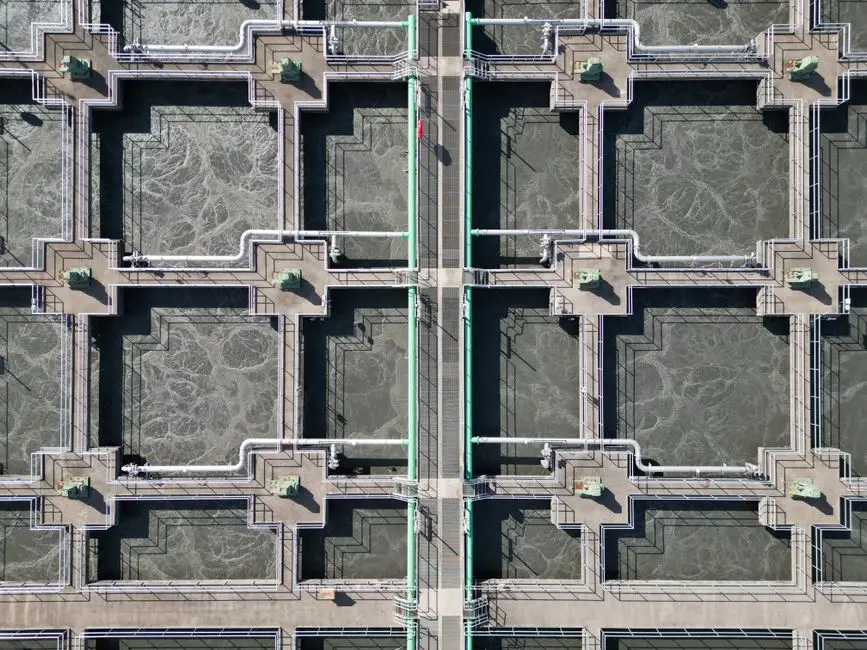
A defensible treatment train links each contaminant to a specific removal or control stage and then ends at an authorized monitoring point. Missing links between solids removal, metal control, polishing, and monitoring should be identified before equipment procurement.
- Collect and protect the system. Use coarse screening or solids control before downstream pumps, valves, membranes, and chemical-feed equipment where the wastewater contains suspended material.
- Control pH. Adjust pH where required for chemical reactions, precipitation, or downstream process protection.
- Remove dissolved metals where necessary. Use chemical precipitation when the objective requires dissolved metals to be converted into a separable form. LiqTech lists chemical precipitation within its complete mining-water-treatment scope.
- Separate generated solids. Use clarification or flotation to remove precipitated solids or buoyant material.
- Apply polishing when justified. Use filtration or membrane treatment where the permit, process specification, or reuse objective requires additional solids control.
- Manage treatment solids. Route sludge to dewatering or another controlled solids-management process; LiqTech includes dewatering in its integrated mining-treatment scope.
- Monitor and authorize the discharge. Confirm that the final outlet is the permitted connection and that monitoring and reporting match the applicable authorization.
HydropureWater’s DAF systems are published for flow rates from 4–300 m³/h across 13 standard models and are designed to address suspended solids, oil and grease, FOG, and colloidal matter. Its UF systems are published at 2,000–40,000 L/h, use 0.03 micron PVDF membranes, accept feed turbidity up to 300 ppm, and provide automatic backwash and air scour. These are equipment-selection inputs, not proof that a proposed configuration will meet a Calera permit.
| Treatment stage | Primary compliance function | Equipment questions to resolve |
|---|---|---|
| Collection and screening | Removes coarse material and protects downstream treatment | What screen or solids-control duty matches the stream, and where do captured solids go? |
| pH adjustment and chemical precipitation | Creates conditions for dissolved metal removal | Which metals require control, what chemicals are permitted, and how is dose established from site data? |
| Clarification or flotation | Separates precipitated or buoyant solids | How are hydraulic and solids-loading conditions verified? |
| Filtration or membrane polishing | Controls residual suspended solids for the specified objective | What pretreatment, cleaning, monitoring, and replacement requirements apply to the actual feed? |
| Dewatering and solids management | Controls the residue generated by liquid treatment | What is the expected residual volume and the authorized handling route? |
| Final monitoring | Produces evidence at the permitted discharge point | Does the sampling protocol match the permit’s method, frequency, and averaging basis? |
Specific components should be evaluated against the design basis, including a rotary mechanical bar screen, a PLC-controlled chemical dosing system, a high-efficiency sedimentation tank, and a plate-frame filter press.
Choose the Treatment Train by Discharge Objective
Select equipment by the contaminant duty, discharge objective, available footprint, and operating conditions—not by a generic package description. For suspended-solids and colloidal removal, compare DAF, lamella clarification, multimedia filtration, and MBR duties against the characterized wastewater and site constraints.
HydropureWater’s lamella clarifiers combine sludge recirculation, flocculation, and inclined-plate separation in one compact unit. Their published surface loading rates are 20–40 m/h, and the manufacturer states that the design can reduce chemical consumption by up to 30%. Those figures require confirmation against the proposed wastewater, operating schedule, and selected flow.
For high-solids mine water, the integrated JY mine-water treatment system combines coagulation, flocculation, sedimentation, filtration, and automatic backwash in one compact unit. Its published capacity is 10–200 m³/h, with a surface-water turbidity application stated as up to 3,000 mg/L to below 3 mg/L. Because that range is explicitly associated with surface water, it should not be represented as proof of performance for every mining-wastewater stream or sewer permit.
For recovery objectives or flows requiring biological treatment, HydropureWater’s integrated MBR wastewater treatment system combines activated sludge with submerged PVDF membrane filtration. Its published capacity is 10–2,000 m³/day, with effluent below 1 μm. A multimedia filtration system may instead suit the solids-removal duty and operating envelope; the correct comparison depends on the required effluent, site data, and treatment objectives.
| If the primary objective is… | Evaluate… | Selection evidence required |
|---|---|---|
| Suspended-solids or colloidal removal | DAF, lamella clarification, multimedia filtration, or MBR | Characterized feed, hydraulic and solids loading, footprint, chemical use, sludge handling, and final-effluent objective |
| Dissolved-metal control | pH adjustment with chemical precipitation followed by solids separation | Target metals, precipitation chemistry, solids separation, residual monitoring, and permit limits |
| Water recovery or biological treatment | MBR or another defined biological and membrane process | Biodegradability, feed characterization, membrane fouling controls, cleaning, reuse criteria, and monitoring |
| Wastewater reuse rather than sewer discharge | Treatment train selected to the reuse specification | End-use water quality, variability, recovery objectives, and confirmation of any remaining sewer or regulatory obligations |
Do not select a membrane from nominal pore size alone. Compare feed quality, fouling tendency, chemical exposure, cleaning strategy, required pretreatment, and the stated discharge basis. Equipment performance claims do not replace permit-specific verification or documented compliance monitoring.
Validate Compliance Before and During Sewer Discharge
Commissioning converts the treatment design into operating evidence. Test each relevant unit for flow balance, pH control, solids removal, chemical dosing, alarm response, and final discharge sampling. A wet commissioning exercise is not enough if it does not reproduce the characterized wastewater or the conditions under which non-routine flows can occur.
Set operating ranges and alarm limits from the approved design, the receiving sewer authority’s requirements, and measured plant performance. Generic equipment defaults are not a substitute for project-specific control limits. Where a result depends on dose, verify the chemical-feed system under the flow and operating conditions expected during the permit’s monitoring window.
Retain the records needed to reconstruct compliance decisions:
- Sampling records and laboratory results;
- Instrument calibration and calibration-verification records;
- Chemical-use and dosing records;
- Equipment operating logs, alarms, and deviations;
- Corrective-action records and return-to-service evidence; and
- Permit correspondence, authorization conditions, and approved operating procedures.
Prepare a bypass analysis for upset, power failure, and high-flow conditions. It should identify isolation points, containment provisions, automatic actions, operator response, and whether notification is required. If a bypass could reach the sewer, the operating plan must make that consequence explicit rather than treating bypass as an equipment-protection detail.
LiqTech’s integrated PLC and HMI solutions can monitor and control a mining-water treatment process, and its systems can be cloud-enabled for remote monitoring. These are examples of operating-control capabilities, not evidence that a particular Calera installation will provide compliant discharge. The treatment valves and filter-media selection considerations also remain relevant to maintaining the intended hydraulic and filtration performance.
Control Implementation and Supplier Risk
The lowest capital bid can carry the highest compliance risk if it leaves the permit basis, sludge route, operating envelope, or testing responsibility unresolved. Require each bidder to define the design basis and the boundaries of its guarantee before comparing proposals.
Ask bidders to state the characterized flow and wastewater basis, pretreatment assumptions, treatment objectives, guaranteed operating conditions, performance criteria, and responsibility for permit support. Also require a complete operating balance covering chemical consumption, sludge yield, maintenance access, instrumentation, controls, utilities, and residuals. A package that omits feed characterization, sludge handling, or monitoring should not be evaluated as a complete pretreatment proposal.
Confirm that the proposed process was matched to the wastewater rather than copied from a generic package-plant scope. LiqTech reports more than two decades of experience developing customized mining wastewater solutions and provides installation, peripheral equipment, PLC/HMI integration, and optional cloud-enabled remote monitoring. Those capabilities are useful supplier-evaluation dimensions, not universal procurement requirements or proof that any bidder will meet the project’s permit.
Before award, obtain a written spare-parts and consumables plan, including membrane or media replacement criteria, warranty scope, technical-support responsibility, and commissioning plan. Use the industrial wastewater ETP and DAF selection guide as a bid-review reference for matching technology to wastewater and site constraints; it does not provide a Calera price or local permit standard.
| Bid item to require | Acceptable response | Procurement risk if omitted |
|---|---|---|
| Design basis | Traceable flow, wastewater-analysis, permit, and operating-schedule inputs | Equipment may be oversized, undersized, or unsuitable for the actual stream |
| Performance criteria | Defined conditions, test methods, sampling points, and acceptance procedure | Disputed performance and unclear compliance responsibility |
| Control and alarms | Instrument list, control narrative, alarm setpoint basis, and fail-state behavior | Operator cannot maintain the required operating condition |
| Sludge and residual management | Generation basis, collection method, dewatering, storage, and disposal route | Treatment creates an unmanaged solid-waste stream |
| Documentation and training | Manuals, as-built drawings, procedures, training plan, and commissioning records | Facility cannot operate or demonstrate the system after handover |
| Permit and schedule allocation | Named deliverables, responsible party, dates, and acceptance criteria | Authorization or commissioning delay becomes the owner’s unmanaged risk |
| Lifecycle support | Spares, consumables, warranty, service response, and technical support | Long-term performance and operating availability remain uncertain |
Include a contract schedule for permit support, sampling, operator training, documentation, and performance testing. Require those deliverables to be tied to payment, acceptance, or both. The metals-plant sewer pretreatment approach near Stuarts Draft provides another comparison point for structuring project questions, not a substitute for Calera authority requirements.
Frequently Asked Questions
How much does a mining or metals pretreatment system near Calera cost?
The supplied research provides no local project cost figure, so a defensible price cannot be quoted. Request a bid based on characterized flow, analytical results, permit basis, treatment objectives, utilities, footprint, chemical consumption, sludge handling, controls, commissioning, and documentation. Require bidders to state exclusions and assumptions so equivalent scopes can be compared.
Which treatment process is best for metal-bearing wastewater near Calera?
No single process is universally best. pH control and chemical precipitation may be required for dissolved metals; clarification, flotation, or filtration then removes the separated solids. Permit-specific polishing and compliance verification follow. Equipment selection should also reflect flow variability, other contaminants, reuse objectives, and the available solids-management route.
How should a plant size a pretreatment system for variable mining flows?
Size the system against characterized operating and peak conditions, including startup, shutdown, cleaning, upset, and relevant stormwater flows—not average flow alone. Ask each bidder to state which flow condition controls hydraulic capacity, chemical dosing, treatment capacity, and sludge handling, and whether equalization is included.
What should a wastewater-equipment supplier provide to reduce permit-compliance risk?
Require a stated design basis, project-specific performance criteria, control and alarm functions, commissioning and test protocol, sampling support, documentation, sludge-management plan, and clear allocation of permit responsibilities. Also require the bidder to identify what it will not guarantee, because that boundary should be reviewed before the contract is signed.
Can treated mining water be reused instead of discharged to the sewer?
LiqTech states that properly designed mining wastewater treatment can support recycling. Whether reuse is appropriate depends on the end use, treatment objective, site conditions, and applicable obligations. Confirm any remaining sewer-discharge requirements with the receiving authority and applicable regulators rather than assuming reuse eliminates authorization requirements.