What MABR Changes at a University Campus
MABR can suit university campus wastewater when the objective is compact biological treatment, efficient aeration, nutrient removal, or retrofitting an existing activated-sludge plant. It transfers oxygen through membranes directly to a fixed nitrifying biofilm while denitrification occurs in surrounding anoxic liquid. University of Michigan modeling reported a hybrid MABR system operating at one-third the cost and one-third the size of conventional treatment. Fluence separately reports up to 90% aeration-energy savings for certain packaged systems and up to 30% total plant energy reduction for its SUBRE retrofits. These figures are source- and project-specific, not guaranteed results; campus feasibility still depends on flow, load, temperature, discharge limits, footprint, and existing infrastructure.
A membrane aerated biofilm reactor changes how a biological reactor receives oxygen. As Fluence and the University of Michigan explain, a nitrifying biofilm develops on gas-permeable membrane surfaces. Oxygen passes through those membranes to the attached bacteria, while denitrification occurs in the surrounding anoxic bulk liquid. This “bubbleless” transfer differs from conventional bubble-diffuser aeration, where oxygen bubbles rise through mixed liquor and transfer oxygen as they move through the tank.
The distinction matters because MABR does not eliminate the broader activated-sludge treatment train. It does not replace screening, flow equalization, solids separation and management, disinfection where required, or discharge monitoring. It also does not, by itself, prove that a campus has sufficient carbon, anoxic volume, mixing, or solids inventory for complete biological nutrient removal.
A campus evaluation becomes credible when the trigger is specific: constrained construction space, an existing plant approaching capacity or effluent limits, difficult access for new basins, variable academic occupancy that destabilizes loading, or a sustainability objective focused on aeration energy. The underground package sewage treatment plant option becomes relevant when minimizing above-ground construction is central, while upstream mechanical screening remains part of the complete treatment train.
For MABR design assessment for industrial wastewater, the same evidence discipline applies: distinguish the biological mechanism from the wider treatment objective, then test claims against the actual wastewater and receiving route.
Campus Wastewater Inputs That Decide MABR Suitability
The decisive MABR inputs are campus-specific flow and load records, the receiving route, the required treatment objectives, and the physical constraints of the site. No supplied source establishes a universal campus flow profile, so an engineering brief should request measured data rather than infer demand from enrollment or building occupancy alone.
Hydraulic monitoring should distinguish average flow, peak flow, peak-day load, and instantaneous peak. Academic buildings can generate demand linked to class changes, laboratories can discharge variable contaminant loads, and residential facilities operate differently during weekends, holidays, and academic terms. Stormwater and infiltration can distort both flow and load if the collection system is not separately characterized.
Wastewater characterization should cover COD/BOD, ammonia, total nitrogen, phosphorus, suspended solids, temperature, pH, and toxicity. Laboratory, dining, laundry, boiler, cooling, and other non-domestic discharges need separate identification and metering where they could affect loading or treatment compatibility. The receiving route and applicable discharge or reuse requirements must be defined before selecting MABR; the supplied research does not establish a universal regulatory limit for university campuses.
| Engineering input | Evidence required for the MABR brief | Decision affected |
|---|---|---|
| Hydraulic profile | Diurnal, seasonal, academic-term, weekend, storm, and infiltration data; average flow, peak flow, peak-day load, and instantaneous peak reported separately | Reactor sizing, equalization, redundancy, and phased capital delivery |
| Wastewater characterization | COD/BOD, ammonia, total nitrogen, phosphorus, suspended solids, temperature, pH, toxicity, and separately metered non-domestic streams | Process configuration, nutrient-removal scope, pilot conditions, and discharge compliance |
| Receiving route and objectives | Applicable discharge or reuse requirements, plus reuse, energy, N2O, and residual-solids goals | MABR, MBR, or conventional activated-sludge selection |
| Site and constructability | Footprint, access, utilities, blower provision, electrical supply, odor and noise limits, and outage or phased-construction constraints | Retrofit feasibility, equipment arrangement, delivery sequence, and lifecycle cost |
Footprint assessment must include permanent installation and maintenance access. The project brief should also establish electrical supply, blower duty, utilities, odor controls, noise limits, and whether construction can proceed while the facility remains in service. If chemical dosing or solids separation is required, candidate equipment such as an automatic chemical dosing system or dissolved air flotation equipment should be evaluated within the complete process rather than treated as MABR accessories.
Energy and carbon goals should be stated separately. Stanford’s N2O-recovery pilot is a specialized reference for carbon recovery, not a baseline requirement for ordinary campus sewage treatment.
Choose Between a Campus MABR Retrofit and a New Treatment Plant
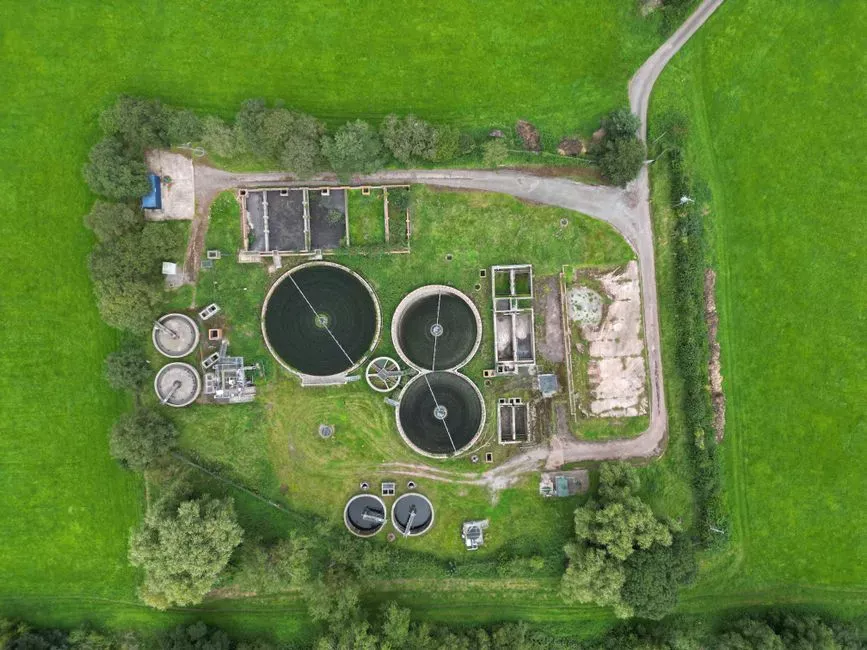
Fluence’s SUBRE retrofit is the stronger starting point when the university already operates a conventional aerobic plant and needs more capacity, lower energy use, or improved effluent quality. The retrofit path depends on compatible basin geometry and process conditions; it is not simply a drop-in equipment purchase.
Fluence states that SUBRE modules can be submerged in existing chambers, introduced one basin at a time, and installed at basin depths of 1.5–6 m (5–20 feet). The company also reports improved effluent quality in one to three weeks and up to a 30% decrease in overall plant energy use following retrofit. These are vendor-reported results and should not be transferred directly to a university without comparable operating conditions and acceptance testing.
The supplied Fluence material contains an unresolved capacity discrepancy. One passage gives SUBRE basin coverage as 2,000–100,000 m³/d and converts that range to 0.5–22 MGD; another gives 2,000–100,000 m³/d and converts it to 0.5–25 MGD. Because the metric and flow values do not agree, the supplier should reconcile the conversion and identify the design basis behind the upper limit. Silently normalizing it would create procurement risk.
| Decision factor | Existing-plant retrofit | New packaged or campus treatment plant |
|---|---|---|
| Primary rationale | Add treatment capacity, improve effluent quality, or reduce energy demand within an existing aerobic plant | Replace inadequate assets, meet a constrained site plan, or establish a new decentralized treatment route |
| Supplier-described configuration | Fluence SUBRE towers submerged in existing chambers; installation one basin at a time | Fluence Aspiral capacities start at 20 m³/d depending on effluent requirements and design temperature, with several containers connectable in tandem |
| Principal risks | Basin compatibility, anoxic-volume loss, mixing, biomass inventory, hydraulic residence time, construction disruption, and single-point maintenance | Collection-system tie-ins, footprint, utilities, phased delivery, redundancy, and operator capability |
| Evidence to require | Installed-basin geometry, process simulation, blower duty, commissioning sequence, site-specific energy model, and outage plan | Campus hydraulic and load basis, treatment guarantees, module arrangement, testing protocol, and phased commissioning plan |
For either route, require the supplier to explain how the module arrangement preserves mixing, biomass solids inventory, anoxic volume, hydraulic residence time, and redundancy during maintenance. Retrofitting a full plant without maintaining permit compliance is not an acceptable delivery strategy.
The University of Chicago trial citation should not support this decision. The supplied DOI for that trial returned a 404 page in 2026, so it is unusable as evidence of campus suitability or performance. If an equivalent Chicago study is relevant, require the supplier or university to provide a working bibliographic reference and the underlying report before it enters the decision record.
For decentralized or phased installations, an integrated MBR membrane bioreactor may be relevant when solids separation is central. Any comparison should occur alongside a process-specific MBR membrane module evaluation rather than treating MABR and MBR as interchangeable equipment.
Compare MABR, MBR, and Conventional Activated Sludge
MABR, MBR, and activated sludge should be selected against the campus treatment objective and available infrastructure. MABR is not universally superior: it changes the aeration mechanism, MBR changes solids separation, and conventional activated sludge may remain the lowest-risk baseline where its basins, aeration system, and operating history are adequate.
In MABR, membranes deliver oxygen to an attached nitrifying biofilm. In MBR, membranes primarily separate solids from treated liquid. An MBR therefore becomes attractive when solids separation, near-reuse-quality effluent, or a compact integrated biological treatment train is central to the project. HydropureWater specifies capacities from 10 to 2,000 m³/day for its integrated MBR system; those stated capacities are product specifications, not evidence of campus-wide effluent performance.
The strongest MABR comparison available in the supplied academic material is a University of Michigan model of a hybrid MABR system. The university reported one-third the cost, one-third the size, and greater nitrogen-removal ability than traditional treatment in 2021. Because these were modeling results for a hybrid configuration, they are not direct product guarantees and should not be applied to a campus without matching flow, load, process, and cost assumptions. The broader MBR versus conventional activated sludge assessment also illustrates why treatment objectives and wastewater characteristics must precede technology ranking.
| Selection criterion | MABR | MBR | Conventional activated sludge |
|---|---|---|---|
| Primary membrane function | Transfers oxygen to an attached nitrifying biofilm | Separates solids from treated liquid | No membrane in the conventional baseline |
| Best fit for the campus decision | Aeration efficiency, biological nutrient removal, compact biological treatment, or an activated-sludge retrofit | High-quality solids separation, reuse-oriented treatment, or a compact integrated train | A site with proven operations, available basin volume, and no compelling footprint or retrofit constraint |
| Evidence limitation | Vendor energy claims and academic hybrid-system modeling are not universal guarantees | Performance and lifecycle conclusions depend on feed, membrane design, controls, and solids handling | A familiar baseline can still face aeration, footprint, construction, and nutrient-removal constraints |
| Lifecycle variables to compare | Energy, chemicals, module or membrane replacement, biofilm management, labor, redundancy, downtime, phasing, and residual sludge handling | Energy, chemicals, membrane replacement, labor, redundancy, downtime, construction phasing, and residual sludge handling | Energy, chemicals, aeration maintenance, labor, redundancy, downtime, construction phasing, and residual sludge handling |
Fluence’s claim of up to 90% aeration-energy savings applies to its small- to medium-capacity MABR systems and compares aeration with conventional plants. It is not a campus-wide or whole-plant guarantee. A defensible comparison should therefore price the same boundary for each route: aeration alone for a blower comparison, total plant energy for a broader comparison, and whole-life cost for the investment case.
Residual solids handling must remain in the comparison, including the role of plate-frame filter presses where solids dewatering is part of the campus service chain. A packaged treatment approach can be evaluated through the packaged sewage treatment plant selection framework, but campus occupancy and discharge requirements still govern the decision.
Pilot, Design, and Procurement Checklist
A defensible MABR project starts with a wastewater characterization and hydraulic profile, not campus population alone. The university should issue a common data template to every bidder so hydraulic averages, peak flows, loads, temperatures, treatment objectives, site constraints, and acceptance criteria can be compared on the same basis.
- Establish the design basis. Record average flow, peak flow, peak-day load, instantaneous peak, seasonal and academic-term variation, wastewater constituents, non-domestic streams, receiving route, and applicable discharge or reuse requirements.
- Define pilot acceptance criteria in advance. Address flow, COD removal, ammonia and total-nitrogen performance, phosphorus where applicable, temperature range, startup time, biofilm stability, and energy consumption. Do not allow the supplier to set acceptance limits after the pilot.
- Map the complete nutrient-removal process. An MABR alone does not establish complete biological nutrient removal. The design must address anoxic mixing, carbon availability, solids separation, and the handling of residual biomass.
- Classify every performance claim. Require bidders to label each value as modeled, independently measured, vendor reported, or obtained from a comparable installation, with the operating conditions attached.
- Require operational and commercial detail. Ask for installation drawings, basin compatibility, blower duty, controls, module or membrane warranties, replacement terms, remote monitoring, operator training, and service-response commitments.
- Protect campus operations. Require a campus-scale outage plan, phased commissioning sequence, permit-compliance controls, and a strategy for keeping essential services online.
Stanford’s pilot provides a useful evidence-classification example. Stanford reported that its pilot treated 4,320 gallons of secondary effluent per day, recovered more than 99% of N2O, and operated at approximately 0.06 kWh/m³. Because it addressed specialized N2O recovery rather than conventional campus sewage treatment, those results cannot serve as baseline MABR performance.
Equipment interfaces remain part of the procurement scope. The university should identify any UV disinfection requirements and clarify included treatment valves, media, and replacement parts rather than accepting incomplete vendor scope.
Frequently Asked Questions
How much does MABR cost for a university campus wastewater project?
No universal campus price can be stated from the supplied research. Request a life-cycle cost quote that separates design, equipment, civil work, utilities, controls, installation, commissioning, energy, chemicals, module or membrane replacement, labor, redundancy, and residual-sludge handling. Also require the quote to identify which performance values are modeled, measured, or vendor reported, because the University of Michigan’s one-third cost result was specific to a modeled hybrid system.
Should the university retrofit an existing activated-sludge plant or install a new MABR system?
Evaluate the retrofit first if the existing basins are compatible, the aeration process is sound, construction cannot be accepted at a greenfield site, and the objective is additional capacity, lower energy use, or improved effluent quality. Choose a new plant if the existing asset lacks adequate basin volume or reliable operation, phased deployment is required, or the site plan favors packaged or underground treatment. Require a site-specific comparison rather than relying on either route by default.
How should MABR capacity be sized for a campus with residential and academic buildings?
Size from measured hydraulic and load data, not annual population alone. Keep average flow, peak flow, peak-day load, instantaneous peak, academic-term variation, weekends, residential use, and storm or infiltration effects separate. The supplier should demonstrate how the proposed arrangement provides redundancy and preserves treatment during maintenance.
What evidence should be requested from an MABR supplier before selecting equipment?
Request test data, references with comparable wastewater and operating conditions, the engineering basis for every performance claim, installation details, blower and control requirements, warranty and replacement terms, operator training, remote monitoring, service commitments, and a campus-scale phased outage plan. Reconcile conflicts in published capacity or conversion data during qualification rather than accepting them as procurement assumptions.
Does MABR alone provide complete biological nutrient removal?
No. MABR supplies oxygen to a fixed nitrifying biofilm, while denitrification occurs in surrounding anoxic liquid. Complete biological nutrient removal also depends on carbon availability, mixing, anoxic volume, solids separation, and hydraulic residence time. Pilot the whole treatment train against defined ammonia, total-nitrogen, phosphorus, and effluent-quality criteria.