
Which domestic sewage treatment system fits a Cameroonian site?
Domestic sewage treatment in Cameroon should be selected from the receiving environment and reuse endpoint first, then verified against local hydraulics and loads, and finally tested against land, power, odor, sludge-management and lifecycle-cost constraints. For environmental discharge, the underground WSZ package sewage treatment plant provides an integrated A/O reference, while the MBR membrane bioreactor for reuse-grade effluent is the relevant high-grade option. This is a community-scale procurement framework, not a housing-only equipment guide.
Domestic sewage treatment means the collection, biological treatment, solids separation, disinfection and compliant disposal or reuse of wastewater from households and domestic facilities. The correct route is not determined by the lowest equipment price. A permit application that cannot demonstrate the required effluent quality, or an operating plan that leaves sludge disposal unresolved, is incomplete.
| Route | Most suitable project basis | Buyer’s primary check |
|---|---|---|
| Septic tank plus intermittent sand filter | Lower-capital site where effluent performance can be verified for the stated load and discharge endpoint | Obtain demonstrated BOD, COD, TSS and disinfection performance before accepting the route |
| A/O biological contact oxidation | Conventional environmental discharge with a packaged, relatively compact installation | Confirm anoxic and aerobic stages, clarification, disinfection, equalization, power resilience and sludge withdrawal |
| MBR | Near-reuse-quality effluent or a compact footprint is required | Define the end-use specification and require membrane, pretreatment and disinfection guarantees |
| Constructed wetland or vermifiltration | Decentralized operation with lower specialist-expertise requirements | Obtain site-specific performance evidence and verify land, climate and residual-sludge arrangements |
The verified WSZ catalog describes a single buried package combining anoxic/aerobic biological contact oxidation, sedimentation and disinfection, with automated operation and a capacity range of 1–80 m³/h. For comparison, the verified MBR catalog specifies submerged PVDF membranes below 1 μm, a 10–2,000 m³/day range and an approximately 60% smaller footprint than conventional systems. Those catalog attributes narrow the shortlist; they do not establish compliance for a particular site.
Apply the decision rule in sequence: receiving environment and reuse purpose; measured flow and load; footprint and geotechnical conditions; power and operator requirements; odor and residual-sludge handling; then lifecycle cost. A Cameroon reuse precedent reinforces that endpoint: a study at the Cité-Verte wastewater treatment plant in Yaoundé found that contaminants remained in treated water and that additional treatment was required before reuse for toilet flushing (Treatment and Reuse of Domestic Wastewater, Science Publishing Group, 2025-11-02).
What compliance baseline should the design target?
MINEE Decree 2023-001 provides a concrete environmental-discharge baseline for the procurement specification: BOD below 30 mg/L, COD below 50 mg/L, TSS below 30 mg/L and pH 6–9 (HydropureWater, Residential Wastewater Treatment in Cameroon: 2026 Engineering Guide, 2025). These are discharge targets, not a complete reuse specification.
The receiving authority and the proposed reuse must agree on additional requirements. Do not assume that meeting the environmental-discharge baseline automatically makes water suitable for irrigation, toilet flushing, landscaping or another non-discharge use. The reuse assessment should identify the end use, exposure pathway, public-health controls, monitoring requirements and who accepts responsibility for water quality.
Chlorine or UV is the principal disinfection approach referenced in HydropureWater’s discussion of MINSANTE Decree 2024-042, which covers hospital and food-processing effluents. HydropureWater further states that a development containing a school, clinic or market may be expected to include disinfection. Where disinfection is required, buyers can evaluate a UV disinfection system or an on-site chlorine-dioxide generator, but selection must follow the agreed process and permit conditions rather than the equipment list alone.
| Design or submission item | Minimum information to request |
|---|---|
| Environmental discharge | BOD below 30 mg/L, COD below 50 mg/L, TSS below 30 mg/L and pH 6–9 under MINEE Decree 2023-001 |
| Reuse | Authority-agreed end-use quality, monitoring and application controls; the environmental-discharge baseline is not automatically sufficient |
| Disinfection | Defined technology, dose or performance condition, contact arrangement, residual controls where applicable and commissioning evidence |
| Laboratory evidence | Influent and effluent test reports from an ISO 17025-accredited laboratory |
| Submission drawings | Process schematic, hydraulic profile, site layout, sampling points and discharge or reuse connection |
| Operation | Maintenance plan and operator training records |
| Performance evidence | Tests across the proposed project’s influent envelope and stated discharge or reuse endpoint |
The submission package identified in HydropureWater’s Cameroon residential guide comprises ISO 17025-accredited influent and effluent test reports, schematics, a maintenance plan and operator training records (HydropureWater, 2025). Ask each supplier to state exactly how its proposed equipment was tested across the project’s stated influent envelope and endpoint. Generic statements that a unit is “designed for municipal wastewater” do not demonstrate that it can treat the proposed load while meeting the applicable discharge or reuse specification.
How should domestic sewage flow and load be sized?
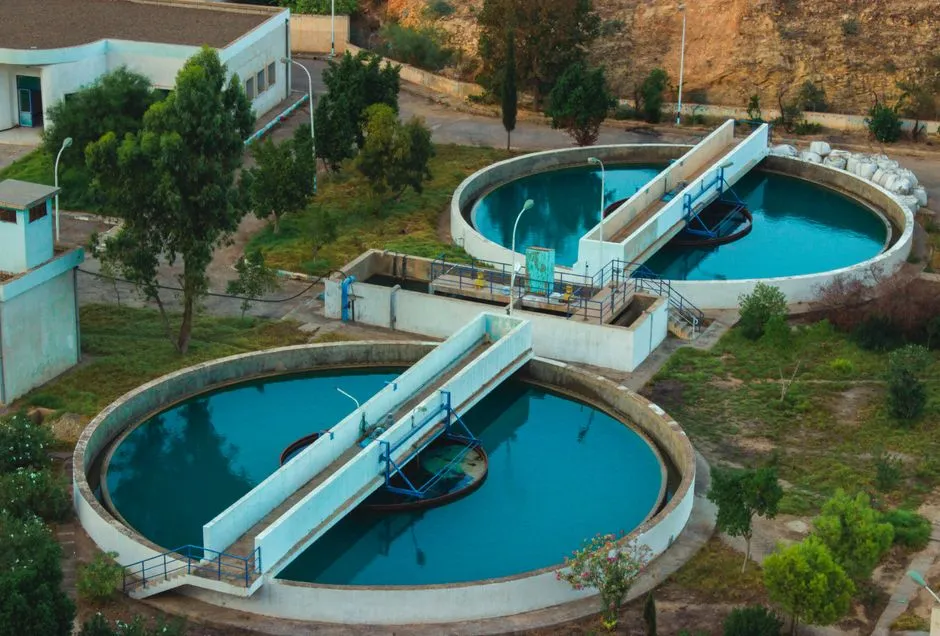
A defensible sewage treatment sizing starts by separating measured project data from assumptions. The designer should document population or fixture units, occupancy, daily demand, groundwater infiltration, stormwater entry, commercial contributions and peak periods. Every value then needs a source: survey, meter record, occupancy schedule or stated design assumption.
HydropureWater’s worked example uses 200 homes, six persons per home and 120 L/person/day: 200 × 6 × 120 L equals 144 m³/day base flow. Applying the cited 1.3 peak factor gives approximately 187 m³/day average flow and 243 m³/day peak flow (HydropureWater, 2025). The 120 L/person/day value and 1.3 peak factor are stated starting assumptions for Cameroonian residential catchments, not universal constants. Validate them against site data before accepting the hydraulic capacity.
| Design input | Cited worked value | Procurement treatment |
|---|---|---|
| Population basis | 200 homes × 6 persons | Separate confirmed occupancy from assumptions about vacant units and future development |
| Base flow | 144 m³/day | Reconcile with metered demand and fixture-unit records |
| Peak factor | 1.3 | Check morning and evening peaks, infiltration and commercial contributions |
| Average flow | Approximately 187 m³/day | Use as an illustration until the design basis is approved |
| Peak flow | 243 m³/day | Check biological and hydraulic peak behavior, equalization and screen losses |
| BOD | 250–350 mg/L | Require evidence across the proposed range |
| Urban municipal TSS | 200–800 mg/L | HydropureWater field-data envelope, 2025 |
| Rural-cluster TSS | 500–3,000 mg/L | HydropureWater field-data envelope, 2025 |
The cited load envelope is important because reactor selection follows the treatment objective but is constrained by incoming strength. HydropureWater reports urban municipal TSS at 200–800 mg/L and rural-cluster TSS at 500–3,000 mg/L; the 200-home illustration uses BOD of 250–350 mg/L (HydropureWater field data, 2025). These values show the assumption range carried into the calculation. They do not replace site sampling, especially where a community contains commercial or mixed domestic contributions.
In the cited guide, this example leads to an A/O or MBR train with hydraulic retention time of 8–10 hours. Final selection must also test peak flow, equalization, screen losses and the process response to load peaks. A package that satisfies average daily flow but lacks peak-flow or equalization capacity is not an equivalent offer.
Wet-season design is a separate check, not an optional sensitivity. HydropureWater recommends planning for TSS up to 3,000 mg/L, equalization for at least 6 hours of peak inflow and upstream screening with a 3–5 mm aperture bar screen (HydropureWater field data, 2025). A GX rotary mechanical bar screen can remove suspended solids, rags, plastics and fibrous debris before they reach pumps, valves and biological treatment. Require the supplier to demonstrate how the selected screen, equalization system and biological train operate together at the wet-season planning condition.
What does the treatment train need to include?
A treatment proposal must show the complete process route and its ancillary systems, not merely supply a tank. The A/O sequence is screening and equalization, anoxic biological treatment, aerobic contact oxidation, secondary clarification and disinfection. Each stage should appear in the process schematic, duty schedule and commercial scope so omissions are visible during tender comparison.
The MBR route adds activated sludge with submerged membrane separation, followed by the disinfection and ancillary systems required for the reuse endpoint. The equipment proposal must identify membrane modules, pumping, controls, backwashing or cleaning provisions, membrane replacement provisions and the connection between the biological process and final effluent quality.
HydropureWater identifies UV as an option after MBR when upstream TSS is held below roughly 10 mg/L (HydropureWater, 2025). That condition makes membrane performance, solids separation and pretreatment inseparable from disinfection selection. A UV unit cannot be credited as reliable final disinfection if upstream solids can intermittently obstruct or overload the required transfer condition.
Compare proposals on power resilience, odor control, accessible sampling, flow equalization and remote monitoring. These features determine whether the system remains operable and verifiable at a decentralized site. Also request a clear statement of who performs routine inspection, responds to alarms and manages power interruptions.
Residual sludge requires a defined route from the reactor to its final destination. HydropureWater’s Cameroon guide describes planning a 6–12 month desludging interval and using a plate and frame filter press to concentrate sludge for transport rather than paying for liquid removal (HydropureWater, 2025). Where sludge logistics form part of the permit and operating plan, the plate and frame sludge filter press is the relevant dewatering reference. The offer should identify the sludge-producing unit, expected removal frequency, dewatering scope, receiving container, transport contractor and final disposal site.
What will domestic sewage treatment in Cameroon cost and how long will delivery take?
HydropureWater’s 2025 estimates place a small 5–10 m³/day installation at US$15,000–US$30,000, a 10–50 m³/day system at US$30,000–US$120,000, and a 50–200 m³/day reuse-grade MBR with UV at US$150,000–US$500,000. These are indicative HydropureWater field-data estimates from 2025, not quotations or universal market prices.
| System scale | Indicative 2025 equipment band | Stated delivery lead time |
|---|---|---|
| 5–10 m³/day | US$15,000–US$30,000 | Standard units serving 5–50 m³/day: 4–8 weeks from order to delivery |
| 10–50 m³/day | US$30,000–US$120,000 | Standard units serving 5–50 m³/day: 4–8 weeks from order to delivery |
| 50–200 m³/day reuse-grade MBR with UV | US$150,000–US$500,000 | Full UV trains: 10–16 weeks |
The cited schedule is equipment delivery, not project completion. HydropureWater states that civil works and commissioning may add 1–2 weeks for the standard-system case (HydropureWater field data, 2025). The complete schedule must also distinguish equipment manufacture, shipping, customs, site preparation, installation, testing, regulatory approval, operator training and acceptance. Civil works can be on the critical path even when the packaged unit is delivered promptly.
Ask for separate prices for incoming sewer construction, excavation, foundations, flow equalization, electrical works, power backup, sludge handling, laboratory testing, permitting, training, commissioning and first-year operation. Without these exclusions, two bids may appear comparable while covering different project scopes. Reuse grade, disinfection and site conditions also affect the final quotation.
HydropureWater reports that MINEE rural grants may cover up to 50% of project cost for qualifying initiatives (HydropureWater, 2025). Buyers should verify eligibility, timing and which costs qualify rather than reducing the base budget before written confirmation. The domestic sewage treatment options in Yamoussoukro provide another application example, but it does not replace a Cameroon-specific design basis or quotation.
How should a supplier proposal be evaluated before purchase?
A comparable supplier proposal should trace every component from collection through treatment, disinfection and residual-sludge disposal. Issue the same design-basis, drawing, schedule and acceptance-test package to every bidder, and require each response to identify which items are factory supplied, locally supplied or excluded.
| RFQ check | Required supplier response |
|---|---|
| Duty statement | Calculated average and peak flow; stated TSS and BOD design envelope; wet-season planning condition where relevant; equalization sized for at least 6 hours of peak inflow |
| Process scope | Component-by-component map against the agreed treatment train and discharge or reuse endpoint |
| Effluent guarantee | Guaranteed BOD, COD, TSS and pH values, test protocol, sample points and commissioning acceptance criteria |
| Wet-season readiness | Upstream screening, equalization operation and process response under the agreed load envelope |
| Sludge | Ownership of removal and treatment, expected desludging frequency, dewatered residual volume and cake destination |
| O&M and training | Routine tasks, recommended spares, operator competency, training duration, remote support and emergency response for power interruptions |
| Schedule and price | Delivery, installation, commissioning, exclusions, site conditions and acceptance milestones |
The A/O versus MBR package-plant comparison provides a useful question pattern for comparing process fit, footprint, disinfection and reuse capability. It does not supply Cameroon-specific flows, loads, permits, site conditions or sludge arrangements. Those inputs must come from the project design basis and regulator engagement.
Require guaranteed effluent values rather than “typical” performance. The acceptance protocol should define sampling locations, test methods, operating conditions, sample timing, correction for abnormal influent and remedy if acceptance is not achieved. Price the complete lifecycle responsibility: equipment, civil interfaces, power, chemicals or UV consumption, spare parts, operator competence, sludge removal and final disposal.
Frequently Asked Questions
How much does domestic sewage treatment in Cameroon cost?
HydropureWater’s 2025 estimates are US$15,000–US$30,000 for a 5–10 m³/day system, US$30,000–US$120,000 for 10–50 m³/day, and US$150,000–US$500,000 for 50–200 m³/day reuse-grade MBR systems with UV. These are indicative field-data estimates, not quotations. Request itemized pricing for civil works, power, equalization, sludge handling, permits, commissioning and O&M.
How do you size a domestic sewage treatment plant for a residential community?
Start with the cited 200-home illustration: 200 homes × 6 persons × 120 L/person/day gives 144 m³/day base flow, and a 1.3 peak factor gives approximately 187 m³/day average and 243 m³/day peak flow (HydropureWater, 2025). Treat 120 L/person/day, six-person occupancy and 1.3 as starting assumptions, then validate them against site data before sizing equipment, equalization and pretreatment.
Which supplier should be selected for a decentralized sewage treatment plant?
Select the supplier that demonstrates process fit across the stated flow and load envelope, guarantees the applicable effluent parameters, defines the complete scope and provides an O&M package with competent training and remote support. Also assign sludge removal, treatment, transport and disposal explicitly; a plant price is incomplete if residual-sludge responsibility is unresolved.
How long does sewage treatment plant delivery take in Cameroon?
HydropureWater’s 2025 equipment schedule is 4–8 weeks from order to delivery for standard 5–50 m³/day units and 10–16 weeks for MBR systems with full UV trains; civil works and commissioning may add 1–2 weeks for the standard case. The contractual schedule should separately cover approvals, customs, installation, site works, testing and acceptance because equipment delivery is only one part of project completion.
What compliance risks should a buyer address before approving the treatment design?
For environmental discharge, the cited MINEE Decree 2023-001 targets are BOD below 30 mg/L, COD below 50 mg/L, TSS below 30 mg/L and pH 6–9 (HydropureWater, 2025). Address disinfection requirements, especially where a clinic, school or market may trigger expectations under MINSANTE Decree 2024-042, and request ISO 17025 influent and effluent reports, schematics, a maintenance plan and operator training records. These materials support approval; they do not replace regulator review.
Related Equipment
- underground WSZ package sewage treatment plant — specifications, capacity range, and technical data