What should a 180 nm GaN-on-SiC pHEMT factory choose in 2026?
For a 180 nm GaN-on-SiC pHEMT fab in 2026, factories should not select DAF or a clarifier from generic capacity charts. Choose DAF where sampled drains contain floatable oil, surfactants, conditioned colloids or floc-prone solids; choose lamella or conventional clarification where solids are dense and reliably settleable. A mixed fab drain may warrant DAF primary clarification, lamella polishing and subsequent chemical, biological or membrane treatment. Neither unit removes dissolved semiconductor chemicals on its own, so characterize each segregated drain, perform jar tests and pilot the selected train before final sizing.
The device designation and process node do not determine the separator. Drain composition, particle density, flow variation, chemical-conditioning requirements and downstream treatment duty do. A bulk-drain comparison can also conceal the stream that actually controls solids loading or chemical consumption.
For a mixed drain, evaluate DAF for primary removal of floatables and conditioned colloids, followed by lamella clarification or chemical precipitation for residual settleables. Dissolved contaminants require separate treatment. The supplied TFT-LCD research reports that organic solvents exceeded 33% of total wastewater and identifies DMSO, MEA, TMAH and chelating agents as major constituents; that is optoelectronic evidence, not a pHEMT performance guarantee (HydropureWater’s semiconductor DAF and clarifier selection guide).
Map the wastewater before comparing equipment
Segregated drains must be mapped because primary clarification is a stream-specific solids-separation duty, not a property of the entire fab effluent. Sampling should separate CMP-related slurry, photoresist and developer residues, acid and alkaline rinses, fluoride-bearing etchant streams, cleaning operations and any oily or surfactant-bearing sources.
For every drain, request flow and discharge timing, TSS, FOG, turbidity, particle-size distribution and pH. Add the dissolved constituents relevant to the proposed downstream process, such as fluoride, process metals, solvents, alkalinity and chelating compounds. The measurement should reflect normal production, cleaning cycles and representative wet-weather or upset conditions where applicable.
The next task is to classify the dominant physical duty: low-density floatables, colloidal or floc-prone solids, dense settleable solids, or a mixed profile. A CMP drain containing colloidal silica, alumina or ceria may also contain stabilizing surfactants; a segregated rinse may be dominated by precipitated solids. These are screening descriptions, not substitutes for sampling.
The TFT-LCD study cited by HydropureWater reports that organic solvents accounted for more than 33% of total wastewater and identifies DMSO, MEA, TMAH and chelating agents as major constituents (HydropureWater, 2026). It demonstrates the need to distinguish dissolved chemistry from particulate loading, but it does not establish composition for a 180 nm GaN-on-SiC pHEMT fab.
| Segregated drain | Measurements to request | Primary separator decision | Unresolved engineering input |
|---|---|---|---|
| CMP-related slurry | Flow, TSS, turbidity, particle-size distribution, FOG, pH | Evaluate DAF if colloids require conditioning; evaluate lamella only if floc forms reliably settleable solids | Particle density, surfactant demand and settleability after conditioning |
| Photoresist and developer residues | Flow, TSS, FOG, turbidity, particle-size distribution, pH and relevant dissolved constituents | Evaluate DAF for floatable or conditioned material, followed by biological or chemical polishing as required | Organic loading and compatibility with the selected conditioning and downstream processes |
| Acid and alkaline rinses | Flow, pH, TSS, turbidity, particle-size distribution, metals and fluoride where relevant | Evaluate lamella or conventional clarification for dense, reliably settleable solids | Neutralization demand, precipitation chemistry and hydraulic profile |
| Fluoride-bearing etchant streams | Flow, pH, TSS, fluoride, turbidity, metals and particle-size distribution | Clarify suspended solids before fluoride-removal equipment | Downstream fluoride objective and residual-solids tolerance |
| Cleaning, oily or surfactant-bearing drains | Flow, FOG, TSS, turbidity, particle-size distribution, pH and surfactant chemistry | Evaluate DAF after equalization and the required conditioning | Release pattern, foam control and chemical dose |
A bulk sample taken after clarification or flotation is not adequate for this assignment. It can mask the chemistry and loading of the drain that actually requires treatment. Use the semiconductor wastewater treatment-train configuration to document segregation, sampling points and downstream objectives before issuing an equipment RFP.
How DAF and clarification separate different solids
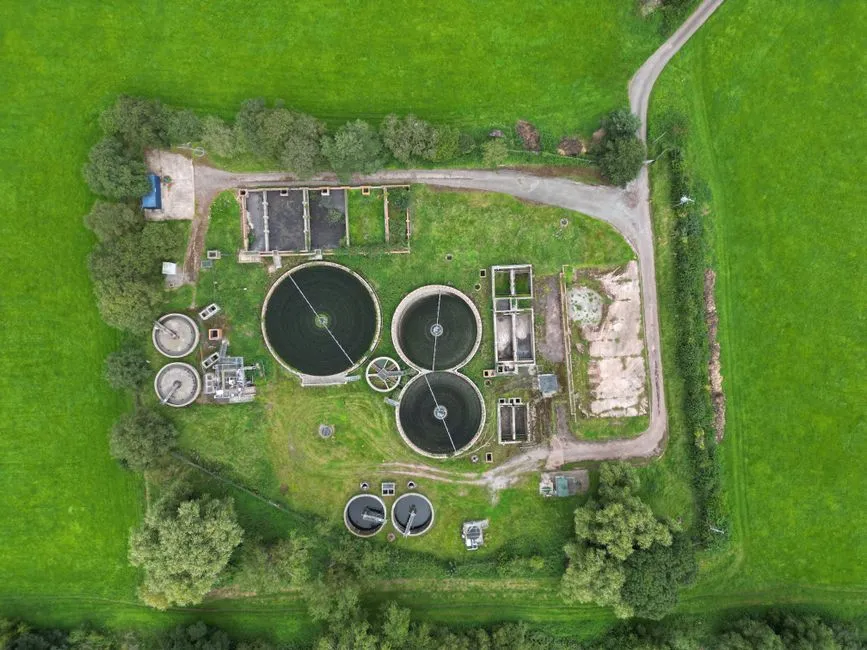
DAF is most suitable when air-bubble attachment can capture material that will not separate reliably by gravity. A conventional clarifier is most suitable when the dominant solids are dense and settle predictably; a lamella clarifier adds inclined settling surfaces to increase effective clarification area within a defined footprint.
In DAF, chemical conditioning enlarges or restructures particles so they attach to microbubbles. The resulting bubble-floc matrix rises and is removed by skimming, while heavier settled material is withdrawn separately. Clearwater/SigmaDAF describes 30–50 micron microbubbles and emphasizes that coagulation and flocculation improve bubble contact and capture (Clearwater, 2026-04). The important engineering variable is therefore attachment and floc condition, not bubble size alone.
Surfactants can alter that attachment behavior. The supplied HydropureWater research reports a typically optimized contact angle of 40–80 degrees, but explicitly states that the applicable semiconductor range must be established through chemistry review and testing (HydropureWater, 2026). Do not transfer that range directly into a guarantee.
For clarification, the process is gravity-driven. Inclined lamella plates increase available settling area, but hydraulic and sludge-loading limits still apply. This mechanism is generally more suitable for dense settleable solids. Flotation is generally more useful for low-density particles, oils, surfactants and conditioned colloids. The practical selection test is therefore whether the sampled material can be made to float or made to settle under the available conditioning and hydraulic conditions.
Review the physical separation basis in the industrial DAF system and the lamella clarifier description before setting the pilot acceptance criteria.
Compare DAF and clarifiers on the criteria buyers actually receive bids against
DAF and clarifiers should be compared as complete clarification duties because their quoted equipment packages conceal different operating, footprint, materials and lifecycle costs. A bid that states only tank dimensions, nominal flow or solids-removal percentage does not establish suitability for a segregated fab drain.
HydropureWater’s Tampa article reports approximately 90% oil removal with coagulation and flocculation from Hahn (2010, S3). That result is not a universal DAF guarantee for semiconductor wastewater. HydropureWater’s manufacturer information for its lamella clarifier states surface-loading rates of 20–40 m/h and chemical-consumption reduction of up to 30%; both figures require a valid flocculation and operating basis and do not automatically apply to the proposed pHEMT treatment train.
Clearwater/SigmaDAF states that 304SS is standard for its DAF systems, with 316SS and polypropylene available where chemistry warrants (Clearwater, 2026-04). Require bidders to select materials against the actual segregated chemistry rather than accepting a generic material schedule.
Lifecycle cost must include DAF recycle, compressed air, conditioning and sludge handling. A clarifier may require more coagulant, controlled sludge removal or additional polishing. DAF Corp lists skid-mounted FC Maximizers from 48 to 450 gpm, its broader FC range from 10 to 11,000 gpm, and the RC UniMax from 10 to 1,000 gpm; these are vendor flow examples, not a pHEMT sizing recommendation.
| Procurement criterion | DAF | Conventional or lamella clarifier | Bid information required |
|---|---|---|---|
| Separation duty | Floatables, oils, surfactants and conditioned colloids | Dense, reliably settleable solids; lamella provides compact settling area | Measured stream characterization and separation mechanism |
| Hydraulic sensitivity | Sensitive to hydraulic loading, recycle and air-to-solids conditions | Sensitive to hydraulic surges and solids accumulation | Equalization basis, hydraulic profile and peak-load response |
| Chemical demand | Coagulation and flocculation normally required for reliable capture | May require coagulant or polymer aid; lamella polish may need conditioning | Dose-response data and chemical consumption calculation |
| Utilities | Adds recycle and compressed-air demand | Lower air demand but may require powered scrapers or sludge systems | Recycle ratio, air demand, pressure and connected power |
| Sludge and float handling | Separate floated and settled fractions | Concentrated settled sludge | Residue characteristics, removal method and disposal assumptions |
| Materials | 304SS standard; 316SS and polypropylene available, according to Clearwater/SigmaDAF, 2026-04 | Material selection depends on actual chemistry, temperature and cleaning regime | Wet-process material schedule and compatibility justification |
| Automation | Requires control of recycle, air, conditioning and skimming | Requires control of sludge withdrawal and, where fitted, scrapers | PLC/SCADA requirements and failure-response philosophy |
| Downstream protection | Can remove floatables and conditioned colloids before biological, UF or RO | Can reduce settleable solids before precipitation or membrane treatment | Residual TSS, FOG, turbidity and particle-size limits for the next process |
The semiconductor DAF and clarifier selection guide should be used to challenge bidders on operating assumptions behind their guarantees, especially recycle and compressed air.
Choose the treatment train by stream, not by one bulk drain
The treatment train should assign each separated stream a physical removal duty before assigning downstream chemical or biological duties. Primary clarification protects downstream processes; it does not complete the permit treatment train.
A floatable-oil or surfactant-bearing drain should normally proceed through equalization and the required conditioning before DAF. A dense, reliably settleable solids stream can proceed to lamella or conventional clarification where lower mechanical complexity and gravity separation are preferred. For a mixed drain, evaluate DAF for primary removal of colloids and FOG, followed by lamella clarification or chemical precipitation to remove residual settleables before downstream fluoride or metals removal.
If biological treatment is planned, evaluate the separator with an MBR treatment system rather than judging it only by solids removal. DAF can protect biological treatment, UF or RO from floatables, oil, surfactants and colloids, but dissolved contaminants still require their own treatment.
| Stream profile | Recommended primary duty | Polishing or downstream duty | Decision condition |
|---|---|---|---|
| Floatable oil and surfactant-bearing | Equalization, conditioning and DAF | Chemical, biological or membrane treatment as required | Use when flotation attachment and foam control are demonstrated |
| Dense, reliably settleable solids | Lamella or conventional clarification | Residual-solids polishing or chemical treatment | Use when gravity separation is stable and verified |
| Colloidal or floc-prone mixed solids | DAF primary clarification | Lamella clarification or chemical precipitation | Use when conditioning produces a floatable or separately settleable fraction |
| Fluoride-bearing with process metals | Clarification to reduce suspended solids | Fluoride and metals removal | Set residual-solids limits from the downstream unit |
| Dissolved-organic-rich drain | DAF only for removable floatables and conditioned solids | Separate biological or chemical treatment | Do not assign dissolved removal to either separator |
| Low-FOG, low-colloid general rinse | Lamella clarification may be adequate | Required fluoride, metals or membrane pretreatment | Confirm hydraulic and sludge loading |
Where UF is the next barrier, evaluate the separator against the UF treatment system’s incoming solids and colloid tolerance. For broader high-salinity context, review chip-fab high-salinity wastewater treatment, but keep the segregation and testing basis specific to the pHEMT fab.
Size through jar testing and pilot work
Equipment sizing should proceed from documented wastewater characterization to jar testing, representative piloting and then a guarantee basis tied to measured operating conditions. A vendor nameplate curve cannot establish performance for an undefined mixed fab drain.
- Create a sampling plan by segregated drain and production condition. Measure flow, TSS, FOG, turbidity, particle-size distribution, pH and relevant dissolved constituents.
- Run jar tests across coagulant and flocculant doses. Measure TSS, FOG, turbidity and particle-size distribution, and observe whether conditioning creates floc suitable for flotation or settling.
- Pilot the proposed train on representative wastewater. Validate hydraulic loading, air-to-solids ratio, float or sludge removal, chemical demand and downstream response.
- Document equalization performance, recycle ratio, compressed-air availability, tank geometry, sludge characteristics and future flow variation.
- Convert the verified results into contractual guarantees and a bid package tied to the selected drains.
The supplied research identifies the TFT-LCD biological findings as dependent on controlled reactor conditions. They cannot be attributed to DAF or a clarifier, nor used as a biological guarantee for this project (HydropureWater, 2026).
| Stage | Required input | Output used in selection | Acceptance focus |
|---|---|---|---|
| Characterization | Representative segregated-drain samples and flow profile | Dissolved and particulate boundary; dominant separator duty | Data quality and relevance to production and cleaning cycles |
| Jar testing | Baseline chemistry and chemical-dose series | Selected conditioning regime and measured removal response | TSS, FOG, turbidity, particle-size distribution and floc behavior |
| Pilot testing | Representative flow, chemistry and intended recycle arrangement | Verified hydraulic and operating basis | Float or sludge removal, chemical demand, air demand and downstream response |
| Final design and guarantee | Approved design basis and operating envelope | Equipment sizing, materials, controls and performance guarantees | Defined test method, stream, load and operating assumptions |
The automatic chemical dosing system scope should follow the jar-test and pilot results rather than precede them. A fixed dose without a verified dose-response basis is not a defensible guarantee.
Questions to put in the 2026 supplier request
A 2026 supplier request should compare complete treatment duties and expose the assumptions behind every performance claim. Each bidder should identify the target segregated stream, measured flow and loading basis, selected separation mechanism, downstream objective and test method.
Request itemized CAPEX for DAF, lamella clarification, equalization, conditioning and integration. Request OPEX for polymer, compressed air, electricity and sludge handling using the proposed operating scenario. A comparative total should include utilities, controls, installation and downstream impacts; the supplied research does not provide a defensible quotation for this pHEMT application, so bidders must supply project-specific pricing.
Ask bidders to identify tank geometry, recycle ratio, compressed-air assumptions, materials of construction, sludge and float handling, controls and PLC or SCADA integration. Require semiconductor or electronics wastewater evidence, jar-test support, pilot capability and a lead-time commitment tied to the project schedule.
Compliance should be evaluated at train level. Require each proposal to explain how residual solids, FOG and colloids will be controlled before downstream fluoride-removal, biological, UF or RO processes.
| RFP question | Evidence the bidder must provide | Procurement check |
|---|---|---|
| Which segregated stream does this package treat? | Named drains, measured flows, loading basis and water chemistry | Reject generic semiconductor claims that do not identify the design wastewater |
| What separation duty is guaranteed? | Test method, outlet TSS, FOG, turbidity or particle-size criterion as applicable | Ensure the guarantee addresses the contaminant profile and not only solids |
| How is performance sustained? | Equalization, recycle, air, chemical and operating-envelope assumptions | Compare complete operating systems rather than separator tanks |
| What are the capital and operating costs? | Itemized CAPEX and OPEX for the proposed duty | Normalize utilities, sludge handling and downstream impacts |
| How does the train protect downstream treatment? | Residual-solids, FOG and colloid limits plus an integration description | Confirm compatibility with biological, UF, RO, fluoride or metals processes |
| Can the supplier validate the proposal? | Jar-test records, pilot plan or results and relevant reference projects | Make guarantee release dependent on verified wastewater and operating conditions |
| When will the system be delivered? | Committed schedule tied to drawings, approvals and site readiness | Align lead time with the fab construction and compliance schedule |
The semiconductor wastewater treatment-train configuration provides a useful structure for separating technical, commercial and schedule deliverables in the RFP.
Frequently Asked Questions
Should a 180 nm GaN-on-SiC pHEMT fab use DAF or a lamella clarifier?
Use DAF when the segregated drain contains floatable oil, surfactants, conditioned colloids or floc-prone solids. Use a lamella clarifier when the solids are dense and reliably settleable. A mixed drain may need DAF primary clarification followed by lamella polishing or chemical precipitation. The deciding evidence should come from actual-drain jar tests and pilot work, not the device designation or generic capacity charts.
How much will DAF and clarifier systems cost?
No defensible project price can be calculated from the supplied research because it contains no pHEMT-specific quotation. Request itemized CAPEX and OPEX for each complete duty, including equalization, conditioning, compressed air, recycle, electricity and sludge handling. Compare the proposals over the same flow, loading and operating envelope, including any claimed reduction in downstream chemical demand.
How should equipment size be selected?
Size from measured segregated-drain flow and loading, then validate the separation mechanism through jar testing and representative pilot work. A bidder should provide the tested chemical dose, hydraulic basis, recycle ratio, air demand and guarantee conditions. Generic surface-loading values or vendor flow ranges should not replace actual wastewater testing.
Which supplier qualifications reduce compliance and delivery risk?
Require named wastewater streams, semiconductor or electronics references, jar-test support, pilot capability, guarantee test methods, material selections and controls integration. Also request a lead-time commitment tied to the project schedule and a train-level explanation of how the separator protects downstream fluoride, biological, UF or RO treatment. A generic application list is not sufficient evidence of fit.