Start with the Long Beach permit, not an assumed discharge limit
Petroleum bulk plants near Long Beach meet sewer pretreatment limits by controlling the actual industrial-user permit, not by relying on a generic effluent standard. They segregate oily streams, remove free oil with an API separator or CPI interceptor, polish emulsified oil with DAF, and add biological or adsorption treatment only when the permit requires it. Design is based on peak slug flow, daily oil load, and a target residual below the written limit. Operators then maintain monitoring and reporting records that match the permit’s required methods, frequency, and deadlines.
Begin with a written jurisdiction determination. A commercial petroleum pretreatment guide dated 2026 describes industrial users generally as facilities discharging process wastewater to a POTW or contributing at least 25,000 gpd of non-domestic waste under 40 CFR Part 403. Confirm the facility’s status with Long Beach Utilities and determine whether the discharge is subject to Long Beach Municipal Code Chapter 14.28. A broad industrial wastewater article also identifies Chapter 14.28 as the local pretreatment ordinance, but it does not establish a universal petroleum-bulk-plant limit.
Request the current industrial-user permit and its attachments directly from the controlling POTW. The purchase package should include local limits, the Maximum Allowable Headworks Loading and Maximum Allowable Industrial Loading basis, monitoring frequencies, sampling instructions, reporting deadlines, slug-discharge provisions, and enforcement language. A 2020 St. Joseph, Missouri TBLL evaluation cited by the petroleum guide explains that MAHL considers the POTW’s NPDES permit, state water-quality standards, biosolids-disposal criteria, and worker or ecosystem factors. The POTW then allocates allowable mass to each user; that allocation should appear in the facility’s written permit rather than be reconstructed from general guidance.
Do not adopt the petroleum guide’s typical 2026 values of 100–200 mg/L HEM and approximately 250 mg/L TSS as Long Beach limits. The guide presents them as market context and notes that stricter water-reuse basins may have daily-maximum HEM near 50 mg/L. Likewise, verify whether benzene, toluene, ethylbenzene, xylene, or total petroleum hydrocarbons are independently limited. The 2026 petroleum guide identifies benzene and TPH as important permit-negotiation parameters, but a local numerical limit still requires agency confirmation.
| Document or limit | What the buyer must establish | Why it controls design |
|---|---|---|
| Current Long Beach industrial-user permit | Applicability, local limits, monitoring, reporting, slug rules | Defines the legally enforceable discharge conditions |
| MAHL and MAIL calculations | Pollutant-specific mass-loading basis and allocation | Connects flow and concentration to POTW capacity |
| EPA Method 1664A HEM method | Current laboratory and reporting instructions | Defines how oil and grease compliance is demonstrated |
| BTEX and TPH conditions | Whether a numerical local limit applies | Determines whether additional polishing or monitoring is required |
| Enforcement provisions | Notice, cure, surcharge, and SNC consequences | Sets the operational and reporting risk to be controlled |
For another site-specific sizing framework, see how industrial users structure permit-to-equipment decisions.
Map each petroleum waste stream before sizing equipment
Equipment should be sized from segregated streams and measured loads, not from the plant’s average sanitary discharge. Inventory tank-bottom water, API coalescer dumps, truck and rail loading drip, vehicle wash-rack wastewater, hydrostatic-test water, and stormwater that contacts product-handling areas. The 2026 petroleum guide distinguishes their behavior: loading-arm drip is mostly free oil, wash-rack water may contain detergent-driven emulsions, and tank-bottom water may contain free oil plus sludge.
Characterize each stream separately for flow, frequency, free oil, emulsified oil, suspended solids, BTEX, and TPH. Keep event duration and discharge destination in the record. A dump that lasts several hours cannot be represented by a daily average, and an oily stream mixed with clean stormwater can increase treatment flow while diluting the concentration seen at a fixed sample point.
- List every source, operating event, receiving lateral, and disposal route.
- Measure instantaneous flow during representative dumps, drops, loading, and wash-rack operation.
- Determine the daily oil and grease mass load from tank turnover, wash-rack volume, and drip rates.
- Set the target residual from the written permit; the 2026 petroleum guide recommends setting it 20–30% below the applicable limit when feasible.
- Route segregated laterals, covered dump valves, and dedicated oil/water piping before calculating the treatment-unit footprint.
The petroleum guide reports that coalescer dumps or tank drops can produce peaks 3–5 times the daily mean. It also reports 40–70% flow reduction in field retrofits using segregated laterals, covered dump valves, and dedicated oil/water sewering, based on HydropureWater field data from 2025–2026. Those figures support early segregation, but they do not replace measurement at the terminal.
| Waste stream | Expected contaminant form | Characterization and design input |
|---|---|---|
| Tank-bottom water | Free oil with sludge | Tank turnover, drain volume, free-oil concentration, solids, dump duration |
| API coalescer dumps | Concentrated free oil | Event volume, peak flow, oil load, upstream separator condition |
| Truck and rail loading drip | Predominantly free oil | Frequency, collected volume, drip rate, containment performance |
| Vehicle wash-rack water | Potential emulsified oil and detergent | Peak flow, droplet-size distribution, oil load, surfactant demand |
| Hydrostatic-test water | Variable hydrocarbon concentration | Test frequency, volume, source product, disposal route |
| Contact stormwater | Variable free oil, solids, and dissolved pollutants | Drainage area, rainfall response, exposure duration, segregation status |
Build a slug-resistant four-stage pretreatment train
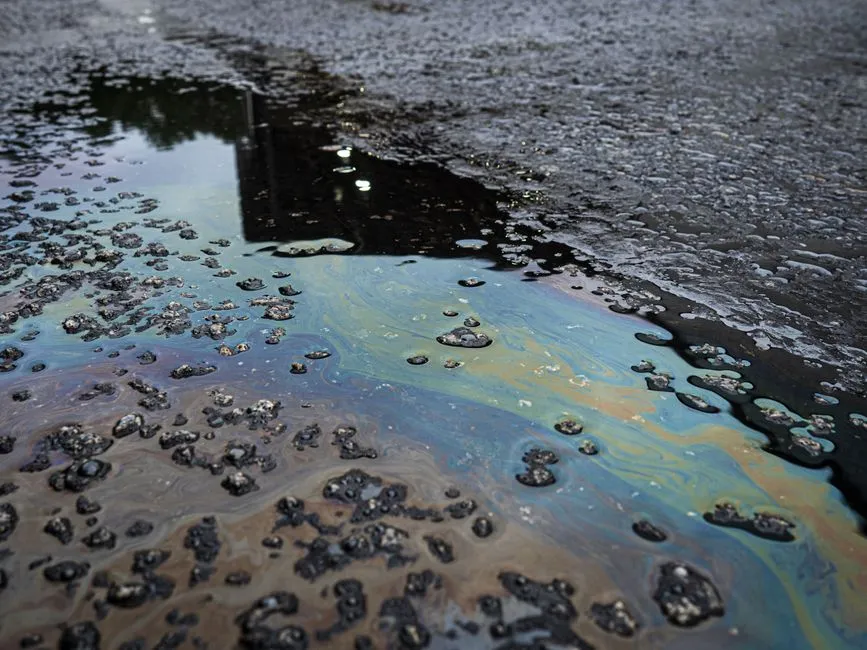
A petroleum wastewater train should separate free oil before polishing emulsified oil, because a separator and DAF solve different removal problems. The order is source segregation, primary free-oil separation, emulsified-oil polishing, and optional biological or adsorption treatment. This sequence reflects the 2026 petroleum pretreatment guide and provides a clearer procurement basis than selecting a single vessel by name.
Stage 1: segregate at the source. Keep hydrocarbon-contaminated process water separate from clean stormwater. Provide dedicated collection for dumps, loading areas, and wash racks, with covered dump valves and clearly marked sample points. The 2026 guide notes that segregation prevents clean stormwater from increasing the load reaching treatment.
Stage 2: remove free oil. An API gravity separator, corrugated plate interceptor, or coalescer can recover free-oil droplets, but it should not be credited with reliable emulsion breaking. The guide describes primary separators as targeting free-oil droplets rather than emulsions. For API equipment, its reference calls for at least 30 minutes of residence time at peak flow. For CPI equipment, it cites 1–2-inch plate spacing and corrugation near 45 degrees, while requiring the final design to use the manufacturer’s confirmed droplet-removal curve.
Stage 3: polish emulsified oil with DAF. The 2026 petroleum guide states that a CPI alone rarely meets a 100 mg/L HEM limit on emulsified wash-rack water because it does not reliably remove sub-60-micron droplets. DAF can float smaller droplets; the guide describes a DAF service range of 10–25-micron droplets. A DAF system for petroleum wastewater should therefore follow primary separation, not replace it.
Stage 4: add treatment only where required. Biological or adsorption polishing is warranted only if the permit requires reductions in ammonia, sulfide, or dissolved hydrocarbons that physical separation cannot achieve. Avoid buying that stage on the assumption that a general “zero-risk” blueprint applies; the Long Beach permit controls the actual requirement.
| Treatment stage | Primary function | Key design issue | Typical use in the train |
|---|---|---|---|
| Source segregation | Exclude clean water and isolate events | Drainage, dump routing, containment | First control layer |
| API separator | Free-oil gravity separation | Peak residence time and sludge removal | Primary stage |
| CPI interceptor | Free-oil droplet coalescence | Vendor droplet-removal curve and plate fouling | Primary stage |
| DAF | Emulsified-oil flotation | Hydraulic loading, ASR, chemistry, upstream oil removal | Polishing stage |
| Biological or adsorption treatment | Remove selected dissolved pollutants | Permit-specific residual and waste handling | Conditional final stage |
Retaining primary treatment ahead of DAF is not optional under the guide’s slug-load rationale: free oil from coalescer dumps and tank drops can blanket DAF micro-bubbles and reduce air-to-solids performance. The 2026 field guidance therefore identifies DAF alone without primary gravity treatment as vulnerable during dump events.
Size DAF for peak loading and use chemistry deliberately
DAF should be sized for the slug event, not the average sanitary flow. The 2026 petroleum guide identifies peak instantaneous flow as a primary design number and recommends evaluating a coalescer dump or tank drop as a distinct case. It also warns that DAF without upstream primary separation is slug-sensitive because free oil can interfere with bubble-surface performance.
Apply two hydraulic checks. The guide cites surface hydraulic loading of 2–5 gpm/ft² for oilfield service and recommends a 20–30% safety margin on both hydraulic loading and air-to-solids loading. The margin is a design allowance, not evidence that a selected vessel will pass the permit. The equipment proposal should show the calculation, selected chamber area, design flow, oil load, and an operating response to the largest identified dump.
Use the influent droplet-size and emulsion character to select the treatment route. The petroleum guide gives 10–25 microns as the DAF design range and identifies emulsified oil as a principal DAF application. Wash-rack water with detergent can create smaller, stabilized droplets, so primary free-oil removal, chemical conditioning, and a residual-performance test should be addressed together. Where a comparison is needed, the DAF and clarifier selection guide provides a separate technology framework that should be evaluated against petroleum emulsion behavior.
Control chemistry automatically rather than by operator guesswork. The 2026 guide cites pH 6.5–7.5 ahead of DAF and a 50–200 mg/L demulsifier or coagulant dose. Jar testing must establish the actual product and dose for the measured wastewater; those values are not universal prescriptions. A PLC-controlled chemical dosing system can stage coagulants, flocculants, pH adjusters, and specialty chemicals, but control logic should respond to measured flow, oil condition, and treatment performance.
For hydraulic comparison, the guide presents DAF surface loading as 2–5 gpm/ft² and notes that undersizing is a common cause of carryover in field retrofits. The available equipment range is 4–300 m³/h across 13 standard models with PLC-controlled dosing. Final selection requires actual peak flow, oil load, target residual, footprint, utilities, redundancy, and sludge handling. A price or model number without those inputs is not a defensible selection.
Turn sampling and reporting into the compliance control system

Treatment performance becomes defensible only when sampling, analysis, reporting, and corrective action follow the permit. The 2026 petroleum guide describes a minimum monitoring cadence for petroleum bulk plants: daily visual free-oil inspection at the outlet weir, weekly TSS grab sampling, monthly HEM composite sampling, and a 24-hour flow-proportional BTEX/TPH composite where a local limit is nonzero. The Long Beach permit must be checked because its written frequency and method govern.
Use EPA Method 1664A for HEM. The 2026 petroleum guide states that the method uses n-hexane extraction and reports Hexane Extractable Material under 40 CFR § 401.16. Use the permit’s required sample type, preservation, laboratory, and reporting basis. The same guide notes that sampling-procedure deficiencies, rather than treatment failure alone, are a common source of Significant Noncompliance findings.
Keep taps accessible and identified. Calibrate flow meters annually, maintain custody forms, preserve split samples where required, and reconcile sample times with operating and chemical-dosing logs. These records should show not only the result but also the response: a high HEM result, rising outlet-weir oil, or a slug event must trigger a documented investigation and corrective action.
The 2026 guide gives three SNC escalation criteria: a numerical violation of at least 1.5 times on any single day, violation on more than 5% of measurement days in a six-month period, or failure to provide required reports within 30 days of the due date. A late report is therefore an enforcement event, not an administrative afterthought. For operating-cost context beyond compliance administration, the DAF operating-cost breakdown separates power, air, chemicals, sludge handling, and maintenance considerations that belong in lifecycle review.
| Control element | Required record | Compliance purpose |
|---|---|---|
| Daily free-oil inspection | Dated and initialed outlet-weir observation | Documents the primary-stage operating condition |
| Weekly TSS | Sample result, method, analyst, and flow context | Tracks solids carryover and identifies upsets |
| Monthly HEM composite | Method 1664A result and chain of custody | Documents the principal oil-and-greasure compliance parameter |
| BTEX/TPH composite | 24-hour flow-proportional result where required | Tests permit-specific hydrocarbon limits |
| Calibration and maintenance | Annual flow-meter calibration and equipment records | Supports the validity of reported results |
| Corrective-action log | Cause, response, retest, and closure | Shows that exceedances were investigated |
Maintain a pre-audit file using the EPA National Pretreatment Program audit-checklist categories cited in the 2026 guide. Include the permit, monitoring results, inspection records, calibration certificates, chain-of-custody records, chemical logs, operating narratives, and corrective actions. Organize the file so each reported result can be traced from sample collection through laboratory analysis and permit submission.
Use a pre-purchase compliance checklist before ordering equipment
A defensible purchase starts with a permit-compliance package, not an equipment model. Give each supplier the current permit, waste-stream inventory, measured peak flow, daily oil load, target residual, footprint, utilities, expansion plan, sludge route, and monitoring or automation requirements. The buyer should then require a traceable design calculation showing how each selected stage contributes to the written permit target.
For every proposal, request:
- The primary separator and polishing sequence.
- Peak-flow and oil-load calculations, including safety margins.
- Hydraulic loading and air-to-solids assumptions.
- Chemical demand and control sequence.
- Sludge, oil, and media handling interfaces.
- Redundancy, maintenance access, utilities, and future expansion.
- Expected residual performance under representative wastewater.
Separate purchase price from lifecycle cost. Ask each bidder to state assumptions for power, compressed air, chemicals, consumables or media, maintenance, operator labor, inspections, and sludge disposal. No verified Long Beach petroleum-bulk-plant project price appears in the supplied research, so a project quotation must be requested rather than inferred from generic system ranges.
Treat the petroleum guide’s 2026 typical values of 100–200 mg/L HEM and approximately 250 mg/L TSS as preliminary benchmarks only. Final sizing and cost allocation must use the facility’s written permit and measured influent. The broader Long Beach industrial article lists general COD, TSS, and FOG figures, but those are not established as universal petroleum-terminal requirements. A supplier’s promise against a generic benchmark should not count as a proposal against the site permit.
| Pre-purchase item | Required supplier response | Acceptance check |
|---|---|---|
| Permit target | Named parameter, limit, averaging period, and monitoring method | Matches the current written permit |
| Design basis | Peak flow, daily oil load, event duration, target residual | Traceable to measured site data |
| Treatment train | Primary, polishing, and conditional stages | Each stage has a defined removal function |
| Safety margins | Hydraulic and air-to-solids design margins | Acceptable under the selected design case |
| Operations | Chemical, sludge, inspection, and maintenance requirements | Resources and access are realistic |
| Commissioning | Clean-water, representative-waste, chemistry, and slug-test protocol | Each result maps to a permit condition |
Plan commissioning with clean-water verification, representative wastewater, chemical-response testing, and observation of a controlled slug-load condition. Use a written protocol that connects each operating condition to the permit limit and identifies the sampling point, flow state, and acceptance result. Where technology selection is still open, use the DAF and clarifier comparison for transportation wastewater as a secondary engineering reference, not as a substitute for petroleum influent testing.
Frequently Asked Questions
What will a pretreatment system for a Long Beach petroleum bulk plant cost?
The supplied research does not provide a verified project price for a Long Beach petroleum-bulk-plant installation. Request a site-specific quotation with peak flow, daily oil load, permit residual, footprint, utilities, treatment stages, chemical consumption, maintenance, and sludge-disposal assumptions. Do not use generic equipment or industrial-treatment price ranges as a permit-compliant budget.
Which supplier should be selected for petroleum wastewater treatment?
Require each supplier to show the permit parameter being targeted, design flow, oil load, treatment stages, hydraulic and air-to-solids margins, chemical controls, sludge interface, and monitoring scope. Require a proposed residual under representative wastewater and a commissioning protocol tied to the written permit. Equipment capacity alone is not evidence of compliance.
What three numbers should determine treatment-plant sizing?
Use peak instantaneous flow, daily oil and grease load, and target residual concentration. The 2026 petroleum guide identifies these as the three core design numbers. Peak flow governs hydraulic capacity, daily load governs contaminant removal, and the residual sets the treatment objective beneath the applicable permit limit.
What can trigger Significant Noncompliance at a petroleum terminal?
The 2026 petroleum guide cites a numerical violation of at least 1.5 times on any single day, violations on more than 5% of measurement days in a six-month period, or failure to provide a required report within 30 days of its due date. Defensible sampling procedures, timely reports, and documented corrective actions help prevent both treatment exceedances and monitoring-related findings.