Which separator should a 350 semiconductor factory choose in 2026?
For semiconductor and Optoelectronics wastewater in 350, DAF is usually the stronger pilot candidate when wastewater contains fine, colloidal, oily or chemically conditioned solids that benefit from flotation. A gravity or lamella clarifier is generally more practical when the solids are predominantly settleable, flow is steady and chemical use, sludge handling or operating simplicity dominate. DAF should follow a wastewater-specific coagulation and flocculation trial; published equipment claims are not semiconductor guarantees. A lamella clarifier, DAF and chemical conditioning should be compared side by side using the factory’s actual flow, TSS, particle distribution, metals, FOG, pH and reuse targets before a final purchase in 2026.
The choice should be framed around the dominant physical separation problem, not around a generic preference for one equipment category. Fine, oily or poorly settleable solids can favor dissolved air flotation, while readily settleable solids may make gravity sedimentation or a lamella clarifier more appropriate. A useful starting point is the DAF versus clarifier factory guide, but the wastewater data must come from the 350 facility.
Municipal evidence demonstrates that DAF can function as a liquid–solid separation step within a larger treatment train. In the 2026 MDPI paper A Simplified Whole-Plant Model to Predict Biosorption in a High-Rate Biological Contactor, DAF separates waste activated sludge from biosorbed organics in an HRBC process. The model assumed 70% solids capture; that was a model assumption, not a semiconductor performance result. The study also states that its municipal warm-climate findings may not generalize to other wastewaters or climates.
Location alone does not determine the answer. The supplied research establishes no local discharge limit for 350 or a semiconductor-specific regulatory threshold. The factory must apply its verified discharge, pretreatment and reuse requirements to the selected separator.
What changes when the wastewater comes from semiconductor and Optoelectronics production?
Semiconductor wastewater must be segmented because production chemistry, flow variability and downstream reuse requirements can change the separation problem within the same plant. Averaging the entire site can conceal the stream that controls solids loading, chemical demand or membrane pretreatment risk.
- Map cleaning, etching, plating and other process operations to their wastewater streams.
- Record minimum, average and maximum flow, including production-campaign and clean-in-place transitions.
- Analyze TSS, particle-size distribution, pH, metals, oil and grease where relevant, and constituents that affect coagulation and flocculation.
- Identify the next step: reuse, membrane pretreatment, biological treatment or permitted discharge.
Use segmented sampling rather than a single composite sample. Cleaning cycles, dumping practices and production changes can alter both concentration and character. The silicon wafer wastewater reclamation blueprint provides relevant process context, while the data-hall wastewater compliance guide illustrates why a site-specific compliance basis matters.
| Data package | Why it controls separator selection |
|---|---|
| Stream-by-stream flow envelope | Identifies peak hydraulic loading, production variability and unsuitable combined flows. |
| TSS and particle-size distribution | Shows whether particles are readily settleable, fine, colloidal or floatable. |
| Metals, FOG and pH | Defines solids chemistry, precipitation risk and conditioning requirements. |
| Chemical constituents | Tests compatibility with coagulants, flocculants and downstream treatment. |
| Reuse or pretreatment specification | Sets the required solids outcome and exposes downstream fouling risk. |
The MDPI study supports the role of DAF as a separation step after biosorption, but it does not validate DAF for semiconductor wastewater. Its municipal feedstock had comparatively low composition variability. A fab stream containing cleaning chemicals and metals can behave differently enough that conditioning must be developed on site.
How DAF and clarifiers remove solids
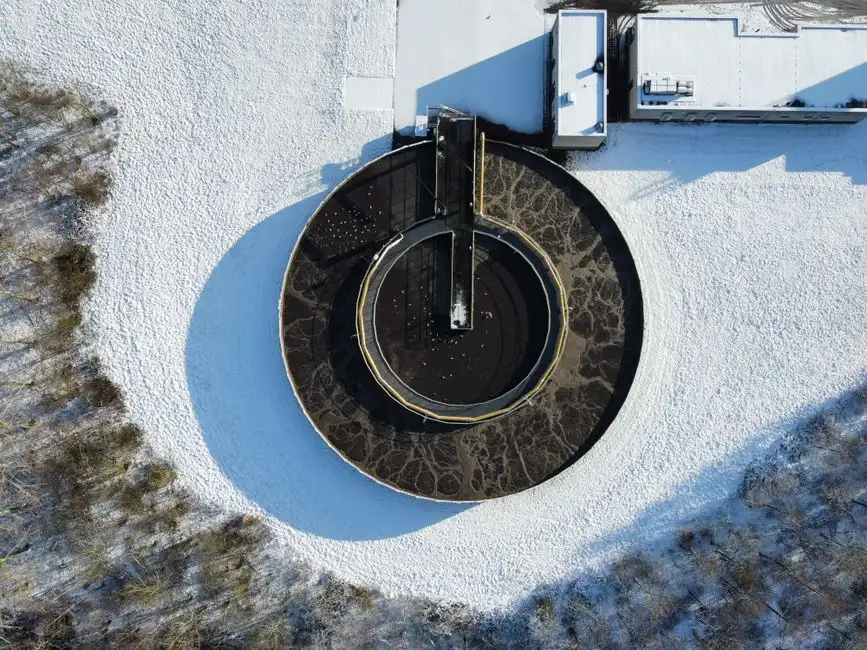
Dissolved air flotation is a clarification mechanism in which dissolved air forms microbubbles that attach to particles, lift them to the surface and permit a skimmer to remove the float.
Clearwater Industries describes 30–50 micron microbubbles in its DAF systems and states that the technology should be paired with proper coagulation and flocculation. These are commercial equipment statements, not universal design requirements. Conditioning increases particle size and improves contact with the microbubbles before the solids enter the flotation tank.
A gravity clarifier relies on the settling velocity of solids and the available separation area. A lamella clarifier adds inclined plates to increase effective separation area within a more compact structure. The lamella clarifier for compact solids separation therefore differs from a conventional gravity tank through its settling geometry, not through a different downstream treatment objective.
For a fab, the mapping is straightforward: choose DAF when the required particles are floatable after conditioning or when oil-bearing solids must be lifted; test a lamella or gravity clarifier when the solids demonstrate reliable settling. The industrial DAF system for semiconductor wastewater remains one candidate within a broader solids-separation train.
Neither mechanism removes dissolved contaminants simply because suspended solids are captured. Metals can remain dissolved or occur in several chemical forms, while soluble cleaning chemicals require treatment selected for their chemistry. Bulk solids removal may therefore protect a downstream membrane or reclaim system without meeting its final water-quality requirements.
DAF versus clarifier for semiconductor wastewater
The decisive difference is how the real wastewater responds to flotation versus settling after treatment, because the technologies differ in hydraulic response, chemical demand, solids handling and downstream implications.
| Decision factor | DAF | Lamella or gravity clarifier |
|---|---|---|
| Best-fit solids behavior | Fine, colloidal, oily or conditioned particles that can be floated. | Particles with reliable settling characteristics. |
| Conditioning | Normally evaluated with coagulation and flocculation to improve bubble contact and capture. | May need less conditioning, but flocculation can improve settling where required. |
| Hydraulic variation | Must be checked against peak flow, available flotation area, recycle arrangement and loading. | Must be checked against peak settling area, solids inventory and sludge withdrawal. |
| Recovered solids | Surface float plus settled heavy material; handling must prevent float return. | Concentrated settled sludge; hopper withdrawal and sludge conditioning require verification. |
| Downstream reuse | Can provide bulk solids removal before membranes, subject to pilot evidence. | Can protect downstream units if settling and carryover are controlled. |
| Maintenance and controls | More moving and operating elements: recycle, air saturation, conditioning, skimming and instrumentation. | Generally fewer process steps, but plate fouling, sludge removal and access still require attention. |
DAF Corporation reports TSS removal of 92%–98% for the FC Maximizer and 85%–90% for the RC UniMax. These are manufacturer-reported ranges tied to named configurations, not guarantees for fab wastewater. The same supplier states that thickened sludge consistency can reach 2%–4%; actual consistency and dewatering demand must be verified with the selected wastewater and float or sludge handling route.
For hydraulic screening, DAF Corporation states a 10–11,000 gpm flow range for the FC Maximizer and 10–1,000 gpm for the RC UniMax. These are supplier equipment ranges rather than project guarantees. HydropureWater’s DAF catalog range of 4–300 m³/h across 13 standard models is another preliminary screen, not a substitute for sizing against the factory’s flow and solids envelope.
Where conditioning is central, compare the separator together with an automatic chemical dosing and coagulation system. Chemical use, float stability, sludge handling and downstream response can reverse an equipment ranking based only on nominal TSS removal.
Build a fair pilot before ordering full-scale equipment
A defensible pilot compares technologies on the same wastewater, at representative flow and chemistry, because a grab-sample TSS result cannot establish plant performance or distinguish separator limitations from conditioning failures.
- Characterize the raw stream and establish the required solids outcome.
- Optimize coagulation and flocculation on the relevant stream.
- Test DAF and a representative clarifier where practical.
- Verify float or sludge removal and mass balance.
- Confirm compatibility with the next reuse or treatment step.
Use the same feed condition, flow range and measurement points for each unit. Measure TSS and particle-size distribution before and after separation, along with pH and residual conditioning chemicals. Record float or sludge solids concentration, skimmer stability, sludge withdrawal behavior and any impact on membrane pretreatment or reuse.
| Pilot stage | Required evidence | Decision enabled |
|---|---|---|
| Raw characterization | TSS, particle-size distribution, pH, metals, FOG where relevant and flow envelope. | Defines the dominant separation mechanism and candidate streams. |
| Conditioning trials | Chemistry, dose, mixing, pH response, residual chemicals and floc stability. | Shows whether flotation or settling performance is limited by chemistry. |
| Separation trials | Matched feed, flow, TSS measurements and particle carryover. | Compares DAF with lamella or gravity separation. |
| Solids handling | Float or sludge concentration, recovery rate and dewatering observations. | Confirms that captured solids leave the unit and can be handled. |
| Mass balance | Captured solids, discharged solids and accumulated inventory reconciled. | Tests whether a single sample reflects steady performance. |
| Downstream check | Membrane flux, residual chemistry, reuse quality or pretreatment impact. | Confirms fit with the complete treatment train. |
Track chemical consumption, available tank area, operator actions and skimming stability through flow and production-campaign changes. The seven root causes of wastewater-treatment underperformance is useful when a trial fails, because chemical compatibility, hydraulic upset and solids removal must be checked before blaming the separator.
Require every bidder to identify the test wastewater, conditioning chemistry, flow, loading and performance metric underlying each claim. Manufacturer data can support preliminary screening; it cannot substitute for a site-specific pilot.
Equipment specification and supplier-selection checklist
A technically comparable RFQ should define the wastewater, separation objective and operating envelope before asking bidders to propose equipment.
- Include minimum, average and peak flow; segmented wastewater characterization; required TSS or solids outcome; conditioning concept; float or sludge destination; and downstream reuse requirements.
- Request separator geometry, sizing and loading basis, materials of construction, recycle-pump and air-saturation arrangement, instrumentation, controls, skimmer or sludge-removal design, and utility demands.
- Ask each bidder to state its proposed guarantee, test method, sample points, operating conditions, exclusions, and whether each result is measured, calculated or modeled.
- Compare lifecycle inputs: conditioning chemicals, electricity, compressed air, operator attention, maintenance, sludge handling and cleaning downtime.
Generic capacity ranges are screening information only. A bid is not technically compliant until the proposed system covers the factory’s actual flow, solids loading, chemistry and production variability. The plate-frame filter press for solids dewatering may need to be evaluated in parallel if the separator’s recovered solids cannot be handled by the existing route.
For 350, require the supplier to identify the governing permit, reuse specification and pretreatment duty. If a project will advance to an advanced treatment or zero-liquid-discharge configuration, use the advanced semiconductor wastewater treatment blueprint to keep the separator within the intended treatment architecture.
Frequently Asked Questions
What cost should a 350 factory budget for a DAF or clarifier?
No reliable universal price can be derived from the supplied research. Request model-specific quotations that separate the separator, coagulation and flocculation equipment, tanks, pumps, air-saturation system, instrumentation, controls, installation and sludge handling. Also request chemical-consumption and utility estimates. Compare those lifecycle inputs rather than ranking bids on equipment price alone.
How should a supplier size the separator?
Require the supplier to use the segmented minimum, average and peak flow, wastewater analysis, required separation outcome, chemical-conditioning concept and downstream treatment constraints. Do not apply a universal flow-per-unit rule. Verify that the proposal remains inside the tested wastewater envelope during production campaigns and cleaning cycles.
Which performance claims should be challenged during pilot testing?
Ask for the exact wastewater, conditioning chemistry, flow, solids loading, test method and sample point behind each TSS-removal claim. Manufacturer ranges such as the reported FC Maximizer and RC UniMax performance are screening references, not fab guarantees. Reconcile captured, discharged and accumulated solids through a mass balance.
How does downstream water reuse affect the DAF-versus-clarifier decision?
Specify the next reuse or pretreatment requirement before selecting the separator, then test the treated water through that process step. Compare particle carryover, residual chemicals and membrane or reuse impacts in addition to TSS. A separator that meets the bulk-solids target can still be unsuitable if it compromises downstream treatment.
What should be checked before accepting a supplier’s compliance proposal?
Require the proposal to identify the applicable 350 site requirements, the proposed treatment-train position and the evidence supporting each claim. Confirm that performance was measured under defined conditions rather than modeled. The separator is only one part of the train and must not be presented as a complete compliance solution by itself.