Start with the sewer authority's local limits
Semiconductor plants near Foundry and SiPh meet sewer-pretreatment limits by controlling pollutants at the source, segregating incompatible wastewater streams, obtaining permit-specific requirements from the receiving sewer authority and verifying final effluent before discharge. Treatment may combine source reduction, chemical control, solids separation, membrane filtration and polishing for acids, oxidizers, metals and other regulated constituents. ElectraMet notes that semiconductor wastewater can include high-purity acids, oxidizing blends, proprietary chemistries and dissolved metals at parts-per-billion levels. Because the supplied research does not state Foundry/SiPh numerical limits, each plant must confirm its local limits, sampling protocol and monitoring obligations with the applicable authority.
Industrial pretreatment is the removal, reduction or alteration of harmful pollutants before industrial wastewater enters a public sanitary sewer. Clean Water Services explains that this protects worker safety, water resource recovery facilities and the sewer system, while potentially recovering industrial byproducts, chemicals and metals at the source. The receiving authority’s enforceable requirements—not a generic equipment specification—must define the treatment objective.
Clean Water Services provides a concrete permitting sequence: a nondomestic waste survey is followed, when requested, by a Nondomestic Waste Discharge Application. CWS states that a completed application should be submitted at least 90 days before wastewater discharge. This is a CWS requirement, not a Foundry/SiPh deadline. The analogous industrial sewer pretreatment compliance guide illustrates how permit evidence should drive engineering decisions.
Request the receiving authority’s sewer-use ordinance, industrial discharge permit, local-limit table, prohibited-discharge list, monitoring frequency, approved sampling point, reporting format, surcharge rules and authorization conditions. CWS may classify a discharger as a Significant Industrial User or Nonsignificant User; its local limits apply to Significant Industrial Users and can also apply to Nonsignificant Users. Monitoring and reporting duties remain permit-driven.
| Permit document or requirement | Engineering question to resolve | Evidence to obtain |
|---|---|---|
| Local discharge limits | What concentration and loading conditions must the final effluent meet? | Authority-issued limit table; do not substitute assumed pH, metal, COD, TSS, oxidizer, fluoride or PFAS values |
| Prohibited discharges | Which chemical or physical properties are barred from entering the sewer? | Current prohibited-discharge list and written applicability determination |
| Monitoring plan | Where, when and how will compliance be demonstrated? | Sampling point, frequency, batch-event treatment, averaging rules and analytical methods |
| Authorization conditions | Are pretreatment, monitoring or retention provisions special conditions? | Approved permit, flow and concentration limits, approval conditions and reporting forms |
| Economic conditions | What permit, connection, capacity, usage or strength charges apply? | Current fee schedules, surcharge criteria and approved discharge-volume basis |
The supplied research contains no verified numerical Foundry or SiPh discharge limits. Treat pH, metals, COD, TSS, oxidizers, fluoride, PFAS and any other constituent as a permit-confirmation item. The industrial-plant pretreatment limits guide provides a useful comparative workflow, but only the applicable receiving authority can establish enforceable requirements.
Map every wastewater stream before selecting treatment
Semiconductor treatment decisions should begin with a stream-by-stream inventory, because continuous rinsewater and an abrupt oxidizer-bearing batch dump impose different hydraulic, chemical and compatibility constraints. ElectraMet identifies SPM/Piranha, APM, HF blends, phosphoric, nitric and other wet-process solutions, and reports that semiconductor fabrication wastewater may contain high-purity acids, engineered oxidizing blends, proprietary chemistries and dissolved metals measured in parts per billion.
Segment each stream by chemistry, flow profile and batch frequency. At minimum, distinguish continuous rinsewater; acid and base drains; oxidizer-bearing dumps; metal-bearing process waste; cleaning solutions; sludge or solids-bearing waste; and domestic sewage. Record the source tool or process area, average and peak flow, discharge timing, chemical constituents, known excursion limits and whether the stream is candidates for reclaim, treatment, controlled disposal or further segregation.
ElectraMet explains that rinsewater creates continuous flow, while batch dumps introduce abrupt spikes in metal load and oxidizer strength. It also identifies interactions among high-purity acids, oxidizers and proprietary blends as a weakness of common treatment infrastructure. A shared equalization basin, chemical line or membrane train should therefore not receive incompatible streams without a documented compatibility assessment and treatment strategy.
Include PFAS in the source-characterization questionnaire, but do not assume either a general requirement or a numerical limit from the supplied research. The Semiconductor Industry Association’s PFAS discharge survey confirms industry attention to PFAS releases to wastewater. Determine whether products, process chemistry or site documentation indicate PFAS use before asking the authority and analytical laboratory for the appropriate scope of investigation. For broader source-control context, the acquisition wastewater-requirements guide demonstrates why permit obligations must be reviewed during facility and equipment planning.
| Stream class | Operational signature | Characterization priority | Treatment-design implication |
|---|---|---|---|
| Continuous rinsewater | Steady flow with low-concentration contaminants | Flow, pH, suspended solids, metals, oxidizer and conductivity | Evaluate continuous solids removal and polishing; avoid sizing from average flow alone |
| Acid and base drains | Variable pH and potentially high-purity chemistry | Acid/base constituents, metals, fluoride and incompatible species | Segregate by chemistry and review pH control, materials and acid-recovery options |
| Oxidizer-bearing dumps | Abrupt batch loading and oxidizer excursion | Oxidizer identity and concentration, acidity, metals and dump volume | Establish dedicated oxidant-destruction and compatibility requirements |
| Metal-bearing process waste | Trace concentrations that may still impair reclaim or membranes | Target metals and analytical detection limits | Define low-level removal and verification needs |
| Solids- or sludge-bearing waste | Intermittent solids and precipitates | Solids character, settleability, hazardous characteristics | Provide solids capture, dewatering and a defined disposal route |
| Domestic sewage | Regular sanitary flow | Conventional domestic characteristics and local restrictions | Assess whether separate metering and treatment are required |
Build a pretreatment train around contaminant mechanism
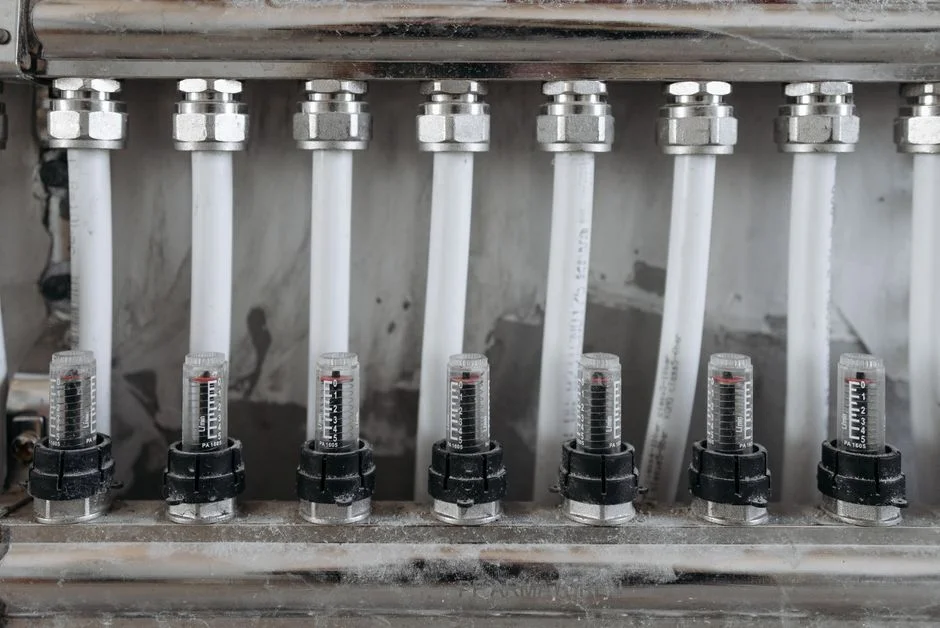
A semiconductor pretreatment train should assign each unit operation to a specific contaminant mechanism, and the supplied equipment specifications provide selection data rather than evidence of Foundry/SiPh compliance. Solids, oxidizers, dissolved metals, pH and total dissolved solids require different treatment functions; a single end-of-pipe system cannot be selected from flow data alone.
For suspended solids, oil and grease, and colloidal matter, an industrial DAF pretreatment system is a high-efficiency pretreatment option with automatic skimming. Its catalogued flow range is 4–300 m³/h. That range is selection information, not a demonstrated semiconductor-compliance envelope. Confirm actual wastewater chemistry, peak hydraulic loading, solids characteristics and final permit target before including DAF.
For solids control before membrane or reverse-osmosis equipment, a multi-media filter can remove suspended solids, turbidity and colloidal matter, providing downstream filtration that protects RO. The TOC monitoring for high-purity manufacturing provides relevant context for high-purity water systems, although TOC and semiconductor pretreatment are not interchangeable acceptance parameters.
A UF system for solids separation provides a chemical-free barrier for bacteria, colloids and suspended solids. Catalogued specifications include 0.03 micron PVDF membranes, a 2,000–40,000 L/h range, turbidity acceptance up to 300 ppm, automatic backwash and air scour. These values do not establish that every semiconductor stream will remain within those conditions; oxidizer compatibility, feed chemistry, cleaning requirements and peak loading still require engineering review.
Industrial reverse osmosis is presented as an option serving semiconductor applications, with up to 95% permeate recovery. Before selecting RO, perform an engineering check of feed chemistry, oxidizer removal, scaling, membrane compatibility and pretreatment requirements. Oxidizer residual is not a normal membrane-feed condition, and trace metals can compromise reclaim and membrane performance.
For precise pH or chemical control, a PLC-controlled chemical dosing skid can meter coagulants, flocculants, pH adjusters and specialty chemicals. Dosing must follow the approved permit, chemical-compatibility review and verified mixing performance; automatic controls do not replace that engineering basis.
ElectraMet states that hydrogen peroxide is essential to several wet cleans and that residual peroxide blocks reuse and hauling. The plant should request a dedicated oxidant-destruction duty and compatibility demonstration rather than assume DAF, UF or RO will perform that function. This treatment must avoid degrading the acid matrix or creating secondary contaminants.
Trace-metal polishing and analytical verification may be needed where reclaim, membranes or tool reliability are affected. The IWA Publishing study on flue-gas-desulphurisation wastewater discusses a mercury limit of 10 ng L−1, but that is an illustrative FGD monitoring benchmark—not a Foundry/SiPh semiconductor limit. Use it only to demonstrate why detection limits must be aligned with the receiving authority’s requirement.
For final solids separation, a lamella clarifier combines sludge recirculation, flocculation and inclined-plate separation. Its catalogued surface loading is 20–40 m/h, and chemical consumption is stated as up to 30% lower. Those are catalogued claims whose applicability must be checked against the actual wastewater train. The chemical-wastewater treatment guide provides additional context for comparing biological and targeted approaches.
| Contaminant mechanism or objective | Potential unit operation | Selection data | Mandatory engineering check |
|---|---|---|---|
| Suspended solids, FOG and colloids | DAF or clarification | DAF: 4–300 m³/h; automatic skimming | Actual matrix, peak solids loading, sludge route and permit target |
| Solids protection before RO | Multi-media filtration | Suspended solids, turbidity and colloidal-matter filtration | Compatibility with downstream membrane and oxidizer-removal requirements |
| Colloids and suspended solids | UF | 0.03 micron PVDF; 2,000–40,000 L/h; up to 300 ppm turbidity acceptance | Feed envelope, cleaning, redundancy and batch response |
| Dissolved-solids control | Industrial RO | Up to 95% permeate recovery | Oxidizer removal, scaling, membrane chemistry and pretreatment |
| pH and chemical dosing | PLC-controlled dosing | Coagulants, flocculants, pH adjusters and specialty chemicals | Approved limits, mixing, compatibility and dosing-range validation |
| Oxidizer residual | Dedicated oxidant destruction | No generic performance claim supported by the research | Oxidant identity, acid matrix, by-products, dwell time and destination |
| Trace metals | Targeted polishing and verification | Removal objective must come from permit or process need | Target metal, analytical method, detection limit and recovery effect |
| Final solids separation | Lamella clarifier | 20–40 m/h surface loading; chemical consumption stated as up to 30% lower | Flocculation chemistry, hydraulic peak and sludge handling |
Verify performance before the sewer connection
Sewer authorization should follow a documented evidence chain: source inventory, waste-notification application, permit and local-limit review, proposed process train, pilot or bench validation, installation and verification sampling, discharge authorization, and routine monitoring. A compliant-looking final sample does not compensate for an unmapped source stream or an unapproved treatment train.
Create a sampling plan that distinguishes daily averages from individual batch events. Where required by the permit, use flow-proportional or time-proportional collection and define how batch discharges affect the reported value. The receiving authority should approve sampling points, analytical methods, qualifiers, retention, flow measurement and reporting format. Include both average and peak conditions when evaluating process stability.
The scale of water use matters to reuse and treatment planning. Durban University of Technology’s study states that the industrial sector consumes nearly 20% of available fresh water and generates corresponding large effluent volumes. At semiconductor facilities, this supports separating reclamation objectives from sewer compliance, while recognizing that the research does not provide a Foundry/SiPh reuse ratio.
Production stability belongs in acceptance criteria. ElectraMet states that wastewater systems must protect production uptime and support reclaim goals without disrupting upstream processes. The supplier should therefore document isolation, bypass, upset response, control interlocks and recovery operating modes—not only removal performance under a steady laboratory feed.
For budget preparation, CWS provides useful units for calculating local fees: one industrial EDU equals 625 gallons per day, monthly usage is measured in CCF, and one CCF equals 748 gallons. COD and TSS strength surcharges may also apply. These are CWS billing examples, not Foundry/SiPh charges; obtain the receiving authority’s current rate structure and assess the permit basis for each applicable fee.
| Acceptance stage | Required evidence | Decision gate |
|---|---|---|
| Source characterization | Stream inventory, flow records, chemistry and batch-event data | Every proposed treatment step has a defined contaminant objective |
| Permit review | Local limits, prohibitions, monitoring rules, sampling point and surcharges | Design basis matches enforceable conditions |
| Validation | Pilot or bench results for the actual matrix and relevant excursions | Removal or polishing target is demonstrated |
| Installation verification | Installation records, calibration, controls, training and waste routes | Equipment and operating procedures match the approved plan |
| Compliance sampling | Representative samples, analytical results and flow records | Receiving authority grants discharge authorization |
| Operations | Monitoring records, corrective actions and periodic reports | Performance remains within permit conditions |
The MBR and activated-sludge comparison guide illustrates how biological-system selection depends on wastewater characteristics. For semiconductor streams, that comparison should not displace the source-specific, pretreatment-focused path established above.
Choose treatment and suppliers without buying an oversized system

Supplier comparison should begin with the design stream, not a generic flow range. Require each bidder to define peak and average flow, chemistry envelope, batch-dump response, treatment objective, footprint, utilities, control architecture, waste-generation route and acceptance-test method. This prevents a nominally sufficient unit from becoming a bottleneck when a validated matrix, upset condition or production sequence is introduced.
Compare modular treatment only after checking upstream compatibility. ElectraMet warns that conventional systems designed for steady state can struggle with tool-cycle variability, while targeted technologies may be needed at specific points in the wastewater architecture. Module boundaries should therefore follow segregation, treatment mechanism and recovery objectives.
Ask whether performance was demonstrated for the actual semiconductor matrix rather than a generic industrial-wastewater surrogate. A credible answer identifies the tested pH, metals, oxidizer, suspended solids, temperature and batch-loading conditions, along with analytical methods and detection limits. For a permit-critical claim, request the acceptance procedure, acceptance values and remedy for failed performance.
For sludge or precipitate handling, evaluate a plate-and-frame filter press for industrial solids separation. Its catalogued filtration areas range from 1 m² to 500 m², with manual, hydraulic or fully automatic PLC-controlled operation. The [decanter centrifuge equipment guide](/blog/12906-decanter-centrifuge-for-mining-wastewater-2026-guide.html) and [sludge dewatering specifications](/blog/2280-sludge-dewatering-equipment-in-new-zealand-2026-specs-and-cost.html) provide comparison context, but the selected route must match the wastewater chemistry, solids properties, destination and permitted disposal method.
| Procurement question | Evidence required | Risk if omitted |
|---|---|---|
| Was the design basis stream-specific? | Flow, chemistry, batch schedule and production assumptions | Oversized equipment with unresolved performance risk |
| Was compatibility demonstrated? | Material, oxidizer and chemical-compatibility documentation | Equipment damage, unsafe reactions or bypass |
| How will acceptance be measured? | Representative sampling plan, analytical methods and acceptance criteria | Disputed commissioning results |
| What is the waste route? | Sludge, precipitate and spent-chemical handling plan | Operating bottleneck after treatment |
| What is the lifecycle burden? | Chemical, sludge, monitoring, redundancy, operator and hauling costs | Purchase price masks the larger permit and operating exposure |
Treat lifecycle cost as a permit-risk decision. Include chemical consumption, sludge handling, monitoring, redundancy, operator burden, electricity and potential hauling. A lower purchase price does not compensate for a treatment train that cannot meet the approved limit, cannot accept a batch dump or creates a waste stream with no authorized destination.
Frequently Asked Questions
How much does semiconductor wastewater pretreatment cost near Foundry and SiPh?
The supplied research does not provide a valid Foundry/SiPh equipment price or sewer-fee estimate. A defensible budget requires the proposed stream inventory, average and peak flows, chemistry, batch-dump schedule, permit limits, monitoring requirements, selected treatment train, solids and chemical-disposal routes, utilities, redundancy and facility-access constraints. For fee-calculation inputs, Clean Water Services states that one industrial EDU equals 625 gallons per day and that one CCF equals 748 gallons; these are CWS units, not Foundry/SiPh tariffs. Request the receiving authority’s current permit, connection, capacity, usage and strength-surcharge schedules, then obtain supplier pricing against the same design basis.
What capacity is required for Foundry and SiPh semiconductor wastewater pretreatment?
Do not size the system from average flow alone. Separate average continuous rinsewater, peak flow and the instantaneous hydraulic and chemical load from batch dumps, then add the required treatment and equalization functions. Permit limits, stream chemistry, recovery objectives and the selected DAF, UF, RO, dosing or solids-handling configuration must be known before equipment capacity is finalized. A supplier should size and demonstrate the actual combination of continuous load and relevant batch excursions, including downstream treatment and disposal constraints.
Which supplier qualifications matter for semiconductor sewer pretreatment?
Require stream-specific test data using the actual wastewater matrix, a written guarantee tied to measurable acceptance criteria, chemical-compatibility information, control narratives, utilities, waste routes, commissioning methods and documents needed for the permit application. Also ask for evidence that the equipment handles the stated batch-dump response and maintains the claimed treatment objective during normal production variability. Generic capacity charts and results from surrogate wastewater do not answer these questions.
What are the main compliance risks before sewer discharge?
The supplied research does not state Foundry/SiPh numerical local limits, so final compliance depends on the applicable permit, current local limits, representative sampling and receiving-authority approval. The principal risks are mixing incompatible streams, under-sizing for batch discharges, failing to control oxidizer residual, selecting equipment outside its demonstrated chemistry envelope, using inadequate analytical methods, and discharging before authorization. The regional sewer-limits guide reinforces the need to use the receiving authority’s own rules rather than transfer limits from another jurisdiction.