Why a data center in Bannu cannot treat water the way a generic guide describes
Bannu is not a generic data-center site, and treating it as one risks oversizing freshwater intake while undersizing discharge permitting efforts. District Bannu sits inside Khyber Pakhtunkhwa, a province where the World Bank and Pakistan's water-resource planning rank among the most supply-constrained in the country, and where domestic and agricultural users compete for the same aquifer. Globally, roughly 57% of data centers draw cooling water from potable municipal or groundwater systems, per the 2026 UGA CAES Field Report — a model that does not transfer cleanly to a Bannu site without first engineering the reuse train.
The local public-health layer makes discharge management sensitive. A 2023 surveillance study by the University of Management and Technology reported that District Bannu is among the highest-burden districts in KP for acute flaccid paralysis (AFP) cases linked to poliovirus transmission, with wastewater identified as a transmission route. Any discharge pathway from a data center enters a regulatory and public-health environment where local wastewater infrastructure is under scrutiny, so the design cannot rely on "dilute and discharge" as a default.
On the technical side, evaporative cooling at roughly 4 cycles of concentration concentrates dissolved solids into a blowdown stream of 1,200–6,000 mg/L TDS, per Genesis Water Tech's 2026 blowdown-technology brief. At that concentration, sending blowdown to a KP municipal drain without treatment is incompatible with Pakistan's National Environmental Quality Standards (NEQS) and any provincial KP overlay. The practical consequence is that a Bannu train must be sized for high recovery and a defensible discharge stream from day one, rather than retrofitted after commissioning.
What cooling-tower blowdown actually contains and why it is hard to reuse
Cooling-tower blowdown (CTBD) is the controlled purge from a recirculating cooling loop. As water evaporates to reject heat, dissolved salts and treatment chemicals remain in the circulating water; to keep scaling and corrosion in check, operators bleed off a fraction of the loop. A data center cooling tower at 4 cycles of concentration typically loses 25–30% of its makeup water as blowdown, which is the recovery target a reuse train is designed against.
The chemistry of CTBD complicates reuse. Genesis Water Tech (2026) characterizes the stream as carrying elevated TDS in the 1,200–6,000 mg/L range, scaling minerals (calcium, magnesium, silica, alkalinity), suspended solids of 10–50 mg/L from corrosion products, biofilm fragments, airborne dust, and accumulated treatment chemicals including biocides, corrosion inhibitors, scale inhibitors, and dispersants. That mix rules out any single-barrier solution.
The membrane-stage limit is the binding constraint. Conventional brackish-water reverse osmosis (BWRO) on CTBD typically plateaus at 75–80% recovery because sparingly soluble salts — silica, calcium carbonate, calcium sulfate — reach scaling thresholds beyond that point, per IDE's 2026 review of CTBD reuse. Pushing recovery higher with conventional staging demands more pumps, interstage boosting, and aggressive chemical programs, which compounds cost and operating risk. Any reuse train for Bannu must polish suspended solids and biology, control scaling chemistry proactively, and either accept a conservative local recovery or pair RO with a salt-separation step to push overall recovery higher.
| Parameter | Typical CTBD range | Design implication for Bannu |
|---|---|---|
| Total dissolved solids (TDS) | 1,200–6,000 mg/L | Sets osmotic load on RO; favors antiscalant-dosed BWRO at conservative local recovery |
| Silica, calcium, magnesium, alkalinity | Elevated; scaling-prone at 75–80% recovery | Drives pretreatment and concentrate handling decisions |
| Suspended solids | 10–50 mg/L | Requires side-stream or multimedia filtration before any membrane |
| Treatment-chemical residues | Biocides, inhibitors, dispersants | Must be compatible with downstream membranes and any reuse end use |
| Biological content | Planktonic bacteria, biofilm fragments | Triggers UF barrier and downstream disinfection on reused makeup |
A sequenced treatment train that actually works in Bannu
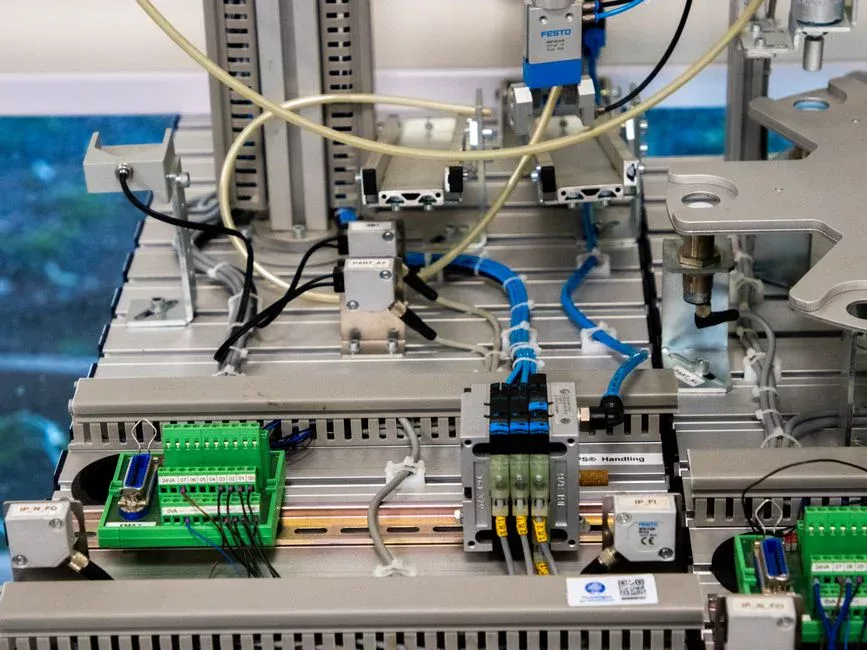
A defensible Bannu train is sequenced in five steps, with each sized for the water quality the previous step produces. These steps keep the RO stage inside its scaling envelope while ensuring the concentrate stream is either reusable, treatable, or compliantly dischargeable.
- Side-stream filtration on the cooling loop. A multimedia or self-cleaning spiral filter on 1–5% of circulation flow removes suspended solids, corrosion products, and biofilm carriers before they concentrate in the blowdown, per Genesis Water Tech (2026). This protects downstream unit operations and enables higher cycles of concentration. For this step, a multi-media filter for side-stream cooling-water filtration is the typical specification.
- Ultrafiltration as RO pretreatment. UF at 0.01–0.1 micron pore size runs at low pressure (10–30 psi) and recovers 90–95%, producing an SDI-stable feed for downstream RO, per Genesis Water Tech (2026). The relevant ultrafiltration pretreatment for cooling-tower blowdown is sized on blowdown flow.
- Antiscalant-dosed reverse osmosis at conservative local recovery. Operating at 150–400 psi, RO removes 95–99% of dissolved solids and produces a 10–50 mg/L TDS permeate suitable for blending back as cooling-tower makeup, per Genesis Water Tech (2026). Antiscalant chemistry and conservative local recovery keep the membrane stage inside the scaling envelope below the 75–80% BWRO ceiling identified by IDE (2026). An automatic antiscalant and biocide dosing skid is paired with an industrial RO system sized for blowdown recovery.
- Concentrate handling decision. If discharge rules and economics allow, the RO concentrate is sent to a controlled brine step. Options include an MVC brine concentrator at 95–98% recovery, a closed-loop high-recovery configuration (per the IDE MAXH₂O-style logic of removing sparingly soluble salts as solids to allow a near-NaCl closed loop), or a partial ZLD configuration. The choice is economic.
- Disinfection of reused makeup. A UV or ClO₂ polish on the permeate stream controls biological carryover from the cooling loop, which is necessary for an inland Pakistan site where downstream users and local drainage are sensitive to microbial loading.
The Konya data center blowdown treatment guide documents a comparable configuration in a similarly water-stressed setting.
Matching the train to Bannu conditions: reuse, compliant discharge, or ZLD
The right endpoint is an economic choice depending on Bannu-area discharge permits and available freshwater alternatives. Three end states cover nearly every data center case.
Cooling-tower makeup reuse is the highest-value end use: treatment reduces scaling potential, suspended solids, and biological content while remaining compatible with the existing cooling-water chemistry program, typically achieving 60–85% recovery on the blowdown stream, per Genesis Water Tech (2026). For a Bannu site facing KP supply constraints, this is the default first step.
Compliant discharge is the baseline for performance. Direct discharge fees in water-stressed regions run $5–$15 per thousand gallons, per Genesis Water Tech (2026), and some jurisdictions impose TDS caps that prohibit untreated blowdown discharge. NEQS and any KP provincial overlay set the limits a Bannu site must hit, and the train should be designed against those limits from day one.
Zero liquid discharge is justified only where freshwater alternatives are unavailable or discharge is prohibited. Full ZLD CAPEX runs $3–8 million for typical data center blowdown capacities, per Genesis Water Tech (2026). Partial ZLD — 80–90% volume reduction on the blowdown stream — captures most of the freshwater-saving benefit at a fraction of full ZLD cost, often serving as the optimal solution for an inland Pakistan site. For the polish step on reused makeup, a UV sterilizer on the reused makeup stream or a chlorine dioxide generator handles biological control without residuals that complicate discharge.
| Endpoint | Typical recovery | Best fit when | Key economic signal |
|---|---|---|---|
| Cooling-tower makeup reuse | 60–85% on blowdown | Freshwater is constrained; KP supply is unreliable | Avoided freshwater cost and reduced discharge volume |
| Compliant discharge (treated) | Varies by parameter | NEQS/KP limits are achievable; some discharge is permitted | Avoided discharge fees of $5–$15 per thousand gallons |
| Partial ZLD | 80–90% volume reduction | Discharge is constrained but not prohibited | Most freshwater benefit per dollar of CAPEX |
| Full ZLD | 95–99% | No discharge path; freshwater effectively unavailable | $3–8M CAPEX; only when alternatives are exhausted |
CAPEX, OPEX and what to ask a supplier in Pakistan
Cost bands for a Bannu-sized blowdown train are documented for the unit operations in the previous section. A 50,000 GPD RO skid treating blowdown runs $250,000–$500,000 installed, with OPEX of $1.50–$3.00 per thousand gallons treated including energy, chemicals, membrane replacement, and maintenance, per Genesis Water Tech (2026). An MVC brine concentrator sized for 10,000–30,000 GPD of concentrate runs $1–3 million in CAPEX and consumes 15–25 kWh per 1,000 US gallons of distillate produced, per the same source. A full ZLD system serving data center blowdown typically runs $3–8 million CAPEX and $5–$15 per thousand gallons OPEX, per Genesis Water Tech (2026). Buyers should treat these as the band the supplier must meet, not as a fixed quote.
For a Bannu project, supplier-qualification questions differ from a coastal or U.S. site. Ask for skidded, containerized designs that survive inland-Pakistan road transport from Karachi port to KP; PLC automation with remote monitoring so the Bannu operations team can supervise the train without daily on-site chemistry staff; documented compatibility with locally available antiscalants and cleaning chemicals; and reference performance on silica-bearing brackish feed. The data center cooling water sustainability options guide and the ultrafiltration design parameters guide are useful companions during specification review.
Frequently Asked Questions
What is a realistic CAPEX and OPEX range for a cooling-tower blowdown reuse train at a Bannu data center?
A 50,000 GPD RO skid treating blowdown is documented at $250,000–$500,000 installed with OPEX of $1.50–$3.00 per thousand gallons treated, per Genesis Water Tech (2026). Adding an MVC brine concentrator at 10,000–30,000 GPD adds $1–3 million CAPEX and 15–25 kWh per 1,000 US gallons of distillate. Full ZLD runs $3–8 million CAPEX and $5–$15 per thousand gallons OPEX. Buyers should request a sized budgetary quote against a specific feed analysis and target overall recovery, as published bands do not price Pakistan-bound logistics, duties, or local installation.
How do I size the RO and concentrate-handling stages for Bannu-area silica-bearing groundwater?
Size the RO stage to operate at conservative local recovery below the 75–80% BWRO scaling ceiling identified by IDE (2026), with antiscalant chemistry matched to the actual silica, calcium, and alkalinity numbers from
Frequently Asked Questions
What wastewater treatment does a data center in Bannu, Pakistan need in 2026?
Data centers in Bannu must implement multi-stage treatment to handle high-TDS (Total Dissolved Solids) groundwater and cooling tower blowdown. A standard 2026 configuration requires pre-treatment via multimedia filtration and ultrafiltration to remove suspended solids, followed by high-recovery reverse osmosis (RO) to manage scaling agents. Given the local climate, chemical conditioning for antiscalants and pH adjustment is mandatory to prevent silica precipitation before final discharge or reuse.
How much does a cooling-tower blowdown reuse system cost for a data center in Pakistan?
For a medium-scale data center, capital expenditure for a cooling tower blowdown recovery system typically ranges between $80,000 and $250,000 USD, depending on the required volumetric throughput and the sophistication of the brine management system. Operational costs in the Bannu region are influenced heavily by electricity tariffs and the frequent replacement of RO membranes necessitated by high-hardness feed water, often adding $0.15 to $0.40 per cubic meter of treated water.
Is ZLD (zero liquid discharge) worth it for a data center in Bannu, or is high-recovery RO enough?
Zero Liquid Discharge (ZLD) is generally not cost-effective for Bannu data centers unless specific environmental mandates are enforced by the Khyber Pakhtunkhwa Environmental Protection Agency. High-recovery RO is usually sufficient, as it can achieve 75–80% water recovery, significantly lowering the volume of blowdown. ZLD, which requires energy-intensive evaporators and crystallizers, typically carries a 300% higher operational cost than standard RO-based recovery systems.
What is the typical recovery rate of RO on cooling-tower blowdown, and why does it stall at 75–80%?
The practical recovery rate for cooling tower blowdown using standard RO technology is capped at 75–80% due to the saturation limits of sparingly soluble salts. Beyond this threshold, the concentration of calcium carbonate, calcium sulfate, and silica in the concentrate stream exceeds the solubility product constant, leading to rapid membrane fouling and irreversible scaling. While advanced batch RO or vibratory shear enhanced processing can exceed these limits, they are rarely deployed in standard Pakistani data center infrastructure due to complexity.
Which Pakistan effluent and reuse regulations apply to data center wastewater discharge in Khyber Pakhtunkhwa?
Data centers must comply with the National Environmental Quality Standards (NEQS) for Municipal and Liquid Industrial Effluents, as adopted and monitored by the Khyber Pakhtunkhwa Environmental Protection Agency (KP-EPA). Specifically, discharge must adhere to limits on BOD, COD, and TDS before entering municipal sewers or surface water bodies. Furthermore, if the treated water is reused for irrigation or cooling makeup, it must meet the specific standards for chemical safety and biological purity defined under the Pakistan Environmental Protection Act.