What an Effluent Treatment Plant in Sharjah Has to Handle in 2026
Sharjah's industrial base is heterogeneous, and the influent reaching an industrial ETP in Sharjah changes by sector: textile streams carry high colour and TDS, food and beverage plants generate fats, oils and grease (FOG) with high BOD, metal finishing contributes heavy metals and acid/alkali swings, pharmaceutical plants discharge APIs and solvents, and plastics operations release hydrocarbons and high-temperature condensate. The 2026 decision is not whether a Sharjah ETP is needed—discharge consent and reuse economics already make that case—but which unit-process train and how much polishing.
Two climatic realities shape every design. First, ambient temperatures remain high for most of the year, which raises biological reaction rates but also depresses dissolved oxygen saturation in aeration tanks, so blower and diffuser sizing must carry design margin. Second, TDS in the local municipal supply is high, which means any Sharjah plant targeting reuse should plan for a membrane polishing step (RO or NF) downstream of the biological stage; Schrader's PhD thesis at the University of Twente documents direct nanofiltration as a route to upgrade WWTP effluent to agricultural or potable-reuse quality. Where cooling-tower make-up or boiler feed is the target, RO and EDI downstream of UF become the realistic envelope, and the desalination load has to be sized against the source TDS rather than a generic figure.
The available footprint usually drives the first major split: civil builds (concrete tanks, on-site assembly) suit flows above ~500 m³/day where land is available, while containerised MBR packages suit 10–2,000 m³/day with tight civil windows. Before sizing anything, an engineer should match the sector's pollutant profile against the unit process, not the other way around.
The Process Flow of a Modern Industrial ETP
A modern industrial ETP runs in six sequential blocks. The exact equipment in each block depends on influent and reuse target, but the train itself is consistent across Sharjah sectors: equalise, remove solids and FOG, biodegrade organics, polish, disinfect, and dewater the sludge.
- Influent screening and equalisation. Rotary bar screens protect downstream pumps and membranes from rags and grit. Equalisation buffers diurnal flow and pH swings—a critical function in food and metal-finishing plants where batch discharges are common. A rotary mechanical bar screen is the usual first step.
- Primary physico-chemical. A DAF unit for primary FOG and TSS removal suits food, textile and metal-finishing streams with high FOG or colloidal loads. Lamella clarifiers are alternatives for high-TSS streams where dissolved-air flotation is not justified.
- Biological secondary. Activated sludge remains the baseline; an integrated MBR system adds submerged <1 μm membranes to the aeration tank, producing reuse-quality supernatant directly and halving the footprint relative to conventional activated sludge with a separate clarifier.
- Tertiary polishing. Ultrafiltration is the standard RO/NF pretreatment, removing residual suspended solids and protecting the high-pressure membrane from fouling. Direct nanofiltration as a polishing step is documented in Schrader's thesis at the University of Twente, which assessed NF as a technique for effluent reclamation to EU WFD and reuse standards.
- Disinfection. A pipeline UV sterilizer for reuse water delivers chemical-free disinfection suited to irrigation or cooling-tower make-up; chlorine dioxide is used where a residual is required in the distribution loop; ozone is reserved for refractory COD or colour removal in textile and dye-house effluents.
- Sludge handling. A plate-and-frame filter press for sludge dewatering produces a dry cake suitable for off-site disposal and reduces sludge volume—the largest single line item on the disposal OPEX.
| Block | Typical Equipment | Main Purpose |
|---|---|---|
| Screening & equalisation | Rotary bar screen, equalisation tank | Protect downstream equipment, buffer flow |
| Primary physico-chemical | DAF, lamella clarifier | Remove FOG, colloids, settleable TSS |
| Biological | Activated sludge or MBR | Degrade dissolved organics, nitrify |
| Tertiary | UF, NF or RO | Polishing to reuse or discharge quality |
| Disinfection | UV, ClO₂, ozone | Pathogen control, residual if needed |
| Sludge | Filter press, decanter centrifuge | Reduce sludge volume for disposal |
Choosing the Right Biological Step for a Sharjah ETP
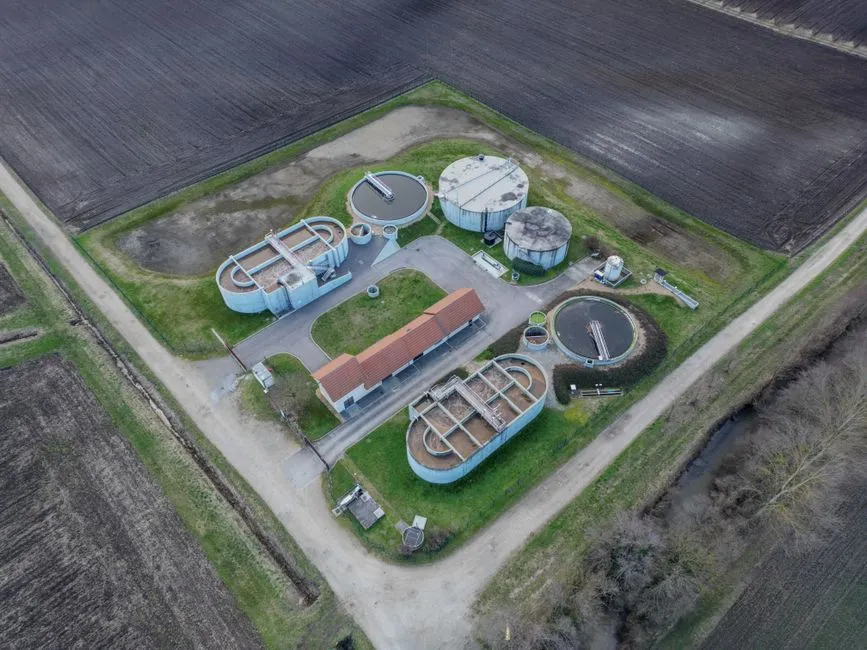
The biological reactor is the most capital-intensive single block and the largest OPEX line, so the choice should follow flow, footprint, reuse target and operator skill—not vendor preference. Das et al. (2025), modelling an activated-sludge ETP at a southern-India pharmaceutical plant, reported baseline removals of 98.8% turbidity and 93% BOD, but only 48% COD and 62% total nitrogen. The implication is direct: a conventional activated-sludge ETP alone will not meet reuse COD limits, and tertiary polishing is mandatory when reuse is the end use.
MBR combines activated sludge with submerged membranes in a single tank, which roughly halves the civil footprint and produces a supernatant that is already low in TSS and turbidity—typically suitable as RO feed after UF polishing. The trade-off is membrane-replacement cost and the need for operators trained in membrane maintenance. Containerised MBR packages are the most common 2026 build for Sharjah sites in the 10–2,000 m³/day range because the civil scope is limited to a slab and interconnecting pipework. For sites with intermittent discharge and a small footprint, sequencing batch reactors (SBR) remain a credible option, especially at sub-100 m³/day flows.
Where adjacent land is available, constructed-wetland polishing (Lei, Wageningen 2022) is documented as a tertiary stage for micropollutants and offers a low-energy alternative to advanced oxidation for the final polish. The wetland is a complementary step, not a replacement for biological treatment.
| Reactor Type | Footprint | Operator Skill | Best Fit in Sharjah |
|---|---|---|---|
| Conventional activated sludge | Largest (separate clarifier) | Standard | High-flow civil builds with land available |
| MBR (submerged membranes) | ~½ of conventional | Membrane-aware | Containerised packages, reuse targets, tight plots |
| SBR | Moderate | Standard + controls | Intermittent or low-flow sites <100 m³/day |
| Packaged A/O | Small | Standard | Municipal-style sewage, light industrial |
An integrated MBR system is the 2026 reference solution for industrial ETPs in Sharjah because it compresses civil works and delivers reuse-quality supernatant in a single step. A related option for sites with restricted below-grade work is an underground integrated sewage treatment package for small municipal or staff-accommodation flows.
Reuse vs Discharge: How Far Does the Treatment Chain Need to Go?
The end use of the treated water drives the polishing chain more than the influent does. Cooling-tower make-up typically requires RO after biological and UF polishing, with a side-stream conductivity target driven by the cycles of concentration the cooling system is designed for. Pharmaceutical or boiler-feed applications add EDI downstream of RO; an EDI system polishes RO permeate to the resistivity range that high-pressure boilers expect, without the chemical regeneration load of conventional ion exchange.
Irrigation reuse of WWTP effluent is feasible with NF polishing, as documented in Schrader's University of Twente PhD thesis, and at lower energy than full desalination because NF operates at lower pressure than RO. Direct sea or sewer discharge to Sharjah Municipality requires biological treatment plus disinfection, but the numeric consent limits must be confirmed with the authority before the design is frozen. A recent engineering guide on MBR as the 2026 standard lays out how reuse-grade operation changes both the biological and polishing blocks.
Energy, OPEX and What the 2026 Numbers Look Like
Aeration dominates the electricity OPEX of any biological ETP, and the lever documented in Das et al. (2025) is the most defensible energy number in the supplied research. Modelling the activated-sludge ETP at a southern-India pharmaceutical plant with a BioWin digital twin, the authors reported a 20% energy saving by reducing aeration time and alternating aerobic and anoxic conditions, alongside improved ammoniacal-nitrogen and COD removal. The same source documents rainwater harvesting of 23,292.5 KL/annually as a freshwater-offset lever at the same site—a useful comparator when a Sharjah buyer is sizing the freshwater make-up against treated-effluent reuse.
Sludge handling is the second major OPEX line. A plate-and-frame filter press for sludge dewatering reduces sludge volume and produces a stackable cake, which lowers disposal cost per cubic metre. Chemical OPEX is controlled by accurate dosing; an automatic chemical dosing skid avoids over- or under-dosing, reduces sludge mass, and keeps the downstream biological stage within its design envelope.
For reuse chains, the membrane stage has its own OPEX envelope: NF operates at lower pressure than RO but still needs periodic chemical cleaning, while RO and EDI together require high-quality feedwater, which is why UF is normally the protective barrier upstream of both.
Sizing Inputs You Must Gather Before Talking to a Sharjah ETP Supplier
A complete RFQ to any Sharjah ETP manufacturer starts with site data the buyer can collect, not with a vendor list. The table below is the minimum data set; any supplier quoting without these inputs is producing a budgetary estimate, not a bid.
| Input | Why It Matters |
|---|---|
| Average and peak daily flow, with diurnal curve | Sizes equalisation tank and hydraulic capacity |
| Influent BOD, COD, TSS, FOG, TN/TP, pH, temperature, salinity | Selects primary and biological process |
| Daily operating hours and seasonal variation | Sets hydraulic and load design factors |
| Available plot area, buried-installation constraints | Decides containerised vs civil build |
| Target end use of treated water | Drives need for NF, RO, or EDI polishing |
| Local discharge consent parameters | To be confirmed with Sharjah Municipality |
Two further items should be on the buyer's checklist: a list of the unit operations the buyer is willing to accept civil-built versus skid-mounted, and an O&M term the buyer is willing to commit to. A separate sizing guide for containerised MBR STP in Sharjah walks through how each input converts into a sized package, while a general review of industrial COD reduction methods is a useful cross-check on the biological step.
Frequently Asked Questions
What budget should a Sharjah buyer plan for an industrial ETP in 2026?
The actionable step is to issue a brief RFQ listing average and peak flow, influent parameters, target end use and plot area, and request itemised CAPEX and OPEX per cubic metre treated. Comparing at least three itemised bids on the same data set is the most defensible way to set a 2026 budget.
How do I choose between a containerised MBR and a civil-built ETP in Sharjah?
Use three filters: flow rate, available plot, and reuse target. Containerised MBR packages are the practical choice for 10–2,000 m³/day sites with limited civil scope, tight schedules, or a reuse target that benefits from the small footprint. Civil builds become competitive above
Frequently Asked Questions
What is the typical cost of an effluent treatment plant in Sharjah for a 50–200 m³/day industrial flow?
For a project of this capacity in Sharjah, capital expenditure typically ranges between AED 450,000 and AED 1.2 million, depending on the influent characteristics and the level of automation required. This estimate covers the electromechanical equipment, tankage, and control systems, but excludes civil works and land preparation.
Operational costs generally fluctuate between AED 1.50 and AED 3.50 per cubic meter of treated water, accounting for electricity, chemical dosing, sludge disposal, and routine membrane maintenance if an MBR system is utilized.
How do I choose between a containerised MBR and a civil-built activated sludge ETP for a Sharjah factory?
A containerised Membrane Bioreactor (MBR) is recommended for factories with limited plot space or those requiring a modular, scalable solution, as it provides a superior effluent quality suitable for non-potable reuse with a footprint 50% smaller than traditional systems. These units are pre-fabricated, allowing for rapid deployment and flexibility if the factory relocates.
A civil-built activated sludge ETP is more cost-effective for high-volume, long-term installations where space is abundant and the effluent profile is consistent. While civil construction requires a longer timeline, it offers lower mechanical complexity and reduced long-term component replacement costs compared to membrane-based systems.
What is the realistic lead time to design, build and commission a 100 m³/day ETP in Sharjah?
The total project lifecycle from initial design approval to final commissioning typically spans 16 to 24 weeks. The design and permitting phase requires approximately 4 to 6 weeks, while procurement and fabrication of major equipment take 8 to 12 weeks.
On-site installation and mechanical completion occur over 4 to 6 weeks, followed by a 2-week period for testing, seeding of biological cultures, and final performance validation to ensure the effluent meets discharge standards before official handover.
Which Sharjah authority issues industrial effluent discharge consents and what parameters are typically checked?
Industrial effluent discharge into the municipal sewer network is regulated by the Sharjah Municipality (SM) and, where applicable, the Sharjah Electricity, Water and Gas Authority (SEWA). Compliance is mandatory based on the specific industrial zone's bylaws.
Key parameters strictly monitored include Biochemical Oxygen Demand (BOD), Chemical Oxygen Demand (COD), Total Suspended Solids (TSS), Oil and Grease (O&G), pH levels, and heavy metal concentrations. Exceeding these limits often results in heavy fines or the suspension of trade licenses.
Can treated Sharjah ETP effluent be reused for landscape irrigation without a full RO step?
Yes, treated effluent can be reused for landscape irrigation without Reverse Osmosis (RO) provided the ETP achieves secondary or tertiary treatment levels that comply with the UAE standards for restricted irrigation. The process must consistently meet criteria for BOD (<20 mg/L), TSS (<30 mg/L), and fecal coliforms (<1000 CFU/100ml).
However, the system must include a robust disinfection stage, such as UV sterilization or chlorination, to ensure pathogen removal. If the industrial effluent contains high concentrations of Total Dissolved Solids (TDS) or specific salinity, RO may still be required to prevent soil degradation and plant toxicity.