
What a Filter Press Does and Where It Fits in a Dewatering Train
A recessed-plate or plate-and-frame filter press is a batch cake-filtration device: conditioned sludge is pumped under high pressure (or squeezed by an elastomeric diaphragm) against a pack of filter plates, water passes through the cloth as filtrate, and a compact cake is released when the plates separate at the end of each cycle. The unit sits downstream of thickening (gravity, DAF, or a high-efficiency sedimentation tank for sludge thickening upstream of the press) and upstream of cake disposal or incineration. Compared with the other two families the engineering literature benchmarks it against — vacuum filtration, exemplified by a vacuum belt, and centrifugal dewatering via a decanter centrifuge — the filter press belongs to the pressure-filtration family and is engineered to deliver the highest cake-solids output of any mechanical device.
The US EPA's fact sheet on recessed-plate filter presses (EPA 832-F-00-058, September 2000) states that this equipment "can produce the highest cake solids concentration of any mechanical dewatering equipment" and "is more commonly used in industrial applications than in municipal wastewater facilities." That positioning reflects the technology's appetite for chemical or thermal conditioning and its batch mode of operation. A representative industrial feed is the polymer-effluent sludge from the 2024 Processes retrofit study (Processes, 2024, doi:10.3390/pr12040703): roughly 9% dry solids, COD above 40,000 mg/L, TSS 10,500 mg/L and pH 8.5 — a colloidal emulsion that a conventional belt could only partially dewater. Engineers specifying a filter press for any feed should anchor the basis of design to that plate and frame filter press range from 1 to 500 m² while mapping the upstream conditioning step (lime, polymer, steam, or skeleton builder) into the same scope.
Filter Press Advantages: Cake Solids, Capture Efficiency, and Compliance
A filter press produces the highest cake-solids concentration of any mechanical dewatering device (EPA 832-F-00-058, September 2000). That single claim drives most of the advantages the engineer is asked to defend in a CAPEX review. Conventional mechanical dewatering typically reaches about 20% dry solids (DS); fibrous sludges from pulp and paper can reach 50–60% DS on simpler equipment, while the 2024 polymer-sludge retrofit lifted cake solids from 19% (vacuum belt) to 35% with a recessed-plate press (Processes, 2024, doi:10.3390/pr12040703). The literature commonly quotes a baseline "filter cakes with a moisture content of around 80%" (Processes, 2024); a 35% DS cake is therefore a step change in moisture removal relative to that benchmark.
Filtrate quality is the second advantage that converts an internal sceptic. In the same retrofit the filtrate from the filter press "met local discharge regulations" and was disposed of directly without further treatment (Processes, 2024), removing a secondary treatment load that the previous vacuum-belt filtrate imposed via a recycle stream back to the head of the effluent plant. Solids capture efficiency is also high when the cloth and any precoat are specified correctly. A plate-frame press with cotton cloth at 4% w/w CaCO₃ feed reached 56.00% removal efficiency (BRIN JTL study 218), and the 2024 case study attributes spontaneous cake release to a diatomaceous-earth precoat — a configuration that protects the cloth and keeps capture efficiency stable across cycles (Processes, 2024).
Operating-cost upside is the third advantage, and the one a procurement manager will press on. The 2024 retrofit delivered annual cost savings of up to 50%, driven mainly by the reduction in wet tonnage sent to disposal once cake solids moved from 19% to 35% (Processes, 2024). Filter cake moisture content is the technical lever: every additional point of cake DS cuts the tonnage a hauler takes to landfill, and that hauler cost is the dominant OPEX line for most industrial sites. Engineers who want to convert the headline claim into a line item should request a side-by-side solids-capture and cake-moisture test on their own sludge before signing the PO, and they should size the plate and frame filter press range from 1 to 500 m² to the disposal tariff, not just the hydraulic load.
Filter Press Disadvantages: Batch Cycle, Footprint, Cloth, and Conditioning
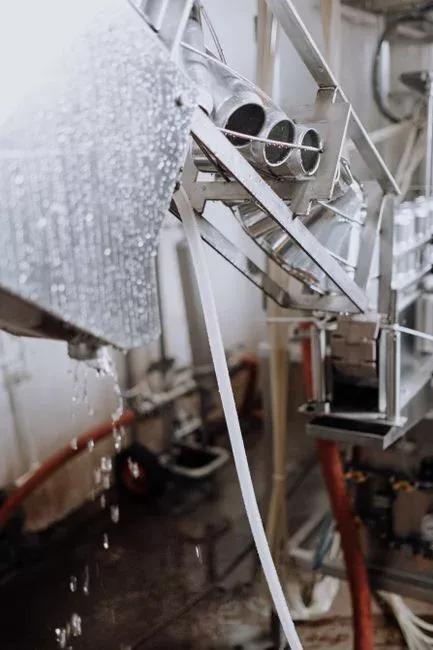
Every advantage above has a paired drawback, and an honest specification addresses both. The first is batch, not continuous, operation: each cycle is fill–press–cake discharge–cloth wash, and the hourly throughput a buyer is quoted is the average over the full cycle, not a continuous rating. The 2024 case study reports 108 m³ of sludge processed per month over 50 h of run time, equivalent to 2,160 L/h through the prior vacuum belt (Processes, 2024). A filter press sized to match or beat that 2,160 L/h figure must be specified on the basis of an average cycle that includes cloth-wash time, not on the pump's instantaneous flow.
Second, the high-pressure feed system and hydraulic closure raise both CAPEX and the structural demand on the building. A 1–500 m² press needs a high-pressure feed pump (typically 7–15 bar for recessed-plate units, higher with a diaphragm squeeze stage), reinforced foundations, and a hydraulic power pack for plate closure. Third, filter-cloth blinding and wear drive recurring OPEX: the 2024 retrofit used a diatomaceous-earth precoat so cakes "dislodged spontaneously"; without that precoat, cloth life shortens and wash-water consumption rises (Processes, 2024). Fourth, chemical or thermal conditioning is typically required — the same case study dosed lime plus steam ahead of pressing to release bound water and stabilise odours, and that automatic chemical dosing system for lime and polymer conditioning must be in the same supply scope as the press itself.
Footprint is the fifth drawback. A recessed-plate press plus cake-handling skip plus cloth-wash station occupies more floor area than a decanter centrifuge of similar solids throughput, and the headroom required to open the plate pack drives the building height. Safety and maintenance close the list: high-pressure hydraulics, manual plate handling during cake discharge, and confined-space entry for cloth changes all need written procedures, lockout/tagout, and routine inspection of the hydraulic hoses and plate-pack seals. Each of these drawbacks has a documented mitigation, summarised in the table below.
| Disadvantage | Concrete mitigation |
|---|---|
| Batch throughput | Size plate area and number of cycles to match upstream feed rate; verify cycle includes cloth-wash time. |
| High-pressure feed system | Specify diaphragm-squeeze stage to cut cycle time; use variable-speed feed pump for pressure ramp. |
| Cloth blinding and wear | Apply diatomaceous-earth precoat; match cloth weave (cotton, polypropylene, monofilament) to sludge particle size. |
| Conditioning chemistry | Integrate an automatic chemical dosing system; add steam injection for thermal release of bound water. |
| Footprint | Use recessed-plate pack rather than plate-and-frame; mount cake skip on a mezzanine to recover floor area. |
| Plate handling / safety | Specify fully automatic PLC-controlled plate shifting; lockout procedures on hydraulic pack. |
Filter Press vs Vacuum Belt vs Decanter Centrifuge: Parameter Comparison
The buyer's real decision is not "filter press: yes or no" but "filter press versus vacuum belt versus decanter centrifuge on this sludge." The table below is the single asset the top SERP results do not provide: a side-by-side parameter comparison on the same axes, anchored to the 2024 polymer-sludge case study numbers so the buyer can hand it straight to procurement. The −0.3 bar vacuum figure for the belt and the 2,160 L/h belt throughput come from the 2024 retrofit (Processes, 2024, doi:10.3390/pr12040703); the cake-solids comparison is on the same feed and the same conditioning chemistry.
| Parameter | Recessed-plate / plate-and-frame filter press | Vacuum belt filter | Decanter centrifuge |
|---|---|---|---|
| Feed %DS (typical) | 2–10% (case study: ~9%) | 2–8% (case study: ~9%) | 1–5% |
| Achieved cake %DS | 30–45% (case study: 35%) | 15–25% (case study: 19%) | 20–35% |
| Solids capture efficiency | High; 56.00% CaCO₃ at 4% w/w with cotton cloth (BRIN JTL 218); high capture on polymer sludge (Processes, 2024) | Moderate; filtrate returned as recycle (Processes, 2024) | Moderate to high; dependent on bowl speed and differential |
| Operating duty | Batch (fill, press, discharge, wash) | Continuous | Continuous |
| Typical pressure / vacuum | 7–15 bar feed; up to 30 bar with diaphragm | −0.3 bar vacuum (case study) | 2,000–4,000 G centrifugal |
| Throughput reference | Match 2,160 L/h by plate-area sizing (case-study belt rate, Processes, 2024) | 2,160 L/h, 108 m³ per month over 50 h (Processes, 2024) | 5–50 m³/h typical industrial range |
| Filtrate handling | Often directly dischargeable (case study: met local regulations, Processes, 2024) | Filtrate contaminated; returned as recycle (Processes, 2024) | Centrate typically returned to head of plant |
| Footprint | Largest (plate pack + cake skip + wash station) | Medium | Smallest for given capacity |
| CAPEX band | High (hydraulics, plate pack, dosing system) | Medium | Medium to high |
| OPEX drivers | Cloth replacement, lime/polymer dose, hydraulic power, cake transport | Belt wear, vacuum pump power, cake transport | Power, polymer dose, wear parts (scroll, bowl) |
| Best-fit sludge | Colloidal / fine inorganic sludges; chemical, polymer, mining; sludges needing 30–45% cake DS for landfill routing | Lower-solids feeds where recycle is acceptable; smaller flows | Oil & gas, food, municipal biosolids; continuous duty |
Two specific findings reshape the comparison. First, fibrous sludges such as pulp and paper can already reach 50–60% DS on simpler equipment (Processes, 2024), which compresses the filter press's advantage window and pushes selection toward a screw press or belt press. Second, a decanter centrifuge wins on continuous duty and footprint, but a recessed-plate press is still the higher-solids mechanical option per EPA 832-F-00-058 (September 2000). When the plate and frame filter press range from 1 to 500 m² is sized to the same hydraulic load as the 2,160 L/h belt, the dry-cake tonnage and the dischargeable filtrate are the deciding factors.
When a Filter Press Is the Wrong Choice
A filter press is the wrong tool when the disadvantages above dominate. The first category is sludge that responds poorly to chemical or thermal conditioning: low-filterability feeds, very fine colloids, or oil-bound cakes will not yield to pressure alone, and the specific resistance to filtration (SRF) of the feed sets the floor on cycle time and cake dryness. Engineers should request an SRF or capillary suction time (CST) test on their actual sludge before specifying a press, and refuse the order if the SRF sits in the poor-filterability band. The second is very small flows where batch operation creates unacceptable idle time and a skid-mounted screw press or DAF-thickener is sufficient for the disposal route. The third is sites with no space for the press, cake skip, and cloth-wash station, in which case a high-efficiency sedimentation tank for sludge thickening upstream of the press plus a decanter centrifuge is a better fit.
The fourth is applications where the cake must go to incineration and very high dryness is the priority: a filter press will deliver higher cake DS than a belt, but the longer cycle time of a high-DS run can throttle throughput. Engineers should model the trade-off between cake %DS and cycles per shift explicitly. The fifth is municipal plants with continuous 24/7 hydraulic loading, where the EPA fact sheet notes that recessed-plate presses "are more commonly used in industrial applications than in municipal wastewater facilities" (EPA 832-F-00-058, September 2000) — a belt press or centrifuge is operationally simpler for that duty pattern. None of these exclusions cancels the technology; they define the boundary of where its advantages actually show up in a tender.
ROI and Payback: A Worked Example From a 2024 Retrofit
The 2024 polymer-sludge retrofit is the cleanest published example of a filter press ROI a procurement manager can act on. After replacing a vacuum belt with a recessed-plate press, the site recorded annual cost savings of up to 50% and a payback period of 1.5 years (Processes, 2024, doi:10.3390/pr12040703). The mechanism is straightforward: cake solids moved from 19% to 35%, which directly cuts the wet tonnage a hauler takes to disposal, and the filtrate met local discharge regulations with no further treatment, which removes a secondary-treatment load on the head of the effluent plant. The same study notes that the 80%-moisture figure is the typical baseline for filter cakes, so a 35% DS cake sits well below that benchmark in water content.
For a buyer building a budget, the table below maps the published claim to the line items that need a vendor quote. Every number in the table outside the 50% / 1.5-year figures is a scope item a buyer should request, not a quoted value: the Processes paper does not break out CAPEX in a public line-item form, so request these inputs from shortlisted vendors instead of assuming them.
| Category | Line item to request from vendor | Source of evidence |
|---|---|---|
| CAPEX | Press body and plate pack, sized to 2,160 L/h feed rate | Processes, 2024 (feed rate); sizing on plate and frame filter press range from 1 to 500 m² |
| CAPEX | High-pressure feed pump | Processes, 2024 (high-pressure operation) |
| CAPEX | Diaphragm squeeze stage (if specified) | EPA 832-F-00-058 (pressure-filtration family) |
| CAPEX | Cloth material and diatomaceous-earth precoat dosing | Processes, 2024 (precoat enabled spontaneous cake release) |
| CAPEX | Cake-handling skip | Processes, 2024 (cake discharge described) |
| CAPEX | PLC / automation | Operating-pattern requirement |
| OPEX | Lime + steam conditioning dose | Processes, 2024 (lime + steam conditioning chemistry) |
| OPEX | Cloth replacement frequency | Processes, 2024 (cloth blinding / wear cited) |
| OPEX | Wash-water use | Processes, 2024 (cloth-wash step in cycle) |
| OPEX | Hydraulic power | Standard filter-press load |
| OPEX | Cake transport and disposal tonnage | Processes, 2024 (50% OPEX reduction attributed to lower tonnage) |
| Result | Annual cost savings up to 50%; payback 1.5 years | Processes, 2024, doi:10.3390/pr12040703 |
Sizing, Supplier Selection, and Compliance Checklist
Moving from decision to action means handing a vendor a complete sizing pack. The minimum inputs are feed flow (m³/h), feed %DS, target cake %DS, acceptable cycle time, cloth material, available footprint, and the local discharge standard the filtrate must meet. The 2024 case study used ~9% feed DS and a target cake DS of 35% on a 2,160 L/h feed (Processes, 2024); any vendor who cannot tell you the cycle time at those numbers including the cloth-wash step is not quoting against the right basis. Compliance must be confirmed before specifying the press: the same study explicitly states the filtrate "met local discharge regulations" (Processes, 2024), but that outcome is sludge-specific and the buyer must verify it on the actual feed rather than assume it.
For supplier selection, score the candidate on plate-pack material (polypropylene for corrosion resistance, cast iron for high pressure, stainless for hygienic duty), hydraulic versus fully automatic PLC operation, reference installs on similar sludge, and after-sales cloth and spare-parts supply. Lead-time and scope risk deserve equal weight: clarify whether the press is a standard model or engineered, whether the precoat and dosing system are in the same supply scope, and who owns the plate-pack alignment procedure during commissioning. Engineers building a broader plant water strategy can also reference our coverage of high water volume management best practices for manufacturing and the related UASB reactor advantages and disadvantages engineering guide to position the press against the upstream biology.
Frequently Asked Questions
What is a realistic budget for a recessed-plate filter press in 2026?
CAPEX scales with filtration area, plate-pack material, and the level of automation, so a plate and frame filter press for sludge dewatering is sold in a range from small skid units to large engineered systems (HydropureWater product catalog, 2026). The 2024 retrofit showed the operating side delivering annual dewatering cost savings of up to 50% and a 1.5-year payback on a polymer-sludge duty (Processes, 2024, doi:10.3390/pr12040703). Request a vendor quote that breaks the price into press body and plate pack, high-pressure feed pump, diaphragm squeeze (if specified), cloth and precoat dosing, cake skip, and PLC/automation so the CAPEX is auditable rather than a single lump sum.
How do I pick the right supplier for an industrial filter press?
Shortlist on plate-pack material, automation level, reference installs on a comparable sludge, and the supplier's ability to deliver cloth, precoat dosing, and spare parts as one scope. The 2024 case study credits spontaneous cake release to a diatomaceous-earth precoat (Processes, 2024), so the precoat system must be inside the same supply scope as the press, not a separate purchase. Ask each vendor for cycle time at your target cake %DS including the cloth-wash step, and confirm in writing that the filtrate will be tested against your local discharge standard before the PO is released.
Which sludge types should rule out a filter press?
Rule out a filter press for sludges with poor filterability (very high SRF, very fine colloids, oil-bound cake), for very small flows where batch operation creates idle time, and for municipal plants with continuous 24/7 hydraulic loading where the EPA fact sheet notes recessed-plate presses are less common than in industrial service (EPA 832-F-00-058, September 2000). Fibrous sludges such as pulp and paper can already reach 50–60% DS on simpler equipment (Processes, 2024), which compresses the filter press's advantage window and pushes selection toward a screw press or belt press.
What cake dryness do I need for landfill or incineration routing?
That is a destination-specific question and the buyer must request the local landfill or incinerator's cake %DS specification before specifying the press. The 2024 polymer-sludge retrofit used a 35% DS cake (Processes, 2024) and reported a 50% OPEX reduction against a 19% DS vacuum-belt baseline; the EPA fact sheet frames a recessed-plate press as the highest-solids mechanical option (EPA 832-F-00-058, September 2000). Treat the 35% DS figure as one data point, not a universal threshold, and confirm the disposal route's moisture limit with the receiving site.