What 'Sizing' a Containerized MBR STP Actually Means in Atlanta
Sizing a containerized MBR is not a single rated capacity but a five-input decision: design flow, peak factor, influent BOD/COD load, effluent target, and ISO container envelope. Pure Aqua's MBR-C uses a 50 gpd per capita design flow assumption, and MENA-Water ships in standard 20' and 40' high-cube ISO containers, which means the sizing output should land on one of those standard envelopes (Pure Aqua, MBR-C specification page; MENA-Water, MBR Sewage Treatment Plant).
For an Atlanta project, those five inputs must be reconciled with Georgia EPD requirements and any local sanitary sewer pretreatment ordinance before a kW or m³/day can be locked in. The receiving sanitary sewer authority — not the equipment supplier — sets the local BOD, TSS, and FOG discharge limits. A defensible sizing memo therefore states each input, the source of the value, and the regulatory hook that constrains it, so a reviewer can see that the container envelope was selected from the flow and load, not the other way around.
The result is a documented basis: a daily flow in gpd and m³/day, a peak-hour flow, an organic load, an effluent target, and a container envelope. That packet is what you bring to a supplier as the RFQ attachment; without it, the supplier is guessing, and the price reflects the guess.
Step 1 — Build the Design Flow from Population and Use Pattern
Start from the 50 gpd per capita figure that Pure Aqua publishes for MBR-C sizing (Pure Aqua, MBR-C specification page). For a residential project, request occupied-unit count and bedroom count from the developer, because two-person and four-bedroom homes produce different per-unit peaks even when the per-capita average looks similar. For a camp, request maximum headcount, session length, and any concurrent facility use (kitchen, laundry, showers), since meals and showers drive peak-hour surges.
Convert US gpd to m³/day using 1 m³ = 264.2 US gallons from the IDA Water Security Handbook; this avoids the most common unit-conversion error in US MBR specs (IDA Water Security Handbook, 2019, p. conversion table). The arithmetic for a 200-person camp, for example, is 200 × 50 gpd = 10,000 gpd, which converts to 10,000 / 264.2 ≈ 37.8 m³/day average daily flow.
Apply a peak hourly factor above the average daily flow. Confirm the local sewer authority's required peaking allowance before final sizing, because Atlanta jurisdictions differ. A defensible RFQ states the average daily flow, the assumed peak factor, and the source of the factor in the same line, so the supplier can size the equalization and pumping against a known target.
Step 2 — Characterize the Load (BOD, COD, NH₃, FOG)

For residential and camp sewage, request typical per-capita BOD, COD, TSS, NH₃-N, and FOG figures from the supplier, because the research does not publish them. The supplier's reference plant data, expressed in mg/L or lb/day per 1,000 gpd, is what you rebase to your project's flow. Without that rebasing, the container envelope selected on flow alone can fail the discharge limit on load.
MBR technology can sustain a higher mixed-liquor suspended solids concentration than conventional activated sludge, which is why a small container can handle a high organic load — but only if the upstream load is characterized (MENA-Water, MBR Sewage Treatment Plant; HUBER Technology, MENA-Water MBR Complete Plants). A 20' container sized on flow will undersize the biology if the influent runs two or three times typical residential strength — a common situation at remote camps with kitchen and laundry flows concentrated into short windows.
If the camp has a commercial kitchen, confirm FOG limits with the receiving utility and decide whether a DAF pre-treatment unit is required before the container, or whether a grease trap and the supplier's standard drum screen are sufficient. Pure Aqua lists drum-screen pre-treatment (1.5 mm perforation) as standard on MBR-C, so a rotary mechanical bar screen upstream is a defensible addition only where the site carries debris the drum screen would otherwise handle alone.
Step 3 — Match the Flow to a 20' or 40' High-Cube Container
MENA-Water confirms MBR package plants are standardized ISO sizes, with a single 40-ft container capable of up to 1,200 m³/day — the upper bound that covers almost all Atlanta residential and camp projects (MENA-Water, MBR Sewage Treatment Plant). Pure Aqua's MBR-C is offered in 40' and 20' high-cube containers, so the output of sizing is always one of those two standard envelopes (Pure Aqua, MBR-C specification page). A containerized MBR system from either manufacturer is the unit type a US installer is prepared to receive, crane, and connect.
For Atlanta sites, check that the chosen container fits site access (truck reach, crane radius, setback from property lines) before locking the envelope. A 40' HC needs roughly 40 ft of straight truck approach plus crane radius for the lift; a 20' HC can usually be placed on a tighter residential pad. The decision is rarely about capacity at this scale — it is about access, future expansion headroom, and whether the supplier standardizes the smaller envelope for the project's flow band.
| Population served | Average daily flow (50 gpd per capita) | Recommended ISO envelope |
|---|---|---|
| Up to ~50 persons | Up to ~2,500 gpd (≈9.5 m³/day) | 20' high-cube container |
| 50–250 persons | 2,500–12,500 gpd (≈9.5–47 m³/day) | 20' HC, or 40' HC if peak factor or future expansion warrants |
| 250–2,000 persons | 12,500–100,000 gpd (≈47–378 m³/day) | 40' high-cube container |
| 2,000–24,000 persons | 100,000–1,200,000 gpd (≈378–4,540 m³/day) | Multiple 40' HC units in parallel |
The table uses 50 gpd per capita from Pure Aqua and the 1,200 m³/day single-container ceiling from MENA-Water. All flows are average daily; apply the local peak factor before final selection.
Step 4 — Confirm the Membrane Cut and Effluent Target
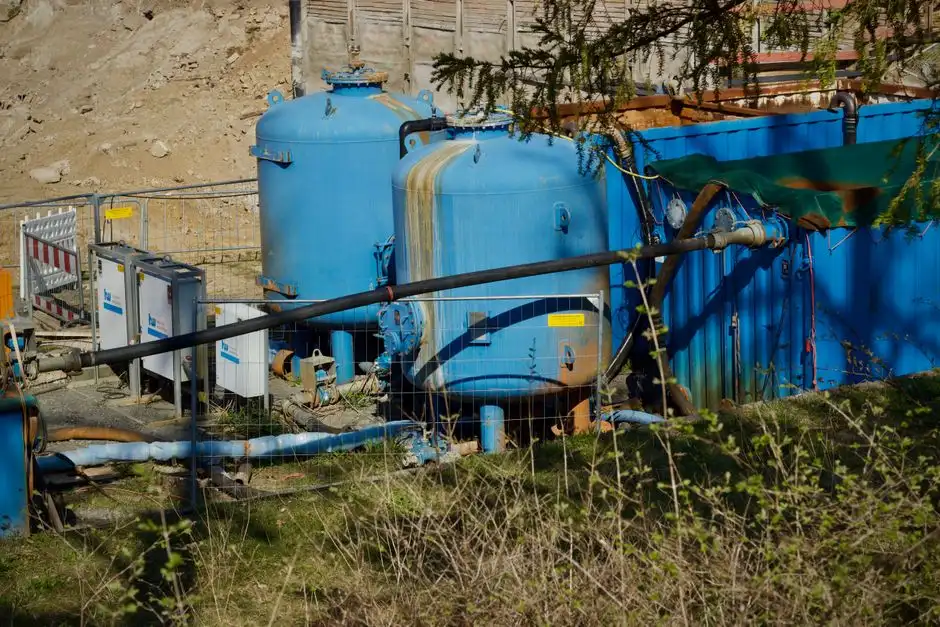
Pure Aqua's MBR-C uses hollow-fiber UF membranes with a 0.04 µm nominal pore size; MENA-Water describes UF pore sizes in the 2–100 nm range — both produce effluent suitable for subsurface irrigation or sewer discharge (Pure Aqua, MBR-C specification page; MENA-Water, MBR Sewage Treatment Plant; HUBER Technology, MENA-Water MBR Complete Plants). A flat-sheet MBR membrane module or a hollow-fiber module both deliver this pore-size band; the choice between them is a supplier preference, not a discharge-limit decision at the residential/camp scale.
HUBER/MENA-Water note that UF retains activated-sludge flocs and the smallest solid particles, so suspended solids in the effluent are effectively zero — useful when the receiving utility has a tight TSS limit (HUBER Technology, MENA-Water MBR Complete Plants). For a project specifying replacement UF membrane elements as spares, confirm the supplier's part number matches the installed module, because PVDF hollow-fiber and flat-sheet replacements are not interchangeable.
If denitrification is required, specify an anoxic zone in the bioreactor; Pure Aqua lists this as a standard MBR-C feature (Pure Aqua, MBR-C specification page). Confirm with the receiving utility whether total nitrogen is regulated; if it is, the anoxic zone must appear on the P&ID, not just in the supplier's option list.
| Membrane specification | Value | Source |
|---|---|---|
| Membrane type (MBR-C) | Hollow-fiber UF, PVDF (TIPS), submerged | Pure Aqua, MBR-C specification page |
| Nominal pore size (MBR-C) | 0.04 µm | Pure Aqua, MBR-C specification page |
| UF pore size range (general) | 2–100 nm | HUBER Technology, MENA-Water MBR Complete Plants |
| Pre-treatment perforation (MBR-C) | 1.5 mm drum screen | Pure Aqua, MBR-C specification page |
| Denitrification | Anoxic zone, standard option | Pure Aqua, MBR-C specification page |
Step 5 — Verify Site Utilities and Climate Envelope
Confirm 460V/3Ph/60Hz three-phase power is available at the pad; Pure Aqua lists this as the standard MBR-C electrical supply (Pure Aqua, MBR-C specification page). A residential lot served only by single-phase 240V will need a utility-side service upgrade, and that lead time can exceed the container's fabrication lead time. Confirm the service size at the quote stage, not at the install stage.
Design operating temperature is 68°F (20°C) with an operating range of 68–86°F (20–30°C) for MBR-C; for an uncovered Atlanta site in winter, plan insulation or a small building enclosure (Pure Aqua, MBR-C specification page). Atlanta winter nights regularly fall below the stated operating range, and biological activity drops with temperature even if the membranes themselves do not freeze. Pure Aqua lists insulated container walls as a standard MBR-C build feature, which is the right answer for most US sites.
Specify remote monitoring at the quote stage — Pure Aqua lists it as an available MBR-C option, and MENA-Water offers back-office remote support for both performance and maintenance (Pure Aqua, MBR-C specification page; MENA-Water, MBR Sewage Treatment Plant). For a residential community or a camp with no on-site operator, remote monitoring is the difference between a plant that runs and a plant that runs unattended.
Worked Example — 200-Person Camp in Metro Atlanta
Design flow: 200 persons × 50 gpd = 10,000 gpd; convert to m³/day using 1 m³ = 264.2 US gallons from the IDA Water Security Handbook, giving roughly 37.8 m³/day average daily flow (Pure Aqua, MBR-C specification page; IDA Water Security Handbook, 2019, p. conversion table). Apply the local peak factor — confirm with the receiving sewer authority — to land on a peak hourly flow for pump and equalization sizing.
Container selection: 37.8 m³/day is well below the 1,200 m³/day ceiling of a 40-ft container, so a 20' high-cube ISO container is the appropriate starting point; a 40' HC can be reserved for headroom or future expansion (MENA-Water, MBR Sewage Treatment Plant; Pure Aqua, MBR-C specification page). The smaller envelope also reduces crane radius and truck-reach requirements, which matters on a camp site with limited access.
Effluent target: confirm with the receiving utility whether sewer discharge or surface irrigation applies; if irrigation, the MBR's near-zero TSS effluent typically qualifies without tertiary filtration (HUBER Technology, MENA-Water MBR Complete Plants). For a camp on a tight lot with no irrigation option, the receiving sanitary sewer is the usual path, and the local utility's pretreatment ordinance controls.
Pre-treatment: a rotary mechanical bar screen is appropriate upstream of the MBR-C drum screen for a camp with outdoor recreation debris; a DAF unit is only needed if FOG from a commercial kitchen exceeds the receiving utility's limit (Pure Aqua, MBR-C specification page). For most 200-person camps without a commercial kitchen, the standard drum screen plus a grease trap is enough. For a more detailed comparison of biological carrier options at similar flow, see the MBBR capacity and sizing guide, and for an analogous UK jurisdiction worked example see the Birmingham containerized MBR sizing guide.
Choosing a Supplier and Reducing Delivery Risk
Request factory witness testing of the containerized MBR before shipment — Pure Aqua and MENA-Water both highlight that quality testing at the factory is what enables 'Plug & Play' site delivery (MENA-Water, MBR Sewage Treatment Plant; Pure Aqua, MBR-C specification page). Witness testing is the single step that converts a fabricated container into a defensibly accepted unit, and the FAT report should be attached to the RFQ as a deliverable.
Ask for documented performance on residential or camp sewage, not just industrial or municipal references. The hydraulic and organic profile of camp sewage is closer to residential than to industrial, and a supplier whose reference plants are all food-and-beverage or refinery work may not have tuned the biology to the lower, more variable load. Reference-list scrutiny is a faster risk screen than a year of operating data.
For US delivery, confirm insulation of container walls and zero water leakage as standard build features (Pure Aqua lists both for MBR-C) (Pure Aqua, MBR-C specification page). Use a checklist of pre-ship, in-transit, and on-site acceptance criteria to avoid acceptance disputes after delivery — the checklist should reference the FAT report, the container's IP rating, the membrane serial numbers, and the as-built P&ID. For a broader set of plant-side practices relevant to high-flow sites, the high water volume management practices article covers utility-side considerations that overlap with camp and residential plant operation.
Frequently Asked Questions
How much does a containerized MBR sewage treatment plant cost for a small residential or camp project in Atlanta?
The research does not publish a price for an MBR-C or a MENA-Water containerized MBR, so the only defensible answer is to request a current quote from the supplier with your five-input sizing packet attached. A useful input check before that quote: state the population, the gpd, the m³/day conversion, the peak factor, and the effluent target in the RFQ so the supplier is pricing the same scope you are sizing.
What size containerized MBR do I need for 200 people in the Atlanta metro?
At 50 gpd per capita, 200 persons produce about 10,000 gpd or roughly 37.8 m³/day average daily flow, which sits well within a 20' high-cube ISO container. The 20' envelope is the right starting point; select a 40' HC only if the local peak factor, the organic load from a commercial kitchen, or a planned expansion pushes the design above the 20' envelope's capacity band.
How do I confirm the effluent target is right for a Georgia EPD and local-utility discharge?
Route the effluent-target question to the receiving sanitary sewer authority and to Georgia EPD, not to the equipment supplier, because the limits are set by the discharger, not the manufacturer. The supplier can tell you what the MBR will produce; the regulator tells you what the MBR must produce, and the two numbers must match before you lock the membrane spec.
What is the realistic lead time for a US-delivered containerized MBR?
The research does not publish a fabrication or delivery lead time for either the MBR-C or the MENA-Water unit, so request a written lead time from the supplier and pin it to the FAT date rather than the order date. A defensible acceptance check: have the supplier commit to a FAT window, an in-transit date, and a punch-list turnaround, all in the same schedule, so delays surface before the container is loaded.